

Plot Summary
The Fall Beneath Niflheim
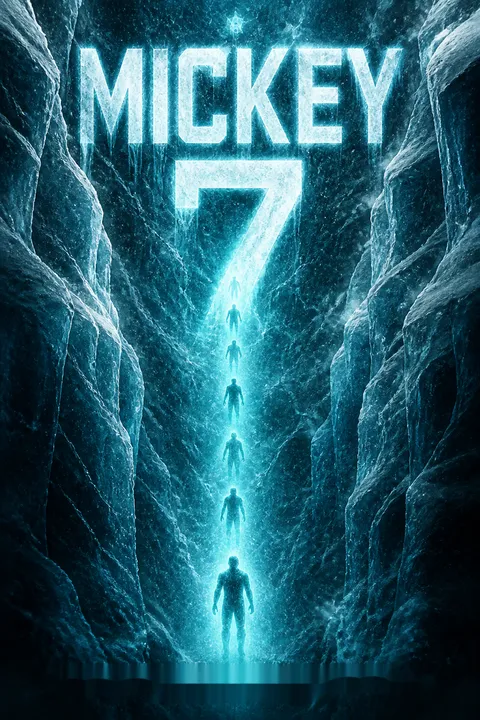
Mickey Barnes wakes on cold stone, his wrist swollen after a fall into a deep crevasse. Pilot Berto Gomez refuses to risk a recovery, but Nasha Adjaya circles overhead, ready to try. Mickey persuades her to leave rather than endanger herself, then abandons his plan to freeze and follows strange, warming tunnels beneath the ice.
A giant, many-limbed creature catches him, carries him through the maze, and releases him near the colony dome. Mickey reaches home alive, conceals what he encountered, and climbs to his room. Someone is already sleeping in his bed: a newly printed Mickey, the next copy in the same chain of lives. Their shared identity makes survival suddenly more complicated than escaping the tunnels.
The opening makes Mickey's supposed immortality feel less like a superpower than a bureaucratic arrangement. Berto weighs a human life against the cost of retrieval, while Nasha's willingness to risk herself gives Mickey a reason to choose her safety over rescue. The creature's unexpected mercy destabilizes the colony's assumption that anything unfamiliar is simply prey or threat. Then the duplicate turns a physical survival story into a question of personhood: Mickey has returned, but someone else has arrived to occupy the life he thought was waiting for him.
A Berth Bought in Fear
Years earlier on Midgard, Mickey is an underemployed history enthusiast with no clear place in a society where machines perform most useful work. His friend Berto wins a pog-ball tournament after Mickey bets against him, leaving Mickey buried in gambling debt to the dangerous Darius Blank. When Blank's enforcer tortures him, Mickey sees the last open berth on the colony ship Drakkar as an escape.
It is the Mission Expendable post, a job built around lethal assignments and repeated regeneration. Recruiter Gwen Johansen warns him that death will hurt and that his copies may not feel like a continuation of him. Mickey accepts anyway. He is not pursuing glory so much as fleeing a life that has become intolerable.
Mickey's choice is not simple recklessness. It grows from a world where material comfort has not given him purpose, then becomes urgent when debt turns his private drift into physical danger. The job's promise of immortality is persuasive because it converts self-erasure into employment, a bargain with official language wrapped around coercion. Mickey understands the risk intellectually, but the threat on Midgard narrows his sense of alternatives. His later uncertainty about whether each copy is truly him begins here, in the gap between choosing a job and consenting to every death the job will demand.
Graduation Means Death
On Himmel Station, trainer Jemma teaches Mickey the Drakkar's systems and the practical uses of an Expendable body. She also introduces the Ship of Theseus problem, asking whether a person remains the same when the body is gradually or suddenly rebuilt. After Mickey's first complete biological and personality backups, Jemma gives him a burner and instructs him to kill himself as a final test.
He cannot pull the trigger. His first death comes later, when an interstellar collision damages the ship and radiation sends him outside to repair its field generator. The next copy completes a second hazardous repair and dies as well. Mickey learns that recorded memory can preserve procedure, but it cannot make the fear of dying disappear.
Jemma's lesson supplies Mickey with an elegant theory of continuity, but his body resists the conclusion. He cannot make himself die merely because a backup exists, revealing how little philosophical reassurance can overrule an embodied survival instinct. The ship's emergencies then turn the theory into a work routine: each copy inherits knowledge, while the person facing radiation still experiences pain and panic. The gap between these facts becomes the novel's central psychological pressure. Mickey may be replaceable to the mission, but each present-tense version of him experiences its life as singular.
Nasha Across the Void
After Mickey's early deaths, he meets Nasha, a combat pilot whose family came to Midgard as refugees from the failed colony New Hope. She understands exclusion and has trained to fly because she wants a place on the expedition, not because Midgard ever felt like home.
Mickey and Nasha become lovers during the long, weightless voyage. When the Drakkar reaches Niflheim, they find a frozen world with too little oxygen for unprotected life. Nasha pilots the first lander, and Mickey is sent into biological isolation to test local microbes.
As successive Mickeys suffer lethal infections, Nasha stays close, eventually holding him through a particularly brutal death. Their intimacy becomes a practiced response to the colony's repeated demand that Mickey die alone.
Nasha and Mickey are drawn together by different forms of displacement. She carries the inherited outsider status of a refugee family, while he has made himself socially marginal through a life without direction. Their bond is not a cure for danger, but a witness to it. Nasha's presence gives Mickey's deaths relational consequences that the colony's accounting system cannot capture. At the same time, her pilot's competence and her own history keep her from being reduced to a caretaker. They share a future-building project even when the work of establishing it treats Mickey as expendable material.
Two Mickeys One Ration
Back in the present, Mickey and his new copy, Mickey8, understand that only one registered Expendable is permitted. Their colony is short of food, and a second adult body consumes calories and protein the settlement cannot spare.
Both argue that the other should enter the bio-cycler, then take the dispute to a game of rock-paper-scissors. Mickey8 wins, but cannot bring himself to watch Mickey die, and pulls him away from the cycler's disassembler. They decide to hide the duplication, divide a single ration card, and alternate work whenever possible.
Mickey's injured wrist and the copies' nearly identical appearance make concealment difficult. Their first alliance is practical, but it begins with the unsettling recognition that neither is willing to treat the other as disposable.
The conflict turns an abstract puzzle about identity into a material one. The copies cannot resolve their dispute by appealing to seniority, because Mickey8 inherits almost all of Mickey's memories and has only just begun his own conscious life. Their ration card makes personhood visible as a calorie problem, exposing how institutions convert moral decisions into resource management. Mickey8's refusal to proceed after winning is a small act of recognition: he grants the other copy the same fear he feels himself. Their secrecy protects them, but it also forces their friendship and rivalry to develop without social or legal support.
The Snipe Hunt
The colony's perimeter begins failing. Security officer Gabe Torricelli disappears, and creepers cut into the main lock's decking, forcing the defense system to vent plasma while a wounded guard is still inside. Commander Marshall orders a field hunt for a specimen.
Mickey warns biologist Dugan against heavy armor, which would sink into the snow, but the party goes out armed anyway. Creepers erupt beneath them. Dugan and two Security officers are dragged down, while Mickey runs for a rock outcrop.
Corporal Cat Chen pulls him upright; he uses a linear accelerator to destroy one creature, and Berto's lifter extracts them with part of its body as a sample. The colony gains evidence, but loses more people and discovers its familiar weapons may not protect it.
The expedition's losses expose a mismatch between command habits and the terrain. Marshall treats reconnaissance as a manageable technical problem, while the creatures use the snow and underground routes to make ordinary visibility and firepower unreliable. Mickey's survival depends less on a heroic plan than on changing tactics and accepting Cat's help. The specimen matters because it shifts the threat from rumor to evidence, but the sample is bought at a price the colony cannot easily replace. The scene also reveals how an institution can call a mission necessary while quietly assigning its greatest risk to the person whose death it has normalized.
The Ocular Sees More
The next day, Mickey and Cat patrol the perimeter with linear accelerators. Cat shoots a creeper near a rocky outcrop, and the snow around them begins to rise in a moving wave as more creatures approach. Automated burners turn the air white with steam. Mickey's vision abruptly fractures: through his ocular, he sees stylized figures that seem to be himself and Cat, as if someone else is viewing them through a crude interface.
He collapses before he can explain what he saw. In Medical, Cat reports that she shot a much larger creature before the swarm retreated, while the doctor finds a power surge in Mickey's ocular. The event leaves him unsure whether he suffered a malfunction or glimpsed a mind trying to observe him.
The strange vision is an epistemic rupture: Mickey's own sensory equipment, usually a dependable extension of his mind, becomes a possible channel for another intelligence. His inability to explain the experience leaves him caught between medical and alien interpretations. Cat's account of the giant creature offers a partial external anchor, but not a full explanation. The event also sharpens the story's recurring problem of perspective. The colony reads the creepers as animals because it sees them through human categories; Mickey's altered viewpoint suggests that the other side may be looking back, though neither species yet knows how to interpret the encounter.
Berto Bets Again
While Mickey and Mickey8 struggle to divide their reduced food allowance, Berto risks a reconnaissance flitter by flying it through a narrow gap in a rock formation. He wins the ration pool he has arranged around the stunt and treats the result as a chance to share a feast with Mickey. Mickey is furious that Berto risked a machine and his own life for calories after refusing to risk himself for a friend in the crevasse.
Before he can explain how he knows, Security officer Darren Drake provokes Berto at their table. Berto knocks Darren down, and the cafeteria erupts into a fight. Marshall docks both Berto's and Mickey's rations, worsening the hunger that already makes the concealed double life increasingly precarious.
Berto's stunt makes his contradiction impossible for Mickey to ignore. He will gamble his life for excitement and a ration windfall, yet he previously judged Mickey's recovery too dangerous to attempt. Mickey's anger is therefore about more than loyalty: Berto's choices expose the unequal value assigned to Mickey's successive selves. The fight converts private resentment into a public incident, while Marshall's punishment uses food to enforce discipline in a colony already near scarcity. Hunger becomes both literal pressure and a social weapon, making every relationship depend on who can afford to take a risk for whom.
The Secret Walks In
Cat notices that the Mickey who patrols with her has a bruised wrist, while the Mickey she sees working in Agriculture does not. She confronts him privately, and he admits that two versions of him are moving through the dome. Cat does not immediately report him, but warns that secrecy cannot last.
Meanwhile Nasha learns the truth and accepts both copies, even as their shared identity makes jealousy and intimacy unexpectedly difficult. Cat later opens Mickey's room and finds Nasha in bed with both Mickeys. She flees; Security officers arrive and take the three into custody. Their hidden arrangement has survived hunger, duty shifts, and suspicion, but one unguarded door turns a private accident into a disciplinary crisis.
Cat's discovery begins with attention to material evidence rather than prejudice: the bruised wrist exposes a discrepancy that personality and memory cannot conceal. Her hesitation shows that duty and personal regard can coexist uneasily, though neither removes the danger of concealment. Nasha's response rejects the idea that one copy must automatically cancel the other, but intimacy cannot erase the colony's legal and resource constraints. The open door makes visibility itself decisive. Their private arrangement becomes a public fact, and the copies lose control over the terms by which others will define them.
Antimatter at the Threshold
In custody, Mickey tells Marshall that the tunnels he explored were deliberately constructed and that living creatures inhabit them. Examination of the captured specimen confirms that the creepers are hybrid military technology, not ordinary fauna, putting the colony on a war footing.
The danger is magnified by the history of Alan Manikova, whose mass-produced copies seized Gault and helped provoke the Union's most catastrophic response. The colony's taboo against multiples reflects that history, while its ban on antimatter weapons remembers the Bubble War and the devastation such weapons can cause.
Marshall nevertheless assigns both Mickeys a mission carrying antimatter devices into the tunnels. If they refuse, he threatens to erase them rather than permit another copy. Survival and genocide now occupy the same assignment.
The revelations bind two distinct historical fears to the present crisis. Multiple copies are not merely a religious offense; Manikova's use of replication as a tool of conquest made duplication politically terrifying. Antimatter carries an even wider threat, because its use can erase populations and make a habitable world uninhabitable. Marshall understands these histories yet responds by placing weapons in the hands of people he considers morally suspect. The irony is structural: the colony's effort to preserve humanity may reproduce the violence that once nearly destroyed it. Mickey's task is no longer simply to survive, but to decide what survival is allowed to cost.
The Prime in the Tunnels
Before descent, Mickey asks Berto what truly happened to Mickey6. Berto admits that creepers dragged the earlier copy underground and that fear kept him from attempting a rescue. Below the ice, the two current copies separate to distribute their devices.
Mickey8 encounters a cavern packed with smaller creepers and is killed before he can trigger his weapon. Mickey receives a final image of the creature's maw, then meets a giant one in the tunnel. It identifies Eight as an ancillary and asks whether Mickey is prime.
Rather than detonate his device, Mickey accepts the creature's invitation to communicate. He learns that the beings understand individuals differently from humans, and their exchange opens a path away from immediate retaliation.
Berto's confession reframes earlier betrayals as failures of courage, not proof that he feels nothing for Mickey. The admission arrives too late to save Mickey6 or repair trust, but it gives Mickey a clearer account of the past. Eight's death then forces the identity question into grief: Mickey cannot dismiss the other copy as merely himself when he has just watched that person become absent. Choosing communication over detonation does not arise from certainty. It is a risky suspension of the colony's assumption that violence is the only language the creatures can understand.
A Bomb Becomes a Bargain
Mickey emerges from the tunnels carrying one antimatter device and claims that the creatures have Eight's device and know what it can do. He asks Marshall to meet him outside the dome, where the defense pylons train burners on him. Marshall orders Cat and another guard to kill Mickey, but they hesitate when they realize his pack could destroy them all.
Mickey argues that killing him would eliminate the colony's only link to the new intelligence. Marshall withdraws rather than risk an explosion or lose the chance of negotiation. The standoff ends without a shot. Mickey has bought time by making himself indispensable, though he has not told Marshall the whole truth about what the creatures know or where both devices may be.
Mickey's leverage is deliberately unstable. He uses the colony's fear of antimatter to interrupt Marshall's command, while the guards must weigh obedience against catastrophic consequences. His argument is effective because the colony has already made violence its default response and now needs someone who can interpret the enemy. Yet he also manipulates the truth, preserving room for choices Marshall would foreclose. This is not a clean diplomatic victory. It is a tactical pause in which trust has not been earned, but the immediate machinery of extermination has been stopped.
The Expendable Resigns
Marshall later apologizes, then asks Mickey to enter the antimatter core and return the recovered fuel by hand, a task likely to kill him. Mickey refuses, resigns as Expendable, and uses his role as liaison to deter Marshall from forcing him. He then punches Berto for abandoning him and leaves their friendship unresolved rather than accepting another easy apology.
About a year later, Niflheim warms enough for the snow to retreat and plants to take hold. Mickey walks with Nasha to the tunnels, where he retrieves Mickey8's device, which the creatures had returned after he asked for it. He hides it beneath rocks, having kept the truth from both sides, and chooses a fragile future over a clean resolution.
Mickey's refusal marks a change in the terms of his life: he stops treating survival as something Command can allocate and names a boundary even when the consequences remain uncertain. His punch does not repair his bond with Berto, but it makes the injury impossible to smooth over with another apology. The thaw offers material hope, not proof of safety. By hiding the second device, Mickey preserves deterrence and limits Marshall's capacity to resume extermination, yet creates a danger that may outlast him. The ending's peace is therefore provisional, held together by restraint, secrecy, and the possibility of learning to coexist.
Analysis
Mickey7 treats immortality not as escape from death but as a labor arrangement that distributes death unevenly. The colony can call Mickey replaceable because memory appears transferable, yet every copy experiences hunger, fear, and attachment from inside a life that feels singular. Mickey8 makes that contradiction impossible to keep abstract: the supposedly interchangeable self has its own present tense, and neither copy can prove a superior claim to existence.
The novel's resource economy sharpens this question. Rations, body mass, and bio-cycler feedstock translate ethical choices into administrative arithmetic. Marshall's command is not separate from scarcity; it is one of the ways scarcity acquires power over bodies. But the book also refuses to let Mickey's status as victim make every action virtuous. His secrecy, manipulation, and willingness to use a bomb as leverage complicate the comforting idea that moral insight automatically produces clean choices.
The creepers extend the same problem across species. Human colonists initially interpret unfamiliar movement as predation and answer it with weapons, while the creatures lack human assumptions about individual injury and retaliation. Mickey's decision to communicate is consequential precisely because understanding remains partial. The truce does not rest on perfect translation, only on restraint and a workable boundary. Niflheim's thaw offers hope without erasing the danger of the hidden bomb or the colony's capacity for violence.
Ultimately, the book asks what makes a life count when bodies can be copied and civilizations can treat whole populations as obstacles. Mickey's refusal to accept another lethal assignment is not a grand escape from mortality. It is a smaller, more difficult assertion: survival cannot be meaningful if it requires surrendering every judgment about how others should live.
Review Summary
Mickey7 is a sci-fi novel about an expendable clone on a dangerous space mission. Readers found it entertaining, with witty dialogue and thought-provoking themes on identity and immortality. Many praised its humor and accessible writing style, comparing it to Andy Weir's works. However, some felt the story didn't fully explore its potential, with underdeveloped characters and a mundane plot. Despite mixed opinions, most agreed it was a fun, fast-paced read, generating excitement for the upcoming film adaptation.
People Also Read

Characters
Mickey Barnes
The reluctant ExpendableMickey is a historian by inclination, a generalist by circumstance, and a man who accepted a lethal job because Midgard offered him no meaningful future and debt made escape urgent. Repeated regeneration has given him a practical education in death without teaching him to welcome it. His humor keeps fear at conversational distance, while his curiosity makes him notice the details others dismiss, especially when he studies the creepers. He wants to matter to someone and to the colony, but gradually questions whether usefulness is worth obedience without limit. His defining tension is between being treated as replaceable and insisting that every version of him experiences a singular life.
Nasha Adjaya
The fearless combat pilotNasha is a skilled pilot whose refugee family history has taught her that belonging is rarely granted automatically. She joins the expedition to make a home beyond Midgard, and her confidence in the cockpit contrasts with the tenderness she shows Mickey when his work sends him toward death. She does not mistake his regeneration for painless immortality, and her willingness to witness his suffering gives their relationship unusual honesty. Nasha is loyal without being passive: she challenges Mickey, makes her own judgments, and understands that survival requires both courage and restraint. Her commitment to him is grounded in shared experience rather than an idealized image of heroism.
Berto Gomez
The brilliant risk-takerBerto is a gifted pilot and former champion athlete, quick to master difficult skills and quick to seek excitement when life becomes dull. His long friendship with Mickey contains genuine affection, but also a selfish streak: he often places his own ambitions and comfort first. He is charismatic enough to make that imbalance easy to excuse, and talented enough that others repeatedly trust him with dangerous equipment. Berto's deepest conflict is between the fearless identity he performs and the fear he rarely admits. His friendship with Mickey reveals the cost of treating courage as a reputation to defend instead of a choice made for another person.
Hieronymus Marshall
The severe commanderMarshall is the colony's ground commander, a disciplined administrator whose authority rests on ration control, personnel assignments, and the threat of punishment. His Natalist faith makes him distrust the replication that keeps Mickey available, while the colony's precarious resources reinforce his instinct to treat people as assets. He is not simply a tyrant: he understands the mission's vulnerabilities and believes that hard decisions are necessary to preserve the settlement. Yet his certainty can narrow his moral vision, particularly when he sees violence as the efficient answer. Marshall represents the collision between institutional survival and the individual lives that institutions claim to protect.
Cat Chen
The observant Security officerCat is a Security corporal who is practical, blunt, and willing to act under pressure. She helps Mickey survive a failed expedition, then confronts the unequal risks he faces and the strange privilege his regenerative role seems to grant. Her questions about identity are not detached philosophy; they arise from watching colleagues die while Mickey returns. Cat's grief over her bunkmate makes her wary of easy reassurances, and her attention to concrete discrepancies helps her see what others miss. She wants to serve the colony without surrendering her own judgment, a balance that becomes difficult when duty, sympathy, and fear pull in different directions.
Mickey8
Mickey's newest copyMickey8 is a newly printed version of Mickey Barnes, carrying nearly all the memories and traits of the prior iteration. He is not a blank replacement: he wakes with the same fears, appetites, attachments, and claims to survival. His presence turns Mickey's private doubts about continuity into an immediate conflict over food, work, and which life should continue. He is often blunt and hungry, but capable of restraint, including when he refuses to make Mickey die alone. The relationship between the two copies is part rivalry, part mirror, and part improvised kinship.
Jemma
The station trainerJemma trains Mickey on Himmel Station before the Drakkar departs. She is patient and funny, but her work requires her to make the meaning of his Expendable role unmistakable. Her lessons in ship systems and personal identity give Mickey tools he will carry into later crises, even when those lessons cannot settle what a copy is. Jemma is compassionate without pretending the job is humane, and her final test shows how institutions can make a person's consent feel both voluntary and coerced.
Gwen Johansen
The candid recruiterGwen interviews Mickey for the Expendable berth and plainly describes the deaths the work may require. She recognizes that he is not ignorant so much as desperate, and her bluntness gives him a clearer view of the bargain he is accepting. Gwen's brief role establishes the gap between informed consent and real freedom when someone has few viable alternatives.
Darius Blank
The debt collectorDarius Blank is the creditor who turns Mickey's gambling loss into a physical threat. His enforcer's torture makes Mickey's decision to leave Midgard urgent, showing how an ordinary financial mistake can become an engine of coercion.
Dugan
The colony biologistDugan works in Biology and needs specimens to understand Niflheim's ecology. His scientific purpose is essential to the colony, but his confidence in equipment and procedure does not prepare him for a threat that moves beneath the snow. He embodies the limits of technical expertise when the living world refuses to behave like a controlled experiment.
The creepers
The subterranean inhabitantsThe creepers are segmented, clawed beings that travel through extensive tunnels beneath Niflheim's ice and rock. Their smaller forms can overwhelm armed colonists, while larger individuals display behavior that resists the colony's assumption that they are ordinary predators. Their actions are difficult for humans to interpret because the two species do not begin with shared ideas about individuality, injury, or territory.
Burke
The colony medicoBurke treats Mickey after dangerous assignments and evaluates the physical effects of his regeneration. His pragmatic manner reflects the colony's strained medical culture, where Mickey's unusual biology can make care seem like another form of experimentation.
Arkady
The isolation technicianArkady oversees Mickey's exposure to Niflheim's microorganisms and insists on collecting data even as Mickey suffers. He represents the research system's clinical distance from the person serving as its test subject.
Plot Devices
Regeneration and backups
A life repeated imperfectlyThe colony stores Mickey's biological pattern and personality, then prints a replacement after his death. Memory gives each copy a powerful sense of continuity, but the process cannot prove that the new person is the same consciousness as the one who died. This device drives the book's ethical conflicts: Mickey is assigned lethal work, the colony counts his body as recyclable protein, and Mickey8's arrival forces two versions to defend their separate claims to life. The technology makes survival possible while making the meaning of survival uncertain.
The bio-cycler
Scarcity made physicalThe bio-cycler reduces waste and corpses to raw materials, then repurposes them as food or biological feedstock. On a colony with failing agriculture, its efficiency is vital, but it also turns a person's body into a measurable contribution to the ration system. The machine makes Mickey's second copy a practical crisis as well as a legal one: two bodies require calories the colony does not have. Its central opening becomes the visible threat behind every argument about who deserves to continue living.
The ocular network
A window that may be watchedColonists use ocular implants for communication, status information, and visual enhancement. Mickey's implant carries the memory of his life and later displays images that may not originate with him, suggesting that Niflheim's inhabitants can observe or interact through its systems. The network also makes duplicate concealment difficult: identical handles and overlapping duties leave traces that other colonists can compare. It connects the novel's most private question, who is seeing through Mickey's eyes, to the larger challenge of learning how another intelligence communicates.
Creeper tunnel system
A hidden world beneath campThe tunnels provide the creepers with shelter, movement, and access to places the colony believes are secure. Because the passages were absent from orbital surveys and lie beneath the snow and rock, conventional perimeter sensors fail to reveal the scale of the hidden population. The tunnel network first traps Mickey, then carries him back toward the dome, and ultimately becomes the setting where he can meet the intelligence the colony has mistaken for fauna. It changes the geography of the conflict: the humans are not exploring empty ground, but living on the edge of someone else's home.
Antimatter bubble bombs
Deterrence with extinction insideMagnetic monopole bubbles isolate antimatter until the containment breaks, allowing a compact device to release catastrophic energy or lethal radiation. The Union's history makes such weapons a forbidden threshold because they can erase populations and devastate the worlds colonies depend on. Marshall sends the copies into the tunnels with these devices, turning Mickey's choice into a test of whether the colony's survival justifies extermination. Later, the bomb's uncertain location gives Mickey leverage and lets him restrain both human aggression and the danger of accidental use.
FAQ
Synopsis & Basic Details
What is Mickey7 about?
- Expendable explores Niflheim: Mickey is a science fiction story about Mickey Barnes, an "Expendable" on a human colony on the inhospitable ice planet Niflheim. Expendables are cloned individuals who take on dangerous tasks, as they can be easily replaced if they die.
- One death leads to complications: After falling into a crevasse and presumed dead, Mickey7 discovers a network of tunnels and sentient creatures beneath the ice. However, he also finds that a new version of himself, Mickey8, has already been created.
- Navigating a dual existence: The novel follows Mickey as he navigates the ethical and practical challenges of existing alongside another version of himself, while also trying to understand the nature of the alien creatures and the secrets of Niflheim.
Why should I read Mickey7?
- Unique take on immortality: The book offers a thought-provoking exploration of immortality and identity through the lens of an Expendable, raising questions about what it means to be human when death is not the end.
- Intriguing blend of genres: It combines elements of science fiction, thriller, and dark humor, creating a compelling and unpredictable narrative that keeps readers engaged.
- Exploration of complex themes: The story delves into themes of survival, sacrifice, and the ethical dilemmas of colonization, prompting reflection on humanity's place in the universe.
What is the background of Mickey7?
- Interstellar colonization setting: The story is set in a future where humanity has spread to other star systems, but faces challenges in establishing viable colonies on harsh planets like Niflheim.
- Technological advancements: The existence of bio-printing technology, personality downloads, and antimatter-driven starships shapes the world and the characters' lives.
- Ethical debates on expendability: The concept of Expendables reflects ongoing debates about the ethics of cloning, genetic engineering, and the value of human life in the face of resource scarcity and survival imperatives.
What are the most memorable quotes in Mickey7?
- "This is gonna be my stupidest death ever.": This opening line immediately establishes the dark humor and absurd nature of Mickey's existence as an Expendable, setting the tone for the story.
- "In my line of work, you spend a lot of time pondering different ways to die—when you're not actually experiencing them, that is.": This quote encapsulates the grim reality of Mickey's job and the constant threat of death that hangs over him.
- "Replace "go to sleep" with "get crushed, or vaporized, or set on fire" and you've pretty much got my life.": This highlights the disconnect between Mickey's experience and the average person's, emphasizing the extreme nature of his role.
What writing style, narrative choices, and literary techniques does Edward Ashton use?
- First-person narrative: The story is told from Mickey's perspective, providing an intimate and often humorous look into his thoughts and feelings, while also creating a sense of unreliable narration.
- Dark humor and sarcasm: Ashton uses dark humor and sarcasm to explore serious themes, creating a unique tone that is both engaging and thought-provoking.
- Frequent use of flashbacks: Flashbacks are used to reveal Mickey's past and provide context for his present situation, gradually building a more complete picture of his character and motivations.
Hidden Details & Subtle Connections
What are some minor details that add significant meaning?
- The Aztec ass-ball analogy: Mickey's comparison of Expendables to Aztec ass-ball players highlights the expendability and eventual sacrifice inherent in his role, foreshadowing his fate.
- Gwen Johansen's discouragement: The recruiter's attempts to dissuade Mickey from becoming an Expendable reveal the true horrors of the job and the lack of other options for him.
- The name "Himmel Station": The name of the station (Himmel means "heaven" in German) is ironic, given the harsh realities and moral compromises that the colonists face.
What are some subtle foreshadowing and callbacks?
- Early mention of crevasse mapping: Marshall's initial assignment of Mickey to map crevasses foreshadows Mickey7's eventual fall and the discovery of the tunnel system.
- Recurring dream of suffocation: Mickey's recurring dream of suffocating in space foreshadows the potential for a violent and isolating death, highlighting his underlying fears.
- The spider and the garden: Mickey's memory of releasing a spider in his grandmother's garden mirrors the creeper's act of releasing him near the dome, blurring the lines between benevolent god and unwitting pawn.
What are some unexpected character connections?
- Jemma's training and influence: Jemma's training of Mickey on Himmel Station, particularly her discussion of the Ship of Theseus, profoundly shapes his understanding of his own identity and the nature of existence.
- Darius Blank's indirect influence: Darius Blank's actions, though never directly seen, set the entire plot in motion by forcing Mickey to become an Expendable, highlighting the far-reaching consequences of seemingly minor events.
- Cat Chen's evolving role: Cat Chen's transformation from a skeptical Security officer to a potential ally and confidante reveals the capacity for connection and empathy even in a harsh environment.
Who are the most significant supporting characters?
- Nasha Adjaya: As Mickey's partner, Nasha provides emotional support and a sense of connection to humanity, but her own fears and vulnerabilities also reflect the challenges of life on Niflheim.
- Berto Gomez: Berto's complex friendship with Mickey highlights the ethical compromises and personal sacrifices that are made in the name of survival, and his actions often drive the plot forward.
- Commander Hieronymus Marshall: Marshall's leadership style and Natalist beliefs create conflict and tension, forcing Mickey to confront difficult choices and question the colony's values.
Psychological, Emotional, & Relational Analysis
What are some unspoken motivations of the characters?
- Marshall's fear of the unknown: Marshall's rigid adherence to protocol and his distrust of Expendables stem from a deep-seated fear of the unknown and a desire to maintain control in a chaotic environment.
- Berto's need for validation: Berto's reckless behavior and his need to be seen as a hero mask a deep-seated insecurity and a desire for validation from others.
- Nasha's desire for stability: Nasha's immigrant background and her experiences on a failed colony drive her desire for stability and a sense of belonging, which she seeks in her relationship with Mickey.
What psychological complexities do the characters exhibit?
- Mickey's existential dread: Mickey's repeated deaths and rebirths lead to a profound sense of existential dread and a questioning of his own identity and purpose.
- Cat's moral conflict: Cat's internal conflict between her duty to the colony and her growing empathy for Mickey highlights the ethical complexities of life on Niflheim.
- Marshall's religious zealotry: Marshall's Natalist beliefs and his distrust of bio-printed bodies reveal a deep-seated fear of technology and a desire to preserve traditional values in a rapidly changing world.
What are the major emotional turning points?
- Mickey's decision to save Cat: Mickey's decision to save Cat during the creeper attack marks a shift in his character, demonstrating his capacity for empathy and selflessness despite his expendable status.
- The revelation of the tunnels: The discovery of the tunnels and the sentient nature of the creepers forces Mickey to confront the ethical implications of colonization and the potential for coexistence.
- Marshall's attempt to sacrifice Mickey: Marshall's attempt to sacrifice Mickey to the antimatter core forces Mickey to question his loyalty to the colony and to assert his own agency.
How do relationship dynamics evolve?
- Mickey and Berto's strained friendship: The revelation of Berto's lies and his willingness to prioritize his own safety over Mickey's strains their friendship, forcing them to confront their differing values and priorities.
- Mickey and Nasha's deepening bond: Despite the challenges of their relationship, Mickey and Nasha's bond deepens as they face danger and loss together, finding solace and support in one another.
- Mickey and Cat's unexpected connection: The unexpected connection between Mickey and Cat challenges their initial assumptions about one another, revealing their shared humanity and their capacity for empathy.
Interpretation & Debate
Which parts of the story remain ambiguous or open-ended?
- The true nature of the creepers: The extent of the creepers' intelligence, their motivations, and their long-term plans for Niflheim remain ambiguous, leaving open the possibility of future conflict or cooperation.
- The fate of the colony: The long-term viability of the colony and its ability to coexist with the creepers is uncertain, leaving the ending open to interpretation.
- Mickey's ultimate fate: Whether Mickey will ever find a sense of peace and belonging, or whether he will continue to be defined by his expendable status, remains an open question.
What are some debatable, controversial scenes or moments in Mickey7?
- Berto's decision to leave Mickey in the crevasse: Berto's decision to abandon Mickey raises questions about the limits of friendship and the ethical implications of prioritizing one's own safety over another's life.
- Marshall's treatment of Expendables: Marshall's dismissive and often cruel treatment of Mickey sparks debate about the ethics of the Expendable system and the dehumanizing effects of power.
- Mickey's decision to withhold the antimatter weapon: Mickey's decision to withhold the antimatter weapon from Marshall raises questions about the morality of his actions and the potential consequences for the colony.
Mickey7 Ending Explained: How It Ends & What It Means
- A fragile truce is established: The ending sees a fragile truce established between the humans and the creepers, but the long-term implications of this truce are uncertain.
- Mickey asserts his agency: Mickey's resignation as the colony's Expendable and his decision to protect the creepers demonstrate his newfound sense of agency and his rejection of the dehumanizing aspects of his role.
- Hope for coexistence, but uncertainty remains: The ending offers a glimmer of hope for coexistence and understanding, but it also acknowledges the challenges and uncertainties that lie ahead, leaving the reader to ponder the future of the colony and the fate of its inhabitants.
Download PDF
Download EPUB
.epub digital book format is ideal for reading ebooks on phones, tablets, and e-readers.








