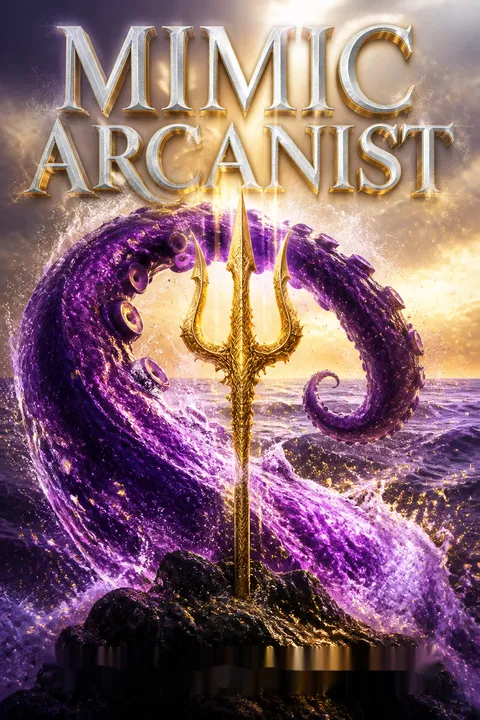


Plot Summary
Scars Beneath the Uniform
Three weeks into Astra Academy, Gray Lexly still hides the scars Death Lord Deimos left across his body. His mimic eldrin, Twain, notices the fear he tries to bury, while Gray insists the danger has passed. Twin brother Sorin brings news of a month-long class expedition to Red Cape, where students will camp, learn survival skills, and build a school for a remote village.
Gray welcomes the prospect of leaving the damaged Academy, especially when Professor Helmith, the mentor who once protected him in his nightmares, is expected to join them. The trip will also include a competition for a magical prize. Gray’s hope for ordinary school life is already shadowed by his injury and by memories of the basement battle.
Gray’s private shame is not simply fear of injury. The scars contradict the magical identity he expects to inhabit, making his survival feel like visible evidence of a failure to heal. The expedition offers movement and community, but it is also an attempt to recover normality by changing scenery. Sorin’s eager announcement matters because his warmth gives Gray an immediate social foothold, while Twain’s concern quietly exposes how little Gray’s confident reassurances convince the people closest to him.
Red Cape Burns
At Red Cape, Captain Leon leads the class inland to a strange landscape altered by occult ore, a magical mineral that can strengthen living things when properly prepared. Gray and Ashlyn Kross turn their collection task into a contest. Gray borrows the fire magic of Leon’s cerberus, Sticks, and scorches a patch of grass to expose buried ore.
He and Ashlyn manage to contain the blaze, but a waterlogged corpse crawls from the burned trees and slashes Gray’s shoulder. Ashlyn attacks with lightning, and Twain mimics a typhoon dragon to help destroy the creature. It dissolves after its skull is crushed, yet Gray’s wound keeps bleeding, his old scars ache, and the surrounding earth is soaked with water that should not be there.
The mishap begins as adolescent competition, but Gray’s improvised solution turns a school exercise into a consequence he cannot dismiss. His mimicry gives him extraordinary flexibility without the judgment that expertise normally supplies: he can borrow destructive power before he understands how to control it. Ashlyn’s quick defense establishes a form of care that is practical rather than sentimental. The wound’s failure to heal then converts Gray’s lingering trauma into evidence. His unease is no longer only psychological, because the world is presenting physical facts his classmates cannot explain.
The Gate in the Mud
Following the unnatural water through the warped forest, Gray discovers a sliver of silver metal embedded near a dead tree. He recognizes it as a fragment of Professor Zahn’s shattered Gate of Crossing, the portal that once opened into the abyssal hells. Gray wraps the fragment in torn fabric rather than touch it, then carries it to Professor Helmith.
She takes it to the Academy and promises that the headmaster can handle the danger, calming Gray without explaining how the fragment drew a corpse into the woods. Ashlyn binds Gray’s shoulder, and he gives her the ore he collected in thanks. Meanwhile, Raaza claims the day’s prize by using fox fire to pass off illusory ore as real. Gray knows the trick, but keeps his silence.
The fragment makes Gray’s guilt concrete: the gate was destroyed to save the Academy, yet its scattered pieces continue to export danger into ordinary places. Helmith’s reassurance is compassionate, but her confidence leaves Gray dependent on authority rather than informed participation. His decision to conceal Raaza’s fraud is a smaller echo of that same tension. He values loyalty and options, but his silence also allows a dishonest victory. The scene begins to define the book’s central problem: good intentions do not neutralize the consequences of power once it has been broken into pieces.
Five Levels Below
Around the campfire, Captain Leon teaches the students how arcanists manipulate the world through their eldrin. Nasbit, the class’s bookish golem arcanist, recognizes Gray’s fragment story as a reason to research the abyssal hells.
He explains that its five layers range from a place associated with rebirth to a final oblivion where souls are destroyed. Death Lords rule the third layer, while elder-creatures grow powerful in the fourth by consuming whole souls.
Gray and Sorin absorb the account uneasily, especially when Sorin wonders where their dead mother’s soul might be. Gray tries to reassure him that she belongs in the gentlest layer. Their private fear now has a cosmology, and Gray realizes that the closed gate may connect their world to a much larger imbalance.
Nasbit’s scholarship changes the emotional scale of the threat. The gate fragment is no longer merely a dangerous relic; it belongs to a system involving judgment, rebirth, and the fate of the dead. For Sorin, this knowledge finds its way directly to the wound he carries over their mother’s death. Gray responds by trying to protect him from uncertainty, but reassurance cannot erase the question. The brothers’ exchange reveals their different coping styles: Sorin lets grief become inquiry, while Gray tries to contain it through certainty, even when he has no proof.
The Graveyard Answers
After the class builds Red Cape’s schoolhouse, Professor Helmith takes Gray and Nini to tend the village graveyard and learn how magic can cultivate a place of communal importance. Gray senses several broken magical threads before the group can finish clearing weeds.
Abyssal corpses emerge from the dark. Nini merges with Waste, her reaper, and uses blood magic against them, while Gray borrows Waste’s form and fights with a scythe. Helmith returns injured and destroys the remaining threat.
Waste gains two unnamed links on his chain, marking the dead arcanists he has slain. Helmith then admits she suspects the fragments activate around Gray because he is the elder twin. Rather than risk another outbreak, she ends the expedition and takes the fragment back.
The graveyard turns cultivation into an ethical test. Gray and Nini are asked to care for the dead, then forced to confront bodies animated by a system neither understands. Nini’s fear does not keep her from acting; merging with Waste gives her competence without making the cost disappear. The new links on Waste’s chain make that cost visible. Helmith’s theory gives Gray’s danger a personal mechanism: his birth order may be functioning as a key. Her admission also complicates her earlier reassurance, showing that protection without full disclosure can leave a student exposed.
Lessons After the Ruins
Back at Astra Academy, the students resume their lessons in magic, history, and combat. Headmaster Venrover gathers thirteen fragments of Zahn’s gate, and the Warlord of Magic, Volke Savan, demonstrates that his enchanted sword can split them but cannot destroy them.
The pieces fuse when brought together, growing more potent. Venrover keeps Death Lord Deimos’s trident, Vivigöl, for study despite Volke’s warning that it damages souls. Meanwhile, Professor Ren replaces Zahn in Magical Fundamentals and sends the class through a cave gauntlet filled with magical hazards.
Gray finds another fragment there; it melts into his skin before he can remove it. The Academy assigns the invisible wendigo arcanist Fain to guard him, while the headmaster and Helmith investigate how to extract the metal.
The Academy’s return to routine is deliberately unstable. Students are asked to study and train beside relics that resist destruction, while the adults disagree about whether dangerous knowledge should be preserved or eliminated. Venrover’s decision to study the trident echoes a familiar institutional temptation: the hope that a hazardous object can be made useful through expertise. Gray’s fragment entering his body collapses the distance between student and threat. His assigned guardian offers protection, but also confirms that his ordinary presence has become a security problem.
Invitations and Obligations
As the Kross Cotillion approaches, Gray learns that Archduke Septimus Kross has invited the class’s noble students but excluded island-born classmates such as Gray, Sorin, Nini, and Raaza. Professor Ren lets Gray attend as his guest, while Knovak persuades Nasbit to give him an invitation.
Sorin agrees to escort Exie, who says she needs protection from the social cruelty of the event. Nini is hurt when Sorin tells her the truth, and she leaves the dining hall.
Gray initially tries to manage the situation for his brother, but Sorin chooses honesty instead. Nini eventually forgives him, and they become sweethearts. Knovak also takes Gray and Sorin to Anchor Isle to buy formal clothes, turning his own social exclusion into an occasion to show generosity.
The cotillion’s invitations translate class hierarchy into a literal guest list. Gray’s resentment is partly about status, but it also reflects a deeper desire to be recognized as someone whose origins do not define his future. Sorin’s decision to tell Nini the truth creates immediate pain, yet it gives their relationship a basis sturdier than Gray’s proposed concealment. Knovak’s clothing offer similarly turns wounded pride into action. The social subplot therefore mirrors the larger plot: trust is not the absence of risk, but a choice to let others respond to the truth.
Ashlyn’s Promised Match
While trying on his cotillion clothes, Gray learns that Ashlyn is expected to marry Valo Fitzroy, a talented arcanist chosen by her family. She admits on the Academy balcony that she likes Gray and has considered running away, but believes she owes her family obedience. Gray kisses her, and she returns the moment before telling him she cannot pursue a relationship while betrothed.
The revelation leaves Gray hurt, yet he refuses to treat Ashlyn’s decision as a simple rejection. He resolves to prove himself to her father, though he does not yet know Valo or what the match means to Ashlyn. Their attraction now sits inside the pressures of family power, and Gray must decide whether ambition can help without becoming another form of pressure.
The balcony scene brings private feeling into conflict with inherited obligation. Ashlyn’s hesitation is not coyness; she is weighing affection against a family system that treats marriage as political architecture. Gray’s impulse to prove himself offers energy, but it risks translating her complicated position into a contest he can win. The kiss matters because it confirms mutual desire without solving the structure that constrains it. The scene asks whether individual courage can change an arrangement when the person most affected has not yet chosen to resist it.
A Voice in Dreams
Gray’s nightmares return, and Deimos speaks to him across dreams of the sea. The Death Lord recounts a brutal childhood under an emperor who killed his mother and infant siblings, then sent Deimos and his twin brother away to die. Deimos says that he fought wars, claimed power, and became a Death Lord to preserve the cycle of souls.
He believes the living arcanists betrayed the Death Lords by sealing the gates, leaving new abyssal dragons to become destructive elder-creatures. Gray cannot know how much of this account is truth and how much is persuasion, but the story unsettles his simple image of Deimos as a monster. Professor Helmith examines Gray’s dreams, finds no presence there, and promises to shield him while she investigates.
Deimos’s story does not absolve his violence; it makes his self-understanding legible. He frames vengeance as restoration and cruelty as the consequence of a world that broke its own cycle. Gray is forced to encounter an antagonist who understands himself as wronged rather than wicked, a perspective that can explain motive without validating action. Helmith’s intervention marks a crucial boundary: she accepts Gray’s fear as worth investigating even when she cannot verify the dream. Her care protects him, but her decision to suppress the nightmares also postpones the question of what the dreams might know.
The Cotillion Kraken
At the Kross Cotillion in Freestorm, Gray searches the amphitheater for a fragment he senses nearby while the guests mingle. He meets Valo, whose casual contempt for young women confirms Gray’s distrust, then slips away to look for Ashlyn. When a midnight depths kraken erupts from the bay, its tentacles smash the theater and trap guests beneath the wreckage.
Gray borrows knightmare magic to resist the kraken’s fear and helps Sorin and Exie pull people free. He then copies the power of Septimus’s typhoon dragon and pushes the bay water aside so the trapped guests can breathe. Among them, Gray spots a waterlogged cultist holding a large gate fragment. The man charges him, declaring loyalty to Deimos.
The cotillion’s polished display of rank and beauty is abruptly replaced by a disaster that makes every guest physically vulnerable. Gray’s borrowed powers become useful because he applies them to rescue rather than competition, though his control remains precarious. The kraken’s arrival shows that the fragments do not merely summon isolated corpses; they can open a path for a force capable of wrecking an entire gathering. The cultist’s presence gives the catastrophe human intention. What looked like an accident is part of an organized effort to restore Deimos.
Deimos Takes the Helm
Gray kills the cultist with an uncontrolled lightning blast, but the water sprite bonded to the man attacks him with the fragment. The metal sinks into Gray’s skin, and Deimos begins controlling his body. Gray resists long enough to avoid killing everyone, but Deimos throws Knovak overboard and forces the boat crew to take him toward Astra Academy.
Fain rescues Gray from the bay, yet Gray’s body continues moving under Deimos’s command. Deimos threatens Gray with the fate of his mother’s soul until Gray stops resisting and guides him into the Academy basement. There, Deimos retrieves Vivigöl, the trident kept from their first battle. His weapon once again in hand, he turns toward the accumulated fragments.
Possession makes the conflict intimate in the most literal sense: Gray remains conscious but cannot reliably choose what his body does. His resistance is measured in brief interruptions, such as lowering a hand before Deimos can strike again. The threat against his mother converts his grief into leverage, exploiting the same protective instinct that shapes his bond with Sorin. Fain’s rescue can save Gray from drowning but cannot restore his agency. Deimos’s return to the Academy is therefore not a simple invasion; it is the hijacking of Gray’s identity as a route through the world.
The Basement Trap
Nasbit brings Professor Ren and Professor Helmith to the basement, recognizing that Gray is no longer in control. Ren restrains him with webs that he hardens into metal, then sets them alight to weaken Deimos’s hold. Deimos breaks free with Vivigöl and absorbs more fragments, gaining firmer control. Ren’s eldrin, Trove, stabs Gray from behind, but Deimos wounds Ren with a beam of raw magic.
Helmith stays beside the injured professor, then approaches Gray behind a protective barrier. Deimos’s trident pierces her body when Gray briefly disrupts his aim, but Helmith reaches Gray’s face and puts him to sleep. Her action carries them both into a dream landscape where Deimos’s fragment of soul can be confronted directly.
The basement battle gathers the book’s competing ideas of protection into one room. Ren uses technical skill and traps; Helmith risks proximity because she understands Gray’s inner life; Nasbit overcomes his usual hesitation by summoning help. Gray’s brief interference with Deimos is small but consequential, proof that possession has not erased him. Helmith’s touch is both a rescue attempt and a gamble with her own life. The transition into a dream does not evade the physical fight; it relocates the struggle to the one terrain where her magic can challenge Deimos’s presence.
Hope Holds the Dream
In the dream realm, Helmith confronts Deimos while her body in the waking world weakens. Gray borrows abyssal dragon magic and blasts a hole through Deimos, but the Death Lord heals himself with raw magic and attacks in return. Helmith’s ethereal whelk, Ushi, is badly damaged while shielding them.
Rather than give up, Helmith draws on her hope that life can improve and Ushi transforms into a powerful true form. Helmith then traps Deimos in a prison of dream-forged stone that his magic cannot break. The dream collapses around them, but the prison remains long enough to contain him. Gray wakes in the infirmary, alive, while Helmith and Ren are taken away to recover from their serious injuries.
The decisive change comes not from greater force but from a new alignment between Helmith and Ushi. Her true form embodies hope as active labor: the belief that conditions can be changed, followed by the willingness to keep acting while the outcome is uncertain. Gray’s borrowed abyssal magic can injure Deimos but cannot settle the contest, clarifying the limits of imitation when it is detached from a sustaining purpose. Helmith’s victory contains rather than erases the antagonist. The dream’s prison is a meaningful reprieve, not proof that the larger history has been repaired.
A Trident Around Gray
In the infirmary, Gray learns that the headmaster found Dr. Samuel Muldoon, a relickeeper arcanist whose eldrin can hold dangerous magical objects in stasis. Dr. Doon removes the gate fragments from Gray’s body, and Venrover confirms that Sorin, Nini, Knovak, Ashlyn, and the other students survived.
Yet Vivigöl remains wrapped around Gray’s shoulders and neck as abyssal coral. When Gray imagines hiding the weapon as a broom, it changes shape, revealing that it responds to his mimic magic.
He can remove it, but it remains dangerous to anyone else. Helmith and Ren will recover, though Helmith needs more time. Gray’s friends return to his bedside, and he learns that the immediate invasion has ended without severing Deimos’s connection to him.
The medical resolution is deliberately partial. Dr. Doon can extract the metal fragments because his relickeeper magic can immobilize magical objects, but he cannot remove the deeper bond that has formed between Gray and Deimos. Vivigöl’s responsiveness turns a weapon associated with Gray’s violation into a possible tool, though not a safe possession. The friends’ return restores the social world that the attack interrupted. Gray is no longer alone in the infirmary, but companionship cannot make the remaining connection disappear.
The Thread Still Leads
Sorin and Nini visit Gray after classes, and their presence briefly restores the familiar rhythm of dorm life. Sorin jokes with Twain, who protests being treated like a pet, while Nini asks whether Gray is truly well. Gray senses the magical threads around the infirmary and discovers one that leads not to a nearby creature, but back to himself: Deimos’s abyssal dragon remains reachable through the soul fragment lodged within him.
He hides his alarm and borrows Sorin’s knightmare magic to free Twain from his brother’s teasing. The others hear that Gray is recovering, but he knows the danger has not vanished. The book ends with the students reunited and the Academy still standing, while Gray carries an unresolved link to the Death Lord.
The ending refuses the comforting equation of survival with closure. Gray has regained bodily control and his friends have returned, yet his growing sensitivity to magic reveals that the antagonist remains structurally present inside him. His ability to choose which thread to pull is now also a reminder that one thread may lead to danger. The ordinary play between Sorin and Twain gives the final scene warmth without canceling its unease. Gray’s next task is not simply to defeat a monster, but to understand a connection that has become part of his own magical perception.
Analysis
Mimic Arcanist makes the consequences of victory its central engine. Gray helped stop Zahn and close the gate, but the scattered fragments mean that a successful act of defense does not restore the world to its prior condition. Each fragment carries danger into ordinary spaces: a forest lesson, a village graveyard, a classroom cave, and finally a public celebration. The escalation is effective because it follows Gray’s emotional life. He begins by trying to hide his scars and reassure those around him; later, the damage becomes literal possession of his body.
The novel also treats learning as a question of judgment rather than information alone. Gray can borrow another creature’s magic, but that does not make him competent in its use. Nasbit’s research supplies crucial context, while Helmith’s teaching turns experience into insight. Their contrasting forms of knowledge matter: facts can identify a threat, but care and courage determine what to do with it. True forms extend this logic, making magical growth depend on practiced virtues such as hope or selflessness.
Deimos complicates the moral landscape by presenting a history in which the living may have betrayed the dead and disrupted a cosmic cycle. His grievance helps explain his persistence, but his coercion of Gray and threat to Gray’s mother demonstrate how he turns injury into permission to injure others. The book does not resolve that contradiction. Helmith contains Deimos’s soul fragment, the relickeeper removes the gate pieces, and the students survive, yet the abyssal dragon remains linked to Gray. That ending preserves the difference between stopping an immediate attack and repairing the conditions that made it possible. Gray’s real development is therefore not mastery over every borrowed power, but a growing recognition that he cannot treat fear, history, and responsibility as problems he can simply outrun.
Review Summary
Characters
Gray Lexly
The borrowing arcanistGray is an island-born first-year student at Astra Academy and the older of twin brothers. His mimic eldrin lets him copy the shape and magic of nearby creatures, giving him versatility but requiring him to learn many abilities without mastering them all. Gray is curious, quick with sarcasm, and protective of Sorin, yet he often hides fear behind jokes or insists he is fine when he is not. His scars from a previous battle trouble him because they make survival visible. He wants education, recognition, and a life larger than the candle-making home he left behind, while struggling to distinguish courage from the urge to handle every danger himself.
Twain
Gray’s sharp-tongued mimicTwain is Gray’s mimic eldrin, a small orange creature with lynx-like ears and a kitten’s shape. He can transform into other mystical creatures, allowing Gray to use their evocations and manipulations. Twain is affectionate, opinionated, food-motivated, and more perceptive about Gray’s fear than Gray likes to admit. He complains about discomfort and danger, but stays close when Gray needs him. Their bond is a partnership rather than a simple master-and-pet arrangement: Twain can challenge Gray’s judgment, and Gray relies on Twain’s loyalty even when their humor becomes a way to avoid difficult feelings.
Sorin Lexly
Gray’s steadfast twinSorin is Gray’s twin brother and a knightmare arcanist whose eldrin, Thurin, inhabits the shadows. Taller and more physically imposing than Gray, Sorin is generous, earnest, and inclined to express himself in spontaneous verse. He tries to mediate class conflicts and offers help readily, sometimes before considering whether others might exploit his kindness. His closeness with Nini grows from trust and companionship, though his wish to help Exie complicates their relationship. Sorin’s loyalty to Gray is constant, but he is not merely Gray’s support: he has his own ideals about honesty, romance, and the duty to protect people who cannot protect themselves.
Nini Wanderlin
The wary reaper arcanistNini is a quiet, red-haired islander whose layered clothing and lowered gaze make her seem guarded. Her eldrin, Waste, is a reaper, and her magic involves blood and terror. Nini carries guilt over her brother’s death and fears that her bond with a reaper marks her as dangerous to people she loves. She is especially close to Sorin, though anxiety makes her hesitate to accept his affection. Nini’s reserve should not be mistaken for weakness: when danger arrives, she can act decisively, particularly when merged with Waste. Her story explores how a person can take responsibility for a terrible event without accepting a superstitious identity built around it.
Ashlyn Kross
The driven dragon arcanistAshlyn is a disciplined student from a powerful family, bonded with Ecrib, a typhoon dragon. Competitive and physically capable, she pushes herself to exceed expectations and to equal the achievements of her older brother. She respects preparation and dislikes assistance that might make her feel she has not earned success. Her confidence can become sharp, but it is balanced by direct acts of care, such as treating Gray’s injury and standing between him and danger. Ashlyn’s family obligations press against her independence, and her attraction to Gray develops in the space between the life planned for her and the choices she would prefer to make.
Professor Helmith
Gray’s dreamwise mentorProfessor Helmith teaches first-year students about mystical creatures and is Gray’s longtime protector in dreams. Her eldrin, Ushi, is an ethereal whelk associated with light, dreams, and wakefulness. Helmith is warm and graceful, but her gentle manner does not make her passive: she investigates threats, admits when her judgment has failed, and takes risks to protect her students. As the daughter of Volke Savan, she has grown up near celebrated power, yet her own authority comes from attentiveness and a belief that people can change their circumstances. She balances compassion with a teacher’s instinct to turn experience into learning.
Death Lord Deimos
The exiled soul-keeperDeimos is an ancient Death Lord from the abyssal hells, a formidable warrior whose past reaches into the wars of a vanished empire. In dreams, he presents himself as a guardian of a broken cycle of souls and believes the sealed gates denied him his rightful role. His account of childhood abuse and political betrayal gives shape to his grievance, but it does not excuse his willingness to kill and dominate. Deimos is patient, strategic, and skilled at exploiting other people’s attachments. His conflict with Gray is especially dangerous because it joins ideological ambition to intimate access, making him an adversary who can threaten both the wider world and Gray’s sense of self.
Knovak Gentz
The aspiring gentlemanKnovak is a merchant-family arcanist bonded with Starling, a unicorn. He enjoys ornate clothes, formal manners, and the recognition he believes noble society should grant him. His humor can be prickly, especially when he feels overlooked, but he is capable of surprising generosity and courage. He tries to shape himself into the kind of person he admires, even when his experiments in nobility are awkward.
Raaza
The combat-hungry kitsune arcanistRaaza is a scarred, serious student bonded with Miko, a kitsune who creates tangible fox-fire illusions. He values combat training and wants practical mastery rather than lessons he considers irrelevant. His ambition can turn into impatience, and he is willing to use deception to win a competition. Yet he also seeks advice when he wants to improve, revealing that beneath his hard manner he is still learning how to direct his intensity.
Captain Leon
The blunt field instructorLeon is a guardian captain and cerberus arcanist who teaches the first-years survival, combat, and practical magic. His direct manner and frequent shouting can obscure how closely he watches his students. He designs the Red Cape expedition to teach service as well as survival, and his concern for Gray, Sorin, and Nini reflects the dangers they have already faced. His eldrin, Sticks, is an energetic three-headed dog.
Professor Ren
The flamboyant fundamentals teacherRoark Ren is the new Magical Fundamentals professor, a treasure-cache spider arcanist with a showy style and a taste for hands-on lessons. His presentation is flamboyant, but he treats Trove with tenderness and teaches practical distinctions between magical phenomena, enchanted runes, and ordinary objects. Ren can be impatient when students ignore instructions, yet he recognizes Gray’s initiative and helps him gain access to the cotillion.
Volke Savan
The legendary knight arcanistVolke, known in history as the Warlord of Magic, is Professor Helmith’s father and a highly accomplished knightmare arcanist. His true-form eldrin, Luthair, reflects the ideals of self-sacrifice and duty. Volke is confident without being domineering and speaks to his daughter with evident affection. His expertise is formidable, but he cannot destroy the gate fragments, a reminder that renown does not make every problem solvable.
Headmaster Venrover
The searching sphinx arcanistVenrover leads Astra Academy and is bonded with a sphinx whose abilities help locate people and objects. He is measured, scholarly, and committed to protecting the school, though his willingness to study dangerous artifacts can put caution in tension with curiosity. He coordinates the search for gate fragments and seeks specialists when Gray’s condition exceeds the Academy’s existing knowledge.
Professor Piper
The weary history professorPiper teaches History and Imbuing and is bonded with Reevy, a teleporting rizzel. Often tired and dryly humorous, she is less formal than many Academy instructors and reluctant to force enthusiasm. Her complicated marriage has affected her confidence and her relationship to the Jenkins name. She remains knowledgeable and committed to teaching even when her personal life drains her energy.
Exie
The polished illusionistExie is an elegant, socially ambitious student bonded with Rex, an erlking who creates illusions. She knows how to manage appearances and seeks security in influential company, but her fear of judgment sometimes keeps her from practicing her own abilities openly. Her requests for Sorin’s help complicate his relationship with Nini. Exie is more vulnerable than her polished presentation suggests, though her needs can lead her to take other people’s generosity for granted.
Nasbit
The relentless scholarNasbit is a studious first-year bonded with Brak, a sandstone golem. He reads far beyond the assigned curriculum and often supplies the class with historical or magical context. His learning is a source of confidence, though his body-consciousness and memories of being humiliated in physical competitions make him wary of combat training and elite social events. When danger becomes clear, his research and willingness to seek help prove valuable.
Ecrib
Ashlyn’s protective dragonEcrib is Ashlyn’s young typhoon dragon, a water-affiliated creature whose size and strength make him formidable even before maturity. He is protective of Ashlyn and initially distrustful of Gray, but he works alongside them when danger arrives. His attraction to unusual water helps draw Ashlyn toward the magical waterfalls.
Thurin
Sorin’s shadow knightThurin is Sorin’s knightmare, an incomplete suit of shadow armor that can move through darkness. He speaks with a grave sense of duty and often encourages Sorin to act honorably. Though less powerful than a true-form knightmare, he is a steady presence and an extension of Sorin’s protective instincts.
Waste
Nini’s grave-born reaperWaste is Nini’s reaper eldrin, a floating cloak accompanied by a scythe. He can merge with Nini, lending her strength and weapon skill while her blood magic becomes more useful in combat. His chain records the arcanists he kills, making his power inseparable from death and its consequences.
Fain
The invisible guardianFain is the Academy’s wendigo arcanist and Venrover’s discreet bodyguard. He can move invisibly and wield ice magic with lethal precision. Assigned to watch Gray, he is dependable in immediate danger but does not share Gray’s priorities automatically, which creates friction during the Freestorm crisis.
Dr. Samuel Muldoon
The relickeeper researcherDr. Muldoon is a researcher and relickeeper arcanist whose dragon-shaped eldrin can place magical objects in stasis. The headmaster calls on him when the gate fragments prove impossible to destroy. Curious and precise, he treats unusual magical objects as problems requiring careful study.
Septimus Kross
Ashlyn’s powerful fatherSeptimus is Ashlyn’s father, an archduke and powerful typhoon dragon arcanist. He hosts the cotillion and sees family alliances as a way to strengthen the Kross house. His influence shapes Ashlyn’s expectations and marriage prospects, while his skill in battle makes him a major force when Freestorm is attacked.
Valo Fitzroy
Ashlyn’s intended matchValo is an arcanist bonded with a young leviathan and selected by Septimus as Ashlyn’s future husband. At the cotillion, his remarks about young women reveal a shallow, objectifying attitude beneath the respectable alliance he represents.
Sticks
Leon’s three-headed cerberusSticks is Leon’s large cerberus eldrin, capable of evoking and manipulating fire. He is playful, attentive to the students, and especially enthusiastic about gathering firewood and chasing stray embers.
Ushi
Helmith’s dreamwise whelkUshi is Professor Helmith’s ethereal whelk, a floating, luminous creature associated with dreams and light. Her gentle manner contrasts with the danger of the situations she enters. She supports Helmith’s dream magic and reflects the hope and imagination central to her arcanist’s work.
Plot Devices
Mimicry
Borrowed powers, borrowed risksGray’s bond with Twain lets him copy the shape and magic of nearby mystical creatures. The ability enables creative solutions, from using unicorn stamina during a run to borrowing typhoon dragon water control during the Freestorm disaster. It also requires Gray to understand and manage powers he has not trained to use, and powerful forms strain his body. Mimicry therefore advances action while dramatizing Gray’s tendency to improvise before he has assessed the cost. It also gives him a distinctive way to learn: other people’s abilities become available to him, but their meaning and proper use still have to be earned.
Gate Fragments
The broken portal’s scattered keyPieces of Zahn’s failed Gate of Crossing are scattered beyond the Academy. They draw material and creatures from the abyssal hells, and their connection to Gray as an older twin makes him a catalyst when he comes near. Their growing power is revealed as fragments fuse, while one piece enters Gray’s body and becomes a route through which Deimos can exert influence. The fragments link the book’s school expeditions, graveyard attacks, cave lesson, cotillion disaster, and final possession. They turn the consequences of a past victory into an ongoing danger.
Vivigöl
A weapon that answers GrayVivigöl is Deimos’s abyssal coral trident, a weapon that amplifies its wielder’s magic and disrupts the magic of those it strikes. Its wounds interfere with arcanist healing, and it is normally attuned to Deimos. After Deimos uses Gray’s body to reclaim it, the weapon becomes bound to Gray’s mimic magic and can change shape according to his intent. The trident makes the antagonist’s return physically tangible, but its responsiveness also creates a possible instrument of defense. Its presence at the end preserves the tension between possession, ownership, and control.
True Forms
A virtue made magicalMystical creatures can reach a true form by completing a geas or embodying their creature’s defining virtue. Volke teaches the class this framework, using his knightmare Luthair as an example of self-sacrificial virtue. The concept prepares the reader for Ushi’s transformation during the dream confrontation. Helmith’s hope is not an abstract personality trait but a conviction expressed through her decision to keep protecting Gray despite mortal danger. True forms connect magical advancement to ethical character, suggesting that power develops through action and alignment rather than training alone.
The Abyssal Cycle
A cosmic dispute over the deadNasbit’s explanation of the five abyssal layers gives Gray a framework for understanding souls, Death Lords, and elder-creatures. Deimos later claims that sealing the gates disrupted a cycle in which Death Lords judged souls and abyssal dragons bonded with arcanists. The account is complicated by the history of political betrayal and Deimos’s own violence, so the cosmology functions as both worldbuilding and contested justification. It gives the conflict stakes beyond revenge while leaving Gray uncertain about what is true, what is propaganda, and whether restoring the old order would actually repair its harms.
Astra Academy Series
Download PDF
Download EPUB
.epub digital book format is ideal for reading ebooks on phones, tablets, and e-readers.








