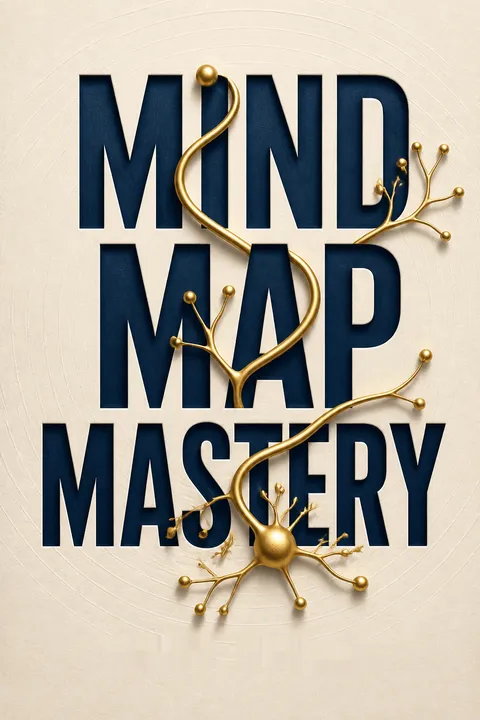


Key Takeaways
Turn tangled notes into a picture that lets ideas find one another
A frustrated student starts searching. At university, Tony Buzan found that taking more conventional notes did not help him learn. He began underlining keywords and noticed that a small fraction of his notes carried the ideas that unlocked the rest. The challenge was to show how those ideas connected, instead of burying them in long, uniform lines of text. His answer became the Mind Map: a visual record that starts with one subject and spreads outward through related ideas.
The page becomes a thinking surface. Buzan presents this as more than a note-taking format. Making connections visible can help a person sort information, generate questions, plan work, and remember what matters. The book's central promise is practical: use a map to see both the main subject and its related parts at a glance.
What's valuable here is the shift from recording information to arranging it for use. A page of notes can preserve what was said while hiding relationships; a diagram makes those relationships available for inspection. This resembles external cognition, the broader idea that people use marks, objects, and diagrams to reduce the load on working memory. The brain-cell analogy that inspired Buzan is evocative, but resemblance is not proof that thought literally follows the same geometry. The map is best judged as a useful interface for thinking, not a miniature model of the brain.
Build every map outward from one image, then branch by association
Give the subject a centre. A Mind Map starts with a central image representing the topic. Major branches radiate from it, each naming a broad category; smaller branches add specific details. Buzan calls the major categories Basic Ordering Ideas, or BOIs. For a Shakespeare map, for instance, broad branches might cover comedies, tragedies, and histories, with plays and related details branching from those categories.
Make the layout readable. The book recommends a large, blank page in landscape orientation, flowing branches that narrow outward, and space between ideas. Colour distinguishes major branches, while images, symbols, and connecting arrows can clarify or link concepts. The goal is a map that keeps the central subject visible while allowing the eye to move among related ideas, rather than forcing a single reading sequence.
This structure gives free association a useful boundary. A central subject prevents brainstorming from becoming a pile of unrelated ideas, while branching lets a person change levels of detail without losing the overview. In information design, the same tension appears between overview and detail: readers need a stable frame, but also enough room to explore. The map's spatial freedom is not automatically clearer, however. A crowded page can become harder to interpret than a well-organized list, so spacing, hierarchy, and a willingness to split a complex map are practical necessities.
Put one potent word on each branch and let it trigger the next
Keep each idea open-ended. Buzan advises placing a single keyword or image on each branch. A word such as “pineapple” can prompt memories of colour, taste, texture, or a particular place. The writer's term Human Language describes this associative, image-rich way of responding, which he argues operates alongside spoken and written languages. A keyword leaves room for a person to develop those associations; a phrase can bundle several ideas together before they have been explored separately.
Make the ideas memorable. The book recommends using colour, imagery, symbols, and visual emphasis to make branches distinct. Buzan cites the von Restorff effect, the finding that an item that stands out from its surroundings is more likely to be remembered. A branch should be legible and distinctive, not an invitation to spend twenty minutes perfecting a drawing.
The practical insight is that compression can prompt thought rather than merely shorten it. A keyword works like a retrieval cue: it can reactivate a wider cluster of related knowledge. Distinctive visuals may also help separate one idea from another, supporting memory through multiple forms of representation. Still, one word per branch is a design preference, not a universal law. Some technical or relational ideas need more context to remain accurate. A useful map should preserve meaning first, then use brevity and visual variety to make that meaning easier to retrieve.
Use maps to expose options before complexity turns into paralysis
Put the dilemma on paper. A map can break a difficult choice into causes, consequences, possible responses, and sources of help. Buzan recommends beginning with a clear, open question rather than a yes-or-no prompt, then considering both content and process: what is happening, and how might it be addressed? If one issue grows too large for the page, it can become a separate mini Mind Map.
A career choice becomes visible. Maneesh Dutt describes mapping his doubts about leaving a secure engineering job to teach Mind Mapping. He separated the discomfort he wanted to escape, what he valued in his current role, the cost of staying, and the rewards he imagined in a new career. The map helped him decide to resign. His story shows how organizing a dilemma can restore movement, though the map itself cannot guarantee the choice will succeed.
A diagram can help with indecision because it makes trade-offs inspectable instead of allowing one anxious thought to dominate. This has a family resemblance to decision analysis, where options and consequences are laid out before commitment. Dutt's story adds an important emotional dimension: the imagined attraction of a new path became visible alongside the risks. Yet maps can also make weak assumptions look orderly. Their value depends on checking the evidence behind each branch, including what is unknown, not just counting how many arguments appear on each side.
Treat a rough first map as a draft, not a verdict
Let the first pass be fast. A hurried map may look crowded because it captures thoughts as they arrive. Buzan treats that as useful raw material, not proof that the method has failed. Review the page, remove redundant branches, strengthen the main categories, and leave room for new connections. If one topic is becoming unwieldy, give it a page of its own as a mini Mind Map.
Notice what keeps returning. A repeated word can signal that the same concern appears in several parts of a problem. The book suggests marking repeated terms and considering whether one of them should become the focus of a new map. It also encourages keeping branches open during exploration, rather than grouping or boxing ideas so early that the map stops developing.
This draft-and-revise approach is closely aligned with iterative design: make a first version, inspect what it reveals, and revise the structure in response. It also reduces perfectionism by separating idea generation from editing. Repetition can indeed expose a recurring theme, but it is a clue rather than a verdict. A word may recur because it is genuinely central, or because the map's categories are poorly defined. The strongest revision asks both what keeps appearing and whether the current structure is causing the same idea to be duplicated.
Make your own map when memory matters; your associations are the glue
Creation strengthens recall. The book argues that a map becomes more memorable when its maker chooses the words, images, and links. Buzan explains this through personal associations: the same word can connect to different memories for different people, so a borrowed map may not activate the same network for its reader.
The studies offer a useful signal. Buzan cites a 2009 presentation by H. Toi reporting memory improvements of up to 32 percent for children recalling words with Mind Maps rather than lists. He also cites a 2002 study by Farrand, Hussain, and Hennessy that found a 10 percent improvement in long-term recall of factual information. These results support trying maps as a study aid, not assuming that every map or subject produces the same benefit.
The strongest learning principle here is active construction. In cognitive psychology, retrieval practice and elaboration support durable learning: learners benefit when they recall information and connect it to what they already know. Making a map can encourage both. The cited results are promising, but the book gives limited detail about sample sizes, comparison methods, and how broadly the findings apply. A map should therefore be paired with a real test of learning, such as closing the page and explaining the topic from memory, rather than judged by how attractive it looks.
Use one map to turn a daunting project into visible categories and choices
The method travels across settings. The book shows maps being used to plan a week, organize a business report, revise a play, prepare a speech, or structure a personal goal. In education, a map of Macbeth can connect a character's ambition and courage to events in the play. At work, branches can organize research, deadlines, resources, and presentation plans. At home, a weekly map can make family commitments and chores visible to everyone.
Maps can support daily functioning too. Kate Swaffer, diagnosed with dementia at 49, used visual maps as part of her approach to learning and organizing life; she later completed university degrees and became an advocate for people with dementia. Her experience illustrates a possible support, not a medical cure. The book also suggests maps for wellbeing plans and care routines, while emphasizing that professional help may still be needed.
The range of uses is a strength because the same visual structure can adapt to very different tasks. It can help a student organize a literary argument, or help a household coordinate responsibilities. Swaffer's experience is especially compelling as an example of agency and accommodation, rather than evidence that mapping reverses cognitive decline. That distinction matters. A thinking aid can reduce friction and make information more accessible without replacing treatment, specialist support, or the particular communication needs of the person using it.
Use digital maps for collaboration, but verify they preserve branching logic
Software changes the workflow. Digital maps can be edited, backed up, linked to multimedia, and shared with colleagues for annotation. Buzan values software that preserves the branching structure, colour, and visual hierarchy he considers essential. He warns that some products called mind-mapping tools instead produce box-based diagrams with several ideas packed into each node.
Technology does not replace judgment. The book imagines future software that could represent maps in three dimensions and asks whether AI could create and explain its own maps. Buzan treats that as an open challenge, not an achieved capability. For present use, the practical test is simpler: does the tool help people generate, organize, and revisit ideas? A polished interface is no guarantee that it supports the user's thinking.
Digital tools add important affordances: rapid editing, search, backup, and collaboration. Those advantages can outweigh the tactile and personal qualities of drawing by hand, especially when several people need to work on one map. The more useful distinction is not paper versus screen, but whether the representation suits the task. Buzan's strict fidelity test protects the method's identity, though it can also make the category too narrow. A different visual diagram may serve a purpose well even if it is not a Mind Map by his definition.
Analysis
Mind Map Mastery is a practical guide built around a strong central claim: people can think more effectively when they make relationships visible. Its narrative begins with Buzan's dissatisfaction with conventional study notes, follows the development of a visual branching method, and expands into examples from education, work, memory, personal decisions, and health. The structure mirrors the tool it teaches: a central premise sends out applications and refinements.
The most durable contribution is not the claim that a map reproduces the brain. It is the method's invitation to externalize thought, group related material, and move between overview and detail. This can reduce the burden of holding every component in working memory, while making omissions and connections easier to notice. The practice also joins idea generation with planning, a useful bridge between creativity and execution.
The book's insistence on colour, imagery, and single-word branches provides a memorable discipline, but its scientific rationale needs care. Neuroscience does not support a simple division in which language belongs to one hemisphere and creativity to the other. Nor does a branching diagram prove that thought itself has the same form as a neuron. Evidence cited for memory benefits is encouraging, but the book offers little methodological detail, and effectiveness is likely to vary with the learner, task, and quality of the map.
The strongest way to use the method is therefore experimental. Create a map for a real task, then test whether it improves understanding, recall, or decision quality compared with the usual approach. Revise or abandon parts that add decoration without clarity. The book is at its best when it treats mapping as a trainable habit and a flexible aid. It is less persuasive when it presents one visual form as the uniquely natural language of all thought. Readers can retain the core technique without accepting every claim made on its behalf.
Review Summary
Mind Map Mastery receives mixed reviews. Many praise its innovative approach to organizing information and problem-solving, finding it useful for various applications. However, some criticize the book for being repetitive, overly promotional, and lacking depth. Readers appreciate the colorful illustrations and practical examples but note that the content could be condensed. While some find mind mapping transformative, others see it as just one of many organizational tools. The book is generally recommended for beginners but may not offer much new information for experienced mind mappers.
People Also Read




Glossary
Mind Map
Branching visual thinking aidA diagram that begins with a central image or topic and expands through radiating branches of related ideas. In Buzan's method, branches use keywords or images, with colour, visual emphasis, and links between related areas. The map is intended both to record information and to help its creator explore, organize, and recall it.
Radiant Thinking
Thought spreading by associationBuzan's term for thinking that develops outward from a central idea through associated concepts. A word, image, or memory can prompt further connections, which can themselves generate new associations. Mind Maps make this process visible on a page, allowing ideas to expand without requiring a single fixed sequence.
Human Language
Imagination and associationBuzan's name for the associative, image-rich mode of thought he considers fundamental to human cognition. He describes it as relying chiefly on imagination and association, with location also helping organize memory. The term is his broad framing, not the conventional linguistic meaning of a shared spoken language.
Basic Ordering Ideas (BOIs)
Main categories for a mapThe broad categories that form the main branches of a Mind Map. BOIs give the subject an initial structure and help the map's creator decide which kinds of related ideas belong together. Sub-branches then add more specific information beneath each category, preserving a hierarchy from general themes to details.
Laws of Mind Mapping
Guidelines for clear mapsBuzan's set of design principles for making a Mind Map visually distinct and usable. They include beginning with a central image, branching outward, placing a keyword or image on each branch, and using colour, visual links, and clear spacing. Buzan treats these principles as defining features of a true Mind Map.
Mini Mind Maps
Separate maps for subtopicsSmaller maps devoted to a detailed issue, question, or offshoot that would overcrowd a larger map. A mini Mind Map may sit beside its parent map or on a separate page. It allows a specific topic to be explored in depth while keeping the main map readable and its wider structure visible.
Method of loci
Memory through imagined placesAn ancient mnemonic technique that links information to familiar or imagined locations in a fixed sequence. A learner mentally places vivid images in different spots along a route or within a building, then recalls the information by revisiting those locations in imagination. Buzan presents it as part of the historical background to memory methods.
Major System
Numbers converted into soundsA mnemonic method described in the book in which numbers are translated into phonetic sounds, then turned into words and memorable images. Those images can be placed in a Memory Palace or connected with other associations. Buzan recounts learning the technique from a university professor who used it as part of an impressive memory demonstration.
Chunking
Grouping information into unitsA memory strategy that combines separate items into meaningful groups, making them easier to handle and recall. Buzan connects the technique to George A. Miller's work on short-term memory and applies it to maps by grouping related branches. He cautions that grouping too early can restrict the development of new connections.
von Restorff effect
Distinctive items remembered betterA memory finding associated with Hedwig von Restorff, who reported that an item that stands out from similar surrounding items is more likely to be remembered. Buzan applies the idea to Mind Maps: colour, symbols, and visual emphasis can make branches more distinctive. The effect supports selective emphasis, not the assumption that more decoration always improves recall.
FAQ
What's "Mind Map Mastery" about?
- Overview: "Mind Map Mastery" by Tony Buzan is a comprehensive guide to understanding and utilizing Mind Maps, a powerful thinking tool designed to enhance creativity, memory, and problem-solving skills.
- Purpose: The book aims to teach readers how to create and use Mind Maps effectively in various aspects of life, from personal development to professional tasks.
- Structure: It includes practical exercises, real-life examples, and stories from master Mind Mappers to illustrate the transformative potential of Mind Mapping.
- Audience: The book is intended for anyone looking to improve their cognitive abilities, whether they are students, professionals, or lifelong learners.
Why should I read "Mind Map Mastery"?
- Cognitive Enhancement: The book offers techniques to improve memory, creativity, and problem-solving skills, which are beneficial in both personal and professional settings.
- Practical Applications: It provides numerous examples of how Mind Maps can be applied to everyday tasks, making it a practical tool for organizing thoughts and projects.
- Community and Support: Reading the book connects you to a global community of Mind Mappers who share their experiences and insights.
- Personal Growth: It encourages self-discovery and personal development by helping you unlock your brain's full potential.
What is a Mind Map according to Tony Buzan?
- Definition: A Mind Map is a visual thinking tool that mirrors the structure of a brain cell, with branches radiating from a central image to represent ideas and associations.
- Components: It includes a central image, thick branches for main themes, and thinner branches for sub-themes, all connected with keywords and images.
- Purpose: Mind Maps are designed to engage both the logical and creative sides of the brain, enhancing memory and creativity.
- Applications: They can be used for note-taking, brainstorming, planning, and problem-solving across various fields.
How do I create a Mind Map as per "Mind Map Mastery"?
- Materials Needed: Start with a large sheet of plain white paper and a selection of colored pens or pencils.
- Central Image: Draw a central image that represents the main subject, using at least three colors to make it visually engaging.
- Branching Out: Create thick branches radiating from the central image, each representing a key theme, and use different colors for each branch.
- Keywords and Images: Place a single keyword or image on each branch to trigger associations and further ideas.
What are the key takeaways of "Mind Map Mastery"?
- Whole-brain Thinking: Mind Maps activate both hemispheres of the brain, enhancing cognitive functions like memory and creativity.
- Versatility: They can be applied to a wide range of activities, from personal goal setting to professional project management.
- Radiant Thinking: The book emphasizes the concept of Radiant Thinking, where ideas radiate from a central point, promoting a non-linear, organic flow of thoughts.
- Mind Mapping Laws: Following the specific Laws of Mind Mapping ensures clarity, creativity, and effectiveness in the maps you create.
What are the Laws of Mind Mapping according to Tony Buzan?
- Blank Paper: Always use a blank sheet of paper in landscape position to allow for free-flowing ideas.
- Central Image: Start with a colorful central image to engage the brain and trigger associations.
- Keywords and Branches: Use single keywords on branches, with each word or image on its own branch to maintain clarity.
- Color and Imagery: Incorporate colors and images throughout the Mind Map to stimulate memory and creativity.
What are the infinite applications of Mind Maps as described in the book?
- Home and Personal Life: Mind Maps can be used for planning events, setting personal goals, and organizing daily activities.
- Work and Professional Use: They are effective for project management, decision-making, and strategic planning.
- Education and Learning: Mind Maps aid in studying, revising, and understanding complex subjects.
- Creativity and Innovation: They foster creative thinking and can be used in artistic and design processes.
How does "Mind Map Mastery" address common misconceptions about Mind Maps?
- Clarification: The book distinguishes Mind Maps from other diagrams like spider diagrams and concept maps, which lack the same structure and effectiveness.
- Misuse: It addresses the issue of Mind Maps being misunderstood or misappropriated by those not fully trained in the technique.
- Laws Importance: Emphasizes the importance of adhering to the Laws of Mind Mapping to ensure the tool's effectiveness.
- Visual Appeal: Highlights the unique visual and cognitive benefits of true Mind Maps compared to other linear or hierarchical diagrams.
What are some advanced Mind Mapping techniques discussed in the book?
- Mini Mind Maps: Use smaller, focused Mind Maps to explore specific aspects of a larger topic without cluttering the main map.
- Chunking and Boundaries: Group related information into chunks and use boundaries to enhance memory and organization.
- 3D Mind Mapping: Envision Mind Maps in three dimensions to better understand spatial relationships and complex ideas.
- Digital Mind Mapping: Utilize software like iMindMap to create, edit, and share Mind Maps digitally, enhancing collaboration and accessibility.
What are the best quotes from "Mind Map Mastery" and what do they mean?
- "Your brain is a sleeping giant, and Mind Map Mastery is here to help wake it up!" This quote emphasizes the untapped potential of the human brain and how Mind Mapping can unlock it.
- "A Mind Map is a mirror of the mind’s inner workings." It highlights how Mind Maps reflect the natural processes of human thought, making them an effective tool for organizing and understanding information.
- "Mind Maps are analytical in the sense that you can use them to solve any problem." This underscores the versatility of Mind Maps in addressing a wide range of challenges and tasks.
- "The Mind Map is a natural evolution of human thinking." It suggests that Mind Maps are an intuitive tool that aligns with the way humans naturally process information.
How does "Mind Map Mastery" relate to digital and AI advancements?
- Digital Evolution: The book discusses the development of digital Mind Mapping tools like iMindMap, which enhance the accessibility and functionality of Mind Maps.
- AI Potential: It explores the possibility of AI mastering Mind Mapping, which would represent a significant advancement in artificial intelligence.
- 3D Mind Mapping: The future of Mind Mapping may include fully three-dimensional digital maps, offering new ways to visualize and interact with information.
- Human Element: Despite technological advancements, the book emphasizes the irreplaceable value of human creativity and intuition in Mind Mapping.
What is the future of Mind Mapping according to Tony Buzan?
- Continued Evolution: Mind Mapping will continue to evolve alongside technological advancements, integrating with digital tools and AI.
- Global Reach: The book envisions a future where Mind Mapping is a universal skill taught to children and adults worldwide.
- AI Integration: There is potential for AI to learn and apply Mind Mapping techniques, pushing the boundaries of artificial intelligence.
- Personal Empowerment: Mind Mapping will remain a powerful tool for personal development, helping individuals unlock their full cognitive potential.
About the Author
Other books by Tony Buzan




Download PDF
Download EPUB
.epub digital book format is ideal for reading ebooks on phones, tablets, and e-readers.








