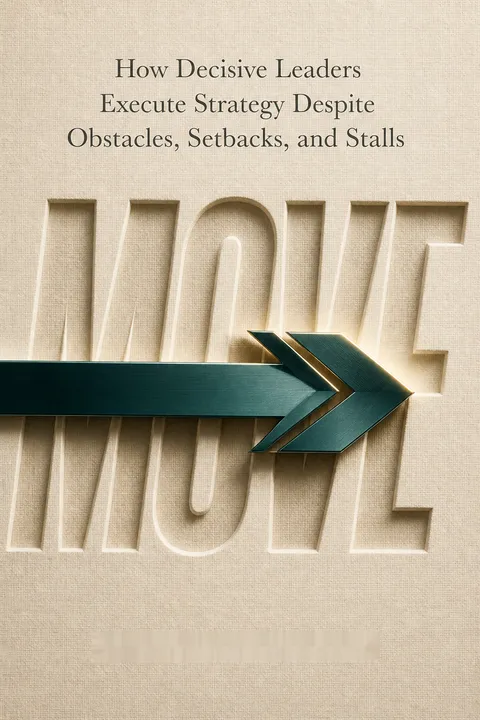


Key Takeaways
Treat execution as the strategy's long middle, not its afterthought
The kickoff is fragile. Azzarello opens with an executive simulation where funding a strategic initiative immediately produces its promised benefit. The joke lands because real organizations often spend money on initiatives without seeing results. After an exciting launch, employees return to familiar work, current pressures crowd out new tasks, and the change loses momentum. The difficult stretch between announcement and outcome is where transformation succeeds or stalls.
Plan the work between. A strategy cannot stop at a destination such as higher revenue or better products. It must specify what people will do, how progress will be measured, and what resources will support the work. The MOVE model organizes this challenge around the long middle, the organization doing the work, the leader's persistence, and participation across the company.
The book's central move is to treat implementation as part of strategy formation, not as a handoff after the senior team finishes thinking. That aligns with a systems view of organizations: outcomes depend on incentives, capacity, information, and repeated decisions, not just declared intent. The simulation joke also exposes a useful test: if an initiative's benefits appear automatically on a slide, the plan has skipped the human work. Still, execution should not become rigid compliance. A strategy needs enough structure to sustain effort and enough feedback to change course when evidence contradicts the plan.
Replace impressive problem talk with outcomes people can actually deliver
Stop rehearsing the problem. Azzarello calls abstract, elaborate discussion that substitutes for action smart talk. A team may repeatedly describe weak European sales, limited resources, and competitive pressure while no one proposes a different approach. The shift is from discussing the situation to defining a concrete outcome: what would be happening if the problem were improving?
Make the result observable. In one example, a company wanted an additional $20 million in European revenue. Discussion revealed that $15 million would need to come from retail, a channel the existing enterprise sales team could not build. The team then identified specific partner, hiring, and marketing actions. Smaller outcomes count too. Improving a few high-impact product issues can be worthwhile even if it does not solve every quality problem at once.
This method turns meetings from diagnosis into design. It also makes hidden assumptions visible: the sales target could not be met by asking an enterprise team to perform retail work it had never done. In problem-solving research, teams often benefit from defining the desired state before choosing interventions, because a shared target narrows the option space. The caution is that action pressure can make teams define outcomes before understanding the cause. A useful rhythm is to investigate enough to avoid treating symptoms, then stop collecting context when it no longer changes the choice.
Give long initiatives near milestones, or they will drift
Make the middle visible. An 18-month goal can feel distant enough to excuse delay. Azzarello recommends working backward from the finish and identifying visible checkpoints along the way. Ask what should be true at nine months, six months, and three months, then determine what must begin now. These milestones show whether the initiative is advancing before the final result arrives.
A sales example. A vague goal to sell higher in enterprise accounts became a year-end target of 50 executive relationships and five major deals. The team then mapped earlier evidence: named target accounts, assigned salespeople, trained representatives, and qualified opportunities. A recurring timeline showed completed work, the current position, and upcoming milestones. A moving marker helped employees see progress and reminded them that the future work had not disappeared.
Milestones counter the planning fallacy, the tendency to underestimate how long complex work takes and to postpone starting because the deadline seems far away. They also create feedback sooner, which can reveal a bad assumption while there is still time to respond. But milestones can become a performance in themselves: teams may hit dates while producing little value. Each checkpoint should therefore describe evidence that the outcome is becoming more likely, not simply activity completed. A timeline is most useful when it supports learning and trade-offs, rather than serving as a decorative promise.
Measure whether reality improved, not whether tasks were completed
Choose an outcome signal. Azzarello distinguishes activity measures from control points, the observable results that indicate whether the work is producing the change the business needs. Counting customer calls closed or staff trained can look reassuring while customers remain unhappy. Temple Grandin's animal-welfare audits illustrate the alternative: rather than inspect every possible cause, look for the visible outcome of cows that are limping. If they are, the operation has a problem to solve.
Follow the customer reality. In one software business, engineers treated difficult installation as a low-priority issue. After engineers watched sales staff struggle to install the product for customers, the team fixed the problems quickly. A customer-centered target, making the initial experience enjoyable within 15 minutes, then required engineering, support, marketing, and other teams to coordinate.
The distinction resembles Goodhart's law: once a proxy becomes a target, people can optimize the number instead of the underlying result. Closing calls quickly, for example, may reward ending conversations rather than resolving customer pain. Outcome measures resist that distortion by keeping attention on what users experience. They also encourage cross-functional work because a customer result rarely belongs to one department. Yet outcomes can be noisy or slow to change. Activity data still has a role as diagnostic evidence, provided it is not mistaken for proof that the strategy is succeeding.
Make the budget confess what the strategy really is
Resources reveal intent. Azzarello argues that plans do not resource themselves. If new work is added without money, people, or time being reassigned, employees will keep doing the work already on their plates. A company can announce expansion in India and China while assigning the effort to one person without a team or budget. The budget, not the speech, reveals what the organization is actually choosing to do.
Match ambition to capacity. Leaders should show what different funding levels can realistically deliver rather than accept an impossible promise. In one turnaround, Azzarello recounts reducing a marketing budget from $140 million to $60 million while rebuilding the plan around attainable results. The business moved from losing $50 million per quarter to making $50 million in its first year. Her principle is to do less with less, and do the chosen work well.
This is a powerful corrective to strategic theater: priorities become real only when scarce resources move. It also reframes budgeting as an ethical act, since impossible targets transfer risk downward to people expected to deliver without the means. The turnaround story suggests that smaller scope can restore focus and morale, but cuts are not automatically strategic. Cutting capacity without protecting critical capabilities can deepen decline. Leaders need to distinguish waste from the investments that create future options, and make the consequences of each funding choice explicit.
Design the team around future work, not today's org chart
Start with the work. Azzarello uses a dogsled team as a test of organizational readiness: are all the dogs pulling in the same direction, able, and willing to carry their share? A team can stall when people oppose the change, lack the required skills, or do not understand their roles. Leaders should define the outcomes first, then sketch the ideal roles on a blank page before assigning current employees to them.
Change roles with respect. In one reorganization, separate business units competed and left company-wide problems without owners. A unified structure better matched the need for one product strategy and a consistent customer message. Azzarello advises defining each role's new responsibilities clearly. That makes a difficult conversation about fit less personal, and helps reveal whether someone needs support, a different role, or replacement.
The blank-page method reduces the status quo bias that makes existing structures feel inevitable. It also distinguishes loyalty to individuals from responsibility for the work. The dogsled image usefully asks not just whether team members agree, but whether their capabilities and incentives align. Still, leaders can misread resistance as disloyalty when it reflects legitimate risk or poor change design. A fair assessment tests whether people understand the mission, have the means to contribute, and receive honest feedback before concluding that the team itself is the obstacle.
Delegate real decisions so the team grows beyond you
Build capacity while delivering. Azzarello says a leader's job includes making the team more capable, not merely completing this year's assignments. Performance conversations should clarify expectations and prevent surprises. Delegation is a development tool when people receive meaningful responsibility, including difficult work, relationships, and decisions that resemble the manager's own responsibilities.
Leave room to learn. If a manager takes over whenever a delegate risks making a mistake, the employee never gets full ownership. Azzarello recommends choosing substantial but recoverable work, so a person can experience consequences, learn, and improve without putting the most critical business result at reckless risk. Employees, too, should seek feedback and ask how their work is perceived. Clear expectations and regular discussion make development part of ordinary work rather than an annual ritual.
Delegation is often described as workload transfer, but this account makes it a form of capability investment. Learning requires some autonomy and informative feedback, not simply exposure to harder tasks. The key phrase is recoverable risk: a mistake should be consequential enough to teach, but not so costly that the organization confuses development with negligence. Psychological safety matters here, meaning people can report problems and learn from errors without humiliation. That does not remove accountability. It makes accountability more useful by turning failure into information rather than concealment.
Protect a few non-negotiable priorities from the tyranny of busy
Busy can block growth. Work that once helped a company survive can prevent it from scaling. Azzarello describes a founder repeatedly pulled into customer emergencies, leaving no time to build a repeatable platform that would reduce future custom work. The immediate rescue kept the underlying problem alive. Leaders must ask which activities need to change before growth, not after it.
Name the true priorities. Ruthless priorities are a very short list, usually one to three outcomes that cannot be allowed to fail. To find them, ask how serious failure would be, not merely how important the task sounds. Protect the people and time assigned to them, and negotiate other demands as later or smaller. This is not a claim that every other task should stop. It is a commitment to prevent urgent distractions from repeatedly displacing the work that changes the business.
The argument is a direct challenge to the moral prestige of being busy. In operations, recurring emergencies often signal a defective process, so heroic intervention can preserve the very system that produces the crisis. A short list of protected priorities reduces decision fatigue and gives teams a common basis for trade-offs. The risk is that leaders may label too many projects non-negotiable, recreating overload under a new name. The test is whether the list forces a real choice, and whether the organization removes or redesigns work that competes with it.
Debate fully, decide clearly, then enforce the commitment
Uncertainty has a cost. When leaders leave a strategic question unanswered, employees make different choices on the ground. One company could not decide which of two business units mattered most, so event teams represented the company inconsistently. Clear direction would have prevented wasted work and mixed signals. Azzarello argues that avoiding conflict can preserve polite agreement while blocking action.
Separate input from action. Listen to relevant views, then let the decision owner choose. Azzarello calls these distinct debate and go phases: first challenge the options, then stop relitigating and execute. If a deadline is missed, discuss what happened, the impact, and the recovery plan. Consequences need not mean firing someone. The point is to show that commitments matter and to learn whether the miss came from poor judgment, unclear ownership, or insufficient capacity.
This approach avoids the false choice between consensus and command. Diverse input improves decisions, but unanimous agreement can be an unattainable standard that conceals who owns the call. Clear decision rights also reduce the coordination burden of unresolved ambiguity. The same principle applies to missed deadlines: accountability works best when it identifies causes and restores progress, not when it becomes punishment for its own sake. A sound process also states when new evidence is sufficient to reopen a decision, so go time does not become stubbornness.
Make change visible in everyday conversation, not just presentations
A presentation is a beginning. Leaders may have studied a strategy for months, while employees hear it once without the context or confidence to act. Azzarello says communication has worked when people can explain the strategy to one another and use it in their decisions. A weekly update she sent for 17 years helped employees feel informed, connected, and assured that priorities remained in force.
Put the message where work happens. An agency's staff abandoned daily executive outreach after a few people returned to urgent tasks. A short daily check-in restored the shared expectation. Heifer International's community livestock program offers a longer view: ceremonial handoffs helped a practice continue in a Cambodian community 17 years after the organization had left. Conversation, recognition, rituals, and visible signs of progress make a change part of the group's habits.
The insight is social as much as informational. People infer whether a change is real by watching peers and leaders, not only by parsing the official announcement. Repetition can reduce uncertainty, while rituals make an abstract priority tangible and memorable. This resembles the way norms spread through visible behavior. Yet repetition without listening becomes propaganda. The strongest communication loop carries information in both directions: leaders explain the purpose, employees surface friction, and teams show concrete evidence of what is changing.
Share power and context so people choose to own the work
Make work matter personally. Azzarello warns that a generic mission statement cannot create commitment if leaders themselves do not care or employees cannot see why their jobs matter. Managers should connect each role to customers, revenue, or service quality, and ask what people personally value rather than guess. A product writer may understand the business differently after meeting customers and seeing how better documentation can reduce support problems.
Trust is built through action. Leaders can share decision-making power, recognize excellent work, respect employees' lives outside work, and give capable people room to excel. A former employee once told Azzarello that he felt like Superman on her team. Her proposed test of leadership is whether people feel powerful and respected enough to do their best work, not whether the boss appears indispensable.
This closes the execution loop by linking organizational purpose to individual agency. People contribute more intelligently when they understand how their work affects the customer and when they are trusted to solve problems. The distinction between role power and personal power is especially useful: a leader's authority is borrowed from the organization, while credibility depends on how it is exercised. Meaning alone cannot compensate for poor pay, excessive workload, or unsafe conditions. Trust becomes credible when respect is reflected in resources, choices, recognition, and the distribution of real authority.
Analysis
MOVE is a practical argument about the gap between announcing change and making it ordinary. Its strongest contribution is not a single management tool, but a connected chain: translate ambition into observable outcomes, schedule evidence of progress, fund the work, fit the organization to the mission, and sustain participation through repeated decisions. This chain explains why the book treats budgets, hiring, metrics, meeting design, and communication as parts of one execution problem rather than isolated management topics.
The framework is especially valuable where leaders mistake agreement for commitment. Concrete plans reveal trade-offs, resource shortages, and disagreement that broad strategic language can hide. The book also offers a humane corrective to command-and-control leadership: listen widely, share context, develop people through delegation, and treat trust as something built through behavior. Its stories make these claims memorable, from engineers confronting a failed installation to a founder repeatedly diverted by customer emergencies.
The main tension is between persistence and adaptation. Consistency helps employees believe that a strategy is real, but unwavering commitment can become attachment to a failing plan. Similarly, milestones and control points focus attention, yet poorly chosen measures can narrow the mission or encourage gaming. The framework works best when leaders distinguish commitment to the desired outcome from loyalty to a particular method. Regular feedback should be capable of changing the method, the measures, and sometimes the strategy itself.
The book is grounded in executive experience rather than controlled research, so its examples illuminate mechanisms more than they prove universal rules. Claims about teams, remote work, and leadership behavior should be adapted to context, not treated as laws. Its enduring lesson is that execution is neither a motivational speech nor relentless supervision. It is the design of conditions in which people know what matters, have the means to act, can see whether their actions work, and trust that their effort will not be abandoned at the first obstacle.
Review Summary
Readers highly praise Move for its practical, actionable advice on executing organizational change. Many found it invaluable for leaders navigating complex transformations. The book's MOVE model (Middle, Organization, Valor, Everyone) resonated with readers, offering concrete strategies for implementing change and engaging employees. Reviewers appreciated the author's concise, clear writing style and relatable examples. While some found parts obvious or struggled with certain sections, most considered it an essential read for managers and executives leading strategic initiatives or long-term projects.
People Also Read









Glossary
MOVE
Transformation execution modelAzzarello's framework for sustaining business transformation. Its four parts focus on the long stretch between launch and outcome, building the organization capable of the work, persisting through obstacles, and engaging people across the organization. The model treats execution as a continuing leadership responsibility rather than a task completed by announcing a strategy.
The Middle
Work between launch and resultThe extended period after a strategy is announced and before its intended results are achieved. During this stretch, employees face existing workloads, shifting priorities, uncertainty, and the temptation to return to familiar routines. Azzarello argues that leaders must define the work, milestones, measures, resources, and communication needed to keep progress visible.
control points
Measures of meaningful outcomesA small number of observable results that indicate whether a project is producing the change it needs to produce. They differ from activity counts, such as calls completed or people trained. A useful control point directs attention to the real-world outcome, while leaving teams room to determine which tasks and process changes will achieve it.
ruthless priorities
Few protected commitmentsA short list, usually one to three items, of outcomes an organization refuses to put at risk. The leader identifies them by asking how serious failure would be, then protects the people and capacity needed to deliver them. Other work may continue, but it must not repeatedly displace these commitments.
smart talk
Impressive discussion without actionA pattern in which articulate, complex, or critical discussion creates the appearance of progress while delaying decisions and work. In Azzarello's account, teams escape the pattern by moving from descriptions of the situation to specific outcomes, proposals, owners, and next actions.
Do Less with Less
Reduce scope to fit resourcesAzzarello's alternative to asking teams to produce more with fewer resources. When funding or staffing falls, leaders should choose a smaller set of achievable outcomes, resource those outcomes adequately, and execute them well. The phrase rejects plans that preserve every commitment while quietly making success impossible.
Decorate the change
Make transformation visibleThe use of visible rituals, artifacts, celebrations, contests, or informal communication to make a transformation noticeable in daily organizational life. These signs reinforce that the change remains active and invite employees to participate. Azzarello emphasizes that decorations work best when they fit the group's own habits and culture.
Unstructured conversation
Open discussion of beliefsAn informal, candid exchange in which leaders and employees discuss what they think, fear, or believe about a strategy. Unlike a formal status review, it can surface misalignment, uncertainty, and useful ideas that people may not voice in scripted meetings. Its purpose is to establish genuine understanding before expecting coordinated action.
Debate time
Open input before a decisionThe phase in Azzarello's decision process when participants are invited to challenge options, explain concerns, and contribute relevant knowledge. It is followed by a distinct execution phase once the decision owner has made the call. Separating discussion from action helps preserve candid input without allowing debate to continue indefinitely.
FAQ
What's Move: How Decisive Leaders Execute Strategy Despite Obstacles, Setbacks, and Stalls about?
- Focus on Execution: The book emphasizes the importance of executing strategies effectively, particularly during the challenging "Middle" phase of transformation.
- MOVE Model: Patty Azzarello introduces the MOVE model, which stands for Middle, Organization, Valor, and Everyone, providing a structured approach to strategy execution.
- Real-World Application: Based on Azzarello's extensive experience, the book offers practical advice and actionable insights for leaders to drive their organizations forward.
Why should I read Move: How Decisive Leaders Execute Strategy Despite Obstacles, Setbacks, and Stalls?
- Practical Guidance: The book provides real-world solutions and frameworks that can be applied immediately by leaders facing challenges in executing strategies.
- Engagement of All Levels: It emphasizes the need for involvement from everyone in the organization, fostering a culture of accountability and ownership.
- Avoiding Common Pitfalls: Readers can learn to identify and avoid common traps that lead to stalled initiatives, such as lack of clarity and ineffective communication.
What are the key takeaways of Move: How Decisive Leaders Execute Strategy Despite Obstacles, Setbacks, and Stalls?
- Importance of the Middle: The "Middle" phase is where most strategies stall, and leaders must focus on maintaining momentum and clarity.
- Concrete Outcomes: Defining specific, actionable outcomes rather than vague goals helps teams understand expectations and measure progress.
- Engagement and Communication: Effective communication and engagement at all levels are crucial for successful execution, fostering alignment and motivation.
What is the MOVE model in Move: How Decisive Leaders Execute Strategy Despite Obstacles, Setbacks, and Stalls?
- Four Key Elements: The MOVE model consists of Middle, Organization, Valor, and Everyone, each addressing a critical aspect of executing strategy.
- Middle: Focuses on the execution phase where strategies often stall, requiring defined actions to maintain momentum.
- Organization: Emphasizes the need for the right team structure and personnel to support transformation, assessing team capabilities and needs.
How can I maintain momentum during the Middle phase according to Move?
- Define Mid-Term Checkpoints: Establish clear, measurable milestones to track progress and keep the team focused and accountable.
- Create a Timeline: Use a timeline to visualize the journey, marking key outcomes and deadlines to maintain urgency and clarity.
- Regular Communication: Consistently communicate progress and celebrate small wins to keep the team motivated and aligned.
What are some common pitfalls in executing strategy as outlined in Move?
- Busy Work: Organizations often neglect strategic initiatives due to day-to-day operations, highlighting the need to prioritize strategic work.
- Lack of Clarity: Unclear expectations and goals can lead to failure; leaders must ensure everyone understands their roles and desired outcomes.
- Resource Allocation Issues: Proper resource planning is crucial to avoid stalling new initiatives, aligning resources with strategic priorities.
How do I build the right team for transformation according to Move?
- Assess Current Team: Evaluate whether your existing team has the skills and motivation needed for the new strategy, being honest about contributions.
- Recruit Continuously: Always look for talent, even without open positions, to build relationships with potential hires for future needs.
- Focus on Strengths: Align team members with roles that match their strengths to enhance performance and engagement.
How does Move address the challenges of decision-making?
- Encourage Timely Decisions: Emphasizes the importance of making decisions promptly to avoid stagnation, acting when enough information is available.
- Balance Input and Authority: Leaders should gather input from teams while being decisive, ensuring decisions are informed yet timely.
- Create a Culture of Accountability: Establish clear expectations and consequences for decision-making, encouraging ownership and responsibility.
How can I build trust within my team according to Move?
- Share Power: Leaders should share power and respect with their teams, fostering loyalty and encouraging ownership of work.
- Open Communication: Engage in open conversations to understand team concerns and motivations, creating a supportive environment.
- Recognize Contributions: Acknowledge and celebrate achievements, boosting morale and reinforcing the importance of individual contributions.
What role does communication play in executing strategy according to Move?
- Clarity and Consistency: Clear and consistent communication ensures everyone understands the strategy and their roles, reducing confusion.
- Foster Conversation: Leaders should create an environment where ongoing conversation is the norm, maintaining engagement and allowing for feedback.
- Top-Down and Bottom-Up: Communication should flow in both directions, with leaders sharing their vision and listening to team feedback for alignment.
What are some effective strategies for engaging remote teams as suggested in Move?
- Regular Check-Ins: Implement regular check-ins to maintain communication and connection among remote team members, ensuring alignment.
- Use Technology: Leverage tools like video conferencing and instant messaging to facilitate collaboration and maintain team cohesion.
- Encourage Team Building: Organize virtual team-building activities to foster relationships and camaraderie, enhancing trust and collaboration.
What are the best quotes from Move and what do they mean?
- “If you want a mission that employees care about, it starts with you actually caring about something.”: Emphasizes the importance of genuine leadership and commitment to the mission.
- “You can't do your job without knowing the things you learn from these conversations.”: Highlights the value of listening to team members for effective decision-making and strategy execution.
- “If you want something to happen, make sure everyone keeps talking about it.”: Underscores the necessity of ongoing conversation in driving change and maintaining focus.
About the Author
Other books by Patty Azzarello

Download PDF
Download EPUB
.epub digital book format is ideal for reading ebooks on phones, tablets, and e-readers.








