

Key Takeaways
Treat every meal as the last stop in a long technical and political journey
The table is an endpoint. A supermarket basket can include olive oil from Andalusia, salmon from Norway, and beans from Kenya. Each item depends on routes, containers, workers, and decisions that usually disappear from view before dinner. Food has been traveling this way for millennia. Roman officers in distant Britain ate fish paste shipped from Spain, while Rome imported much of its food from across the empire.
Waste becomes evidence. Monte Testaccio, a hill in Rome made from discarded olive-oil jars, contains fragments from more than 50 million amphorae. At least 80 percent came from Baetica, in modern Spain. Stamps and painted notes reveal producers, merchants, and customs checks, turning broken packaging into a record of commerce. Rome’s appetite was not unlike ours: an urban population relying on food brought from far away.
What's striking is that the book makes infrastructure visible through objects usually treated as disposable. A jar fragment can reveal not only a trade route, but also the scale of a city’s dependence on distant producers. This perspective changes how a meal is read: its origins include institutions and labor, not just soil and recipe. Archaeological evidence, however, is uneven. Packaging survives more readily than the lives of the people who made, carried, and emptied it, so the material record can illuminate commerce while leaving its human costs faint.
Choose containers carefully: they preserve food and can remake its flavor
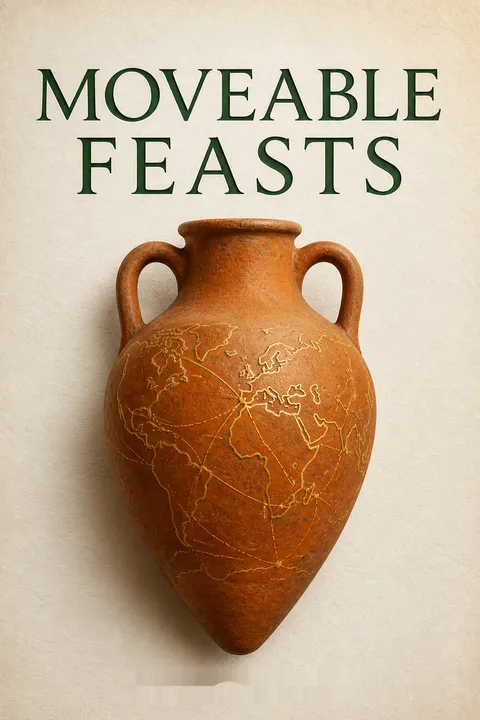
Packaging does more than carry. The Roman amphora was shaped to fit tightly into a ship’s hold, with a pointed base that helped stabilize the jars and gave workers another grip. Centuries later, the wooden barrel did more than prevent leaks: oak could soften wine and contribute flavors shaped by the tree, seasoning, and toasting. A container could be both a transport tool and an ingredient in the result.
Preservation became portable. In the early nineteenth century, Nicolas Appert showed that heating food sealed in an airtight vessel could keep it from spoiling. Military demand helped popularize preserved rations, and later U.S. military researchers developed the flexible retort pouch, which withstands sterilizing heat while taking less space than a can. Similar packaging now holds many supermarket foods.
The container is a useful reminder that technology does not merely move a product unchanged. It can shape taste, shelf life, appearance, and the kinds of foods that become ordinary. In that sense, packaging works like a quiet form of food design. Preservation also changes the bargain between convenience and sensory quality: a meal that travels safely for months may not resemble its freshly made counterpart. The key question is not whether packaging is good or bad, but which qualities it protects, which it alters, and who benefits from the trade.
Standardized freight makes faraway labor part of the recipe
One box changed the economics. In 1956, trucking entrepreneur Malcom McLean launched a scheduled container-ship service. Standard steel containers could move from ship to train to truck without unpacking each item, replacing slow break-bulk handling and sharply reducing labor costs. The system made distance less important to companies deciding where to process goods.
Fish now follows wages. A Norwegian salmon may be frozen, shipped to China, defrosted, filleted by hand, refrozen, and sent back to Western markets. The journey makes sense to sellers because Chinese workers can remove pin bones far more cheaply than workers in Norway or the United States. Refrigerated containers keep the fish cold throughout. The box does not just transport dinner; it lets companies separate where food is caught, processed, and sold.
Containerization illustrates how lower transaction costs reorganize production. Once freight becomes predictable and cheap, firms can divide a product into tasks and locate each task where it is least expensive. Consumers gain access to more goods, while workers and communities experience the gains and losses unevenly. The salmon’s round trip is not irrational so much as optimized for the company’s balance sheet. That distinction matters: efficiency describes how resources are used, not whether the resulting distribution of wages, risk, or opportunity is fair.
Food logistics can feed a city or help decide who rules it
Supply became strategy. When the Soviet Union blockaded West Berlin in 1948, British and American planes flew food and other essentials into the city. The airlift delivered more than 500,000 tons of food and kept over two million people supplied. General William Tunner improved the operation by imposing precise schedules and sending aircraft that missed their landing approach back to base rather than letting them circle dangerously.
Bananas carried power, too. Refrigerated steamships let American fruit companies move bananas at scale and build immense influence in Central America. United Fruit owned land and transport infrastructure, and its interests clashed with Guatemalan president Jacobo Arbenz’s land reforms. In 1954, a U.S.-backed coup removed Arbenz. The banana trade did not alone cause the coup, but it helped create the economic stakes and political connections surrounding it.
These contrasting cases show that logistics has no inherent political virtue. A supply line can sustain civilians under siege, or give a corporation leverage over a government. The important distinction is who controls the route, who depends on it, and who can be excluded. The Berlin Airlift’s success also depended on more than aircraft: coordination, political resolve, and public cooperation made its capacity meaningful. Likewise, the banana story should not be reduced to a single corporate conspiracy; it shows how commercial power can become entangled with state interests.
Build reliability into handoffs, not just into expensive technology
Mumbai runs on a relay. The city’s dabbawallas collect home-cooked lunches, sort them by destination, carry them on commuter trains, and deliver them to offices. The tins then make the return journey. Roughly 5,000 workers deliver about 170,000 meals a day, often with no computers or formal paperwork. Simple codes on each tin identify its route and destination, while experienced teams manage each handoff.
The process is the technology. Each lunch passes through several pairs of hands, but the railway network, shared routines, training, and trust make the system dependable. Forbes magazine once gave the service a Six Sigma rating, a measure of extremely low error rates. Its celebrated precision did not come from sophisticated machines. It came from a route that workers knew, a code they understood, and responsibilities that were clearly divided.
The dabbawallas challenge the assumption that reliability is purchased mainly through software and equipment. Their advantage comes from repeated routines in a stable, locally understood system. This resembles a broader principle in operations: errors often emerge at transitions, so clear handoffs can matter more than adding another layer of monitoring. Still, their model depends on specific conditions, including dense rail service, familiar routes, and strong community ties. It is better understood as a lesson in fit than as a low-cost template every organization can copy.
Let local ecology shape food systems, but do not romanticize their fragility
Mongolia turns grass into meals. Nomadic herders move livestock to seasonal pastures, and the animals convert grass, which people cannot digest, into meat and dairy. In Mongolia, animals outnumber people by about ten to one. Herders milk not only cows and sheep, but also horses, camels, goats, and yaks. Fermenting milk into yogurt, cheese, and drinks such as airag helps preserve it and creates a varied, nutritious diet.
Mobility is skilled work. Pastures are not chosen at random. Herders account for snow, wind, altitude, grass varieties, and the needs of animals with young. Yet the system is vulnerable. Severe winters can kill herds, and after the Soviet collective system collapsed, rising herd sizes contributed to overgrazing. The nomadic food chain depends on ecological knowledge, shared access to land, and conditions that can change quickly.
This example expands the meaning of food technology. Fermentation and seasonal movement are forms of accumulated knowledge, even without laboratories or industrial machinery. The system also makes clear that resilience is not the same as invulnerability. A livelihood adapted to a harsh environment can still be damaged by extreme weather, political disruption, or incentives that encourage overuse. Treating pastoral life as either primitive or perfectly sustainable misses its central lesson: environmental fit requires continual judgment, and social institutions help make that judgment possible.
Follow tea across oceans to see how taste can bankroll empire
A fashionable cup had a long wake. In the nineteenth century, sailing clippers raced from China to Britain with the season’s tea. In 1866, the ships Ariel and Taeping arrived in London only minutes apart, after a voyage of about 16,000 miles. Speed and freshness made the race a public spectacle, but tea’s route also depended on difficult inland transport and intense competition for the Chinese trade.
The trade was not innocent. Britain used opium from India to pay for Chinese tea, despite the drug’s devastating effects in China. The resulting Opium Wars forced China to open ports and surrender Hong Kong. Britain also sought alternative tea supplies within its empire, establishing plantations in India and elsewhere. A familiar drink thus linked consumer fashion, coercive trade, and a shift in the geography of production.
Tea makes visible the distance between a consumer’s experience and a commodity’s political history. The cup can feel domestic and harmless even when its supply depends on coercion far away. That gap is not unique to tea; it is a recurring feature of trade, where benefits are immediate for buyers while costs are dispersed among producers and communities. The chapter also complicates the idea that transport simply connects places. Routes redirect investment and can help create new centers of production, changing who holds economic power.
Judge food's footprint across production, processing, transport, and access
Miles are only one measure. A study of strawberry yogurt found that its ingredients and packaging traveled through a web of suppliers before reaching a shop. Another estimate put the primary ingredients in a locally processed Iowa yogurt at more than 2,200 miles of combined travel. But a U.S. assessment cited in the book attributed about 11 percent of food-system energy use to transport, compared with 29 percent for processing and 26 percent for cooking and preparation.
Context changes the verdict. Tomatoes shipped from Spain may require less energy than tomatoes grown in heated British greenhouses. Airfreighted produce can also support jobs and smallholders in countries such as Kenya. These benefits do not erase emissions or labor concerns. They show why a food’s distance alone cannot tell consumers whether its production is environmentally or socially preferable.
Food miles are memorable because distance is easy to picture, but a life-cycle view asks a more useful question: what happened at every stage, and compared with what alternative? Growing conditions, processing, refrigeration, transport mode, and shopping trips all change the answer. Distribution matters as much as efficiency: a low-carbon option may still rely on poor labor conditions, while trade can provide valuable income in poorer regions. A single label is unlikely to capture those trade-offs, but the effort to measure them can improve decisions.
Industrial infrastructure can outlast its job and reshape art
Buffalo’s elevators moved a continent. When the Erie Canal opened in 1825, Buffalo became a crucial transfer point for grain moving from the Midwest toward eastern markets and Europe. In 1842, Joseph Dart and engineer Robert Dunbar adapted a steam-powered bucket system to lift grain from ships. Their elevator could move at least 1,000 bushels an hour, where manual unloading had taken hundreds of workers several days.
Commerce became an aesthetic. Photographs of Buffalo’s grain elevators reached European architects, including Walter Gropius, Erich Mendelsohn, and Le Corbusier. Their vast, repetitive forms helped inspire modernist design. Later canals and shipping routes bypassed Buffalo, leaving many elevators obsolete. Structures built to move grain had become architectural symbols, showing how the visual language of industry can outlive the economic system that produced it.
The elevators demonstrate that infrastructure has a cultural afterlife. A machine built to solve a practical bottleneck can become an image through which later generations imagine progress, scale, and modernity. The connection is less about architects copying a technical blueprint than borrowing a visual vocabulary: repetition, mass, and stripped-down form. There is a caution here, too. The aesthetic appeal of industrial efficiency can obscure its social and environmental costs, just as nostalgia for abandoned structures can overlook the communities affected when the underlying economy moves elsewhere.
Analysis
Moveable Feasts is a history of food told from the side most histories leave out: the journey. Its central insight is that the dinner table depends on a chain of material solutions, from amphorae and barrels to railways, refrigerated containers, and aircraft. Each solution answers a practical problem, but it also changes what can be eaten, where production happens, who earns from it, and which institutions gain influence.
The book’s strongest organizing device is the contrast between the apparent simplicity of eating and the complexity of delivery. An olive-oil jar becomes evidence of imperial demand. A frozen salmon reveals a global division of labor. An airlift turns calories into a tool of Cold War policy. These stories make logistics legible without reducing the subject to engineering. The machines matter because people, markets, governments, and landscapes decide how they are used.
That approach also resists two easy conclusions. Global trade is neither an uncomplicated triumph of abundance nor a single environmental villain. It can supply a besieged city, provide work for distant farmers, and make once-rare foods common. It can also displace workers, amplify corporate power, and increase dependence on fossil fuels. The book’s discussion of food miles is especially valuable because it distinguishes an evocative measure from a complete environmental account. Distance matters, but so do production methods, energy use, and the alternatives available.
The result is a book about hidden systems that remains grounded in memorable physical things: a hill of broken jars, a steel box at sea, a lunch tin on a crowded train, and a sack of grain falling from an aircraft. Its most lasting invitation is practical rather than moralistic: look past the label and the recipe to ask what had to move, who moved it, and what that movement changed. A meal is not merely a product of agriculture. It is also a product of infrastructure, institutions, and history.
Review Summary
Moveable Feasts received mixed reviews, with an average rating of 3.49 out of 5. Readers found it well-researched and interesting, particularly chapters on ancient Rome, the Berlin Airlift, and Indian tiffin transporters. However, many felt the book lacked cohesion and organization, jumping between topics haphazardly. Some praised Murray's balanced approach to food transportation issues, while others criticized her for downplaying environmental concerns and labor abuses. The book sparked discussions about local food movements and global food logistics, though opinions varied on its overall effectiveness and relevance.
People Also Read

Glossary
amphora
Roman transport jarA large ceramic vessel used in the ancient Mediterranean to transport goods such as olive oil, wine, and fish sauce. Its curved, tapered shape made it strong and relatively easy to pack into a ship’s hold. Marks and inscriptions on amphorae can identify producers, traders, officials, and stages of a shipment.
intermodalism
Seamless freight transfersA system for moving standardized cargo containers between ships, trains, and trucks without unpacking the goods inside. By coordinating the dimensions and handling equipment across transport modes, intermodalism reduces loading time, labor, and the cost of moving freight over long distances.
reefer
Refrigerated shipping containerA temperature-controlled freight container used to transport perishable goods. Its systems can regulate conditions such as temperature, humidity, ventilation, and gases, helping food remain usable across long journeys. Reefer containers support global trade in products including seafood, fruit, and vegetables.
retort pouch
Heat-sterilized flexible packageA flexible, sealed package designed to withstand the high heat used to sterilize food. Developed for military rations, it can keep meals safe without refrigeration while using less space and weight than traditional cans. Similar pouches are now used for many prepared foods sold to consumers.
Six Sigma
Statistical quality-control methodA method for measuring and reducing defects in a process. In the book, the term describes a benchmark of no more than 3.4 defects per million opportunities, as well as a business approach in which trained specialists help organizations improve consistency and customer satisfaction.
dabbawalla
Mumbai lunch-box courierA worker in Mumbai’s lunch-delivery service, which collects home-cooked meals, sorts them by destination, carries them on commuter trains, and delivers them to workplaces. Dabbawallas use simple markings and coordinated handoffs rather than relying on extensive computer systems.
airag
Fermented mare’s milkA traditional Mongolian drink made by fermenting mare’s milk. The mildly alcoholic, slightly fizzy drink is part of social and ceremonial life, and fermentation helps preserve dairy foods in a nomadic society where people move with their herds and do not depend on refrigeration.
food miles
Distance food ingredients travelA measure of the distance traveled by food between production and consumption, sometimes extended to include ingredients and packaging. The term draws attention to transport energy and emissions, but distance alone does not capture a food’s full environmental impact, which also depends on production, processing, storage, and preparation.
estufagem
Heated Madeira wine agingA process used to reproduce the warming that Madeira wine experienced during historic ocean voyages. Fortified wine is heated for an extended period, either in a warm environment or in tanks, before aging in oak. The method arose from the discovery that heat during transport altered the wine’s flavor.
modified atmosphere packaging
Packaging with adjusted gasesA packaging method that changes the gases surrounding food, often by reducing oxygen and adding nitrogen or carbon dioxide. The altered atmosphere can slow spoilage, browning, or wilting in fresh-cut produce. Its effectiveness depends on matching the package’s gas levels and permeability to the product.
hub-and-spoke system
Centralized sorting networkA distribution arrangement in which goods travel through central sorting hubs before being sent to their final destinations. The system allows many locations to share transport routes and can connect places that would not have direct service. FedEx uses this approach to sort and redistribute packages.
Download PDF
Download EPUB
.epub digital book format is ideal for reading ebooks on phones, tablets, and e-readers.








