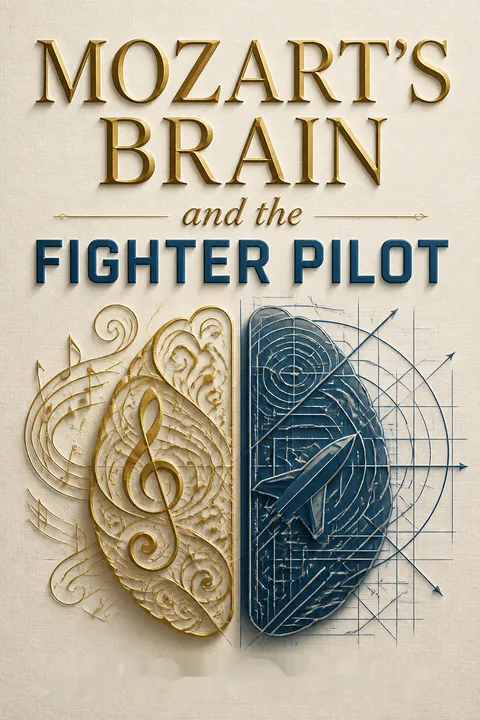


Key Takeaways
Treat your brain as a lifelong project, not a fixed inheritance
Experience reshapes the brain. Restak’s central claim is that mental ability is not simply a fixed endowment: learning and practice alter the brain’s connections throughout life. In animal studies described in the book, rats in stimulating environments developed more neural connections than animals in bare cages. In people, musicians showed stronger responses to musical sounds, while Braille readers developed expanded brain areas for processing the fingers they used. These changes reflected their specific experience, not a general upgrade to every ability.
Use is specific. Restak’s own abandoned tai chi practice illustrates the other side: a skill can become harder when its circuits are neglected, yet return with renewed practice. Plasticity offers grounds for action, not a promise that age, injury, or disease cease to matter. The practical lesson is to keep building skills that are challenging and meaningful to you.
The strongest version of this argument is not that any brain game makes a person broadly smarter, but that brains adapt to sustained demands. Modern accounts of neuroplasticity likewise emphasize that change is often task-specific: practice improves the practiced skill and closely related capacities, not necessarily general intelligence. That qualification makes the advice more useful, not less. Choose activities whose benefits matter in daily life, and practice them consistently. The book’s optimism is valuable, while its occasional suggestion that use makes the brain simply sharper needs restraint: plasticity enables change, but does not guarantee every change is beneficial.
Build bridges between subjects; intelligence grows through useful connections
Knowledge works as a network. Restak argues that the brain stores learning through interconnected neural pathways. A fact becomes more useful when it can connect to other facts, experiences, and questions. He draws on James Burke’s image of knowledge as a web, where one idea can lead unexpectedly to another. Creativity, in this view, is not a mysterious gift so much as the ability to form fresh connections across what one knows.
Make connections visible. A mind map can help: put a central topic on a page, add related ideas around it, and mark links you can explain. A reading journal can do something similar across books, allowing a new argument to meet an older one. Restak’s point is not to collect trivia indiscriminately, but to study widely enough that ideas from science, art, history, and daily life can inform one another.
This network model resembles modern work on associative learning and creative combination: useful ideas often emerge when knowledge from distinct domains is brought into contact. But juxtaposition alone is not insight. A mind map can make a weak association look persuasive simply because it is drawn clearly. The valuable step is to test the connection: What is shared, what differs, and does the analogy help explain anything? Restak’s approach is most powerful when curiosity is paired with verification. Breadth supplies raw material; disciplined comparison turns it into understanding.
Train recall with structure, not brute-force memorization
Memory improves with method. Restak distinguishes useful recall from a perfect recording of experience. The psychologist Aleksandr Luria described a man who remembered vast amounts of detail, yet struggled to keep conversations focused because everything remained equally available. For everyday memory, Restak recommends organizing information into meaningful chunks. Mozart’s famous recollection of a choral work after hearing it twice seems less mysterious when musical knowledge lets a listener group notes into familiar patterns.
Give memories retrieval cues. The ancient method of places links information to vivid images arranged along a familiar mental route. A person might mentally place items to remember in distinct locations around a home, then retrieve them by revisiting the route. The book also recommends testing recall before checking notes. These techniques turn remembering into an active process, rather than a hope that information will somehow stick.
The distinction between storing more and retrieving well is central to effective learning. Contemporary cognitive science supports the value of retrieval practice: trying to recall material strengthens access to it more than simply rereading it. Chunking and vivid cues are useful because they give memory structure, but they can also produce confident errors if the cue is misleading. The best system pairs memorable associations with later verification. The aim is not to reproduce every detail of life, but to recall the information that supports judgment, action, and a coherent sense of experience.
Rehearse the action, then let practiced skills run
Plans become movement. The book describes a motor program as the brain’s organized sequence for carrying out an action. At first, learning a new movement requires conscious attention and planning. With practice, parts of the sequence become more automatic, freeing attention for other demands. Restak uses ordinary actions, such as changing plans when rain disrupts a walk, to show that the brain adjusts its action plan to fit circumstances rather than simply reacting in one fixed way.
Practice and imagine. Studies discussed in the book found that mentally rehearsing a complex movement activates brain areas involved in planning it. Imagery can therefore support a skill when physical practice is temporarily unavailable, though it cannot replace learning the movement itself. Restak also notes that new motor skills need time to consolidate. Trying to learn a second demanding skill immediately may interfere with the first skill’s early learning.
Mental rehearsal is useful because it lets a learner preview sequences and prepare attention for performance. It is especially relevant in music, sport, and other activities where actions unfold in ordered steps. Still, imagined practice lacks the sensory feedback that reveals whether a movement actually works. The most defensible approach is a cycle: plan, practice, review, and allow time for learning to settle. Automaticity is an advantage for familiar routines, but beginners need deliberate attention. Efficient performance depends on knowing when to think through a movement and when to trust trained coordination.
Protect attention by matching tasks to brain demands
Effort recruits more systems. Restak describes experiments in which people initially used widespread brain areas to learn a finger-tapping sequence. Once the sequence became familiar, activity narrowed to areas supporting the movement. Practice makes performance more efficient, but a life dominated by effortless repetition may provide too little challenge. Restak’s practical suggestion is to bring fresh attention to routine work, for example by finding a meaningful variation or focusing fully on the task.
Avoid competing demands. Two activities that both depend on language can interfere with one another, such as following two conversations at once. Reading while listening to instrumental music may be easier because the tasks draw on different kinds of processing. The book discusses the Stroop Test, where a person must name the ink color of a word that spells a different color, as a way to practice resisting an automatic response.
The everyday experience of attention supports Restak’s warning: people do not reliably perform two demanding tasks at once, but switch between them, paying a cost in time and accuracy. His account of brain geography helps readers notice that tasks compete for limited resources. However, the popular idea that each hemisphere has a distinct personality is too simple. Most real activities rely on distributed, interacting networks. The more durable lesson is functional rather than anatomical: identify which tasks demand focused language, perception, or movement, and avoid stacking two high-demand activities just because technology makes both available.
Use emotion as evidence, then check it against reality
Feelings carry information. Restak describes fast emotional processing that can register danger before a person has consciously identified its source. After a frightening car accident, for example, a driver may feel alarm behind the wheel even while knowing that the current drive is safe. The book treats such responses as signals shaped by past experience, not as proof that the present situation is dangerous.
Recover the feeling, too. Memory includes the emotions attached to events, not just their facts. Restak notes that scents can bring back vivid personal memories, and that actors often use experiences from their own lives to understand a character’s feelings. He also recommends noticing the emotional tone that accompanies a thought, then examining what may have prompted it. This can reconnect present reactions with earlier experiences without requiring a person to obey every mood.
This account usefully resists the idea that sound judgment means ignoring emotion. Feelings can summarize patterns a person has learned but cannot yet explain, making them worth investigating. They are not, however, reliable verdicts: anxiety can misread novelty as threat, and strong memories can distort the present. The productive stance is neither submission nor dismissal. Notice the feeling, ask what it might be tracking, and look for evidence that could confirm or revise the interpretation. For persistent or severe distress, self-observation is not a substitute for appropriate professional care.
Schedule demanding work for alert hours, and recover before exhaustion
Energy changes through the day. Restak presents psychologist Robert Thayer’s four broad mood states: calm-energy, calm-tiredness, tense-energy, and tense-tiredness. People also differ in when they feel most alert. A morning-oriented person may do focused writing soon after waking, while an evening-oriented person may work best later. The practical step is to notice your own pattern and reserve difficult tasks for periods of alertness rather than treating every hour as interchangeable.
Match recovery to the state. Restak suggests a short walk when a person feels calmly tired, and rest or a brief nap when fatigue comes with irritability, anxiety, or a sense of being overwhelmed. He also recommends slow abdominal breathing as a way to interrupt stress-driven rapid breathing. The book links severe stress with changes in the hippocampus, a brain structure important to memory, and argues that stress management supports cognitive functioning.
Energy tracking turns vague self-criticism into a practical question: is this a good moment for demanding work, routine work, or recovery? That insight fits research on circadian rhythms and sleep, though individual schedules are also shaped by caregiving, jobs, light exposure, and health. Restak’s breathing and brief-rest suggestions are accessible tools, not universal treatments. Stress ranges from ordinary overload to clinical conditions, and those require different responses. The useful principle is to treat fatigue as information and make room for recovery before exhaustion becomes the default setting.
Slow down conclusions: base rates beat vivid stories
Intuition misreads probability. Restak shows how easily people mistake a streak for a trend. A coin that lands heads several times still has the same chance of landing tails on its next fair toss. Investors may cling to losing shares to avoid admitting a loss, and cabdrivers in a study worked longer on slow days than on profitable ones, even though a steadier strategy could earn more. In each case, a compelling feeling displaced a better comparison.
Keep uncertainty open. When asked whether a shy, tidy person is more likely to be a librarian or a farmer, people may favor a stereotype and overlook how many more farmers there are. Restak calls premature closure the habit of settling on an explanation before considering the relevant evidence. His examples encourage checking base rates, seeking alternative explanations, and waiting before treating a coincidence or vivid anecdote as proof.
The chapter’s examples anticipate a durable insight from behavioral economics: judgment is shaped by framing, loss aversion, and the tendency to substitute a vivid story for statistical context. Base rates are especially useful when evidence is incomplete, but they are not a complete answer. Specific, reliable evidence about an individual can properly outweigh a general frequency. The discipline is to ask what information is relevant, what is merely memorable, and what would change the conclusion. Tolerating uncertainty is not indecision; it is a way to avoid mistaking confidence for accuracy.
Make reading cumulative with a journal and searchable memory
Read across a lifetime. Restak recommends reading in several fields and recording not only what a book says, but also the reader’s own responses. A journal can preserve page references, arguments, and questions, then help connect one author’s view to another’s. Restak illustrates the value of this method by using earlier notes to compare conflicting interpretations of Leonardo da Vinci. The journal makes reading an ongoing conversation rather than a string of books quickly forgotten.
Let tools extend thought. Restak treats notebooks, computers, and recordings as external supports for memory, a role he calls wideware. A searchable journal can reveal links across entries that are difficult to find in handwritten volumes. Yet the point is not to outsource all remembering. External records are most useful when they help a person revisit, compare, and think through ideas.
A reading journal combines two valuable practices: retrieval, which tests what remains in memory, and elaboration, which connects new claims to existing knowledge. Digital search can make those connections easier to recover, while handwriting may encourage a slower, more selective encounter with material. Neither medium guarantees reflection. A large archive can become a warehouse of abandoned notes unless entries are revisited and used. Restak’s most transferable advice is to create a personal knowledge system that supports comparison and revision, rather than simply accumulating information.
Give your brain unfamiliar work through art, movement, and skilled hands
Challenge more than language. Restak urges readers to engage capacities beyond reading and verbal reasoning. Looking closely at art, learning music, balancing on one leg, dancing, and developing a precise hand skill all ask the brain to coordinate different forms of perception and action. He describes Salvador Dalí’s double images, which can be seen in more than one way, as an exercise in resisting the first obvious interpretation. Skilled activities also demand feedback: a small error in a model, instrument, or movement becomes immediately visible.
Broaden without abandoning strengths. Restak advises people to build careers around genuine abilities, but to use their private learning to explore areas outside their usual expertise. A scientist might study literature; a humanities scholar might take up science. The aim is not to become equally accomplished at everything, but to keep curiosity active and expose the brain to varied, meaningful challenges.
This is the book’s most embodied correction to the idea that intelligence lives only in abstract thought. Music, visual perception, balance, and fine hand control involve learning through action and feedback, often in ways that keep motivation high. The claim that each activity broadly enhances cognition should be treated carefully: training effects often remain strongest in the skill being practiced. Even so, the value is not limited to transfer. Art, movement, and craft can improve competence, pleasure, and participation in life, which are worthwhile outcomes in their own right.
Analysis
Restak’s book is best understood as a guide to cognitive agency, not a program for raising a single intelligence score. Its organizing idea is that the brain is an adaptive network: practice strengthens some pathways, neglect weakens them, and new experience can link formerly separate areas of knowledge. From that premise, the book moves outward, connecting memory to identity, motor skill to thought, emotion to judgment, and reading to self-understanding. The result is less a narrow regimen than a menu of ways to make daily life more mentally engaging.
Its most valuable shift is practical. Instead of asking whether a person is smart, it asks which mental capacities can be exercised, supported, or managed better. Memory systems, journals, attention exercises, and routines for rest all convert a vague ambition into observable behaviors. The book also resists the fantasy that cognition is purely verbal or disembodied. Music, perception, balance, hand skills, and physical movement count as serious forms of learning.
The science needs historical context. Published in 2001, the book reflects a period when brain imaging and adult plasticity were reshaping popular neuroscience. Some of its claims about hemisphere specialization, technology shortening attention, specific exercises improving general brainpower, and mental activity preventing dementia are presented more confidently than current evidence warrants. Plasticity is real, but learning tends to be specific, and a change in brain activity is not by itself proof of a broad cognitive benefit. Likewise, acute stress, chronic stress, and clinical illness should not be collapsed into one self-help problem.
The strongest contemporary reading therefore preserves the book’s invitation while sharpening its promise: choose challenging activities that matter, practice them, connect what they teach, and monitor the effects. Do not expect every puzzle, instrument, or exercise to upgrade the whole mind. A richer brain is not necessarily a higher test score. It is a more practiced, better-supported set of abilities that can be deliberately brought to bear on real problems.
Review Summary
Mozart's Brain and the Fighter Pilot offers exercises to improve brain function and cognitive abilities. Readers found it informative but mixed in usefulness. Some appreciated the practical tips and scientific insights, while others felt the exercises were impractical or outdated. The book covers topics like memory, stress management, and mental acuity. It emphasizes the brain's plasticity and the importance of continuous learning. While some readers found it enlightening, others felt it lacked depth or struggled with its presentation style.
People Also Read







Glossary
disuse atrophy
weakening through neglectRestak uses this term for the weakening of neural pathways when a learned activity is no longer practiced. The book’s examples include once-familiar skills such as playing chess or performing tai chi. The skill may become less accessible, but the author argues that renewed practice can rebuild some of the pathways supporting it.
motor program
organized action sequenceA motor program is the brain’s plan for coordinating the movements needed to achieve an action. It can be adjusted when circumstances change, such as when a planned walk becomes a car trip. With practice, parts of a motor program become more automatic, reducing the need for conscious attention.
method of places
memory through familiar locationsAn ancient mnemonic technique that links information to vivid images placed in familiar locations, such as rooms in a home. To retrieve the information, the learner mentally travels through those locations and encounters the images in order. Restak presents it as a practical way to remember lists, facts, or points in a speech.
wideware
external cognitive supportRestak uses wideware for external tools that become part of a person’s regular thinking and memory routines. Examples include computers, notebooks, maps, and recording devices. These tools can extend the brain’s ability to store, search, and organize information, especially when people use them to reflect and make connections rather than merely collect data.
metacognition
thinking about one’s thinkingMetacognition is awareness of how one’s own thinking works, including its strengths, limits, and emotional influences. Restak applies it to noticing memory weaknesses, keeping sight of the larger goal, reviewing performance, and changing strategy. The aim is to make better decisions by observing mental processes rather than reacting to them automatically.
emotional valence
feeling tone of a thoughtEmotional valence is the positive or negative feeling associated with a thought or perception. Restak suggests that noticing this feeling can help identify why a person reacts strongly to a situation or another person. The feeling can guide inquiry, but it does not establish that the interpretation behind it is correct.
tense-tiredness
stressed, depleted moodOne of four daily mood states described by psychologist Robert Thayer and discussed by Restak. Tense-tiredness combines fatigue with negative feelings such as irritability, anxiety, or discouragement. The book distinguishes it from calm-tiredness, where a person may feel physically tired but emotionally settled, and recommends recovery rather than further exertion.
Stroop Test
attention and inhibition testA task that tests the ability to resist an automatic response. In Restak’s example, a person sees color words printed in conflicting ink and must name the ink color rather than read the word. The conflict slows responding and demands focused attention. The book presents the test as an exercise involving concentration and executive control.
About the Author

Download PDF
Download EPUB
.epub digital book format is ideal for reading ebooks on phones, tablets, and e-readers.








