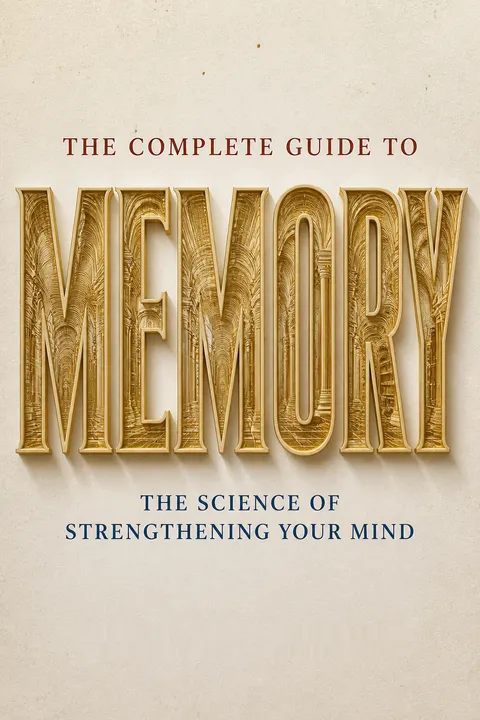


Key Takeaways
Improve memory by improving attention, not fearing every lapse
Attention comes first. A person who forgets where they parked may simply have been thinking about shopping rather than the parking space. Without attention, the memory was never properly encoded. By contrast, forgetting how one arrived at a destination is a more serious change. The book urges readers to judge lapses by their context and by how much a person’s abilities have changed, not by one mistake alone.
Three steps matter. Memory involves encoding information, storing it, and retrieving it. A forgotten name may reflect inattention during introduction, or difficulty accessing a name that was learned. Names are especially hard because a person’s face does not inherently explain what they are called. Emotion, interest, and vivid associations help make information memorable.
What's striking is how often people mistake an attention failure for a storage failure. That distinction can reduce needless anxiety and suggest a practical first response: notice what was happening when the information arrived. It also has limits. A single example cannot diagnose cognitive health, and changes in everyday functioning deserve professional evaluation when they persist or worsen. The book's reassurance that strong memory nearly rules out dementia is much stronger than the evidence presented here can establish. Memory exercises can be worthwhile without becoming a test of whether disease is present.
Turn facts into vivid scenes and familiar places
Build a mental route. The method of loci, an old mnemonic technique, links information to a sequence of familiar places. To remember a list, imagine each item at a distinct location on a route through a home or neighborhood, then mentally walk the route to retrieve the items. The images work best when they are vivid, unusual, and easy to distinguish. Simonides, an ancient Greek poet, is said to have identified victims after a banquet hall collapsed by recalling where each guest had been seated. The story illustrates the basic combination of images and ordered locations.
Make the method yours. A grocery list could become a milk-filled house, bread stacked in a library, or a watermelon inside a coffee cup. Familiar places provide reliable retrieval cues, while bizarre scenes attract attention. Start with a handful of locations and reuse the route only after the previous list has faded.
The method of loci turns memory into a problem of navigation. Its strength is not magic imagery but the use of an already practiced spatial map to organize otherwise disconnected information. That makes it useful for lists, speeches, or ordered facts, especially when a person can picture the locations clearly. It is less suited to every kind of learning: a route can help recall terms without ensuring their meaning is understood. Pairing the scene with an explanation or use case helps prevent a memorable image from becoming an empty label.
Give information meaning before asking your brain to retain it
Create more than one path. The book recommends combining words with images, sounds, sensations, and associations. This is multi-coding: representing information through more than one sensory or verbal route. An abstract word can be easier to remember when tied to a concrete picture or a familiar idea. Organization matters too. A long string of digits becomes manageable when grouped as phone numbers, a process called chunking. The groupings give otherwise random material a structure the brain can work with.
Practice adds elaboration. Psychologist K. Anders Ericsson described a runner who learned to connect number strings to race times. With extensive practice, the runner recalled as many as eighty digits by turning them into meaningful chunks. This is very different from repeating meaningless syllables by rote, the method Hermann Ebbinghaus used in early memory experiments. The more useful question is not how many times information is repeated, but what meaningful pattern can be built around it.
Meaningful encoding is a powerful bridge between memory and understanding. Connecting a new idea to prior knowledge gives retrieval several routes, while chunking reduces the number of separate elements that must be held at once. The runner's remarkable digit score also shows a key boundary: expertise often reflects a highly practiced strategy in a specific domain, not a sudden, universal increase in intelligence. The practical lesson is to borrow the strategy, not expect the record. Memory aids work best when they make information easier to explain as well as easier to recall.
Test yourself repeatedly, then let sleep strengthen what you learned
Retrieval beats passive review. Ebbinghaus found that forgetting is fastest soon after learning and then slows. The book's answer is to return to material and try to recall it, rather than simply reread it. In one study described in the book, students learning Swahili-English word pairs recalled about 80 percent when they kept testing themselves, compared with about 35 percent when they stopped testing each pair as soon as they got it right.
Give learning time to settle. Sleep helps consolidate new memories, and a daytime nap can help too. In one experiment, participants who napped after learning word pairs recalled 21 percent more than those who watched a documentary. Recalling information in a setting or state similar to the one in which it was learned may also help. The practical sequence is simple: learn, pause, retrieve, and revisit.
Self-testing makes learning effortful in a productive way: it reveals what can actually be retrieved, rather than what merely looks familiar on a page. The Swahili example makes that distinction vivid. Sleep adds another layer by supporting memory consolidation, although nap length and timing can affect how refreshed someone feels. These findings support deliberate study routines, not the idea that a particular nap guarantees retention. A useful practice is to space retrieval attempts and treat errors as information about what still needs work.
Build working memory by manipulating information, not merely repeating it
Keep information online. Working memory is the mental workspace used to hold and manipulate information for immediate tasks. It helps with mental arithmetic, following multi-step directions, and keeping a conversation or plan in mind after an interruption. The book describes capacity as limited, often around three or four items at once. In a simple exercise, a person remembers a string of numbers and rearranges them from lowest to highest, then from highest to lowest. Reordering requires more than passive recall.
Practice purposeful juggling. Card-based N-back exercises make this challenge explicit: after turning over cards one by one, identify the card that appeared two turns before a designated card. Planning a day of classes, errands, and an evening appointment also depends on holding goals, times, and locations together. The frontal lobes help manage this mental juggling. Brain injury to those areas can impair planning and sequencing even when basic memory tests appear normal.
Working memory explains why a person can know many facts yet struggle to combine them in real time. It is central to reading, calculation, and planning because each depends on keeping earlier information available while processing something new. Practice with manipulation tasks may sharpen performance on those tasks, but broad transfer to general intelligence should not be assumed from a single exercise. The most immediate benefit may be better awareness of cognitive load. Breaking a complex plan into visible steps can support working memory rather than asking it to carry everything at once.
Protect automatic skills from conscious interference and routine changes
Skills become automatic. Procedural memory stores how to perform practiced actions, such as driving or playing an instrument. It operates differently from memories that can be described in words. Once a skill is automatic, excessive self-monitoring can disrupt it. The book uses gymnast Simone Biles's experience of the twisties, a frightening loss of orientation during a practiced aerial move, to show how pressure and conscious control can interfere with skilled performance.
Routines can misfire. A bus driver accustomed to a single-decker route once took a familiar shortcut while driving a double-decker, with dangerous consequences. The book also describes a caregiver who, after a change in routine, forgot that a child was in the car. The lesson is not that habits are inherently unsafe, but that unusual circumstances can let a well-practiced routine override a new intention. Changes to a familiar sequence deserve deliberate checks.
Automaticity is an efficiency tool: it frees attention from the mechanics of a familiar task. Under pressure, however, monitoring every component can interfere with fluent performance. The same reliance on habit becomes risky when the environment changes, because the routine may still run even when the goal has changed. This distinction has broad relevance in safety-critical work, from transport to health care. A reliable safeguard is to make deviations visible, using a deliberate check at the point where an old routine and a new plan diverge.
Treat vivid memories as reconstructions, not recordings
Recall reshapes the past. Psychologist Frederic Bartlett found that people shortened and altered a story as they retold it, replacing unfamiliar details with more familiar ones. He called the knowledge structures that guide such interpretation schemas. They help people understand everyday routines, but they can also fill gaps with assumptions. Jean Piaget, for example, remembered a dramatic childhood kidnapping attempt that he later learned his family nanny had invented. Repeated retelling had made the story feel like a personal memory.
Words can alter recollection. Researcher Elizabeth Loftus showed that the wording of a question can affect what witnesses later report. In an example from the book, describing a car collision with a stronger verb led witnesses to estimate higher speeds and become more likely to recall broken glass that was not present. Vividness and confidence are not proof that a memory is accurate. New information can become woven into an old recollection.
The reconstructive view explains both memory's usefulness and its vulnerability. A system that rebuilds a past event from partial traces can generalize, infer, and adapt, rather than simply replaying a fixed recording. But that flexibility creates serious risks in interviews, family disputes, and legal testimony. The best response is not blanket distrust of memory; it is careful handling of how recollections are elicited. Open questions, independent records, and clear separation between what was experienced and what was learned afterward can reduce contamination.
Let forgetting prune clutter, but monitor what emotion keeps replaying
Forgetting has a function. The book presents memory as a balance between retaining useful information and allowing old details to fade. A man described by neurologist Aleksander Luria could recall lists even many years later, but his extraordinary memory overwhelmed ordinary conversation with irrelevant detail and made daily life harder. Forgetting helps the mind adapt instead of preserving every input equally.
Emotion changes what lasts. Strong emotional experiences are more likely to be remembered, and distressing memories can persist in painful ways. The book describes Troy, a train operator who developed post-traumatic stress after a passenger died on the tracks. He experienced intrusive images, poor sleep, avoidance, and heightened startle responses. Mood can also shape which memories come to mind. A low mood may draw attention toward painful past events, making them seem more dominant than they are.
This section resists the simplistic idea that more memory is always better. Luria's case shows that recall without effective filtering can become noise, while traumatic persistence shows that emotional intensity can make some memories difficult to set aside. These are not equivalent experiences: ordinary forgetting is adaptive, whereas severe intrusive recollection can be debilitating and may require clinical care. The distinction matters because a memory strategy should not aim for total recall. It should help people retain what serves their goals while recognizing when emotional memories are interfering with life.
Use memory to connect your past self with future plans
Memory supports identity. Episodic memory is recollection of personally experienced events; semantic memory is general knowledge. Together with language and reflection, memories help people connect past experience to a continuing sense of self. The book describes Clive Wearing, a musician whose brain infection left him unable to form new episodic memories or retrieve much of his past, while his procedural musical skills remained. He could still play, but each new encounter quickly vanished from awareness.
The future uses the same machinery. The book argues that imagining a future scene draws on pieces of remembered experience. That capacity lets people plan and picture possible outcomes. The case of another brain-injured patient, K. C., who struggled both to recall personal events and to imagine future ones, supports a close link between remembering and mental simulation. Memory is therefore not only an archive of what happened; it helps a person construct what might happen next.
The link between autobiographical memory and future imagination offers a useful account of planning: people recombine past experiences to preview possible actions and consequences. It also explains why serious memory loss can unsettle identity, not merely factual knowledge. Still, identity is not held by memory alone. Relationships, habits, values, and the responses of other people also help sustain a sense of self. This broader view matters because it avoids reducing a person to their recall score, especially when illness or injury changes what they can remember.
Guard shared history against convenient images and present-day rewriting
Collective memory shifts. Groups remember public events through personal experience, later interpretation, and stories passed between generations. The book notes a poll in which 55 percent of Americans in 2002 said the country changed for the better after September 11, while a later poll found 46 percent saying the change was for the worse and 33 percent saying it was for the better. Collective judgments can change as consequences become clearer and political narratives shift.
Technology can mislead as well as preserve. Photos, recordings, and surveillance footage may support memory, but they are not the same as an unfiltered record of what happened. Images can be edited, stripped of context, or used to make a false account seem certain. Memory laws, which prescribe an official interpretation of history, can also push competing accounts aside. The book's advice is to question who created a record, how it was framed, and what it leaves out.
Shared memory is a civic resource because it helps groups explain what happened and decide what should follow. It is also vulnerable to power: institutions can privilege some accounts, suppress others, or turn a complex event into a simple story. Digital records add evidence, but their apparent precision can invite overconfidence. The more responsible approach combines documentation with provenance and context, while preserving room for disagreement. Revising a public interpretation is not automatically distortion; it can reflect new evidence or a fuller account of whose experiences were previously excluded.
Support memory with sleep, movement, and skepticism about miracle pills
Start with basic supports. The book presents sleep, exercise, and a balanced diet as more dependable supports for memory than memory-enhancing drugs. A study it cites found that people who napped after learning word pairs recalled 21 percent more than those who watched a documentary. It also describes research linking physical activity, including ordinary movement such as walking and housework, with better cognitive outcomes in older adults.
Treat nutrition claims carefully. The book notes research associating two to three cups each of coffee and tea daily with a lower dementia risk, while also acknowledging that no specific diet has been shown to guarantee protection. It describes possible benefits from dark chocolate and Mediterranean-style eating, but these findings should not be mistaken for cures. Stimulant drugs may briefly affect learning, yet bring risks and do not promise durable memory. No pill replaces attention, practice, and rest.
The practical strength of this advice is its emphasis on habits with broad health value, rather than a single supposedly potent supplement. Sleep supports learning, and movement can improve overall health in ways that may benefit cognition. Observational links between diets or beverages and dementia risk, however, do not prove that a particular food prevents memory decline. The book is right to distinguish a supportive lifestyle from a cure. Readers should treat dramatic claims about memory products with caution and seek medical guidance before using drugs or supplements for cognitive enhancement.
Analysis
Restak's central argument is that memory is not a fixed storehouse but a trainable activity shaped by attention, association, emotion, retrieval, and the brain systems that support them. The book makes that argument concrete through a productive mix of clinical cases, historical memory techniques, laboratory findings, and exercises readers can try. Its most useful practical message is unusually coherent: notice information when it arrives, give it meaning, create retrieval cues, and practice bringing it back. The method of loci, chunking, and self-testing translate that message into action rather than leaving it as a neuroscience slogan.
The book also insists on memory's double nature. Remembering gives continuity to identity and supports imagining future choices, but reconstruction makes recollection vulnerable to bias, suggestion, and political framing. That tension is the strongest conceptual thread linking the personal and civic chapters. A memory can be vivid without being accurate, and a digital record can look definitive while hiding the conditions under which it was produced.
Some of the book's claims need more restraint than its confident voice provides. The claim that highly tuned memory virtually rules out dementia is not established by the examples presented, and improvement on a trained memory task should not be taken as proof of broad cognitive enhancement. Nutrition and caffeine findings are associations, not guarantees. The most defensible conclusion is narrower and still valuable: deliberate practice can improve particular memory skills, while sleep, movement, and focused attention support the conditions for learning. This adaptation treats the book as a guide to better remembering, not as a diagnostic tool or promise of disease prevention.
Review Summary
The Complete Guide to Memory receives mostly positive reviews, with readers praising its comprehensive coverage of memory science, practical exercises, and engaging anecdotes. Many find it accessible and informative, appreciating the author's expertise and the book's balance of scientific research and practical advice. Some reviewers note its relevance for aging populations and those concerned about cognitive decline. Criticisms include occasional digressions, dense technical sections, and a lack of novel information for some readers. Overall, it's considered a valuable resource for understanding and improving memory.
People Also Read

Glossary
Method of loci
Place-based memory techniqueA mnemonic technique that stores information by associating each item with a familiar location in a sequence, such as rooms in a home or places along a regular route. To retrieve the information, the learner mentally revisits those locations. Distinctive images placed at each location can make otherwise disconnected material easier to recall.
Chunking
Grouping information meaningfullyA way of organizing separate pieces of information into larger, meaningful units. Instead of trying to hold a long string of digits one by one, a learner might group them as phone numbers or connect them to familiar patterns. Chunking makes material easier to handle in immediate memory, although the usefulness of a chunk depends on what the learner already knows.
Working memory
Mental workspace for manipulationA limited-capacity mental workspace that keeps information available while a person uses or rearranges it. It supports tasks such as mental arithmetic, following instructions, planning, and understanding a long passage. Unlike simply repeating a short sequence, working memory requires maintaining information while attention shifts or the material is manipulated.
Episodic memory
Memory for personal eventsMemory for events a person has experienced, including details of when and where they occurred. Recalling a particular graduation or family meal is episodic memory. It differs from general knowledge because it refers to a personal event rather than a fact whose original learning moment may no longer be remembered.
Semantic memory
General knowledge storeMemory for facts, concepts, and general knowledge, such as knowing the name of a country's capital. The person may know the information without recalling when or where it was learned. Repeated learning and association can move information from a specific learning episode into this broader store of knowledge.
Procedural memory
Memory for practiced skillsMemory for how to perform learned actions, such as riding a bicycle, driving a familiar route, or playing an instrument. With practice, these skills can be carried out with little conscious attention and may be difficult to explain in words. The book distinguishes this action-based memory from facts and personal events that can be consciously described.
Zeigarnik effect
Unfinished tasks stay accessibleA finding associated with psychologist Bluma Zeigarnik: people may remember interrupted or unfinished tasks more readily than tasks they have completed. The book uses the example of a waitress who could retain food orders while customers were still eating but forgot them after the meal was paid for. The effect concerns how task completion can change what remains mentally active.
State-Dependent Memory
Context-linked retrieval advantageThe tendency for recall to improve when conditions during retrieval resemble conditions present during learning. The relevant context can include surroundings, mood, or bodily state. The book illustrates this with experiments in which people recalled more when tested in the same setting or position in which they had studied.
Memory morphing
Memory altered by later informationA process in which a recollection changes as it is recalled and combined with new information, suggestion, or interpretation. The book describes how leading questions or a later account can alter a person's memory of an event. Memory morphing helps explain why confidence and vivid detail do not, by themselves, establish that a recollection is accurate.
Hyperphantasia and hypophantasia
Vivid or faint mental imageryHyperphantasia refers to unusually vivid mental images, while hypophantasia refers to a reduced ability to form them. The book presents both as ends of a range in people's capacity for visual imagery, rather than automatically as disorders. Because many mnemonic techniques rely on imagery, these differences can affect ease of use, though practice may help develop visualization.
FAQ
1. What is "Complete Guide to Memory: The Science of Strengthening Your Mind" by Richard Restak about?
- Comprehensive exploration of memory: The book delves into the science, history, and practical techniques for understanding and improving human memory.
- Blend of neuroscience and practical advice: Restak combines the latest findings in brain science with time-tested memory strategies, making the subject accessible and actionable.
- Addresses memory concerns: It discusses common worries about memory loss, especially as people age, and differentiates between normal forgetfulness and signs of serious problems.
- Focus on enhancement and protection: The book aims to help readers develop a "superpower memory" to enhance cognitive abilities and potentially protect against conditions like Alzheimer’s.
2. Why should I read "Complete Guide to Memory" by Richard Restak?
- Improve everyday memory: The book offers practical tools and exercises to boost memory for daily tasks, names, numbers, and more.
- Understand memory’s role in identity: Restak explains how memory forms the foundation of personal identity and consciousness.
- Reduce anxiety about forgetfulness: By distinguishing normal memory lapses from pathological ones, the book helps alleviate unnecessary fears.
- Protect brain health: The author provides evidence-based strategies that may help maintain cognitive function and reduce dementia risk.
3. What are the key takeaways from "Complete Guide to Memory" by Richard Restak?
- Memory is trainable: With the right techniques, anyone can significantly improve their memory, regardless of age.
- Attention and emotion are crucial: Focused attention and emotional engagement are essential for encoding and retaining memories.
- Memory is fallible and reconstructive: Memories can be distorted, forgotten, or even fabricated, highlighting the importance of critical thinking.
- Lifestyle matters: Sleep, diet, exercise, and mental habits all play significant roles in memory performance and brain health.
4. How does Richard Restak define and categorize different types of memory in "Complete Guide to Memory"?
- Episodic, semantic, procedural: Restak distinguishes between episodic (personal experiences), semantic (general knowledge), and procedural (skills and habits) memory.
- Working memory as "queen": Working memory is highlighted as the most important for intelligence and daily functioning, acting as a mental workspace.
- Sensory memory: Brief, transient memories from sensory input (visual, auditory, etc.) are the first stage of memory processing.
- Implicit vs. explicit memory: The book explains the difference between memories we consciously recall (explicit) and those that influence us unconsciously (implicit).
5. What are the most effective memory improvement techniques recommended in "Complete Guide to Memory"?
- Method of loci (memory palace): Visualizing information placed in familiar locations to aid recall, a technique dating back to ancient Greece.
- Chunking and association: Grouping information into meaningful units and linking new data to existing knowledge enhances retention.
- Multi-coding and imagery: Engaging multiple senses and creating vivid mental images make memories more durable.
- Repetition and self-testing: Regularly retrieving information and testing oneself strengthens long-term memory more than passive review.
6. How does "Complete Guide to Memory" by Richard Restak address common memory worries and distinguish normal from abnormal memory lapses?
- Normal vs. concerning lapses: The book provides scenarios and checklists to help readers differentiate between everyday forgetfulness and signs of serious impairment.
- Role of attention and interest: Many memory lapses are due to lack of attention or interest, not brain disease.
- Context matters: Memory complaints must be evaluated in the context of the individual’s life, stress levels, and routines.
- When to seek help: Persistent, severe, or rapidly worsening memory problems, especially those affecting daily life, may warrant medical evaluation.
7. What is the historical evolution of memory techniques as described in "Complete Guide to Memory"?
- Ancient roots: Techniques like the method of loci originated with Greek and Roman thinkers such as Simonides and Cicero.
- Medieval and Renaissance developments: Memory theaters and elaborate visualization systems were developed by figures like Giulio Camillo and Giordano Bruno.
- Scientific study: The 19th-century work of Hermann Ebbinghaus introduced experimental methods and concepts like the forgetting curve.
- Modern neuroscience: Advances in brain imaging and cognitive psychology have deepened understanding of memory’s biological basis and practical applications.
8. How does "Complete Guide to Memory" explain the relationship between memory, identity, and consciousness?
- Memory as identity’s foundation: Restak argues that memory is central to personal identity; losing memory can mean losing one’s sense of self.
- Developmental perspective: The book explains how memory and identity co-develop in childhood and unravel together in conditions like Alzheimer’s.
- Consciousness and working memory: Working memory is described as the seat of conscious experience, linking past, present, and future.
- Memory’s role in self-reflection: The ability to recall and analyze past experiences is key to self-awareness and personal growth.
9. What are the main threats to memory identified in "Complete Guide to Memory" by Richard Restak?
- Seven "sins" of memory: Absent-mindedness, transience, blocking, misattribution, suggestibility, bias, and persistence (as described by Daniel Schachter).
- Technological distortion: Overreliance on digital devices can weaken natural memory abilities.
- Distraction and multitasking: Modern life’s constant interruptions undermine attention and memory formation.
- Depression and mood: Negative emotions and depression can impair memory encoding and retrieval.
10. How does "Complete Guide to Memory" address the fallibility and distortion of memory, including false memories and collective memory?
- Memory is reconstructive: Memories are not perfect recordings but are rebuilt each time they are recalled, making them susceptible to errors.
- Influence of suggestion and bias: External information, leading questions, and personal beliefs can alter or create false memories.
- Collective and historical memory: Societal narratives, media, and technology shape how groups remember events, sometimes leading to "memory wars" and "memory laws."
- Practical implications: The book warns of the dangers of misinformation, both personally and collectively, and encourages critical evaluation of memories.
11. What lifestyle and accessory aids for better memory does Richard Restak recommend in "Complete Guide to Memory"?
- Sleep and naps: Adequate sleep and even short naps significantly enhance memory consolidation.
- Diet and exercise: Mediterranean and MIND diets, along with regular physical activity, support brain health and memory.
- Moderation with substances: Coffee and tea may be beneficial, but alcohol should be limited or avoided, especially in older age.
- Use of technology: While digital tools can aid memory, they should supplement—not replace—active memory training and attention.
12. What are the best quotes from "Complete Guide to Memory" by Richard Restak and what do they mean?
- "Memory is the key to brain enhancement." – Emphasizes that improving memory boosts overall cognitive abilities.
- "The art of memory is the art of attention." (Samuel Johnson, quoted) – Highlights the foundational role of focused attention in forming memories.
- "Memory is not only crucial to identity, but forms the basis for conscious experience." – Suggests that memory underpins both who we are and our awareness of the world.
- "Let the brain be the brain." – Advises trusting well-learned skills and not overthinking, especially in high-pressure situations.
- "Who controls the past controls the future: who controls the present controls the past." (George Orwell, quoted) – Warns of the power and danger of manipulating collective memory for social or political ends.
About the Author
Download PDF
Download EPUB
.epub digital book format is ideal for reading ebooks on phones, tablets, and e-readers.








