


Key Takeaways
You are the common denominator in every failed relationship you've had
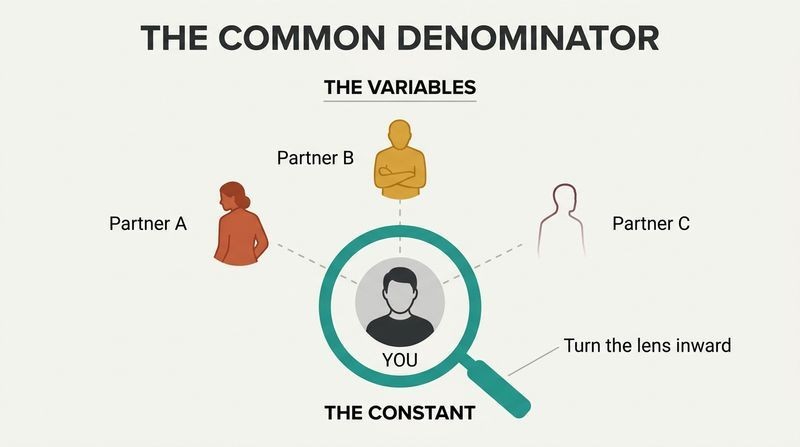
Natalie Lue spent years blaming bad luck for a string of hot-and-cold men, emotionally distant partners, and an 18-month affair that left her having a panic attack in a London Tube doorway while the man escorted her home to his girlfriend. Her turning point came at 28 when she admitted the uncomfortable truth: she was the only recurring character in the soap opera of her love life. If a pattern exists across your relationships, you created it.
The focus shift is the whole game. People land on her site Baggage Reclaim hoping for a trick to win the unavailable man over. The real solution is turning the lens away from him and back onto yourself, your boundaries, and your self-worth. His problems existed before you and will outlast you.
This mirrors the therapeutic principle behind cognitive behavioral work: you cannot control others, only your responses and choices. What's striking is Lue's refusal to let readers wallow in victimhood while also insisting the man's behavior isn't their fault. That distinction (not responsible for his actions, but accountable for staying) is subtle and psychologically sound. It echoes locus-of-control research: people who attribute outcomes to modifiable internal factors recover faster than those who blame fate. The risk is that self-blame masquerades as accountability, which Lue explicitly guards against.
Unavailable doesn't mean absent; it means limited availability dressed as promise

Most people assume an unavailable man simply vanishes or states he isn't interested. Lue's core reframe: unavailability is emotional distance hidden behind walls, where feelings are experienced in short bursts rather than consistently, to avoid the vulnerability of truly caring. Mr Unavailable takes the fringe benefits of a relationship (sex, an ego stroke, a shoulder) without committing to you, to action, or to his own emotions.
Two flavors exist. Temporary unavailability follows trauma like a breakup or bereavement and lifts within roughly two years for emotionally healthy people. Habitual unavailability is a lifelong emotional style, often learned in childhood, that feels like second nature. Both make a healthy, mutually fulfilling relationship impossible until addressed by the person themselves.
Lue's model overlaps neatly with attachment theory, specifically the dismissive-avoidant style, where intimacy triggers deactivation of the attachment system. Her insight that hurt is never fully felt because the avoidant person was never truly in it aligns with research showing avoidants suppress rather than process grief. One nuance worth adding: availability exists on a spectrum and context matters. A person available with one partner may be avoidant with another, suggesting the dynamic is co-created, not purely a fixed trait, which Lue herself argues in the Fallback Girl concept.
If you chase someone who won't commit, you have commitment issues too

The book's most confronting claim: women drawn to Mr Unavailable are themselves emotionally unavailable and commitment-resistant, sneaking their own issues in behind his more obvious ones. Lue calls this partner the Fallback Girl, the woman a man habitually defaults to for his needs while selling her short. You wouldn't tolerate crumbs if you were genuinely available; you'd have folded long ago.
Wanting to commit to someone who resists commitment is not commitment. Lue illustrates with a man who told his ex-wife on her deathbed he wanted to marry her, knowing she'd die the next day. Choosing to commit precisely when commitment is impossible is a way of avoiding it. Every unavailable relationship has a driver (him) and a passenger (you) dodging responsibility.
This is the book's boldest and most contested move. Critics might argue it risks blaming women for men's poor behavior. Lue's defense is structural: she distinguishes enabling from causing. The claim resonates with systems theory in family therapy, where dysfunction is maintained by both parties' complementary roles. It also echoes the concept of covert contracts from men's psychology literature. The steelman: choosing perpetually unavailable partners is itself a commitment-avoidance strategy, letting you appear to want love while guaranteeing you never risk the vulnerability of the real thing.
Hot and cold isn't passion; it's a thermostat set to control you
Mr Unavailable runs alternately hot and cold to keep the relationship at his comfort zone, roughly a 5 out of 10. Blow hot and he wins your confidence and creates expectations he won't meet. Blow cold and he manages down those expectations so you stop wanting more than he'll give. Push above 5 and he retreats; threaten to leave and he sprints back with charm. Over time you acclimatize, giving him the same or more effort for less.
The Reset Button is his signature move. He disappears, reappears, and expects to pick up exactly where he chose to leave off, erasing any wrongdoing. He avoids dwelling on his behavior because reflection would force accountability. Never let a hot-and-cold cycle pass unquestioned; second chances are the limit.
This maps precisely onto operant conditioning's most powerful schedule: intermittent variable reinforcement, the same mechanism that makes slot machines addictive. Unpredictable rewards produce more persistent behavior than consistent ones. Lue intuitively describes what behavioral psychologists have measured for decades. Her thermostat metaphor is more accessible than academic jargon. Worth noting: neuroscience shows dopamine spikes on anticipation of uncertain reward, not the reward itself, which explains why the chase feels more intoxicating than the actual connection. The cure Lue prescribes, refusing to chase, effectively extinguishes the reinforcement loop.
Watch what he does, not what he says; Future Fakers weaponize your hope
Mr Unavailable's actions and words routinely contradict. He avoids confrontation, fears hurting you with honesty, and doesn't want to endanger his supply of sex or attention, so he says whatever fits the moment. Lue coins Future Faking: giving impressions of a shared future (marriage, babies, moving in) to get what he wants in the present, then vanishing or morphing into someone else.
Two types of fakers exist. The intentional confidence trickster says the right things to extract benefits. The careless one means it in the moment but panics when delivery looms, then engineers a fight to escape. Both produce a future that never materializes. Fast Forwarding is a turbocharged version: sweeping you up in manufactured intensity so you skip the due diligence of actually getting to know him.
The actions-over-words principle is ancient (Maya Angelou's when people show you who they are, believe them), but Lue operationalizes it with vivid coinages. Future Faking has since entered popular relationship vocabulary, a testament to its explanatory power. The concept connects to behavioral economics' distinction between cheap talk and costly signals: promises cost nothing, whereas consistent action over time is a costly, credible signal. One caveat: not all who fail to deliver are manipulators. Life genuinely intervenes. Lue's threshold (a pattern of unmet promises rather than isolated slips) is the sensible discriminator.
Crumbs never become loaves; stop celebrating a limited man's limited effort
Mr Unavailable deals in what Lue calls crumb rations of commitment, then inflates them into loaves. He may believe he's operating at 100%, but his capacity is limited, so his best still produces contradiction and stalled progress. When you overvalue these scraps, you turn a limited contribution into what looks like full effort, and you settle. Celebrating his bare-minimum gestures is like championing mediocrity.
The hunger is the signal. If you feel perpetually hungry in the relationship, it lacks substance. Lue's rule of thumb: if you've broken up more than twice, commitment issues are present. When he says he wants to commit but it never materializes, he doesn't want it enough. A crumb is a crumb; take off the rose-tinted magnifying glasses and demand the whole loaf.
The loaf-and-crumbs metaphor is Lue's most memorable device, and it captures a real cognitive distortion: hedonic contrast. When expectations are managed down, small gestures feel disproportionately large, a phenomenon documented in research on relative deprivation and anchoring. Abusers and manipulators exploit this by intermittently offering minimal kindness against a baseline of neglect. There's also a sunk-cost dimension: the more you've invested, the more you inflate the value of small returns to justify staying. Lue's prescription, recalibrating to what a healthy relationship actually offers, is essentially resetting a corrupted reference point.
His sob story is a heads-up, not a bonding moment to fix
Mr Unavailable breaks out excuses and tales of woe, what Lue nicknames This One Time at Band Camp stories, usually a tragic ex who supposedly broke him. Women, conditioned to treasure rare male displays of emotion, interpret tears and sharing as intimacy and proof they're special. In reality he may have told the story a hundred times, is emotionally distanced from it, and uses it to secure hassle-free sex, sympathy, and a pre-built excuse for future letdowns.
Crocodile tears manipulate. He weeps when you try to leave, goes cold once you stay. He cries about missing you, then turns up sleeping with someone else. Genuine emotion doesn't come with a predetermined expectation of how you should respond. When someone uses their wounds as reasons they can't meet your needs, they're announcing their unavailability.
Lue reframes vulnerability-signaling as a strategic tool, which is provocative given how much popular advice urges women to reward male emotional openness. The nuance she adds is crucial: emotional expression and emotional availability are not the same. Someone can perform vulnerability while remaining fundamentally closed. This connects to research on dark-triad manipulation, where feigned distress elicits caretaking. Her band-camp label deflates the drama with humor, a rhetorical strategy that helps readers detach. The constructive tension: some wounded people genuinely heal in relationships, so the discriminator is whether he's actively working on his issues or merely narrating them for sympathy.
You keep leaving the door ajar; operate a closed-door policy instead
Mr Unavailable maintains a foothold in your life via the Friend Card, social-media poking, and requests for sex or favors, all to keep you as an option should he change his mind. But Lue insists the power lies with you, not him. He can only dip in and out for fifty years if you let him. If you leave the door even a crack open, he reads it as fully open.
No Contact is the cure. Lue's technique means cutting all communication until you're genuinely over him: no calls, texts, social stalking, or sex, and no gathering intel through mutual friends. Don't break it because you're lonely, drunk, or nostalgic. Friends don't badger you into friendship or try to sleep with you. Only people undeserving of your friendship have to guilt you into it.
No Contact has become a cornerstone of modern breakup advice, and its logic is sound: continued contact prevents extinction of the attachment response and repeatedly reactivates craving, much like a smoker who keeps one cigarette in the drawer. Neuroscience of romantic rejection (Fisher's fMRI studies) shows the brain treats it like withdrawal from an addictive substance, so abstinence, not tapering through friendship, is the reliable path. Lue's insistence that the power sits with the person leaving is empowering and accurate. The one nuance: for co-parents or colleagues, absolute No Contact is impossible, which she addresses with the Get Out Plan's graduated withdrawal.
Trace your pattern to a parent, usually the emotionally absent father
Lue argues that a habit of chasing unavailable men almost always traces to unresolved issues with one or both parents, especially the first man in your life. She calls it Daddy Hunting: unconsciously recreating the dynamic you had with an emotionally distant, absent, abusive, or inconsistent father in a doomed attempt to finally win the love and validation you missed. Her own first heartbreak was her father visiting her once during a four-week hospital stay at age five, then never returning as promised.
The math of dysfunction. You take an already imperfect father, mentally add a halo of unconditional love and commitment he never provided, then search for that impossible composite. Mothers pass down damage too, through criticism, abandonment, or fearful maxims like any man is better than no man. Understanding the origin isn't about blame; it's the starting point for breaking the cycle.
This is classic psychodynamic theory, the repetition compulsion Freud described, where people unconsciously recreate unresolved childhood dynamics seeking mastery. Modern attachment research supports it: early caregiver relationships form internal working models that shape adult partner selection. Lue's father-daughter emphasis aligns with studies linking paternal absence to relationship difficulties. The strength here is accessibility; she makes depth psychology usable. The limitation is determinism. Not everyone with a distant father becomes a Fallback Girl, and epigenetic and temperamental factors matter too. Lue wisely frames insight as a springboard for action rather than an excuse, avoiding the trap of endless archaeology without change.
Drama isn't love; you may be addicted to Relationship Crack
Fallback Girls learn to equate sparks, highs, and lows with genuine passion, so a kind, consistent available man reads as boring, when what he actually lacks is the negativity you're hooked on. Lue names this Relationship Crack: getting high on the bad stuff, crashing, then returning for more. The hot-and-cold cycle feeds it because uncertainty and anxiety masquerade as excitement and love.
Fear powers every trigger. Boredom, loneliness, feeling abandoned or neglected all set off drama-seeking. The key discipline is distinguishing internal fear (your own insecurity projecting) from external fear (his behavior actually warranting alarm). The short-term drama hit always yields a longer low; if you react at a 4 and spike to an 8, you crash back to a 2 and must climb further. Ride it out instead. Good things don't feel bad.
The addiction framing is more than metaphor. Intermittent reinforcement, cortisol-adrenaline arousal misattributed as attraction (the misattribution-of-arousal effect, famously shown in Dutton and Aron's shaky-bridge study), and dopamine-driven anticipation together create a genuinely compulsive loop. Lue's internal-versus-external fear distinction is a sophisticated piece of emotional regulation, essentially cognitive defusion from ACT therapy: observing whether the alarm is coming from your history or from present reality. Her good things don't feel bad heuristic is elegant, though it needs a caveat she provides: growth and vulnerability can feel uncomfortable too, so the signal is distress plus objective red flags, not mere discomfort.
You cannot date healthily until you're available; if not, stop dating
The book's ultimate prescription flips the reader's original question. Instead of where do I find an available man, the answer is become available yourself, because you attract and recognize what you already are. Being available means feeling your emotions consistently rather than in bursts, having fears without being ruled by them, embracing vulnerability, keeping boundaries, and refusing to rely on drama or the threat of loss to generate desire.
Concrete rehab steps. Lue prescribes defining your boundaries (list at least 5 to 10 non-negotiables), treating dating as a discovery phase rather than assumed commitment, delaying sex if you struggle with its emotional fallout, asking direct questions (never pass three dates without confirming he's single), and getting a full, balanced life so no one man can leave a crater. If you can't date with self-esteem intact, pause dating until you can.
This is where Lue transcends breakup advice and becomes a self-worth manifesto. The like-attracts-like premise isn't mystical; it's assortative mating plus perceptual filtering. People unconsciously select partners matching their attachment style and tolerate treatment consistent with their self-concept. Her boundaries-as-self-protection framing aligns with DBT's interpersonal effectiveness skills. The discovery-phase reframe of dating counters the modern tendency to fast-forward intimacy. The one demanding truth here is patience: rewiring attachment patterns takes sustained work, not a single epiphany, which Lue honestly acknowledges when she says you must exceed the years spent unavailable with genuine effort at being available before claiming you've tried.
Analysis
Mr Unavailable and the Fallback Girl is a memoir-driven self-help book born from Natalie Lue's blog Baggage Reclaim, aimed primarily at women who repeatedly choose emotionally distant, non-committing men. Its structure is anthology-like: it catalogues the behaviors of Mr Unavailable, then mirrors each with the complicit patterns of the Fallback Girl, then excavates root causes, then offers a recovery toolkit.
The book's genuine innovation is its refusal to let the reader stay in victim posture. Where much breakup literature diagnoses the man, Lue diagnoses the dynamic, insisting the reader is the common denominator and, crucially, is herself unavailable. This is intellectually braver and more useful than partner-blaming, and it aligns with systems theory, attachment research, and cognitive behavioral principles even though Lue writes without academic apparatus. Her coinages (Future Faking, Fast Forwarding, the Reset Button, crumbs versus loaves, Relationship Crack) are sticky precisely because they name experiences readers recognize but couldn't articulate. Several have entered mainstream relationship vocabulary, a rare achievement for a self-published author.
The book's underlying engine, whether Lue names it or not, is intermittent variable reinforcement, the same mechanism behind gambling addiction. Her behavioral prescriptions (No Contact, refusing to chase, one strike and out) are effectively extinction protocols.
The limitations are worth flagging. The framing is heteronormative and gendered, though Lue notes men experience these patterns too. The near-total attribution of adult patterns to parental wounds risks determinism and can shade into just-so storytelling. And the claim that all Fallback Girls are unavailable, while provocative and largely defensible, could induce unwarranted self-blame in women who simply encountered a skilled manipulator once.
Still, the core value holds: stop researching him, redirect that forensic energy onto your own beliefs, boundaries, and self-worth, and understand that crumbs never become loaves. It is durable, actionable, humane advice.
Review Summary
Mr Unavailable and the Fallback Girl receives mostly positive reviews, with readers praising its life-changing insights and honest approach to relationships. Many found it empowering and eye-opening, helping them understand unhealthy patterns and set boundaries. Some critics felt it was repetitive or lacked depth, while others found its direct style confronting. The book resonated particularly with women seeking to improve their dating experiences and self-esteem. Despite occasional criticism of grammar and organization, most readers highly recommend it for its practical advice and no-nonsense approach to navigating modern relationships.
People Also Read





Glossary
Mr Unavailable
Emotionally distant, non-committing manLue's term for a man who is emotionally, physically, or spiritually unavailable and enjoys the fringe benefits of a relationship (sex, ego strokes, companionship) without genuinely committing. He blows hot and cold, has excuses, and rarely matches actions to words. His capacity for a mutually fulfilling relationship is limited or defunct, and his behavior predates and outlasts any particular partner.
Fallback Girl
Woman a man habitually defaults toThe woman Mr Unavailable habitually falls back on to meet his needs while selling her short. Lue argues she is herself emotionally unavailable and commitment-resistant, though often unknowingly, hiding her own issues behind his more obvious ones. She accommodates his behavior, overvalues his crumbs of effort, and lacks the boundaries and self-esteem needed for a healthy relationship.
Future Faking
Faking a shared futureUsing words and actions to give the impression of a future (marriage, babies, moving in together) in order to get what one wants in the present, then failing to deliver. Fakers may be intentional confidence tricksters or careless people who mean it in the moment but panic and escape when follow-through looms. Either way, the promised future never materializes.
Fast Forwarding
Manufactured early intensitySweeping someone up in a tide of intensity while pursuing them, pushing emotional and sexual commitment quickly so the target misses crucial red flags and skips the due diligence of getting to know the person. The intensity is unsustainable and eventually collapses into the hot-and-cold cycle, leaving the recipient wondering what happened to the person from the beginning.
The Reset Button
Erasing wrongdoing, resuming as beforeMr Unavailable's tendency to reset the relationship to whatever point makes him most comfortable, effectively erasing his prior wrongdoing. He disappears, reappears, and expects to pick up exactly where he chose to leave off with minimal conflict, denying or dodging accountability so nothing gets resolved and the behavior repeats.
Crumbs versus loaves
Minimal effort inflated as generousLue's metaphor for how Mr Unavailable offers tiny rations of commitment and attention (crumbs) while presenting them as substantial (loaves), and how the Fallback Girl overvalues them into loaves too. Because expectations have been managed down, bare-minimum gestures feel disproportionately generous, leading her to settle for far less than a healthy relationship provides.
Relationship Crack
Addiction to relationship dramaLue's term for the compulsive high derived from the drama, uncertainty, and highs and lows of an unavailable relationship. Like a drug, the short-term hit is followed by a longer crash, and tolerance builds so more drama is needed. Fallback Girls mistake this arousal for passion and love, and find calm, available partners boring by comparison.
Daddy Hunting
Recreating the distant-father dynamicUnconsciously seeking out partners who replicate the relationship one had with an emotionally distant, absent, abusive, or inconsistent father, in a doomed attempt to finally win the love and validation missed in childhood. Lue extends this to mothers too, and frames understanding the origin as a starting point for breaking the pattern rather than assigning blame.
No Contact
Cutting all contact to healLue's core recovery technique: cutting off all communication with an ex (calls, texts, social media, sex, and intel via mutual friends) until you are genuinely over them, in order to break both the relationship and the unhealthy cycle. It functions as an extinction protocol, preventing the repeated reactivation of attachment craving that continued contact causes.
The Justifying Zone
Rationalizing a bad investmentThe mental state Fallback Girls enter, often after sexual involvement, where they hunt for the smallest reasons to justify staying in a relationship that has failed to live up to its initial promise. It functions as a launch pad for betting on potential and represents a refusal to admit a mistake, which only deepens the loss.
Download PDF
Download EPUB
.epub digital book format is ideal for reading ebooks on phones, tablets, and e-readers.








