

Plot Summary
The Flowers and the City
At fifty-two, Clarissa Dalloway walks through Westminster to choose flowers for the party she will give that evening. London’s traffic and summer bustle delight her, but the morning also draws her back to Bourton, where she once loved the daring Sally Seton and argued with Peter Walsh before deciding to marry Richard.
Since influenza, Clarissa feels the limits of her body more sharply; memories of her sister Sylvia and the inevitability of death sharpen that unease. She resents Doris Kilman, the history tutor who has become close to Clarissa’s daughter, Elizabeth, yet catches herself judging a woman made bitter by hardship. In Mulberry’s flower shop, the scent and color steady her until a sudden bang outside interrupts her reverie.
Clarissa’s walk makes public life both nourishment and defense. She notices strangers instinctively, yet worries that she has become a social role rather than a private self. Her resentment toward Kilman exposes the cost of that practiced generosity: Clarissa wants to be kind, but also wants to be liked. The flowers offer more than decoration. They let her turn attention outward when memories of bodily vulnerability, Sylvia, and death threaten to pull her inward.
Smoke Signals in Regent's Park
The bang comes from a motorcar with drawn blinds, and Septimus Warren Smith freezes among the onlookers. His Italian wife, Rezia, tries to lead him away, but he is already reading significance into the crowd and the car. Later, an aeroplane writes an advertisement in smoke above Regent’s Park.
Septimus sees the shifting letters as a revelation addressed to him, while Rezia fears the strangers around them will notice his distress. He has survived the war, but not its aftermath: when his officer and friend Evans died, Septimus felt almost nothing, and now the dead seem to return in voices and visions. Rezia urges him toward ordinary sights; he retreats further into a private world she cannot enter.
The anonymous car and commercial plane become screens onto which Septimus projects a mind struggling to connect sensation with safety. The same public spectacle that briefly unites London’s onlookers isolates him from Rezia. His numbness after Evans’s death matters because he interprets it as a moral failure, not an injury. Rezia’s attempts to direct his attention toward familiar objects are acts of care, but they also reveal how little control either spouse has over what he experiences.
Peter at the Door
Peter Walsh arrives at Clarissa’s house after five years in India, catching her by surprise as she mends her green party dress. Their reunion restores the ease and friction they shared when young, but the old rejection remains between them. Peter describes his attachment to Daisy, a married woman with two children, and his hope of arranging a divorce so they might be together.
Clarissa is startled that he is in love, and moved when he breaks down in tears. She reaches for his hand, then imagines how lively their life might have been had she chosen him. Before Peter can ask whether she is happy, Elizabeth enters. He leaves abruptly, while Clarissa calls after him to remember the party.
The visit gives both characters a brief chance to test the lives they did not choose. Peter’s tears expose the emotion beneath his habitual criticism; Clarissa’s tenderness shows that refusing him never erased their bond. Yet the interruption by Elizabeth prevents nostalgia from becoming a new promise. Clarissa’s marriage and Peter’s uncertain future remain distinct realities. Their intimacy is real, but it does not grant either of them access to the other’s whole life.
The Fountain's Final Answer
After leaving Clarissa, Peter wanders through London, first imagining himself young and free, then following a stranger whose appearance fuels a romantic fantasy. When she disappears into a house, he recognizes how easily he invents a life around a passing face. The city’s marching boys and familiar landmarks return him to Bourton.
He remembers demanding the truth from Clarissa at the garden fountain, after interpreting her defense of Richard as proof that she had chosen him. Clarissa ended their relationship; Peter left that night. He still believes he might have been less hurt if he had demanded less, but cannot stop revisiting the scene. As the day continues, he resolves to attend her party.
Peter turns memory into a courtroom where he is both prosecutor and defendant. His fantasy of the passing woman offers temporary freedom from disappointment, but its collapse reveals how much of his romantic life depends on projection. The fountain memory supplies the cause of his separation from Clarissa without making either person a simple villain: he demanded certainty, while she needed room to choose. His decision to attend the party brings that unresolved history back into the present.
Roses for Clarissa
At Lady Bruton’s lunch, Clarissa is left out while Richard and Hugh Whitbread help their hostess shape a public letter supporting emigration to Canada. Richard later stops to buy flowers for his wife. He wants to tell Clarissa that he loves her, but when he reaches home he can offer only the roses and his hand.
She understands the gesture and receives it warmly. Their brief closeness does not erase the distance between them: Richard leaves for political work, and Clarissa lies down to rest. She recognizes that the parties Peter dismisses as frivolous are her way of bringing disconnected people into one room and making a shared moment possible.
Richard’s flowers carry feeling precisely because he cannot put that feeling into words. His affection is practical and modest, while Clarissa’s response depends on recognizing meaning in a gesture. Lady Bruton’s lunch, where men convert her political purpose into a polished letter, contrasts with Clarissa’s less official social work. The novel does not equate her party with political reform; it asks readers to notice the different forms of labor through which people attempt to connect.
The Daughter Leaves
Clarissa’s discomfort with Doris Kilman becomes acute when she sees the tutor and Elizabeth preparing to go out together. Kilman’s resentment has roots in poverty and in losing her teaching post during the war because she would not condemn her German background. She now teaches Elizabeth history and offers her religious guidance, but her devotion is entangled with envy and a wish to be needed.
At the Army and Navy Stores, Kilman presses Elizabeth to stay with her. Elizabeth finally leaves, boards an omnibus by herself, and enjoys the freedom of moving through London without an escort. The city’s offices and busy streets prompt her to imagine becoming a doctor, farmer, or politician, though she has not yet chosen a direction.
Kilman’s affection for Elizabeth is sincere, but it carries the pressure of someone who has few other sources of recognition. Her faith gives shape to suffering while also giving her a language for judging Clarissa. Elizabeth senses that she is being made responsible for Kilman’s loneliness and escapes without a confrontation. Her solitary ride matters because it is a small experiment in agency: she can imagine a life organized around work rather than beauty, marriage, or her mother’s social world.
Sir William's Prescription
Rezia takes Septimus to Sir William Bradshaw after Dr. Holmes has repeatedly dismissed his distress as a minor complaint. Bradshaw recognizes that Septimus is seriously unwell, but treats his visions and talk of suicide as signs that he needs discipline and isolation. He arranges for Septimus to enter a country home, away from Rezia, and presents separation as necessary care.
Rezia leaves the consultation feeling that the doctor has abandoned them rather than helped. Septimus, who regards Bradshaw and Holmes as forces trying to control him, becomes more fearful of being taken away. Their return home brings no resolution: Rezia has sought protection, while Septimus sees another threat closing around him.
Bradshaw’s authority is frightening not because he lacks confidence, but because he mistakes compliance for recovery. His language of health and proportion makes Septimus’s own account of suffering irrelevant. Rezia is caught between medical authority and the husband she knows intimately; accepting help risks surrendering the person she is trying to protect. The scene makes the couple’s isolation structural as well as emotional: institutions can name Septimus’s condition, yet their prescribed response removes his closest source of trust.
The Window at Bloomsbury
Back at their lodging, Rezia and Septimus briefly recover their old ease while designing a hat for a neighbor. Septimus contributes the colors and arrangement; Rezia sews, and they laugh together over the result. She ties up the papers he has filled with visions and ideas, determined to keep them safe.
Their relief collapses when Dr. Holmes arrives and pushes past Rezia to reach her husband. Septimus understands that the doctors mean to take him away, and sees no route out of their control. Although he does not want to die, he climbs to the window and jumps. Rezia hears the commotion and learns that Septimus has been gravely injured and will not recover.
The hat offers Septimus a rare return to shared, material work. Rezia can answer his ideas without diagnosing them, and their private humor gives the marriage a moment of mutuality. The interruption by Holmes turns the ordinary room into a place of confinement. Septimus’s final act is not presented as simple triumph or simple despair: it is a desperate assertion of control, made under pressure from a system that has treated his will as a symptom to be managed.
Bourton Returns at Night
As Clarissa’s guests arrive, she fears the party is failing, then finds its rhythm as familiar visitors fill the rooms. The Prime Minister’s appearance lends the gathering public importance, though Peter privately mocks the ceremony around him.
Sally Seton arrives unexpectedly, and Clarissa recognizes the friend she once loved at Bourton beneath the older woman’s composed appearance. Sally tells Peter that she has five sons and a prosperous marriage, a life far removed from her rebellious youth.
Their reunion brings the three old friends close to the past they shared, but time has changed each of them. Peter and Sally settle into conversation while Clarissa continues receiving guests, moving between private memory and the duties of the evening.
The party makes Clarissa’s social skill visible as work: she receives people, joins conversations, and keeps the gathering moving. Sally’s arrival briefly restores the emotional charge of Bourton, but her grown family and altered circumstances prevent a simple return to youth. The contrast between the Prime Minister’s ceremonial presence and the friends’ private recognition also separates public status from personal significance. Clarissa’s party succeeds not by erasing difference, but by letting incompatible lives share a room.
Death Enters the Party
Lady Bradshaw tells Clarissa that a young veteran under Sir William’s care has died after throwing himself from a window. The news turns the crowded party suddenly intimate and unbearable. Clarissa withdraws to a smaller room, imagining the young man’s last moments and wondering what drove him to choose death.
She sees in his refusal to be mastered a fierce defense of the private self, though she has never met him. Across the way, an elderly neighbor quietly prepares for bed; watching her helps Clarissa accept the separateness that even love cannot cross. Clarissa returns to her guests. Peter sees her, and the sight fills him with an excitement he cannot yet explain.
Septimus’s death reaches Clarissa through a report, not a relationship, yet it unsettles her because it makes visible the danger she has sensed in living. Her response neither turns his death into an easy lesson nor reduces it to illness: she recognizes both resistance and suffering. The neighbor’s quiet retirement offers a counterimage to the party’s performance, a private life continuing beyond Clarissa’s reach. Returning to the guests is not a cure; it is her chosen way of rejoining the living.
Analysis
Mrs. Dalloway follows one June day, but its real structure is the traffic between public surfaces and private lives. A flower shop, a party, a passing car, and the city’s clocks connect strangers without making them transparent to one another. Clarissa’s social world can look shallow to Peter, yet her work of gathering people is a deliberate answer to isolation. She cannot abolish loneliness, but she can make a room in which people briefly register one another.
Septimus’s story tests that answer under harsher conditions. His war experience has made ordinary life unbearable, and the doctors who claim to help him treat his refusal and visions as problems of discipline. Rezia’s love is more attentive, though it cannot give her access to everything he suffers. When Clarissa hears of his death, she recognizes the stakes of a private self confronted by coercive authority. Their lives never meet, but his death changes how she experiences her party and her own continued life.
The novel also refuses to make its characters’ choices morally tidy. Clarissa’s kindness coexists with class prejudice; Kilman’s hardship does not prevent her from trying to possess Elizabeth’s attention; Peter’s insight is often tangled with self-importance; Richard’s affection is real even when he cannot speak it plainly. Sally’s return shows that the past survives, but not unchanged. By ending with Clarissa rejoining the guests and Peter seeing her anew, the story offers no final cure for mortality or separation. It offers the more modest, demanding act of returning to other people after feeling how little one can know of them.
Review Summary
Mrs. Dalloway receives praise for its stream-of-consciousness style, poetic prose, and exploration of themes like mental health, feminism, and post-war society. Many readers find it challenging but rewarding, appreciating Woolf's ability to delve into characters' inner lives and capture the essence of a single day in London. The novel's portrayal of Clarissa Dalloway and Septimus Smith resonates with readers, offering insights into human nature and societal expectations. While some struggle with the narrative style, others consider it a masterpiece of modernist literature.
People Also Read










Characters
Clarissa Dalloway
Host of social crossingsClarissa is a fifty-two-year-old London society hostess, married to Richard and mother to Elizabeth. She is alert to other people’s moods and uses visits, gifts, and parties to bring people together. That sensitivity coexists with vanity, jealousy, and a fear of becoming invisible as age and illness narrow her sense of possibility. Memories of Bourton, especially Peter and Sally, reveal desires that her respectable life has not erased. Clarissa is not simply a social butterfly: she treats hospitality as a craft, though she sometimes depends on others’ pleasure in her to confirm her own value.
Septimus Warren Smith
War-scarred London clerkSeptimus is a young clerk and former soldier whose experiences of war have damaged his ability to feel safe among other people. He once loved literature and believed in the culture he went to defend; after his friend Evans dies, Septimus is disturbed by his own emotional numbness. He experiences visions and messages that make ordinary sights feel charged with meaning. His intelligence and imagination remain active, but neither offers him a reliable refuge. Septimus’s distress is intensified when doctors dismiss his account and treat obedience as proof of health.
Lucrezia Warren Smith
Loyal Italian wifeKnown as Rezia, she is Septimus’s Italian wife, who left her family and home to build a life with him in England. She is practical, affectionate, and skilled at making hats, but has few friends or sources of support in London. Rezia tries to keep Septimus connected to familiar objects and routines, while also carrying the loneliness of loving someone whose experiences she cannot fully share. Her efforts are neither passive nor sentimental: she seeks medical help, protects his work, and tries to preserve the marriage as a place where they can still meet.
Peter Walsh
Restless former suitorPeter is Clarissa’s old friend and former suitor, newly returned from India. He is observant, emotionally changeable, and quick to judge the social world Clarissa inhabits, even as he remains drawn to it. His pocketknife and recurring memories accompany a mind that revisits old injuries and invents romantic possibilities. Peter wants passion and independence, yet is unsettled by the choices those desires demand. He can be perceptive about Clarissa while mistaking his own interpretations for knowledge of her. His attachment to a woman in India gives his return an immediate personal urgency.
Richard Dalloway
Steady political husbandRichard is Clarissa’s husband, a practical politician who prefers committees, public work, and direct acts of care to emotional discussion. He is conventional, but not cold: he notices Clarissa’s needs and expresses affection through small gestures, even when he cannot explain himself. His steadiness provides Clarissa with security, though their marriage preserves a degree of privacy between them. Richard is also a father who takes pride in Elizabeth and is uneasy about the influence Doris Kilman has over her.
Elizabeth Dalloway
Restless Dalloway daughterElizabeth is Clarissa and Richard’s seventeen-year-old daughter. Quiet and self-contained, she resists being defined by her appearance or her mother’s social world. Her bond with Doris Kilman exposes her curiosity about religion, history, and hardship, while her solitary journey through London awakens thoughts of a profession. She is still uncertain about what she wants, but she values freedom of movement and the chance to imagine a life beyond the roles others propose for her.
Doris Kilman
Bitter history tutorKilman is Elizabeth’s history tutor, a poor, highly educated woman whose teaching career was damaged during the war. She is devout and committed to causes, but her faith is tangled with resentment toward the wealthy people who employ her. She genuinely cares for Elizabeth, yet sometimes treats that affection as a claim on the young woman’s time and loyalty. Her humiliation around Clarissa’s ease and appearance shows how deprivation can turn the wish for dignity into a struggle for moral superiority.
Sally Seton
Bourton's defiant friendSally was Clarissa’s daring friend at Bourton, where her unconventional opinions and impulsive behavior challenged the household’s rules. Clarissa remembers their closeness as a formative emotional experience. Years later, Sally has built a very different life, but retains warmth and a frankness that make her feel familiar to Clarissa and Peter. She represents neither a preserved ideal nor a fallen rebel; she is a person whose youthful intensity has been reshaped by time, family, and circumstance.
Sir William Bradshaw
Authority in a grey suitSir William is a successful psychiatrist whose confidence and social standing make his judgments difficult to challenge. He believes that order, rest, and a sense of proportion can restore troubled patients. That conviction gives him a reassuring manner with families, but leaves little room for patients who describe their suffering in terms he does not accept. Through him, the novel examines how professional expertise can become coercive when it values control over listening.
Hugh Whitbread
Courtly social climberHugh is a well-dressed old acquaintance of Clarissa and Peter, connected to court society and admired by many of Clarissa’s circle. He is courteous and capable of small acts of kindness, yet his comfort with rank and convention makes him a target of Peter’s contempt and Sally’s criticism. Hugh’s importance lies less in private conflict than in how different characters read him: to some he is dependable, to others a polished emblem of social complacency.
Lady Bruton
Imperial-minded hostessLady Bruton is an elderly political hostess whose interests center on public affairs and national policy. She invites Richard and Hugh to help advance her plan for young people to emigrate to Canada, but does not include Clarissa at the lunch. Her briskness can seem inhospitable, yet she recognizes a form of solidarity with Clarissa that neither woman easily expresses. Lady Bruton’s authority also shows how women of her class pursue public influence through networks and male collaborators.
Lucy
Dalloway household maidLucy is Clarissa’s maid and one of the servants preparing the Dalloway house for the evening party. She notices the work and care behind the rooms, and her respectful closeness to Clarissa shows the personal bonds that can form across household rank.
Sylvia Parry
Clarissa's remembered sisterSylvia is Clarissa’s sister, remembered as gifted and full of promise. Though she appears through memory rather than in the day’s events, her place in Clarissa’s past deepens the family’s awareness of sudden loss and helps explain why questions of mortality remain close to Clarissa’s thoughts.
Plot Devices
Big Ben and the city clocks
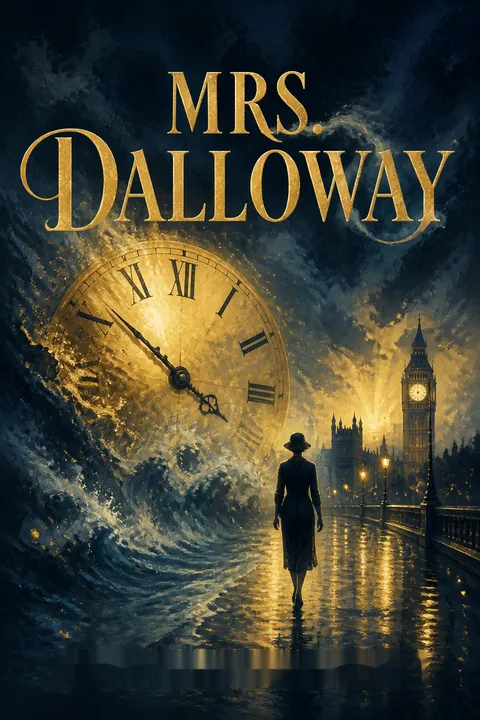
Public time, private memoryThe clocks mark the June day and repeatedly interrupt private thought with a shared measure of time. Their strokes connect people who do not know one another, while also reminding Clarissa and Peter that memory does not proceed as neatly as a schedule. The clock’s public authority contrasts with each character’s inward sense of duration: a half-hour can reopen an old rejection, and an ordinary hour can hold a crisis. This device gives the novel a firm temporal spine without limiting it to a single consciousness.
Clarissa's evening party
A room for collisionsThe party gives Clarissa’s day a practical purpose and gathers characters whose lives otherwise remain separate. Its preparations let her enact care through flowers, invitations, and attention to guests. The event also exposes the limits of that work: some guests feel peripheral, while old friends bring private histories into the crowded rooms. The party is not merely a symbol of status. It is Clarissa’s chosen method of making temporary connections among people who may never fully understand one another.
The motorcar and aeroplane
Spectacle invites projectionThe mysterious car draws London’s attention toward a hidden passenger, and the aeroplane’s smoke advertisement turns the sky into a public puzzle. People around the city attach different meanings to these passing displays. For Septimus, the smoke appears to carry a message meant for him, revealing how intensely he interprets ordinary stimuli. For the crowd, the same spectacle creates brief common attention. The devices show how one event can unite strangers while deepening the distance between a vulnerable person and those trying to help him.
Bradshaw's rest cure
Care becomes controlSir William’s prescribed rest and separation from Rezia frame the novel’s conflict over who gets to define health. Bradshaw sees order and compliance as treatment, whereas Septimus experiences the plan as a threat to his remaining independence. Rezia is placed between her husband’s distress and the doctor’s authority. The device makes medical power part of the story’s action rather than background: a professional decision changes the couple’s choices and intensifies their fear. It also distinguishes practical care from care that listens to the person receiving it.
FAQ
Synopsis & Basic Details
What is Mrs. Dalloway about?
- A Day in London: The novel follows Clarissa Dalloway through a single day in London as she prepares for and hosts a party, interweaving her thoughts and memories with the lives of other characters.
- Inner Lives Explored: It delves into the inner lives of its characters, exploring their thoughts, memories, and emotions through stream-of-consciousness narration.
- Themes of Connection: The story examines themes of connection, isolation, the passage of time, and the impact of war on individuals and society.
Why should I read Mrs. Dalloway?
- Innovative Narrative Style: Experience Virginia Woolf's groundbreaking stream-of-consciousness technique, offering a unique and intimate perspective on characters' inner worlds.
- Profound Psychological Depth: Explore complex characters grappling with identity, trauma, and the search for meaning, providing a rich and thought-provoking reading experience.
- Timeless Themes Explored: Engage with universal themes of time, memory, connection, and the impact of societal pressures, making the novel relevant to contemporary readers.
What is the background of Mrs. Dalloway?
- Post-World War I London: The novel is set in post-World War I London, reflecting the social and psychological impact of the war on individuals and society.
- Modernist Literary Movement: It is a key work of the modernist literary movement, experimenting with narrative structure, perspective, and psychological realism.
- Social Class and Gender: The novel explores the social class and gender dynamics of early 20th-century England, highlighting the constraints and expectations placed on women.
What are the most memorable quotes in Mrs. Dalloway?
- "Fear no more the heat o' the sun": This quote, recurring throughout the novel, encapsulates the theme of mortality and the acceptance of death as a release from life's struggles.
- "She felt very young; at the same time unspeakably aged": This quote captures Clarissa's complex feelings about time and aging, highlighting the duality of her experience.
- "The world wavered and quivered and threatened to burst into flames": This quote reflects Septimus's fragile mental state and his distorted perception of reality, emphasizing the psychological impact of war.
What writing style, narrative choices, and literary techniques does Virginia Woolf use?
- Stream of Consciousness: Woolf employs a stream-of-consciousness narrative, allowing readers direct access to the characters' thoughts, feelings, and memories, creating a sense of immediacy and intimacy.
- Shifting Perspectives: The narrative shifts between different characters' points of view, providing a multifaceted understanding of the events and themes of the novel.
- Symbolism and Imagery: Woolf uses rich symbolism and imagery, such as flowers, birds, and the city of London, to convey deeper meanings and enhance the emotional impact of the story.
Hidden Details & Subtle Connections
What are some minor details that add significant meaning?
- The Sound of Big Ben: The recurring sound of Big Ben acts as a constant reminder of the passage of time and the inevitability of death, influencing the characters' thoughts and actions.
- The Green Dress: Clarissa's green dress, which she mends, symbolizes her efforts to maintain order and beauty in her life, despite the underlying anxieties and insecurities.
- The Motor Car: The mysterious motor car that causes a stir in Bond Street represents the intrusion of the outside world and the power of societal forces on individual lives.
What are some subtle foreshadowing and callbacks?
- Septimus's Suicide Threat: Septimus's early mention of suicide foreshadows his tragic end, creating a sense of impending doom throughout the novel.
- Peter's Knife: Peter's habit of playing with his pocketknife foreshadows his emotional volatility and his potential for violence, reflecting his inner turmoil.
- Bourton Memories: Recurring memories of Bourton, the Dalloways' country home, serve as callbacks to a simpler, more innocent time, contrasting with the complexities of their present lives.
What are some unexpected character connections?
- Clarissa and Septimus: Despite never meeting, Clarissa and Septimus are connected through their shared experiences of isolation, mental distress, and a profound awareness of mortality.
- Peter and Septimus: Peter and Septimus are connected through their shared experiences of war and their struggles with mental health, though they never directly interact.
- Lady Bruton and Septimus: Lady Bruton's focus on duty and societal expectations contrasts with Septimus's rejection of those values, highlighting the different ways people respond to trauma.
Who are the most significant supporting characters?
- Sally Seton: Sally represents a past version of Clarissa, embodying youthful passion and rebellion, and her reappearance forces Clarissa to confront her own choices.
- Lady Bruton: Lady Bruton embodies the traditional values and power structures of English society, providing a foil to Clarissa's more introspective and unconventional nature.
- Miss Kilman: Miss Kilman represents the societal forces of religion and social justice, and her complex relationship with Elizabeth highlights the tensions between different worldviews.
Psychological, Emotional, & Relational Analysis
What are some unspoken motivations of the characters?
- Clarissa's Need for Connection: Clarissa's parties are driven by an unspoken need for connection and validation, masking her underlying insecurities and fears of isolation.
- Septimus's Desire for Meaning: Septimus's mental breakdown is fueled by an unspoken desire to find meaning and purpose in a world that seems chaotic and meaningless after the war.
- Peter's Yearning for the Past: Peter's return to London is driven by an unspoken yearning for the past and a desire to recapture his lost love with Clarissa, revealing his inability to move on.
What psychological complexities do the characters exhibit?
- Clarissa's Duality: Clarissa exhibits a duality between her public persona as a gracious hostess and her private struggles with aging, mortality, and the limitations of her life.
- Septimus's Trauma: Septimus's psychological state is marked by the trauma of war, leading to hallucinations, paranoia, and a profound sense of alienation from reality.
- Peter's Insecurities: Peter's character is marked by his insecurities and his inability to reconcile his past with his present, leading to emotional outbursts and a sense of restlessness.
What are the major emotional turning points?
- Peter's Visit: Peter's unexpected visit to Clarissa stirs up old emotions and regrets, forcing her to confront her past choices and the complexities of her relationships.
- Septimus's Breakdown: Septimus's mental breakdown and his inability to connect with reality mark a turning point in his story, leading to his tragic suicide.
- The News of Septimus's Death: The news of Septimus's suicide at Clarissa's party forces her to confront the fragility of life and the inevitability of death, prompting a deep reflection on her own existence.
How do relationship dynamics evolve?
- Clarissa and Richard: The relationship between Clarissa and Richard evolves from a practical partnership to a deeper understanding of each other's needs and limitations, highlighting the complexities of marriage.
- Clarissa and Peter: The relationship between Clarissa and Peter remains fraught with unresolved feelings and unspoken desires, reflecting the enduring power of their past connection.
- Septimus and Rezia: The relationship between Septimus and Rezia deteriorates as Septimus's mental state worsens, highlighting the challenges of caring for a loved one with mental illness.
Interpretation & Debate
Which parts of the story remain ambiguous or open-ended?
- Clarissa's True Feelings: Clarissa's true feelings for Peter and Richard remain ambiguous, leaving readers to interpret the nature of her relationships and her own desires.
- Septimus's Motivations: Septimus's motivations for suicide are complex and open to interpretation, raising questions about the impact of war and the nature of mental illness.
- The Meaning of the Party: The meaning of Clarissa's party is open to interpretation, with some seeing it as a celebration of life and others as a symbol of societal emptiness.
What are some debatable, controversial scenes or moments in Mrs. Dalloway?
- Clarissa's "Snobbery": Clarissa's social climbing and her focus on appearances are often debated, with some seeing her as a shallow character and others as a complex woman navigating societal expectations.
- Septimus's Suicide: Septimus's suicide is a controversial moment, raising questions about the role of mental illness and the responsibility of society in addressing it.
- The Nature of Love: The novel's portrayal of love, particularly the relationships between Clarissa and Peter and Clarissa and Richard, is often debated, with readers questioning the nature of true connection and fulfillment.
Mrs. Dalloway Ending Explained: How It Ends & What It Means
- Clarissa's Epiphany: The ending sees Clarissa experiencing an epiphany after learning of Septimus's suicide, recognizing the fragility of life and the importance of embracing the present moment.
- Acceptance of Mortality: Clarissa's contemplation of death leads to a sense of acceptance and a renewed appreciation for the beauty and complexity of life, despite its inherent challenges.
- Connection Through Shared Experience: The ending suggests that even in isolation, individuals are connected through their shared experiences of life and death, highlighting the importance of empathy and understanding.
About the Author
Other books by Virginia Woolf





Download PDF
Download EPUB
.epub digital book format is ideal for reading ebooks on phones, tablets, and e-readers.








