

Key Takeaways
Use hand gestures as a repeatable ritual for chakra-focused attention
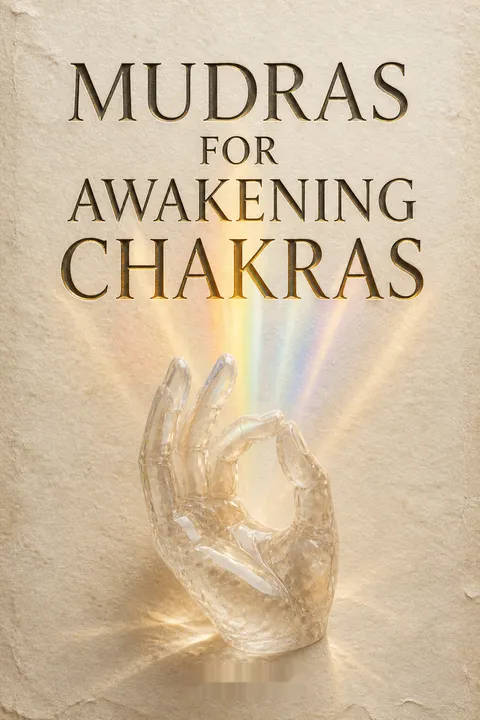
A practice built around the hands. A mudra is a hand position formed by bringing fingers together or pressing them lightly. Advait presents mudras as a practical way to awaken and balance chakras, the seven energy centers placed along the spine and above the head in yogic tradition. The book’s approach is deliberately procedural: take a comfortable posture, make a gesture, breathe, and direct attention toward a particular center.
The appeal is its simplicity. A practice can happen seated at home or during an ordinary pause in the day. The book frames this ritual as a route to physical and emotional health, but those benefits are claims of the author, not demonstrated results in the text.
The format makes an abstract spiritual system tangible: fingers, posture, and attention give the practitioner something concrete to do. Repetition can also make a ritual easier to remember, and focused breathing may help some people settle their attention. Those practical effects are distinct from the book’s claim that hand positions directly balance energy centers or improve health. Keeping that distinction clear allows readers to explore the ritual without mistaking a meaningful personal experience for medical evidence.
Give each finger a symbolic role, then use touch to form the gesture
Five elements, five fingers. The book draws on Panch-Maha-Bhuta, the traditional Indian model of five elements: earth, water, fire, wind, and space. It assigns each element to a finger: thumb to fire, index finger to wind, middle finger to space, ring finger to earth, and little finger to water. A mudra is then made by joining or pressing selected fingers together.
In this account, the gesture adjusts the elements in the body and supports health. That is the book’s traditional explanation, not a physiological mechanism established by the material presented. The map is still useful for understanding why the instructions are organized as they are: finger positions are not random choreography, but symbols within a coherent system.
Symbolic maps can make a practice memorable. The five-finger scheme gives learners a compact way to understand and recall the hand shapes, much as a mnemonic turns information into a structure. Its value as a teaching device does not establish its value as a biological model. Readers can appreciate the symbolism on its own terms while asking a separate question about measurable bodily effects. That distinction respects the tradition and avoids treating metaphor as anatomy.
Use the seven chakras as a map of bodily focus and emotional intention
Seven centers, different emphases. The book links each chakra to a location, color, and set of concerns. The root, at the base of the spine, is red and associated with security. The orange sacral center concerns sexuality and joy; the yellow solar plexus concerns digestion and control; and the green heart center concerns love and care. The blue throat center is associated with expression and creativity, the indigo third eye with insight, and the white or multicolored crown with spiritual satisfaction.
These links guide the visualization and the selection of gestures. They are best understood as the book’s traditional framework, not as a clinical chart showing that a chakra controls a specific organ or gland. The map organizes attention from bodily grounding toward spiritual awareness.
The sequence offers a useful reflective vocabulary: safety, desire, agency, affection, expression, insight, and spiritual connection. A person can use those themes to notice which concerns feel salient without assuming that a feeling identifies a physical disorder. The framework’s strength is interpretive coherence, not diagnostic precision. In particular, the book’s organ and gland associations should not be treated as a substitute for anatomical knowledge or clinical evaluation.
Pair each gesture with steady breathing and a vivid color image
Attention completes the gesture. The instructions repeatedly ask practitioners to sit comfortably, settle their breathing, and imagine light of the chakra’s associated color entering and illuminating that center. The body position and hand shape vary, but this combination of gesture, breath, and visualization is a recurring pattern.
For the root chakra, the book adds repeated contracting and relaxing of the pelvic floor while holding its mudra. For the crown chakra, it raises a hand shape above the head and invites the practitioner to picture light entering from above. The visualizations are part of the practice’s spiritual language. A beginner can follow them as focused imagery without treating the imagined light as a literal physical substance.
Combining a movement with breath and imagery gives attention several coordinated anchors. This resembles practices used in meditation and mental rehearsal, where a simple action helps keep the mind from drifting. The imagery may feel vivid or meaningful, but vividness alone does not show that energy is entering a chakra. A grounded approach is to observe the experience directly, including whether the practice feels calming or uncomfortable, rather than assuming a particular sensation proves a hidden process.
Choose a mudra by intention, not by how elaborate it looks
Gestures carry different aims. Advait offers 19 mudras across the seven chakras, with names and purposes that suggest distinct intentions. The lotus gesture is associated with the heart center, while the liberation gesture is used for the third eye. A gesture named for the divine feminine is assigned to the sacral center, and Kaamjayimudra is presented as a way to restrain sexual desire.
The book also warns readers not to overuse Kaamjayimudra, noting that sexual desire can be a healthy part of relationships and need not be a source of guilt. This makes intention important: a hand shape is not simply a difficult puzzle to master. The reader should understand what the book associates with it and decide whether that purpose fits.
The warning about sexual desire adds welcome nuance to a manual that sometimes describes bodily states in terms of balance or control. It recognizes that reducing a feeling is not automatically an improvement, especially when the feeling is part of ordinary human connection. More broadly, intention helps prevent ritual from becoming a checklist. Still, a gesture’s traditional name or assigned purpose cannot guarantee an outcome. The useful question is what the practitioner is trying to attend to, and whether the practice supports that purpose without shame or coercion.
Schedule seven five-minute practices instead of cramming all 19 together
Make the routine feasible. Although the book describes 19 gestures, it says there is no need to perform them all in one session. Its suggested daily plan is one mudra for each of the seven chakras, held for at least five minutes each. That is about 35 minutes. It also recommends practicing all 19 gestures at least three times a week, while noting that many can be done in different settings and during idle moments.
The instructions commonly suggest morning and evening practice, though the routine section emphasizes fitting the gestures into ordinary life. A reader can treat the schedule as a proposed structure, not a test of commitment. If a posture causes discomfort, the practice should not be forced simply to meet a time target.
The book’s shift from an intimidating list to a repeatable schedule is practical: a routine needs to fit the practitioner’s day, not just look complete on paper. Short, consistent sessions may be easier to sustain than trying to learn every gesture at once. At the same time, the text gives several overlapping targets, including daily practice and repeating all 19 during the week. Readers may benefit from choosing a manageable plan rather than treating every recommendation as mandatory.
Try gentle movement before stillness, but keep the promised boost in perspective
Movement followed by holding. Advait describes Sukshma Asanas as small exercises and proposes doing them before mudras. The reasoning comes from a yogic distinction between action and inaction: movement acts as a stimulus, while holding a gesture afterward is said to reinforce its effect. The book offers one micro-exercise for each chakra through a separate seven-day email course, but does not explain those exercises in this text.
The author claims that this sequence increases the effectiveness of mudras substantially. The book provides no measurements, comparison, or other evidence for the size of that effect. Readers can still explore a gentle movement followed by quiet attention as a personal routine, while regarding the promised increase as a traditional assertion rather than an established result.
The sequence has an intuitive experiential logic: movement can make a transition into stillness feel more deliberate, and the contrast may help a person notice changes in bodily attention. That is a plausible reason to try the order, not proof that it amplifies chakra energy. The author’s strong claim would require a clear definition of effectiveness and a way to measure it. In the absence of either, modest expectations keep a potentially useful ritual from being oversold.
Keep chakra practice supportive, never a substitute for medical care
Separate tradition from treatment. The book links chakras to glands and organs and suggests that blocked or unbalanced centers can lead to illness. It gives the heart chakra as an example, associating imbalance with cardiovascular problems and emotional instability. These are consequential medical claims, yet the text supplies no clinical evidence showing that a mudra prevents or treats those conditions.
The book’s own disclaimer says it does not provide medical advice and directs readers to consult a physician for physical, emotional, or medical problems. That caution matters more than the book’s promotional language about mudras as healing. A reader can use the gestures as a spiritual or reflective practice, but symptoms and diagnosed conditions call for appropriate professional care.
This is the crucial boundary for a book that moves between spiritual practice and claims about organs, glands, and disease. A ritual may provide comfort or structure, but those possibilities do not establish prevention or treatment. The distinction protects both the practitioner and the tradition: spiritual meaning need not depend on unverified medical promises. Claims about cardiovascular disease, endocrine function, or other conditions should be evaluated through medical evidence and care, not inferred from a person’s interpretation of chakra balance.
Analysis
This book is a compact instructional manual, not a narrative argument. Its organizing device is a progression through seven chakras, with 19 hand gestures offered as the practical means of engaging them. The method is deliberately accessible: a practitioner does not need equipment, a special location, or extensive preparation. The book supplies a symbolic map, a set of physical instructions, color visualizations, and a schedule intended to turn an unfamiliar spiritual idea into a repeatable routine.
The adaptation’s central challenge is that the book treats several kinds of claims as if they belonged to one continuous explanation. The finger-to-element relationships and chakra symbolism are components of a traditional worldview. The suggested routines are practical instructions. Claims that a chakra governs an organ or that a gesture improves health are medical assertions, which require a different standard of evidence. The text does not provide that evidence, despite making confident promises. A reliable reading preserves the practice while declining to repeat those promises as established fact.
The strongest practical insight is not that hand positions have demonstrated power over particular organs. It is that a small, structured ritual can direct attention toward bodily sensations and personal themes. Breath, posture, gesture, and imagery provide multiple cues for staying present. The book’s routine advice also recognizes an ordinary obstacle: a list of 19 techniques can feel too burdensome, so the author proposes a shorter daily structure.
The most useful reader stance is curious but discerning. Mudras can be explored as spiritual practice or personal reflection, with comfort and individual experience treated as relevant. Their use should not become a test of faith, a source of shame, or a reason to delay medical care. That distinction lets the book’s accessible ritual survive scrutiny without confusing symbolic coherence with clinical proof.
Review Summary
Mudras for Awakening Chakras receives mixed reviews, with an average rating of 3.84 out of 5. Readers appreciate its concise information, clear layout, and helpful pictures. Many find it a good introduction for beginners, praising its straightforward explanations and practical approach. However, some criticize the lack of depth and detailed information, suggesting it's too basic. Positive reviews highlight its usefulness for quick practice and easy-to-follow instructions. Negative reviews mention insufficient content and excessive promotion of other products. Overall, opinions vary on its value and effectiveness.
People Also Read









Glossary
Mudra
Symbolic hand gestureA hand position made by joining, touching, or lightly pressing particular fingers. In this book, mudras are used as practices for focusing on and balancing a chakra. The author explains their effects through a traditional relationship between fingers and five elements, but the text does not establish the gestures as medical treatment.
Panch-Maha-Bhuta’s
Traditional five-element modelThe five elements named in the book’s account of Vedic tradition: earth, water, fire, wind, and space or vacuum. The author associates each element with a finger and says that the elements make up the human body. This framework explains the symbolic logic behind the book’s mudras; it is not presented with clinical evidence.
Chakras
Seven traditional energy centersThe book describes seven points along the spine and above the head through which universal life energy enters the body. Each chakra is associated with a location, color, element, gland, organ system, and emotional or spiritual quality. These descriptions belong to the book’s spiritual framework and should not be read as a medical map of organ function.
Sukshma Asanas
Small preparatory exercisesThe author’s term for micro-exercises proposed as preparation for practicing mudras. The book presents movement as the active part of a sequence, followed by holding a mudra as the quieter, reinforcing part. This text advertises seven exercises, one for each chakra, through an email course but does not provide their instructions.
Kaamjayimudra
Gesture for restraining desireA mudra the book presents as a way to suppress sexual desire. The author cautions readers against overdoing it and explicitly says sexual desire can be healthy in relationships and need not cause guilt. The text offers the gesture as part of its chakra practice, not as a clinically validated method for changing desire.
Download PDF
Download EPUB
.epub digital book format is ideal for reading ebooks on phones, tablets, and e-readers.








