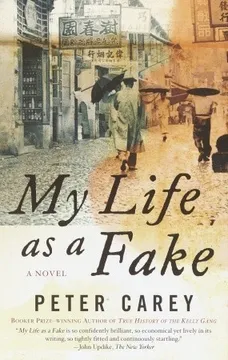


Plot Summary
The Poet in the Bicycle Shop
In 1972, Sarah Wode-Douglass, editor of a struggling poetry magazine, accepts a trip to Malaysia with John Slater, a celebrated poet whose place in her childhood is tangled with her mother’s death. Slater vanishes soon after they arrive. While waiting for him, Sarah notices an Australian man in a bicycle shop, dressed in a sarong and marked by sores.
When Slater returns, he identifies the man as Christopher Chubb, a poet once notorious for inventing a writer named Bob McCorkle. Yet when Chubb salutes Slater, Slater insists he barely knows him. Sarah recognizes the lie. Her irritation with Slater gives way to curiosity about the abandoned man and the mysterious connection he has denied.
The opening makes editorial attention the engine of the plot: Sarah notices a reader, a gesture, and a lie, then follows the evidence instead of accepting the famous man’s account. Her professional habit of searching for value in neglected work doubles as a personal vulnerability. Slater’s authority cannot settle the question, because his charm and evasions are part of what Sarah is trying to understand. Kuala Lumpur also shifts her out of a London literary world where reputations seem fixed. Here, a poet’s identity may be hidden in a bicycle shop, and a lie may prove more revealing than an introduction.
A Hoax Finds Its Editor
Sarah takes a magazine to the bicycle shop, hoping to meet Chubb, but finds only Mrs Lim, the scarred woman who works there. Chubb later contacts her and arrives at her hotel carrying a fragile poem in a sealed sleeve. Its strange, forceful music excites Sarah, who wants to know who wrote it.
Chubb names Bob McCorkle, the invented poet behind his old literary hoax, and Sarah assumes he is trying to trick or sell something to her. Instead, he asks her to hear how the hoax began. Slater warns her that Chubb is unstable and should be dismissed. Sarah refuses. Chubb’s manuscript has already made her curious, and his account promises to explain why a fabricated poet has become the center of his life.
The manuscript turns Sarah’s discernment against her assumptions. She distrusts Chubb for good reason, yet her response to the poem is a bodily certainty that cannot be reduced to reputation or provenance. The tension is not simply whether the page is genuine; it is whether authorship can be separated from the emotional force of a work. Chubb’s apparent neediness complicates the editor’s usual position of judgment. Sarah must listen to a man she suspects, while Slater’s warning carries the self-interest of someone who has already lied about knowing him.
The False Poet Goes to Court
In 1946, Chubb, a gifted but embittered Australian poet, resents David Weiss, a younger editor whose magazine seems more fashionable than serious. Chubb invents Bob McCorkle, a bicycle mechanic with an elaborate biography, and sends Weiss poems designed to test whether he can recognize empty imitation.
Weiss instead praises the work and publishes it. The hoax becomes public, and police prosecute Weiss over alleged obscenity in the poems. Chubb insists that the prosecution is really powered by anti-Semitism and the resentment of Melbourne’s establishment.
In court, Weiss refuses to make the poems simpler for the magistrate and prosecutor, while Chubb watches the state turn a literary joke into a weapon against his friend. The case leaves Chubb ashamed of the harm he caused, but unable to undo it.
Chubb’s experiment is meant to expose critical laziness, but it depends on the same contempt it claims to oppose. He treats Weiss as a specimen, not a friend, and mistakes humiliation for proof. The court then enlarges the prank into institutional violence: a work’s ambiguous language becomes an excuse to punish its publisher. The scene refuses a clean division between innocent art and guilty deception. Chubb has engineered the conditions, Weiss has chosen to defend the poems, and the authorities impose a meaning neither man controls. Literary judgment becomes inseparable from class and prejudice.
McCorkle Steps into Life
During Weiss’s trial, a huge, long-haired man bursts into the courtroom and attacks the detective who has testified against him. The stranger resembles the composite photograph Chubb made for McCorkle, and Weiss believes Chubb has arranged another cruel performance. Later, the man follows the detective home, cuts a patch of scalp from him, then goes to Weiss’s flat to announce himself as the poet.
Weiss calls him a fake and tries to escape through a window. The chair slips, and Weiss falls, striking his head. The giant leaves convinced he has killed him; Chubb flees Melbourne and does not correct the false story that Weiss died by suicide. The hoax has acquired a body, while its creator is left with guilt and fear.
The novel makes the boundary between invention and reality feel dangerous without offering a reliable explanation for its collapse. The giant’s existence may be impossible, but his grievance is specific: he believes a publisher gave him life and then denied him. Weiss’s death follows not from a simple villain’s plan but from accumulated misrecognition, panic, and Chubb’s deception. The creator’s guilt cannot settle whether he made the man, yet it does shape every choice that follows. Imagination here is not a harmless escape from the world; it is a force other people must live inside.
A Birth Certificate for a Ghost
After fleeing to Sydney, Chubb hides in advertising work and meets Noussette Markson, a daring painter and photographer who has reinvented herself more than once. She introduces him to the giant, who demands a birth certificate and insists that Chubb has made him a person without a past.
Noussette promises to find one and enlists Slater, then an intelligence liaison and rising poet, to help. Slater poses for her camera, becomes her lover, and supplies the false document. Chubb later discovers the connection and feels both jealousy and humiliation, though he insists he was never in love with Noussette.
When she becomes pregnant, Chubb agrees to raise the baby girl, Tina, despite having no experience or plan for fatherhood. The invented poet’s demand has drawn all three adults into a life-changing deception.
The birth certificate is more than a prop: it gives bureaucratic form to the question of whether a person can be created. Noussette treats identity as something adaptable, while Chubb experiences invention as a moral trespass and Slater treats the errand as an adventure. Their different attitudes make the false document feel both playful and consequential. Chubb’s decision to care for Tina introduces a new form of responsibility, one he cannot manage through literary standards or self-protective solitude. The novel links the making of a person on paper with the far less controllable work of raising one.
Sarah’s Childhood Rewritten
While Chubb’s story unfolds, Sarah confronts the grievance she has carried since childhood: she believes Slater’s affair with her mother helped drive her to suicide. Slater explains that her mother once kissed him in public after feeling humiliated by her husband, Lord Wode-Douglass, who had gone off with a young actor.
Slater did not return the kiss, and Sarah’s mother later drove her car into a shallow pond. Slater pulled her out; she ran to the house and cut her throat in the kitchen, while young Sarah found her body.
Sarah had remembered a drowning, not the bloody scene, and had mistaken Slater’s role for betrayal. She also learns her father had relationships with men as well as women. The truth loosens her hatred without erasing the grief beneath it.
Sarah’s memory has been a story she inherited and repeatedly retold until it felt like evidence. Slater’s account corrects its central facts but does not offer a comforting replacement: her mother still died by suicide, and her father’s intimate life remains difficult to imagine. The revelation shows how a child can build identity around a partial scene, especially when adults conceal what they cannot explain. Sarah’s reconciliation with Slater is therefore not a simple absolution. It is a shift from accusation to shared knowledge, and it arrives while she is already trying to judge Chubb’s competing versions of reality.
The Search Reaches Penang
Chubb’s attempt to raise Tina ends when McCorkle breaks into his home and carries the week-old baby away. Police suspect Chubb rather than believe his account of a giant kidnapper; he loses his job and home, and years pass before an artist’s letter places McCorkle with a little girl in Indonesia.
Chubb searches Bali, Java, and Sumatra, learning that the child is alive and cared for. His trail leads to Penang, where Tamil schoolteacher K. G. Chomley, called Mulaha, offers help.
Mulaha has survived the Japanese occupation and carries a private history of revenge, along with a dangerous knowledge of poisons. Through rickshaw drivers, he discovers that McCorkle and Tina have gone inland. Chubb accepts Mulaha’s assistance because finding his daughter matters more than safety.
The loss of Tina converts Chubb’s abstract guilt into parental desperation. His search is not a heroic expedition so much as a life narrowed to one question: whether the child is alive. The police response repeats the novel’s concern with who gets believed, particularly when a man’s behavior violates expectations of respectable fatherhood. Mulaha offers practical aid, but his history makes help inseparable from violence. Chubb is drawn toward an ally whose moral world was shaped by occupation and retaliation, even as he claims to want only his daughter back.
The Daughter Chooses McCorkle
At a remote English school, Chubb spots McCorkle working beneath a wealthy Malay ruler’s broken car and follows him through the jungle to the ruler’s village. Chubb tells the ruler that the giant kidnapped his daughter. The village captures McCorkle and brings Tina to Chubb, but the child recoils from the man she remembers as a ghost and clings to her protector.
After days of conflict, McCorkle arrives with Tina, who has been dressed and cared for by the village women. She runs into his arms. Chubb is left watching the reunion from outside the family she has chosen. McCorkle humiliates him in front of the villagers, and Chubb’s wish to reclaim his daughter hardens into a desire to punish the man who took her.
The scene reverses the moral labels that have guided Chubb’s search. The village sees him as the threatening outsider, while Tina experiences McCorkle as the person who has raised and protected her. Chubb’s biological claim, whatever its truth, cannot outweigh the attachments formed in daily care. His anguish is real, but the child is not a prize that can be returned to its rightful owner. The public humiliation makes the rejection harder to bear and pushes Chubb toward revenge, showing how a legitimate wound can still lead to a destructive response.
Poison, Exile, and Return
With Mulaha’s poison, Chubb attacks McCorkle at a post office using a treated nail and a small dagger. The giant survives, while Chubb is arrested, prosecuted, and deported to Australia. A year later, McCorkle writes that he is dying of Graves’ disease, which he blames on Chubb’s attack. Chubb believes he can save him, obtains medication, and returns to Malaysia.
He finds McCorkle gravely ill in the bicycle shop, with Tina and Mrs Lim beside him. Chubb nurses the man who stole his child, but the medicine cannot cure him: McCorkle has leukemia, not Graves’ disease. Before dying, he gives Chubb a manuscript titled My Life as a Fake and asks him to protect it. Chubb promises, hoping the book might preserve the life he cannot repair.
Chubb’s movement from attempted murder to caregiving is not redemption by declaration; it is a sustained, bodily service to someone he hates. He can still confuse punishment with justice, but he also recognizes a duty to preserve life when it is within reach. The mistaken diagnosis sharpens the novel’s concern with stories that become facts through repetition: McCorkle’s claim about Graves’ disease shapes Chubb’s return, though it is medically wrong. The manuscript passes between enemies as a final act of trust, leaving its meaning unsettled by the very history it contains.
The Tree and Its Flowers
Back in Kuala Lumpur, Chubb lives above the bicycle shop and guards McCorkle’s book while Tina and Mrs Lim maintain a shrine to the poet. Sarah learns that the manuscript is not simply a cache of poems left by one man.
During years in the jungle, McCorkle, Tina, and Mrs Lim collected plants, learned their names, made paper, and assembled journals filled with pressed specimens and drawings. Mrs Lim’s scars came from defending McCorkle and Tina during a violent attack.
Tina insists the work belongs to the family they made together, not to Chubb, who wants Sarah to publish it. Sarah recognizes its extraordinary power but refuses to treat the book as an abandoned literary prize. Her editorial ambition now collides with the women’s claim to its history and ownership.
The book’s authorship expands beyond the conventional figure of the solitary genius. McCorkle’s poems and natural-history journals depend on Tina’s drawings, Mrs Lim’s knowledge, and the shared labor of surviving in the jungle. Sarah’s first impulse is to rescue the work for publication, a form of reverence that can still become appropriation. Tina’s refusal forces the editor to see that recognizing artistic value does not confer the right to possess it. The shrine may seem strange to Sarah, but it preserves relationships that literary institutions would be tempted to flatten into a single author’s name.
The Book and the Blood
Slater tells Sarah that Tina and Mrs Lim have used violence before, but Sarah goes with him to negotiate rather than simply take the volume. Tina explains that McCorkle’s poetry belongs to the family who helped make it and refuses to sell the original.
Later, Chubb promises to retrieve the book for Sarah. When she returns to the shop, she finds Mrs Lim wounded, Tina bleeding, and Chubb’s dismembered body below the window. The women say Chubb attacked them and escaped; Slater believes they inflicted their own wounds and killed him.
The manuscript is said to be gone, though Slater thinks it remains in the shrine. Sarah leaves Kuala Lumpur with no book and no reliable account of the killing, forced to accept that the mystery will not yield a clean verdict.
The climax makes ownership inseparable from violence. Sarah’s desire to publish, Chubb’s urge to reclaim the book, and Tina’s defense of the family archive all turn a manuscript into contested territory. The contradictory accounts of Chubb’s death prevent the reader from converting uncertainty into a neat moral judgment. Sarah has learned to distrust official stories, but suspicion alone cannot establish what happened. The blood on her hands marks her proximity to the struggle, not her ability to solve it. The book survives as both literary achievement and an object around which people have been harmed.
The Mystery Outlives Kuala Lumpur
After the killing, Sarah pursues McCorkle’s history obsessively, travelling to Australia and trying to establish where the poet came from. Her investigation strains her finances and contributes to a nervous breakdown. In 1985, she returns to Kuala Lumpur with Slater, now a genuine friend, hoping the visit will help her recover. Jalan Campbell has been renamed, but the bicycle shop remains.
Tina and Mrs Lim are still there, and Sarah recognizes them by their scars and familiar guardedness. Neither woman offers an explanation or restores the manuscript to her. Sarah leaves with the same uncertainty that began her inquiry: McCorkle existed apart from Chubb, but the nature of his creation, his book, and Chubb’s death remain beyond proof.
The ending denies the investigative satisfaction Sarah’s profession has trained her to seek. Her research can establish that McCorkle was physically real, but it cannot settle how such a being came into existence or what exactly occurred in the shop. The return also tests whether grief can be cured by revisiting its source. Sarah finds the setting intact but not the answers she wants. Her bond with Slater has changed, yet the unresolved archive remains a wound rather than a solved case. The novel treats uncertainty not as a puzzle defect, but as the cost of living among other people’s incomplete stories.
Analysis
My Life as a Fake treats authorship not as a settled fact but as a relationship among makers, readers, and the people who bear the consequences of a story. Chubb invents McCorkle to expose literary credulity, yet the hoax becomes morally serious because Weiss trusts the work, a court punishes its publication, and Chubb later understands himself as responsible for a life he may or may not have created. The novel does not let the question of McCorkle’s reality cancel the human damage around him. That uncertainty is the point: belief has material effects even when its object cannot be explained.
The novel also challenges the myth of the solitary genius. McCorkle’s journals emerge from a shared life with Tina and Mrs Lim, whose collecting, drawing, and survival help shape the work. Sarah’s desire to publish is sincere, but sincerity does not make appropriation ethical. Tina’s refusal brings the question of ownership into the foreground: literary value is not the same as public availability.
Sarah’s family history mirrors the larger structure. She has built a life around a false or incomplete account of her mother’s death, just as Chubb and Slater circulate versions of McCorkle. New information changes her judgments, but never restores the past in a clean form. The ending’s unresolved violence denies the comfort of a final authoritative narrator. Sarah can discover, compare, and remember, but she cannot make every fragment agree. The book’s deepest claim is that stories create obligations; truth matters, yet no single account can guarantee that justice follows.
Review Summary
My Life as a Fake receives mixed reviews, with praise for its imaginative premise, complex characters, and lyrical prose. Some find it confusing and disjointed, while others appreciate its exploration of identity, creativity, and literary hoaxes. The novel draws inspiration from the Ern Malley affair and Frankenstein, weaving a tale of a poet's creation coming to life. Critics admire Carey's storytelling but debate the effectiveness of his narrative structure and character development. Overall, it's seen as a thought-provoking, if sometimes challenging, read.
People Also Read

Characters
Sarah Wode-Douglass
The searching editorSarah edits The Modern Review and measures poetry with an exacting, sometimes merciless eye. Her professional hunger for an unknown masterpiece draws her toward Chubb, while her old anger at Slater makes every evasion personal. She is intelligent, proud, and capable of tenderness, but she often mistakes control for judgment and certainty for truth. Her narration exposes her own vanity and self-deception rather than presenting her as a neutral observer. Sarah’s private attachment to Annabelle and her troubled memories of her parents complicate the brisk independence she displays in public. Her deepest drive is to find work that matters, though the search repeatedly forces her to ask what she owes the people who made it.
Christopher Chubb
The guilty hoaxerChubb is an Australian poet, scholar, and former advertising copywriter whose sharp standards conceal a lifelong fear of being provincial or fooled. He invents Bob McCorkle to expose what he sees as fashionable, shallow criticism, but his prank damages the people around him and becomes a burden he cannot escape. Proud and often self-dramatizing, he is also capable of devotion, particularly when he takes responsibility for a child. His habit of insisting on truth coexists with self-deception about his own motives and the harm he has caused. Chubb’s story reaches Sarah through memory, performance, and a manuscript, so the reader must judge both the events and the teller.
John Slater
The seductive poetSlater is a famous poet with a talent for social charm, appetite, and evasion. He has known Sarah since her childhood and remains entwined with her memories of her mother, though she does not initially understand the connection. He is generous when it suits him, capable of cruelty when his pride is touched, and more perceptive about other people than he is about himself. His physical confidence and literary reputation let him steer rooms and conversations, but Sarah’s distrust steadily limits that control. Slater’s actions link the English literary world to Chubb’s Australian past, and his affection for Sarah becomes more genuine as she learns to challenge him.
Bob McCorkle
The invented poetMcCorkle begins as the fictional bicycle mechanic whose poems Chubb sends to David Weiss. He becomes the central figure in Chubb’s account and the subject of a manuscript that unsettles every ordinary idea of authorship. To some characters he is a genius, to others a kidnapper or a protector; his own fierce need for recognition shapes how he treats his creator. His knowledge of languages, plants, and the natural world grows alongside a desire to claim a history and family. The novel keeps the boundary between the invented identity and the man who bears it deliberately unstable, making McCorkle both a character and a challenge to the story’s account of reality.
Tina
The guarded inheritorTina is the girl at the center of Chubb’s search and the adult guardian of McCorkle’s literary legacy. Raised among adults who tell competing stories about her origins, she learns to protect the family and archive she trusts. Her beauty draws attention, but her will is not passive: she can refuse, bargain, and defend the work she considers hers. Tina’s understanding of belonging comes from lived care and shared labor, not simply from biological claims or literary reputations. She represents the next generation asked to inherit the consequences of other people’s inventions, and her insistence on control makes Sarah confront the limits of editorial authority.
Noussette Markson
The self-inventing artistNoussette is a painter and photographer whose changing identities make reinvention seem natural to her. Bold, charismatic, and difficult to pin down, she moves between artistic circles and practical schemes with equal confidence. She attracts Chubb because she appears free of the inhibitions that govern him, yet she does not offer him the certainty he wants. Her choices around Tina’s early life shape the rival claims that later divide Chubb and McCorkle.
David Weiss
The devoted editorWeiss is a young Melbourne editor who recognizes daring in the McCorkle poems and commits himself to publishing them. His education and confidence bring him into conflict with Chubb, whose jealousy is disguised as a test of critical integrity. Weiss is neither merely gullible nor a flawless martyr: he is ambitious, intellectually serious, and willing to defend work he believes matters.
K. G. Chomley
The poison-wise teacherKnown as Mulaha, Chomley is a Penang schoolteacher whose polished manners conceal a history of wartime loss and a practical knowledge of poison. He offers Chubb help in finding Tina, but his idea of justice is shaped by occupation and revenge. His friendship is generous, energetic, and dangerous in equal measure.
Mrs Lim
The fierce keeperMrs Lim works in the bicycle shop and protects the household and the manuscript it shelters. Scarred and wary, she is skilled with tools and unsentimental toward outsiders who mistake poverty for helplessness. Her bond with Tina and McCorkle is built through shared survival and labor, not through the literary world's categories.
Lord Wode-Douglass
Sarah’s elusive fatherSarah’s father, known as Boofy, is a romantic, handsome aristocrat whose charm does not prevent him from being unreliable. His grief after his wife’s death leaves Sarah to manage her own anger and his collapse. His private life and his daughter's memories of him do not easily fit together, and that mismatch shapes her understanding of intimacy and family.
Plot Devices
The McCorkle hoax
Authorship made dangerousChubb invents a poet, biography, photograph, and body of work to expose what he sees as literary fashion without judgment. The deception first ensnares editor David Weiss, then appears to acquire a life beyond Chubb’s control. It binds the novel’s personal conflicts to its central question: whether a work’s meaning depends on who wrote it, who believes in it, or who suffers because of it.
The manuscript journals
A disputed literary inheritanceThe fragile poetry and nature journals give Sarah a reason to listen and give Chubb a reason to keep returning to the people he has harmed. Their physical texture, unusual contents, and uncertain authorship make them evidence as well as art. Tina and Mrs Lim claim a role in their creation and custody, forcing Sarah to confront the difference between discovering a work and having the right to publish it.
The birth certificate
Paper granting personhoodMcCorkle’s demand for a birth certificate turns an abstract identity into a bureaucratic problem. Noussette recruits Slater to produce a false document, briefly satisfying the demand while deepening the deception around the poet’s origins. The certificate echoes the original hoax: both attempt to make a constructed life legible to institutions, while leaving unresolved what recognition can prove about a person.
Download PDF
Download EPUB
.epub digital book format is ideal for reading ebooks on phones, tablets, and e-readers.








