

Plot Summary
Prologue
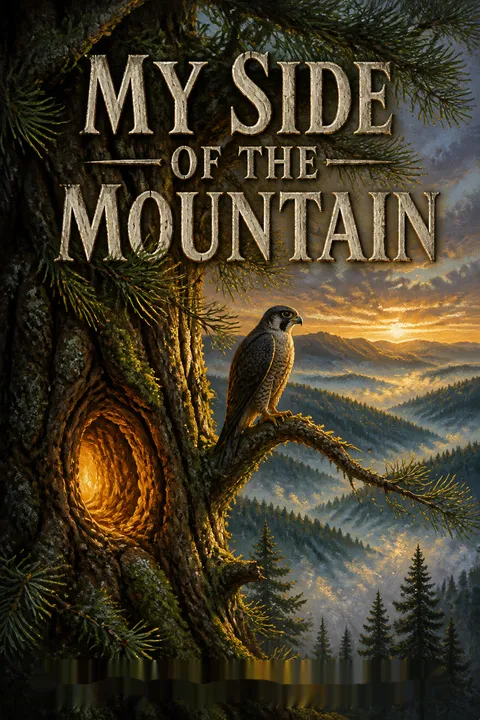
In early December, Sam Gribley waits out his first Catskills blizzard inside a hollow hemlock he has turned into a home. The storm makes him fear that he has misjudged the wilderness, though his tree shelter, small fire, and stored food hold.
When the snow eases, he pushes his head through the drift and rises into a bright, hushed landscape. Frightful, his young falcon, joins him in racing down the mountain. The sight of her tracks and the weasel's play in the snow restores his confidence. The story then turns back eight months, to the spring when Sam first left New York.
The opening gives the reader both the achievement and the fear beneath it. Sam is already sheltered, fed, and capable, yet the blizzard briefly reduces his self-reliance to a question of whether he can get out of his own doorway. His relief at emerging does not erase the panic; it makes courage feel practiced rather than innate. The return to May also changes the reader's perspective. The tree home is not a fantasy discovered ready-made, but the result of a boy learning through mistakes. Winter becomes a test whose emotional meaning depends on the labor that came before it.
The First Night Fails
Twelve-year-old Sam leaves crowded New York for the Catskills, intent on living on the abandoned farm once owned by his great-grandfather. His father has told stories about the family's failed attempt to belong to the land, but Sam wants to test that inheritance for himself. Carrying an ax, a penknife, cord, flint, and forty dollars, he gets a ride into the mountains and camps beside a stream.
His homemade hook brings trout, but he cannot turn sparks into a lasting fire. Cold, hungry, and frightened through the night, he runs to a nearby house at dawn. Its kindly resident, Bill, feeds him and patiently teaches him how to build a fire. Sam leaves with one hard-won skill and a reason to try again.
Sam's first failure makes the adventure less a story of effortless independence than a record of learning how dependence can be used without surrendering the goal. He accepts food, shelter, and instruction from Bill, then carries that lesson back into the woods. The episode also exposes the gap between reading about survival and inhabiting it: Sam knows how to fish in theory, but cold, darkness, and poor judgment turn knowledge into risk. His father's family story gives the escape a deeper charge. Sam is not merely fleeing a crowded apartment; he is challenging the claim that a Gribley cannot make a life on the land.
The Farm Beneath Trees
After sleeping on a schoolhouse porch, Sam asks Delhi librarian Miss Turner to help locate the long-abandoned Gribley farm. She finds its history and draws him a route to the boundary stone wall. At the stream below the mountain, Sam catches a catfish and makes his first successful fire.
Exploring the property, he finds edible bulbs, a marsh, nut trees, old apple trees, and the buried traces of the farmhouse. In a grove of ancient hemlocks, he discovers a hollow trunk large enough to shelter him. Digging it out by hand and ax is exhausting, so he uses fire to burn away the rotten interior. Nearby, he searches among the boulders and finds a spring, giving his future home water close at hand.
The farm becomes real only when Sam can read it as more than inherited acreage. Miss Turner's map translates family legend into a place he can reach, while the stone wall and ruined house connect his private experiment to generations of labor and failure. His choice of a hollow tree is practical but also psychological: it offers concealment without the loneliness of an exposed camp. The spring matters as much as the shelter because it forces Sam to observe the terrain rather than impose a plan upon it. Early independence is therefore built from attention, correction, and the willingness to let the landscape teach him what a home requires.
The Falcon's Steep Arrival
By June, Sam can stand inside his tree house, but he has never heard another person in the woods for weeks. A wiry old strawberry picker finds him in a meadow, assumes he lives nearby, and marches him toward town after he helps fill her basket. Her stories and company awaken Sam's curiosity about people again. At the library, Miss Turner supplies books about falcons and even trims his hair.
Sam watches a hunting bird return to its cliff nest, climbs toward the young, and is struck by the protective mother. He takes the largest nestling and escapes repeated dives by the adult falcon, shielding the chick beneath his sweater. He names the bird Frightful and carries her home, where her feeding and training become part of his daily life.
Frightful's arrival turns Sam's solitude into a relationship that demands care, not simply admiration. He risks injury to take her, but the danger also makes clear that the falcon is not a possession without needs: her mother attacks to defend her young, and Sam must learn to feed and handle the bird. The strawberry picker and Miss Turner provide a parallel human contact. They do not persuade Sam to abandon the mountain; instead, their ordinary kindness makes his isolation feel chosen rather than compulsory. The falcon's dependence also complicates Sam's ideal of self-sufficiency, since he now measures his day by the life he has taken responsibility for.
The Weasel and Warden
A fire warden appears at Sam's camp after smoke from his fire is spotted during a dry spell. Sam assumes someone has come to take him home, so he hides with Frightful and waits until the man leaves. He cleans the ground around his tree to make the camp less visible. The next morning, a box trap catches a weasel, but the furious animal launches onto Sam, wrestles his hair, then marches away unharmed.
Sam calls him the Baron and begins to recognize him as a bold, unpredictable neighbor. When Sam later hears a gunshot and finds a dead deer in the meadow, he hides the carcass from the poacher, then salvages its meat and hide. The animal's hide gives him a way to close the tree's entrance.
The warden's visit introduces a danger Sam cannot solve with food gathering or shelter: discovery could end the life he is building. Rather than confront the man, Sam interprets the signs, withdraws, and changes his habits, showing that survival also means managing visibility. The Baron offers a sharply different encounter with wildness. He is not prey or a tame companion, but a creature whose audacity unsettles Sam's assumption that he is master of the woods. The deer provides material security, yet it arrives through violence Sam did not cause. Sam's refuge depends on both restraint and opportunism, a balance that keeps the wilderness from becoming a simple pastoral refuge.
A Hide Becomes Home
Sam tans the deer hide in an oak stump and hangs it as a door, cutting strips for Frightful's training straps. He smokes excess meat, turns bone into a frog spear, and experiments with traps and hickory salt to attract another deer. A later catch supplies more hide, while a group of hikers accidentally drives the animals away from his camp long enough for him to claim the meat.
Over the summer, Sam teaches Frightful to return to his fist at a whistle and to strike a lure; she eventually catches a sparrow. A scrawny young raccoon, Jessie C. James, appears at Sam's bathing spring and grows into a loyal mussel finder. With food abundant, Sam stores nuts and begins preparing clothes and supplies for winter.
Sam's progress is measured in systems rather than trophies. The deer becomes a door, clothing, food, and tools; Frightful's training turns affection into a working partnership; Jessie contributes labor while remaining unmistakably wild. These exchanges reveal that Sam's independence is relational, even when he prefers to describe it as self-sufficiency. His methods also change from improvisation toward planning. He preserves meat, tests bait, and builds stores because summer abundance will not last. The forest rewards competence, but it never removes uncertainty. Each useful invention depends on observing an animal's habits and accepting that the same living community Sam relies on may also compete for his food.
Bando Finds the Tree
One summer day, Sam returns to find a man asleep near his tree. A police siren had sounded below the mountain, so Sam briefly suspects the stranger is an outlaw. He shares venison and rabbit, then learns the man is Bando, a college English teacher who got lost while hiking. Bando stays for more than a week, helps build a raft, makes clay jam jars, and cooks blueberry jam after returning from town with sugar.
The two share books, food, and music on willow whistles, while Bando treats Sam's mountain life with respect rather than alarm. When Bando leaves for home, promising to return at Christmas, Sam feels the absence sharply. Frightful, Jessie, and the Baron reappear around camp, restoring some of the company he misses.
Bando's visit gives Sam a model of adult attention that does not immediately become supervision. The teacher is curious about the boy's competence, and Sam is free to offer help without having to defend his decision to stay. Their shared projects make companionship tangible: a raft, jam, and music are forms of cooperation that leave Sam's home intact. Yet Bando's departure reveals the cost of that freedom. Sam has wanted solitude, but his loneliness after the visit shows that independence does not cancel the desire to be known. The animals' return comforts him, though it cannot fully replace conversation. His emotional world is widening before he has decided what that expansion means.
Halloween Feeds the Forest
As autumn approaches, Sam worries about cold and begins building a small clay fireplace inside the hemlock. Its chimney leaks, and a first attempt to heat the room makes Frightful faint from lack of fresh air. Sam puts out the fire, cuts more ventilation holes, and tests the room until both can breathe safely. He gathers nuts and apples for winter, then makes a Halloween feast for the animals around camp.
The party brings more visitors than he can manage: raccoons scatter his stored food, a skunk sprays him, and the fox watches from the dark. Sam drives the animals away and learns not to leave food out for them. The episode leaves him with less order than before, but a clearer sense of what winter preparation must protect.
The failed fireplace and disastrous feast are not comic detours from survival; they expose the limits of Sam's confidence. A shelter that traps smoke can become more dangerous than the cold, and generosity toward wildlife can threaten the stores that keep him alive. In each case, Sam learns by experiencing consequences rather than by following a perfect plan. His relationship with animals shifts here: admiration does not mean treating them as guests who understand human boundaries. The Halloween scene briefly reverses the idea of domestication, as Sam's pantry becomes a play space for creatures that have no reason to respect it. He must protect a home without pretending to own the surrounding world.
Hunters, Headlines, and Firewood
When hunting season begins, Sam stays hidden while rifles sound across the mountain. He tracks wounded deer hunters fail to find, claiming the meat and hides only after the men leave. Once the hills grow quieter, he walks into Delhi in his handmade deerskin clothes and meets a boy who teases him as Daniel Boone.
Sam calls him Mr. Jacket and invites him to the farm, but the boy leaves before accepting. On the way home, Sam notices the birds have fallen silent and realizes he has not stacked enough firewood.
He spends the next days hauling and arranging wood within reach of his tree, imagining snow tunnels that he never needs to dig. The encounter leaves him curious about friendship, while the growing piles answer a more urgent winter threat.
The hunting season places Sam in an unsettling position: he survives partly by taking animals wounded by people who would never see him. He does not claim to have killed the deer himself, but his resourcefulness still depends on the hunters' presence. The town visit makes another boundary visible. Sam has built a striking appearance that attracts attention, yet he wants contact with a peer rather than rescue or scrutiny. Mr. Jacket's teasing is not intimacy, but it gives Sam a glimpse of ordinary boyhood. Then the forest's seasonal silence interrupts that possibility with practical urgency. The scene joins social longing to survival planning, showing how easily one can displace the other.
Christmas on Gribley Mountain
Sam rides out the first snowstorm and settles into winter routines of ice fishing, falconry, and meals sweetened with Bando's jam. On Christmas Eve, Bando arrives with newspaper clippings about a supposed wild boy in the Catskills. The reports include sightings by Mrs. Fielder and the fire warden, but officials believe the boy has gone home.
The next day, Sam hears his father's call and races down the mountain. His father has used Mrs. Fielder's directions, Sam's raft, and his tracks to find him. Instead of demanding that Sam return to New York, he joins Bando and Sam for Christmas dinner. Sam's father stays through New Year's, helps with chores, and leaves by a different route so no one can follow him back to the tree.
The newspaper clippings convert Sam's private life into a story others can circulate, but their inaccuracies also protect him: authorities conclude that he has returned home. His father's arrival answers a different question. Sam had expected that discovery might mean capture, yet his father comes from affection and curiosity, not punishment. Their meeting revises the family legend of the Gribleys as people unsuited to land. The father can recognize his son's achievement without pretending that he himself has stopped longing for the sea. Christmas makes the mountain temporarily a family room, revealing that home is not simply a place Sam escaped. It is a relationship capable of changing its shape.
Ice Locks the Mountain
After his father leaves, Sam faces the hardest stretch of winter alone. An ice storm seals his door, coats the trees, and breaks branches with explosive crashes. He inches across the slick ground using an old wagon axle as a cane.
When fatigue, aching joints, and nosebleeds appear, he craves rabbit liver and improves after eating it, though he does not yet understand what his body lacks. He cuts branches for deer when snow buries their food, and watches the herd disappear once the valleys thaw.
In February, he finds two warm great horned owl eggs in a snowbound maple. Their presence tells him that new life is beginning before the landscape looks ready. The mountain's dangers remain real, but Sam's attention has become patient enough to read recovery in small signs.
Winter tests more than Sam's engineering. The ice storm makes the forest physically unstable, while his symptoms reveal that successful food storage does not guarantee a balanced diet. His body supplies information his books and memory have failed to provide. The episode quietly resists a heroic model of mastery: Sam survives partly because he notices a craving and follows it, not because he fully understands the cause. Caring for the deer extends that attentiveness beyond his own needs, while the owl eggs offer a measure of seasonal time that human calendars cannot provide. Spring first appears as an event in animal life, teaching Sam to recognize change before it becomes comfortable.
The Mountain Gains Neighbors
As the valleys thaw, Sam meets Matt Spell, a young newspaper worker searching for the rumored wild boy. Sam feeds the cold reporter rabbit, gives him a false account of the boy's appearance, and agrees to host him if he keeps the secret. When Matt returns in April, Sam leads him blindfolded to the tree; Bando soon joins them, and the men begin hollowing another hemlock for guests.
Matt's article spreads the story anyway, making discovery more likely. Sam also reconnects with Mr. Jacket, now identified as Tom Sidler, who visits and helps prepare turtle soup. Aaron, a songwriter, spends time learning the birds' calls from Sam. Each visitor makes the mountain less solitary, and Sam begins to accept that his refuge now has an address.
Sam's growing company is not a single reversal from solitude to society. Each visitor meets a different need: Matt brings the news of the outside world, Bando brings practiced companionship, Tom offers peer friendship, and Aaron turns the mountain's sounds into music. Sam's agreement with Matt also exposes an ambivalence he has not admitted to himself. He wants company and still fears the machinery of attention that could take his life from him. Building a guest tree makes that contradiction physical: Sam participates in enlarging the settlement while recognizing that a guest house changes what his home means. His identity is shifting from fugitive boy to host, although he has not yet chosen a public life.
The Family Comes North
By June, photographers and reporters have reached Sam's meadow, and their attention makes it harder to remain unnoticed. His father arrives again, this time with Sam's mother and all his siblings. Sam first hears the crowd and considers running, then recognizes his little brother's familiar cry and hurries to meet them. His mother embraces him, and the siblings turn the mountain into a noisy family camp.
She has decided that if Sam will not come home, the family will come to him. Sam resists when his father begins framing a conventional house, wanting everyone to live among trees and hammocks. His mother insists that he is still a child under her care. The family stays, and Sam must share the wilderness he made into a home.
The ending does not resolve Sam's conflict by declaring either the city or the wilderness victorious. His family arrives as both love and intrusion, and his first impulse to flee shows how seriously he takes the life he has made. Recognition of his siblings changes that impulse into joy, but joy does not erase his objection to the house. His mother answers public criticism by refusing to let strangers define her care, while Sam's father brings the family's old pioneer impulse into the present. The compromise remains unfinished: Sam keeps the mountain, but not its solitude. The final change is relational, not geographic. Home expands until it includes people Sam did not expect to bring there.
Analysis
My Side of the Mountain treats independence as a craft rather than a declaration. Sam's early confidence is repeatedly corrected by the material world: he cannot keep a fire alive, his shelter nearly fills with smoke, his stores attract raccoons, and his winter diet leaves him unwell. Each mistake changes his behavior. He observes, revises, and learns to plan across seasons. The mountain is not a backdrop that rewards courage automatically; it is a network of needs that Sam can understand only by paying close attention.
That attention also makes the novel's idea of self-reliance more complicated. Sam catches and preserves food, but he depends on Bill's fire lesson, Miss Turner's maps and books, Frightful's hunting, Bando's skills, and his father's care. Even his most private home is sustained by knowledge passed among people and by relationships with animals he cannot fully control. The book does not treat dependence as the opposite of autonomy. Instead, Sam becomes more capable by learning when to accept help and how to return it.
The family story is similarly unsettled. Sam leaves partly because the city feels crowded and the family legend warns that land is no place for a Gribley. Yet the mountain gradually attracts friends, visitors, and finally his whole family. His mother's decision to come north refuses the public assumption that a runaway must simply be retrieved, while her insistence on a proper house also limits Sam's freedom. The ending offers no clean victory for either wilderness or society. It leaves Sam with a home that is both his achievement and a shared family place. The deeper resolution is not that he stops needing others, but that his independence can survive being loved, visited, and challenged.
Review Summary
My Side of the Mountain receives mixed reviews, averaging 4.1/5 stars. Many readers cherish it as a beloved childhood classic that sparked their imagination and love of nature. They appreciate Sam Gribley's wilderness survival story and resourcefulness. However, critics note significant implausibilities: parents who don't search for their runaway child, unrealistic survival skills for a city boy, and concerning interactions with adult strangers. Some find the 1950s context problematic by modern standards. Despite dated elements and a weak ending, many readers value its inspirational message about self-reliance and connection to nature, though it works better as fantasy than realistic survival fiction.
People Also Read

Characters
Sam Gribley
The resourceful runawaySam is a boy who leaves a crowded New York household to test whether he can live on his great-grandfather's abandoned Catskills farm. He begins with books, courage, and an incomplete understanding of what survival costs. Hunger and cold teach him to revise his plans, while his growing skill with fire, food, shelter, and tools gives him genuine independence. His curiosity extends beyond practical needs: he studies animal behavior, records seasonal changes, and delights in small discoveries. Sam values privacy and self-direction, yet his attachment to Frightful and his pleasure in human company complicate his wish to live alone. He is neither a fearless woodsman nor a rejecter of people; he is a young person learning what kind of life feels like his own.
Frightful
Sam's hunting falconFrightful is a female peregrine falcon whom Sam takes as a nestling from a cliff and trains to return to his fist. Alert, swift, and fiercely independent, she becomes Sam's hunting partner and one of his closest companions. Her hearing and sight often detect danger before he does, giving her a practical role in his safety as well as an emotional one. Frightful's dependence on Sam for food and training sits uneasily beside her powerful wild instincts. Sam loves her, but his need for her makes it difficult to consider what freedom would mean for the bird. Their bond is built through repeated care, trust, and shared routines rather than human speech.
Bando
The teacher in the woodsBando is a college English teacher who gets lost in the Catskills and finds Sam's camp. Warmly curious and practical, he accepts the boy's way of life without treating it as a spectacle or immediately trying to end it. He contributes skills Sam lacks, including making jam and pottery, while welcoming Sam's knowledge of the mountain. Their time together includes food, books, raft building, and music. Bando's ability to be both an adult and a companion gives Sam a rare relationship in which he can offer hospitality rather than receive correction. His chosen nickname reflects the playful, mutual character of their friendship.
Sam's father
The restless sea-minded fatherSam's father once gave up a life at sea to work on New York's docks and has never felt entirely at ease on land. His stories about the Gribley family's failed farm help shape Sam's decision to seek the mountain. He initially treats the runaway plan as a boy's experiment, but his curiosity and affection lead him to take Sam's achievement seriously. He can recognize his son's competence while remaining attached to his own restless nature. Their relationship carries both inherited caution and an unusual freedom to imagine a different family life.
Sam's mother
The determined caregiverSam's mother cares for a large family and takes her responsibility toward her children seriously. She is attentive to practical needs, including food and health, and does not confuse independence with the absence of parental care. Her view of home is shaped by both family loyalty and the expectations of the surrounding community. She respects Sam's resourcefulness, but believes that his age gives her an obligation to protect him. Her strength is grounded rather than severe: she is willing to adapt the family's life to the mountain while holding firm to her own judgment.
The Baron Weasel
The fearless wild neighborThe Baron is a small wild weasel whose confidence repeatedly surprises Sam. After escaping one of Sam's traps, he confronts the boy at close range, then appears around the camp as an unpredictable presence. He does not become a pet or accept Sam's food, and his independence gives their uneasy friendship its character. The Baron represents the limits of Sam's influence over the animals he observes. Even when he seems to seek Sam out, he keeps his own purposes, territory, and temperament.
Jessie C. James
The mussel-finding raccoonJessie C. James is a young, underfed raccoon who appears near Sam's spring. Sam feeds him, and the animal grows healthier and begins following Sam and Frightful to the stream. Jessie proves remarkably useful at finding mussels, though he remains a wild animal with his own habits and appetite. His presence adds companionship and practical help without turning the forest into a human household. Sam's affectionate naming of him reveals how readily he forms attachments to the creatures around him.
Miss Turner
The helpful librarianMiss Turner is the Delhi librarian who helps Sam locate the old Gribley farm in local records. She believes his plan enough to give him maps and offer books about the plants, trees, and animals he will encounter. Later, she helps him find information about falcons and cuts his hair. Her support is practical rather than sentimental. She recognizes that Sam is undertaking something difficult and equips him with knowledge while leaving the decision in his hands.
Mrs. Fielder
The mountain's strawberry pickerMrs. Fielder is an elderly local woman who has gathered strawberries on Sam's mountain for decades. She mistakes him for a boy from Delhi and escorts him toward town, filling his first long silence with local news and conversation. Her account of meeting him later helps Sam's father locate the mountain.
Matt Spell
The young newspaper seekerMatt Spell is a young newspaper worker who searches the Catskills for the rumored wild boy, hoping to advance as a reporter. Cold and hungry when he meets Sam, he accepts the boy's food and becomes curious about how he lives. Matt is energetic and eager to record details, but also capable of keeping a confidence for a time. His interest brings Sam face to face with the difference between private experience and public story.
Tom Sidler
The town boy turned friendTom Sidler is the boy Sam first meets in town while wearing his handmade deerskin clothes. Tom teases him, but the encounter leaves Sam hopeful about making a peer connection. When they meet again on the mountain, Tom becomes more comfortable with Sam's unusual home and helps him prepare a turtle. He brings news of school, friends, and ordinary teenage life, giving Sam a window onto the community below without demanding that he leave the woods.
Aaron
The wandering songwriterAaron is a New York songwriter who wanders into the Catskills and meets Sam near the gorge. Quiet and attentive, he listens to Sam's songs inspired by birds and streams, then works with him to shape a melody. He asks little about Sam's private life, making their meeting unusually easy for the boy.
Bill
The first-night helperBill is the kindly man who gives Sam food, warmth, and a lesson in fire-making after Sam's miserable first night outdoors. His practical generosity turns a frightening failure into a reason to continue.
Jim Handy
The fire wardenJim Handy is the fire warden sent to investigate smoke during a dry spell. His visit frightens Sam into hiding and teaches him to keep his camp less conspicuous. He represents the ordinary authorities whose attention could interrupt Sam's private experiment.
The Gribley siblings
Sam's noisy city familySam's siblings are John, Jim, Mary, Alice, Hank, Joan, Jake, and toddler Nina. They are part of the crowded New York household Sam leaves behind. Their different ages and boisterous affection help explain both his desire for distance and the strength of his family ties. They are not an abstract crowd to him; their familiar habits and voices remain part of his inner life.
Plot Devices
The hollow hemlock
Shelter and hidden homeSam burns and digs a room inside an ancient hemlock, then improves it with a bed, a hide door, storage niches, and a small fireplace. The tree concentrates the practical stakes of the novel: it must protect him from storms, conceal him from visitors, and remain ventilated when he lights a fire. Its hidden entrance also lets the story measure Sam's changing relationship to other people. At first, privacy is essential to his escape; later, the possibility of guest trees challenges the idea that the home must remain secret.
The birch-bark journal
A record of learningSam writes observations, recipes, practical instructions, and seasonal notes on scraps of bark. The journal records not only what works but also what fails: his first fire, his unsafe fireplace, his winter food shortage, and his growing knowledge of animals. It makes the narrative feel like an account assembled through experience, while showing how Sam's attention shifts from immediate hunger toward larger patterns in the mountain. His notes are practical tools, but they also give him a way to think through fear and loneliness without another person present.
Frightful's training
Hunting and companionshipSam raises and trains Frightful to answer his whistle, fly to his fist, and strike a lure. Her hunting brings him rabbits and pheasants, while her senses warn him of approaching people and disturbances. The falcon's role is never merely mechanical: Sam feeds, handles, and talks to her, and her presence makes his isolation emotionally bearable. At the same time, her wild instincts remain stronger than any simple claim of ownership. Frightful's training lets the story explore the difficult line between partnership and captivity through daily routines rather than abstract debate.
Seasonal survival stores
Nature's changing timetableSam gathers nuts, dries apples, smokes meat, digs roots, and stores food according to the mountain's seasonal rhythms. These supplies make winter possible, but the novel repeatedly shows that preparation is imperfect: animals raid the stores, firewood is nearly forgotten, and Sam's body develops symptoms from a limited diet. Seasonal change also structures his emotional life, from summer abundance through winter isolation to the first signs of spring. The system works because Sam watches animals and plants closely, but it never gives him complete control over weather or need.
The wild-boy reports
Privacy under public pressureReports of a boy living in the Catskills begin with local sightings and the fire warden's observations, then grow as Matt Spell investigates and writes about Sam. The stories make Sam's hidden life increasingly vulnerable to photographers and visitors. They also misstate his situation, allowing him to remain unidentified for a time and prompting his father's search. Public attention therefore acts in two directions: it threatens the privacy Sam values while helping his family find him. The device turns the question of whether Sam wants to be discovered into an unresolved tension he must face.
Mountain Series
Download PDF
Download EPUB
.epub digital book format is ideal for reading ebooks on phones, tablets, and e-readers.








