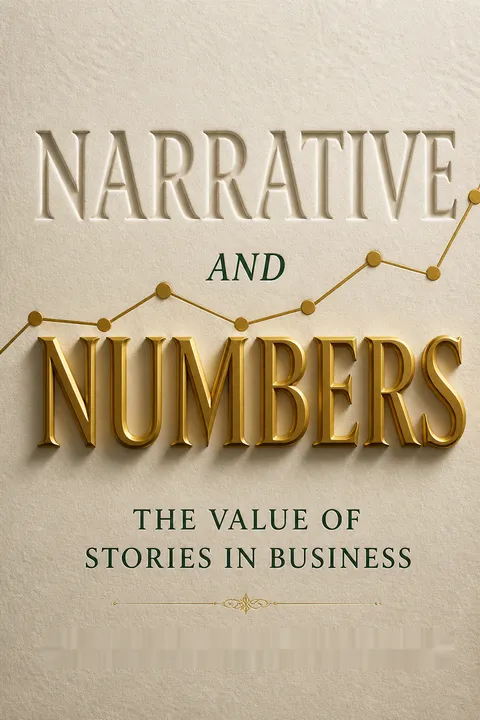


Key Takeaways
Make valuation the handshake between a company's story and its numbers
Stories explain the business. A spreadsheet can show forecast revenue, margins, and cash flows, but those figures are hard to remember and harder to judge without a reason behind them. A story can explain why those numbers make sense, but without numbers it cannot show what the business may be worth. Valuation connects the two: a narrative generates assumptions, and those assumptions generate an estimate of value.
Ferrari makes the point. Before its 2015 IPO, Damodaran described Ferrari as a maker of scarce luxury cars. That story supported low sales growth, high operating margins, and relatively stable earnings. The numbers became easier to interpret because their business logic was visible. A different story about expansion would produce different assumptions and a different valuation.
The useful shift is from asking whether a spreadsheet is sophisticated to asking whether its assumptions form a coherent account of how the company earns money. This is similar to a scientific model: its value lies not in the equations alone, but in the mechanism those equations represent. A story makes that mechanism inspectable. The limitation is that a coherent account can still be wrong, especially when competition or customer behavior changes. The numbers do not verify the narrative; they expose its implications.
Let stories make ideas memorable, but never let emotion certify them
Stories hold attention. Research discussed in the book finds that people remember stories better than equivalent expository material, in part because connected events invite listeners to infer causes. Stories can also make people feel trust, suspense, or hope, which helps explain why they prompt action. In business, that power can attract investors, customers, and employees.
Persuasion is not proof. Theranos offered a gripping account of a founder seeking to make blood testing faster, cheaper, and less painful. Investors and partners were drawn to the promise, but reports in 2015 raised serious doubts about the technology's reliability and use. The appeal of the story did not establish that the product worked. A business narrative needs evidence that its central promise can be delivered.
Narrative is a powerful compression device: it turns scattered facts into a sequence people can remember and discuss. That is useful in a business where no audience can inspect every operational detail. But the same compression can hide missing steps. A practical safeguard is to ask which observable result would have to be true for the story's central claim to hold. This keeps emotional engagement from becoming a substitute for verification, without treating every ambitious or inspiring pitch as suspect.
Treat precise-looking numbers as estimates shaped by choices, not facts
Precision can mislead. A model can produce consistent outputs and still be inaccurate. Its estimates depend on choices about the data, the time period, and the method. Damodaran's example is the historical U.S. equity risk premium: one calculation for 1928 to 2015 produced 6.18 percent, but its standard error implied a broad uncertainty range, roughly 1.58 to 10.78 percent. Different periods and averaging methods produced substantially different results.
Models do not abolish uncertainty. Long-Term Capital Management used sophisticated financial models and heavy borrowing to exploit perceived market mispricing. When the Russian crisis spread across markets in 1998, assumptions about how investments would move together failed, and the fund required a bailout. A numerical risk measure can organize a judgment, but it cannot guarantee control over events.
The distinction between precision and accuracy is especially important because exact outputs invite unwarranted confidence. A valuation shown to the cent can conceal uncertainty in market growth, competitive response, and discount rates. The book's examples also show that errors become dangerous when leverage or institutional authority magnifies them. The constructive lesson is not to abandon models, but to make assumptions and uncertainty visible. A range is often more honest than a polished point estimate, though it still depends on how that range was constructed.
Run every business story through possibility, plausibility, and probability
Use three levels of skepticism. The book's 3P test moves from whether a story can happen, to whether there is evidence that it could happen, to how likely it is to happen. A claim can pass one level and fail the next. In 2014, describing Uber as an urban car service was already plausible because the business was operating in cities. The idea that it might replace car ownership was conceivable, but evidence for that outcome was much weaker.
Check hard limits first. Stories also have to obey constraints: a company cannot capture more than the whole market, earn a profit margin above 100 percent, or grow faster than the economy forever. The test is not a formula for certainty. It is a way to separate a defensible forecast from an attractive possibility.
This sequence helps prevent a common reasoning error: treating imaginable outcomes as likely ones simply because they make an exciting pitch. It also gives investors and founders a shared vocabulary for discussing uncertainty without reducing every disagreement to optimism versus pessimism. The most difficult category is often the middle one, where an outcome is not impossible but lacks persuasive precedent or evidence. That ambiguity should be made explicit. Assigning a numerical probability too early can create a false sense that the uncertainty has been resolved.
Translate every qualitative claim into a driver of cash flow or risk
Give each claim a financial consequence. A large market affects potential revenue; a competitive advantage may support market share or operating margins; a tax benefit changes after-tax income; and a low-investment business needs less reinvestment to grow. A lower-risk story can justify a lower discount rate. These links make claims about brand, culture, or management testable through the assumptions they imply.
Growth has a cost structure. The book's iron triangle of value connects growth, risk, and reinvestment. Growth can add value, but delivering it often requires investment and may increase risk. Ferrari's exclusive-club story forecast slower growth with strong margins, while its expansion story forecast faster growth but lower margins and higher risk. The estimated equity values were close: about €6.3 billion and €6.0 billion.
This translation prevents soft attributes from becoming unexplained premiums. If a founder says a brand is powerful, the question becomes whether it permits higher prices, stronger retention, or lower customer-acquisition costs. The framework is valuable because it forces trade-offs into view rather than allowing every desirable feature to rise independently. Still, a financial proxy never captures the whole qualitative factor. Management quality, for example, may matter most through decisions that have not yet occurred, making the link difficult to estimate before results appear.
Audit how data was chosen before trusting what its averages imply
Bias enters before calculation. Data collection, analysis, and presentation each create opportunities to distort a conclusion. A sample of large successful firms, for example, cannot automatically represent all businesses. Survivor bias appears when failed firms disappear from a dataset. Research discussed in the book estimated that excluding failed hedge funds raised measured average returns by about 2 to 3 percentage points.
Statistics need interpretation. Averages can hide skewed distributions, and removing outliers can erase the cases that matter most. The book recommends using summary statistics and visual tools suited to the question, while resisting decorative charts or overloaded tables. The goal is not to display more data. It is to turn relevant data into information that improves a decision.
The data pipeline is part of the argument, not a neutral prelude to it. Asking who is missing from a sample can reveal more than scrutinizing another decimal place in a regression. This is also why transparent methods matter: they let other people see which choices could change the result. Yet good statistical hygiene cannot repair a poorly framed question. A dataset may be clean, representative, and still tell little about what will happen when the business or market undergoes a structural change.
Treat disagreement and new evidence as inputs to revise your story
Keep the narrative revisable. The book distinguishes a narrative shift, where details change but the core account remains, a narrative change, where the account is substantially rewritten, and a narrative break, where an event ends the original story. Earnings, competitors, regulation, management decisions, and economic conditions can all prompt reassessment.
Uber illustrates revision. In June 2014, Damodaran valued Uber at about $6 billion, viewing it mainly as an urban car-service company. By September 2015, a broader market, new services, and changed assumptions supported an estimate of $23.4 billion. Venture investors were pricing it at about $51 billion. The changing estimate reflected both new information and a revised story, not merely a spreadsheet update.
Revision is a discipline because it requires separating attachment to a thesis from evidence for it. Seeking criticism from people who reject the original assumptions can expose hidden beliefs, such as assuming that growth is always valuable or that a competitive lead will persist. However, changing a story after every price move would be just as unhelpful as refusing to change it at all. A useful update names the evidence, identifies which assumption it affects, and explains why the revised account fits better.
Judge a stock's price separately from your estimate of business value
Value and price answer different questions. Intrinsic value estimates what a business is worth from expected cash flows, growth, and risk. Market price reflects what buyers and sellers are willing to pay, including expectations and market pressures. In October 2014, Damodaran's Amazon estimate was $175.25 per share, while the stock traded around $287. Instead of treating the gap as proof that one side was foolish, he examined what growth and margins the market price implied.
The gap can persist. A value estimate is not a timing signal. Someone can believe a stock is overpriced and still avoid betting against it if the market's pricing may persist beyond the investor's time horizon. The useful move is to reverse-engineer the price, compare its implied story with one's own, and decide whether the difference is persuasive.
This distinction protects analysis from two opposite temptations: assuming the market must be right, or assuming a model's value must soon prevail. Price is evidence about collective expectations, but it is not a direct measurement of intrinsic worth. Conversely, intrinsic value is an estimate that depends on uncertain judgments, not a hidden fact waiting to be uncovered. The time horizon matters because a correct thesis can remain unprofitable if the expected correction arrives too late or never arrives within the investor's constraints.
Separate a macroeconomic forecast from the company you are valuing
Make the source of the bet visible. For commodity, cyclical, and politically exposed businesses, company results may depend heavily on forces management cannot control. A macro-neutral valuation uses current conditions rather than relying on a personal forecast, making it easier to see how much the estimate depends on the company and how much on the wider environment.
Vale shows the danger of mixing them. Damodaran estimated Vale at $19.40 per share in November 2014, using prevailing iron-ore prices and country-risk assumptions. By September 2015, declining earnings and rising Brazilian risk had reduced his estimate to $4.29. The earlier judgment had underestimated how persistent political risk could be and how debt would magnify the damage. The lesson is to identify, and track, each source of uncertainty separately.
Separating company analysis from macro forecasting is a form of attribution: it clarifies which skill is responsible for a decision's outcome. It also helps prevent a confident view of a company from borrowing confidence from an unrelated forecast about oil, interest rates, or national politics. The method cannot make macro risk disappear. A supposedly neutral baseline still embeds a choice about what counts as current or normal, and those choices can be especially consequential when economic conditions are changing quickly.
Change your investment lens as the company moves through its life cycle
Different ages demand different evidence. The corporate life cycle describes a business moving from idea, to product, growth, maturity, and decline. Early on, limited operating history leaves more room for competing narratives. As a business matures, its record constrains the story and financial results become more informative. In decline, a realistic account may involve shrinking the company rather than promising a return to past growth.
Leadership must adapt too. A start-up needs someone able to explain a vision; a growing company needs business-building and scaling skills; a mature company needs disciplined defense; and a declining company may need a leader willing to sell assets or reduce operations. The book's discussion of Yahoo shows the difficulty of reviving an aging technology company when its core business has lost ground and much of its value lies in outside investments.
The life-cycle lens helps explain why one investment method or management style cannot fit every firm. A start-up's lack of history is not simply missing data; it changes which questions can be answered and how much judgment is unavoidable. Mature-company metrics are more useful when the business model is stable, but historical performance can mislead during transition. The stages should therefore be treated as a diagnostic map, not a rigid clock: firms can stall, reinvent themselves, or decline at very different speeds.
Analysis
The book's central achievement is to treat valuation as a reasoning practice rather than a spreadsheet exercise. A narrative proposes a causal account of how a business might earn money; a model translates that account into assumptions; and evidence tests whether those assumptions deserve belief. The sequence makes disagreement productive. Instead of arguing over whether Uber is worth billions, participants can debate the market it serves, its likely share, margins, investment needs, and exposure to failure.
The method is strongest when it makes hidden judgments explicit. A forecast of high growth paired with low reinvestment and low risk is not just optimistic; it may describe an internally inconsistent business. Likewise, identifying sampling choices, survivor bias, and the uncertainty around historical estimates weakens the false authority of data without discarding quantitative discipline. The company's story becomes a compact way to connect operational facts, strategic choices, and financial consequences.
Its main vulnerability is that narrative flexibility can become retrospective rationalization. An analyst can alter the story whenever results disappoint, then present the new assumptions as a fresh, coherent explanation. Transparency and feedback reduce this risk, but they do not eliminate it. Useful practice therefore requires recording assumptions before outcomes arrive, naming what evidence would change them, and distinguishing genuine new information from convenient reinterpretation. The 3P test helps, but judgments about plausibility still depend on experience and analogy, both of which can fail when technology or regulation changes the game.
The book also reveals a governance problem: corporate stories serve different audiences. Employees may hear purpose, customers hear utility, and investors hear future returns. Those stories need not be identical, but persistent contradictions can erode trust. A leader's credibility depends not only on telling a persuasive account, but on making capital allocation and operating choices consistent with it. Ultimately, narrative and numbers discipline each other: stories expose the assumptions hidden in models, while models expose the costs and limits hidden in stories. Neither is a substitute for judgment, but together they make judgment inspectable.
Review Summary
Narrative and Numbers receives mostly positive reviews for combining storytelling with financial analysis in company valuation. Readers appreciate Damodaran's approach of linking narratives to numbers, finding it insightful for investors and business leaders. The book offers valuable case studies and a structured framework for valuation. Some criticize it for being too similar to Damodaran's blog content or not adding enough new material. Overall, reviewers find it helpful in understanding how stories and numbers shape business valuations, though its appeal may be limited to those interested in financial analysis.
People Also Read









Glossary
3P test
Three levels of story testingA sequence for assessing a business narrative. First ask whether the outcome is possible, then whether it is plausible given evidence or relevant precedent, and finally whether it is probable enough to include in a forecast. The sequence separates imaginable outcomes from defensible expectations and helps identify claims that exceed market, accounting, or economic constraints.
Iron triangle of value
Growth, risk, and reinvestmentA way to examine whether a business story's value assumptions fit together. Growth can increase value, while risk and reinvestment affect it in the opposite direction. Fast growth commonly requires more investment and may entail more uncertainty. A story that assumes high growth, low risk, and little reinvestment should be examined for internal inconsistency.
Big market delusion
Collective overestimation of market captureA pattern in which many founders and investors identify the same large market and each becomes overconfident that its own company will capture a substantial share. Individually plausible plans can collectively imply revenues larger than the market can support. Competition then intensifies, expected margins and company-level growth disappoint, and valuations across the sector may fall, even though some firms succeed.
Narrative break
An abrupt end to a business storyA major event that ends or destroys the business account underlying an investment. Causes can include a failed regulatory decision, inability to meet contractual payments, government seizure, a catastrophic event, or loss of access to capital. Unlike a routine change in forecasts, a break can make the original business model nonviable and sharply reduce the value of the investment.
Narrative change
A substantial rewrite of the storyA significant revision to the account of how a company operates or will create value. New information about its market, competitors, costs, leadership, or strategy may change important assumptions such as growth, margins, investment needs, or risk. The business continues, but the previous narrative no longer adequately explains its prospects.
Narrative shift
A limited adjustment to the storyA modification to specific details of a business narrative without changing its basic structure. New earnings information, a modest change in market share, or a small adjustment to expected margins may shift estimated value while leaving the central account of the business intact. It contrasts with a major narrative change or an abrupt narrative break.
Corporate life cycle
Stages of business developmentA model of business evolution from idea and product development through growth, maturity, and decline. Each stage changes what evidence is available and which management or investment questions matter most. Early-stage value depends heavily on uncertain narratives, while mature businesses offer more operating history. Declining businesses may require plans for contraction or liquidation.
Macro-neutral valuation
Value without a personal macro forecastA valuation approach that uses current macroeconomic conditions rather than an analyst's forecast of future commodity prices, interest rates, or other broad variables. Company financials are adjusted where necessary to reflect current conditions. A separate forecast-based valuation can then show how much the conclusion depends on the macro view rather than company-specific judgments.
Crowdvaluing
Publicly testing valuation assumptionsDamodaran's term for inviting other people to examine and alter a valuation, including by changing its inputs in a shared model. The purpose is to expose disagreements about the underlying narrative, such as market size, market share, margins, or risk. It turns criticism into a way of locating weak assumptions, while leaving the final judgment with the analyst.
FAQ
What's Narrative and Numbers about?
- Core Concept: The book explores the intersection of storytelling and quantitative analysis in business, emphasizing that both are essential for effective valuation.
- Two Tribes Concept: It introduces the idea of "two tribes"—storytellers and number crunchers—who often struggle to communicate, leading to a divide in business practices.
- Valuation as a Bridge: Aswath Damodaran argues that valuation serves as a bridge between narratives and numbers, allowing for a more holistic understanding of business value.
Why should I read Narrative and Numbers?
- Enhance Decision-Making Skills: The book provides tools and frameworks to improve your ability to make informed business decisions by integrating qualitative and quantitative analyses.
- Broaden Your Perspective: It encourages readers to appreciate the value of storytelling in business, leading to better engagement with stakeholders and a deeper understanding of market dynamics.
- Practical Applications: Damodaran shares real-world examples and case studies, making the concepts applicable to various business contexts, from startups to established corporations.
What are the key takeaways of Narrative and Numbers?
- Importance of Narratives: A compelling narrative can enhance the memorability and impact of financial data, making it easier for stakeholders to connect with the information.
- Valuation Framework: The book outlines a structured approach to valuation that incorporates both stories and numbers, helping readers create more credible and persuasive business cases.
- Feedback Loop: The necessity of a feedback loop in refining narratives based on real-world outcomes is highlighted, allowing for continuous improvement in business strategies.
What are the best quotes from Narrative and Numbers and what do they mean?
- "A valuation that is not backed up by a story is both soulless and untrustworthy." This underscores the importance of narratives in making financial data relatable and trustworthy.
- "You need to bring both stories and numbers into play in investing and business." This emphasizes the need for a balanced approach that values both qualitative and quantitative insights.
- "The story itself will change over time." This reflects the dynamic nature of business environments, indicating that narratives must be adaptable to remain relevant.
What is the "two tribes" concept in Narrative and Numbers?
- Storytellers vs. Number Crunchers: The concept describes the divide between those who excel in storytelling and those who focus on quantitative analysis, often leading to misunderstandings.
- Cultural Differences: Each group tends to develop its own language and methodologies, creating barriers to collaboration and shared understanding.
- Bridging the Gap: Damodaran provides a framework to help both groups find common ground, enhancing their ability to work together effectively.
How does Damodaran define a "good business story" in Narrative and Numbers?
- Simple and Credible: A good business story should be straightforward and believable, allowing stakeholders to easily grasp its essence and relevance.
- Inspiring Action: The narrative should motivate employees, customers, and investors to engage with the business, driving them to take action.
- Link to Value: The story must connect to the underlying value drivers of the business, ensuring it is grounded in reality and potential outcomes.
What is the "3P test" mentioned in Narrative and Numbers?
- Possible, Plausible, Probable: The 3P test is a framework for evaluating business narratives, assessing whether they are possible, plausible, and probable.
- Testing Narratives: This test helps storytellers refine their narratives by ensuring they are grounded in reality and can withstand scrutiny.
- Avoiding Pitfalls: By applying the 3P test, businesses can avoid crafting impossible or implausible stories that may mislead investors.
How does Narrative and Numbers suggest connecting stories to valuation inputs?
- Valuation Framework: Damodaran outlines a structured approach where stories inform key valuation inputs, such as revenue growth and operating margins.
- Market Share and Growth: The narrative should guide estimates of market size and share, linking qualitative insights to quantitative projections.
- Dynamic Adjustments: As stories evolve, the valuation inputs should be revisited and adjusted to reflect new information and changing market conditions.
What role do qualitative factors play in valuation according to Narrative and Numbers?
- Influence on Value: Qualitative factors, such as management quality and corporate culture, can significantly impact a company's value.
- Bridging Storytelling and Numbers: The book emphasizes that qualitative insights can be quantified, allowing for a more comprehensive understanding of a company's potential.
- Scrutinizing Claims: Investors are encouraged to critically assess qualitative claims made by company founders and managers.
How does Damodaran address the dangers of relying solely on numbers in Narrative and Numbers?
- Illusion of Precision: The book warns that numbers can create a false sense of precision and control, leading to overconfidence in decision-making.
- Bias and Framing: It highlights how biases can enter the data collection and analysis processes, affecting the integrity of conclusions.
- Need for Balance: Damodaran advocates for a balanced approach that incorporates both storytelling and quantitative analysis.
How does the corporate life cycle affect business narratives in Narrative and Numbers?
- Stage-Specific Narratives: Different stages of the corporate life cycle require different types of narratives; early-stage companies focus on potential and growth.
- Transition Challenges: Transitioning between stages can create challenges for management, as the skills required to lead effectively change over time.
- Narrative Constraints: As a company ages, its history constrains the narratives that can be told, making it essential for managers to adapt their stories.
How can I apply the lessons from Narrative and Numbers to my investments?
- Assess Company Narratives: Evaluate the narratives of companies you are considering investing in, ensuring they are credible and aligned with the numbers.
- Adapt to Life Cycle Stages: Tailor your investment strategy based on the life cycle stage of the company, recognizing the different risks and opportunities.
- Embrace Uncertainty: Be open to uncertainty and the possibility of changing narratives, allowing for flexibility in your investment approach.
About the Author
Other books by Aswath Damodaran





Download PDF
Download EPUB
.epub digital book format is ideal for reading ebooks on phones, tablets, and e-readers.








