

Key Takeaways
Choose the best outcome, not merely an agreement.
Agreement is not victory. Rational negotiation means choosing the result that best serves your interests, including walking away when every available deal is worse than your alternative. The book opens with companies trapped in costly competitive promotions. Airlines copied and escalated frequent-flier rewards until their liabilities were estimated as high as $12 billion. In the auto industry, Lee Iacocca publicly offered a cease-fire: Chrysler would end rebates if competitors did, but would match any promotion they continued. The other automakers stopped, avoiding a destructive cycle.
Look beyond the table. The contrast is not simply between cooperation and competition. Iacocca considered how competitors would respond; the airlines did not. A strong negotiator evaluates the likely result of each side's move, rather than treating agreement, market share, or winning as goals in themselves.
What's valuable here is the shift from winning a move to improving the whole outcome. That resembles systems thinking: a choice can look beneficial in isolation while making the larger system worse. The cease-fire worked because it made restraint conditional, not merely hopeful. Such proposals are harder when firms cannot communicate legally or credibly, and a public promise alone cannot guarantee cooperation. The general lesson is to design incentives and responses, not rely on goodwill.
Ignore sunk costs before they turn a bid into a crusade.
Past spending is gone. A sunk cost is time, money, or effort already spent and impossible to recover. It should not determine what to do next. Robert Campeau pursued Federated Department Stores in a bidding war with Macy's. As the price rose, Federated's business weakened, yet Campeau raised his bid by roughly $500 million rather than accept defeat. He won the acquisition battle, then went bankrupt. The earlier commitment did not make the company more valuable.
Notice the trap early. In the dollar auction, the highest bidder wins a $20 bill, while the second-highest bidder must also pay but receives nothing. Once two people have bid near $20, each may pay more simply to avoid locking in a loss. Final bids of $30 to $70 were common in the authors' demonstrations. The rational move is to avoid entering a contest whose rules reward escalation.
This is a practical antidote to the sunk-cost fallacy: assess the next decision as if starting from today. The difficult part is social, not mathematical. A retreat can look like incompetence to colleagues, investors, or a negotiating partner, so people keep spending to defend their reputation. Organizations can reduce that pressure by rewarding sound decisions based on information available at the time, rather than judging managers only by outcomes. Persistence is useful when future returns justify it, not when it merely protects yesterday's choice.
Search for differences in priorities, not just a split of the pie.
One issue can hide several interests. The mythical fixed-pie assumption is the belief that one side can gain only if the other loses. It leads negotiators to divide value before asking whether they value the ingredients differently. In one acquisition, a buyer offered $14 million for a supplier, while the supplier insisted on $16 million. Neither accepted a $15 million compromise. The impasse dissolved when they separated a risky new division from the rest of the business. The buyer valued that division at $1 million; the owners valued it at $6 million and kept control of it. The rest of the company sold for $12 million.
Trade across issues. A useful agreement need not split every item evenly. It can give each side more of what matters to it and less of what matters less. That requires discovering interests and priorities, rather than assuming positions tell the whole story.
The example shows why a compromise is not automatically fair or efficient. A midpoint can leave value unused when preferences differ. The same logic appears in job design, partnerships, and public policy: parties may share a broad goal while preferring different means or bearing different costs. Still, the approach depends on genuine differences and enough information to identify them. If preferences are nearly identical, there may be little to trade, and distributive bargaining remains unavoidable.
Set your walk-away point before discussing the other side's offer.
Start with your alternative. A BATNA, or Best Alternative To a Negotiated Agreement, is what a party can do if no deal is reached. A reservation price is the point at which accepting a deal and choosing that alternative are equally attractive. Together, these ideas show when an offer is better than impasse. The bargaining zone is the range in which both parties prefer agreement to their own alternatives.
Map interests too. Before a negotiation, identify your alternatives, the issues that matter, and their relative importance to each side. The book's account of the Israel-Egypt dispute over Sinai illustrates why stated positions can mislead: Israel needed security, while Egypt wanted the territory. Returning the land with security provisions addressed both interests more effectively than splitting the peninsula. Preparation does not reveal every answer, but it tells negotiators what they need to learn.
A walk-away point is useful because it anchors decisions to a real alternative rather than to the excitement of the current deal. It also disciplines concessions: a negotiator can compare each new offer with the best available option. But alternatives are estimates, not fixed facts. They can change as time passes, new information arrives, or a third party enters. The framework is strongest when treated as a living assessment, not as a number calculated once and defended indefinitely.
Reject an anchor that makes an unreasonable offer seem normal.
First numbers shape judgments. An anchor is an initial value that pulls later estimates toward it, even when it is irrelevant. In an audit study, professionals asked whether management fraud occurred in more than 10 firms per 1,000 estimated an average of about 17. Those asked whether it occurred in more than 200 estimated about 43. The arbitrary starting figures shifted their judgments. Real-estate agents also valued the same house higher when given a higher listing price, despite describing other methods of appraisal.
Frames shift choices. People were far more willing to walk two blocks to save $30 on a $70 watch than to save the same amount on an $800 camera. The cash saving was identical, but the percentage discount changed its appeal. Estimate value independently, and compare absolute costs and benefits before responding to an offer or its presentation.
Anchors and frames are not just tricks used by a clever counterpart. They also shape private judgment, which makes preparation especially important. Independent estimates create a reference point that is not supplied by the other party. At the same time, not every opening number is meaningless: it may contain information about the seller's expectations or market conditions. The task is not to ignore an anchor automatically, but to separate useful evidence from psychological pull.
Audit what feels memorable before treating it as relevant.
Vividness is not probability. Information that is easy to recall can feel more common or more likely than it is. Climatologist Iben Browning predicted a major earthquake near the New Madrid fault on a particular date in 1990. Media coverage made the forecast highly available to the public, although geologists widely discounted it. Insurance companies nevertheless saw a sharp increase in earthquake coverage. The predicted earthquake did not occur.
Check the evidence base. A dramatic story can dominate a decision even when less vivid data are more informative. The book also describes employees who undervalued their health insurance because they focused on their own monthly contribution and overlooked the larger employer payment. In both cases, the most accessible number or image displaced a fuller assessment. Deliberately ask what relevant information is missing, and whether the memorable example represents the broader pattern.
Availability is a useful shortcut when quick decisions are necessary, but negotiation often rewards a slower audit. A vivid event may deserve attention without deserving the weight it receives. The distinction is between a signal that something could happen and evidence about how likely it is. That distinction matters in risk, insurance, and business forecasting. The harder challenge is organizational: decision-makers need access to base rates and independent assessments, not just vivid anecdotes repeated in meetings.
When the other side accepts quickly, ask what they know.
Acceptance can carry information. The winner's curse occurs when a buyer with less information makes an offer that is most likely to be accepted when the item is worth less than the buyer believes. In the book's acquisition exercise, a target's value could range from $0 to $100, but the target knew its value before deciding whether to accept. Although the company would be worth 50 percent more under the buyer's management, any positive offer had a negative expected return under those assumptions. The rational offer was $0.
Check before bidding. In classroom auctions of jars containing $8 in coins, the average winning bid was about $10.01. The highest bidder tended to be the person who overestimated the jar's value most. Independent inspections, appraisals, guarantees, and a seller's reputation can reduce this information gap. An accepted offer is not proof of a bad deal, but it should prompt scrutiny.
The important insight is selection: the seller's acceptance is not a random event. It depends on what the seller knows and on whether the offer is attractive relative to the item's true value. This logic applies wherever quality is hidden, from used goods to acquisitions. Yet acceptance can also reflect urgency, financing needs, or a preference for certainty. It is best treated as a diagnostic clue, then tested against independent evidence rather than interpreted as a verdict.
Calibrate confidence with outside views and deliberate disconfirmation.
Confidence can outrun evidence. In a quiz asking people to make ten estimates and set ranges that should contain the answers 95 percent of the time, most ranges captured only about 30 to 70 percent. Negotiators also overestimated the chance an arbitrator would accept their final offer: their average prediction was 68 percent, even though one of two offers had to win. Ross Johnson's failed attempt to buy RJR Nabisco illustrates how confidence can harden into strategy. He assumed his management ties and financing would secure the deal, underestimated the board's reaction, and failed to anticipate rival bidders.
Seek contrary evidence. Ask what would show that a plan is wrong, consult informed outsiders, and distinguish a good decision from a lucky outcome. Experience helps, but expertise requires understanding why a strategy works and adapting it to a new situation.
Calibration is more useful than confidence as a personal brand. A manager who knows the limits of a forecast can still act decisively, while making room for contingencies and better information. The book's emphasis on disconfirming evidence also guards against a common organizational failure: asking advisers to validate a favored plan. However, outside advice is not automatically objective. Advisers have incentives and biases of their own, so independent perspectives work best when their assumptions are made explicit.
Account for fairness and emotion because money is not the only payoff.
People care about treatment. In an ultimatum bargaining exercise, one person proposed how to divide $1,000 and the other could accept or reject the split. A proposal giving the responder just $50 was often rejected, leaving both with nothing. Financially, accepting would have been better for the responder. But people also care about fairness, anger, and what a deal says about the relationship. The authors note that even when a person could dictate the split, many chose to share some of the money.
Fairness is contextual. People may judge an allocation by equality, contribution, need, or comparison with others. A store raising snow-shovel prices after a storm was commonly viewed as unfair, despite the economic case for prices rising with demand. Negotiators should anticipate these judgments rather than assume that financial logic alone will persuade.
This insight improves both prediction and legitimacy. A deal that looks efficient on paper may be rejected if it violates a shared expectation about acceptable conduct. Fairness can therefore be part of the practical value of an agreement, not an irrational distraction from it. But fairness standards can conflict: equal shares, earned shares, and need-based shares produce different answers. Naming the standard under discussion can turn a moral standoff into a clearer negotiation about what each party considers a defensible rule.
Use group rules that reward information, not just majority power.
More parties mean more complexity. In a group negotiation, individual interests multiply, and coalitions can form to control decisions. At Lehman Brothers, traders and bankers were divided by status and goals. A coalition gained power, bypassed normal decision processes, and made choices that served its members but damaged the firm. Group procedures can either expose differences in priorities or hide them.
Design for trade-offs. In the book's newspaper budget simulation, a majority-rule outcome gave each of five managers 40 points of value. A unanimous agreement that traded a computer system, a new section, and staff allocations could give each 60 points. Unanimity can encourage the exchange of preferences needed for a better package, though it can also give every member a veto. The choice of decision rule changes what agreements are possible.
Group negotiation is partly a problem of information architecture. A vote records preferences but rarely reveals their intensity, so a low-priority objection can block a high-value trade or a coalition can impose its preferred outcome. Consensus procedures encourage discovery, but unlimited veto rights can invite delay and strategic holdouts. Effective design therefore needs both voice and a path to decision. The right balance depends on stakes, the group's continuing relationships, and whether implementation requires broad commitment.
Treat agents and mediators as participants with incentives.
Third parties shape the deal. A mediator helps parties reach an agreement but cannot impose one. An arbitrator chooses or imposes an outcome. An agent represents one party, but may have incentives that do not perfectly match the client's. A real-estate agent paid a commission based on the sale price, for example, benefits from reaching a deal and may benefit slightly from a higher price. The client may care much more about each additional dollar.
Ask whose interests count. Mediators can press for agreement even when walking away would serve one party better. Arbitrators respond to how offers and evidence are presented. Agents may hold information that changes bargaining power. The negotiator should understand each third party's role, authority, incentives, and relationship to the outcome, then decide what information to share and what advice to question.
This is a principal-agent problem: someone acts on another's behalf but does not bear exactly the same costs and rewards. The concept extends beyond brokers to consultants, lawyers, and internal managers. Incentives do not make an intermediary dishonest, but they do make neutrality an assumption worth checking. Good governance clarifies responsibilities, compensation, and decision rights. A trusted representative can add expertise, while an unchecked representative can quietly redefine success as the outcome that suits them.
In repeated conflicts, reciprocate cooperation without starting the fight.
Actions can negotiate. In a prisoner's dilemma, two parties each gain individually by defecting, yet both would do better if they cooperated. When direct discussion is unavailable, behavior communicates intent. The strategy called TIT FOR TAT begins by cooperating, then copies the other side's previous move. In Robert Axelrod's computer tournaments, it performed strongly because it encouraged cooperation while responding to defection, rather than escalating retaliation indefinitely.
Context determines the tactic. In a one-time interaction, or when a relationship has little future value, cooperation may expose a party to exploitation. In a continuing relationship, clear reciprocal behavior can make restraint worthwhile. The same dilemma appears in shared resources: each herdsman benefits by adding cattle to a common pasture, but overuse can destroy it for everyone. Individual incentives may require collective rules.
The strategy captures a credible form of conditional cooperation: begin constructively, respond proportionally, and make the pattern legible. It is a useful bridge between trust and enforcement because cooperation need not rest on blind faith. Still, copying the other party can fail when actions are misunderstood, errors are accidental, or power is unequal. In those cases, explicit communication and mechanisms for correcting mistakes matter. Repeated interaction creates opportunity for cooperation, but does not guarantee it.
Analysis
The book's central contribution is to treat negotiation as a problem of judgment under strategic interdependence. A negotiator must estimate value, infer another person's interests, and anticipate how each party's decisions alter the other's options. The psychological errors it catalogs are consequential precisely because they distort those linked tasks: anchors skew valuation, vivid examples distort probability, overconfidence suppresses compromise, and fixed-pie thinking conceals trades.
Its strongest practical move is to combine two questions that are often separated. What makes the total agreement more valuable, and how should that value be divided? The first requires curiosity about differences in priorities, forecasts, risk, and timing. The second requires a clear alternative to agreement and a defensible walk-away point. This dual view avoids the false choice between being cooperative and being tough. It makes flexibility about the package compatible with firmness about minimum acceptable value.
The framework also has limits. Interests and reservation prices are not always stable or measurable, especially when identity, fairness, or organizational politics are involved. Sharing information can reveal opportunities, but it can also expose a vulnerable party to exploitation. The book's rational negotiator therefore needs more than calculation: trust, credible commitments, and procedures for managing asymmetry. Its examples also assume that parties can identify their own interests reliably, while the book's psychology shows why that assumption is fragile.
A modern reading treats rationality less as perfect optimization than as disciplined correction. The practical standard is not to eliminate emotion, bias, or conflict, but to notice when they may be steering judgment and add safeguards: independent estimates, explicit alternatives, deliberate searches for trade-offs, and periodic reassessment. Negotiating well means improving the quality of the decision process while recognizing that no process can guarantee a favorable outcome. The durable skill is knowing when to collaborate, when to compete, and when the best move is to leave.
Review Summary
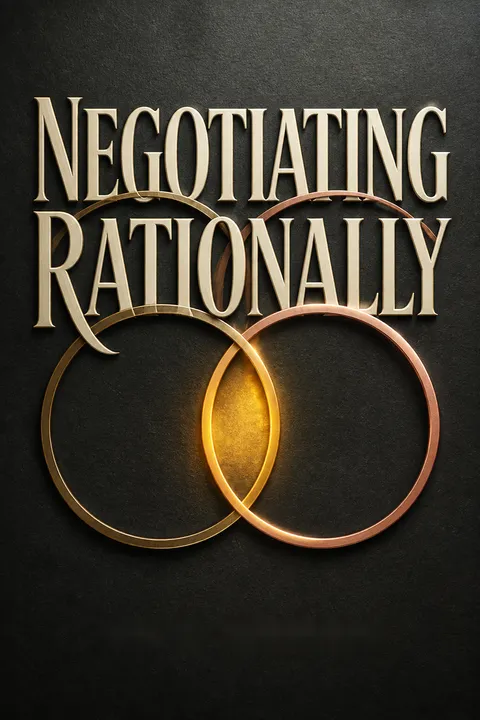
Negotiating Rationally receives mixed reviews, with an average rating of 3.83/5. Readers appreciate its fundamental negotiation concepts and real-world applicability, citing its usefulness for both personal and professional situations. Some find it dry but informative, while others praise its simplicity and non-technical approach. Critics note outdated examples and a lack of depth for novice negotiators. The book's focus on financial negotiations and decision-making biases is apparent, with some readers finding it more suitable for experienced negotiators or academics.
People Also Read







Glossary
BATNA
Best alternative to agreementBATNA means Best Alternative To a Negotiated Agreement. It is the course of action available if talks fail, such as buying from another seller or keeping an existing asset. Comparing an offer with this alternative helps a negotiator decide whether agreement is preferable to impasse and identify a minimum acceptable outcome.
reservation price
Walk-away thresholdA reservation price is the point at which a negotiator is indifferent between accepting an offer and choosing the alternative to agreement. For a buyer, it may be the maximum price worth paying; for a seller, the minimum worth accepting. It follows from the value of the party's BATNA.
bargaining zone
Range both sides acceptThe bargaining zone is the range of agreements that both parties prefer to their alternatives. Its boundaries are set by the parties' reservation prices. If those acceptable ranges overlap, there is a positive zone for agreement. If they do not, the zone is negative, and no agreement on the existing terms benefits both sides.
mythical fixed-pie
Assumed win-lose divisionThe mythical fixed-pie is the assumption that one party's gain must be the other party's loss. It encourages negotiators to focus on dividing value rather than identifying different priorities, interests, or assessments. When parties value issues differently, trading across those issues can produce an agreement better for both than a simple compromise.
endowment effect
Ownership raises perceived valueThe endowment effect is the tendency for people to value something more once they own it. Giving it up can feel like a loss, so a seller may demand more than a buyer would pay for the same item. The book uses coffee-mug experiments to show how ownership changes stated valuations.
winner's curse
Winning by overestimating valueThe winner's curse occurs when the winning bidder has offered more than an item or opportunity is worth, often because the winner had the most optimistic estimate. It is especially likely when value is uncertain and many bidders have comparable information. In negotiations, quick acceptance can also signal that the seller knows something the buyer does not.
TIT FOR TAT
Reciprocate the previous moveTIT FOR TAT is a strategy for repeated prisoner's dilemma interactions. It cooperates on the first move, then responds in each round with the other party's previous action. This makes cooperation possible without accepting persistent exploitation. Its success depends on parties recognizing one another's actions and expecting future interaction.
post-settlement settlement
Improve an agreement after acceptanceA post-settlement settlement is a search for a better agreement after parties have already reached an acceptable one. The initial deal remains in force unless both parties prefer the improved proposal. This creates a relatively safe opportunity to discover additional joint value without risking the agreement already secured.
social dilemma
Individual gain harms the groupA social dilemma arises when individually attractive choices produce a worse outcome for the group if many people make them. In the shared-pasture example, each herdsman gains by adding cattle, but collectively they can overgraze and destroy the resource. Cooperation may require communication, repeated interaction, or rules that limit harmful incentives.
FAQ
What's "Negotiating Rationally" about?
- Overview: "Negotiating Rationally" by Max H. Bazerman and Margaret A. Neale explores the common mistakes people make in negotiations and provides strategies to negotiate more effectively.
- Focus: The book emphasizes the importance of rational thinking in negotiations, drawing on decision theory, game theory, and psychology.
- Structure: It is divided into three parts: common negotiation mistakes, a rational framework for negotiation, and strategies for complex negotiations.
- Goal: The authors aim to help readers make better decisions in negotiations by understanding and avoiding cognitive biases.
Why should I read "Negotiating Rationally"?
- Practical Advice: The book offers actionable strategies to improve negotiation outcomes, making it valuable for anyone involved in negotiations.
- Research-Based: It is grounded in extensive research and real-world examples, providing credibility and depth to the advice given.
- Broad Application: The concepts apply to various negotiation contexts, from business deals to personal interactions.
- Skill Development: Reading the book can enhance your negotiation skills, leading to better decision-making and more favorable agreements.
What are the key takeaways of "Negotiating Rationally"?
- Avoiding Biases: Recognize and mitigate common cognitive biases like anchoring, overconfidence, and the winner's curse.
- Rational Framework: Use a structured approach to evaluate alternatives, interests, and priorities in negotiations.
- Integrative Agreements: Focus on creating mutually beneficial trade-offs rather than viewing negotiations as zero-sum games.
- Preparation and Adaptation: Emphasize the importance of preparation and the ability to adapt strategies based on new information.
What are the best quotes from "Negotiating Rationally" and what do they mean?
- "Negotiating rationally means making the best decisions to maximize your interests." This quote underscores the book's central theme of using rational decision-making to achieve optimal negotiation outcomes.
- "The best choice for your organization means making the best decision based on future costs and benefits, and ignoring any previous commitments." It highlights the importance of focusing on future gains rather than past investments.
- "Negotiation is challenging and exciting. It should also be one of the most honed and effective tools in your arsenal." This emphasizes the value of negotiation skills in achieving personal and professional success.
How does "Negotiating Rationally" define rational negotiation?
- Maximizing Interests: Rational negotiation involves making decisions that maximize your interests and outcomes.
- Beyond Agreement: It is not just about reaching an agreement but ensuring the agreement is beneficial.
- Avoiding Illusions: The book advises against the illusion of "getting to yes" at any cost, emphasizing the importance of knowing when to walk away.
- Decision-Making Framework: It provides a framework for evaluating alternatives, interests, and priorities to guide rational decision-making.
What are common negotiation mistakes according to "Negotiating Rationally"?
- Irrational Escalation: Continuing a course of action beyond what is rational due to sunk costs or ego.
- Fixed-Pie Assumption: Believing that one party's gain is another's loss, which limits creative problem-solving.
- Anchoring and Adjustment: Being overly influenced by initial offers or irrelevant information.
- Overconfidence: Overestimating one's ability to predict outcomes or the likelihood of success.
How does "Negotiating Rationally" suggest overcoming cognitive biases?
- Awareness: Recognize and understand the biases that can affect decision-making.
- Preparation: Thoroughly prepare by evaluating alternatives and understanding both parties' interests.
- Information Sharing: Encourage open communication to uncover underlying interests and create integrative agreements.
- Continuous Learning: Use feedback from negotiations to refine strategies and improve future outcomes.
What is the "winner's curse" in "Negotiating Rationally"?
- Definition: The winner's curse occurs when a party wins a negotiation or auction but overpays due to incomplete information.
- Common Contexts: It is prevalent in competitive bidding situations where the winner often overestimates the value of the prize.
- Avoidance Strategies: The book advises lowering bids in uncertain situations and seeking independent appraisals to avoid overpaying.
- Awareness: Understanding the winner's curse helps negotiators make more informed and rational decisions.
How does "Negotiating Rationally" address the role of fairness and emotion?
- Fairness: The book acknowledges that perceptions of fairness can influence negotiation outcomes and should be considered.
- Emotion: Emotions can impact decision-making, and negotiators should be aware of their own and others' emotional states.
- Balancing Rationality: While rationality is crucial, understanding fairness and emotion can lead to more effective negotiations.
- Social Comparisons: The book discusses how social comparisons and relationships affect perceptions of fairness and decision-making.
What strategies does "Negotiating Rationally" offer for complex negotiations?
- Building Trust: Establish trust and share information to facilitate integrative agreements.
- Multiple Offers: Present multiple offers simultaneously to gather information and show flexibility.
- Post-Settlement Settlements: After reaching an agreement, explore further improvements that benefit both parties.
- Using Differences: Leverage differences in expectations, risk preferences, and time preferences to create value.
How does "Negotiating Rationally" suggest handling group negotiations?
- Coordination: Manage the complexity of multiple parties by establishing clear decision rules and agendas.
- Avoiding Majority Rule: Majority rule can lead to suboptimal outcomes; seek consensus or unanimity when possible.
- Coalitions: Be aware of coalition dynamics and strive for solutions that benefit the entire group.
- Integrative Focus: Encourage group members to share preferences and explore creative solutions for integrative agreements.
What role do third parties play in negotiations according to "Negotiating Rationally"?
- Mediators: Facilitate agreements by controlling interactions but cannot impose solutions.
- Arbitrators: Impose binding decisions, with strategies differing between conventional and final-offer arbitration.
- Agents: Represent one party's interests, often with their own incentives that may not align with the client's.
- Managers: As informal third parties, managers can mediate, arbitrate, or impose solutions based on the situation.
About the Author
Other books by Max H. Bazerman


Download PDF
Download EPUB
.epub digital book format is ideal for reading ebooks on phones, tablets, and e-readers.








