

Key Takeaways
Dead economists still write today's policy, so learn their living ideas
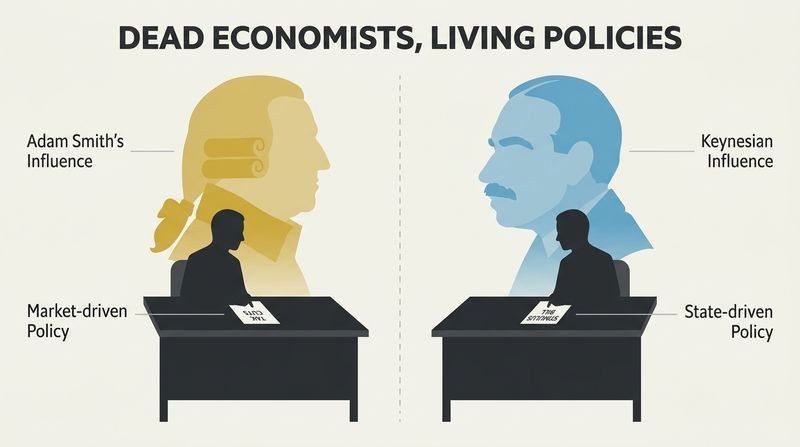
Economics is the study of choice under scarcity. Buchholz argues that today's debates on trade, inflation, taxes, and poverty were fought two centuries ago by a handful of brilliant, quarrelsome thinkers, and their ghosts still shape our prosperity. Reagan's conservatives wore Adam Smith neckties; every president from Roosevelt to Nixon could have worn a Keynes cravat.
The messenger gets blamed. Carlyle branded economics the "dismal science," but economists rarely cause bad news, they only report that we cannot have cleaner air and faster cars, bigger houses and bigger parks, all at once. Understanding the chain from Smith to Malthus to Ricardo to Marx to Keynes to Friedman is not academic nostalgia. It is the operating manual for reading a newspaper intelligently.
The book's framing device (great ideas embodied in vivid, flawed personalities) mirrors how humans actually retain abstract concepts: through story and character. Cognitive psychologists call this the "narrative bias." A caveat worth noting: Buchholz deliberately confines himself to the Anglo-American tradition, sidelining Walras, Menger, and the Austrians, so readers get a particular lineage rather than the whole discipline. Still, the central claim holds up. When politicians reach for protectionism or price controls, they are usually re-litigating settled arguments, unaware they are channeling mercantilists Smith demolished in 1776.
Self-interest, not benevolence, coordinates a prosperous economy through the invisible hand

The butcher feeds you from self-regard, not kindness. Adam Smith's 1776 masterpiece argued that individuals pursuing their own gain are guided "as if by an invisible hand" to serve strangers. A woodcarver who makes hideous vultures nobody wants goes bankrupt, correctly, because he destroyed value by turning scarce wood into something worth less. A carpenter who builds sellable tables gets society's thumbs-up. Prices and profits are signals, screaming at entrepreneurs what to produce and what to charge.
No central planner could gather the information. Hayek later sharpened this with the example of tin: when tin grows scarce, the price rises, and millions economize without knowing why. The market transmits dispersed knowledge that no bureau could ever assemble. Society should harness humanity's strongest motive rather than depend on charity.
Smith's insight anticipates modern complexity theory and distributed systems: order emerges bottom-up without a designer. What's often forgotten is that Smith, a moral philosopher, wrote an entire earlier book on sympathy and conscience (the "impartial spectator"), so he never claimed humans are purely selfish, only that self-interest is the most reliable fuel. Behavioral economics complicates the picture, showing people are neither perfectly rational nor purely selfish. And the invisible hand fails with externalities like pollution, where private costs and social costs diverge. Smith himself flagged monopolies and merchant conspiracies as the hand's chief saboteurs.
Never extrapolate a trend without expecting technology to break it

Malthus predicted doom and got it spectacularly wrong. In 1798 Thomas Malthus argued population grows geometrically (1, 2, 4, 8, 16) while food grows only arithmetically (1, 2, 3, 4, 5), so starvation, war, and plague were humanity's inevitable checks. It was a mathematically tidy nightmare. Reality refused to cooperate: an agricultural revolution doubled English output per worker between 1700 and 1800, medicine cut death rates, and birthrates fell as societies urbanized (the "demographic transition").
The doomsayers keep returning. The 1972 Club of Rome, Paul Ehrlich's population bomb, all repeated Malthus's error of assuming static technology. In 1980 economist Julian Simon bet Ehrlich that five metals would fall in price despite population growth. Simon won. Scarcity raises prices, which spurs substitutes and innovation.
Malthus's failure is a masterclass in the perils of linear projection, a lesson that recurs across disciplines from climate modeling to AI forecasting. The deeper principle: human ingenuity is an endogenous variable, not a constant. Julian Simon's wager crystallized this, though critics note he got lucky on timing (commodity prices are cyclical, and a different decade might have favored Ehrlich). The demographic transition is the real hero here, and it now threatens the opposite problem. Countries from Japan to Italy face population collapse, not explosion. Malthus inverted.
Trade enriches both nations even when one makes everything cheaper
Comparative advantage is economics' least intuitive, most important idea. David Ricardo showed that two parties should specialize in whatever they sacrifice least to produce, then trade, even if one is worse at everything. Imagine a skilled skipper and clumsy Gilligan stranded together. The skipper is faster at both fishing and building huts, yet total output rises if he builds huts (his smaller sacrifice) while Gilligan fishes. The key concept is opportunity cost: what you give up to make something.
Protectionism robs consumers to enrich a few producers. When Japanese carmakers "voluntarily" limited exports in the 1980s, American car prices rose roughly 3,000 dollars, costing consumers far more than the jobs saved were worth. Bush's 2002 steel tariffs spiked prices 30 to 50 percent and were ruled illegal. Free markets are not pain-free, but barriers spiral economies downward.
Comparative advantage remains counterintuitive enough that most politicians still cannot follow it, which is precisely why Ricardo bothered proving it. The logic scales fractally: it explains why individuals, cities, and nations all gain from specialization. Modern trade economics adds nuance Ricardo lacked, including adjustment costs, distributional pain, and the case that displaced workers deserve direct compensation and retraining rather than tariffs. The China shock literature (Autor and colleagues) shows import competition can devastate specific communities even as it lifts aggregate welfare. Ricardo's theorem is airtight on the whole; the fights are about who bears the transition.
Marx's exploitation theory collapsed because value comes from more than labor
Capitalism digs its own grave, Marx predicted. He argued that all value derives from labor, so any profit must be "surplus value" stolen from workers paid mere subsistence. Competition forces owners to replace workers with machines, which cuts profit rates, concentrates capital, deepens depressions, and swells a miserable proletariat until revolution erupts. He called his method historical materialism: the mode of production shapes a society's laws, religion, and morality (the "superstructure").
The prophecy failed on its own terms. Workers' living standards soared instead of sinking. Marx quietly switched from claiming absolute impoverishment to relative impoverishment. His labor theory of value ignored entrepreneurship, imagination, and the reward for delayed gratification. Velcro was invented by a man noticing burrs on his socks, not by exploiting anyone. Value flows from demand and risk-taking, not labor alone.
Marx endures less as an economist than as a diagnostician of alienation and power, which is why radical economics survives in pockets. His fatal flaw, as Marshall argued, was treating capital's "waiting" (deferred consumption) as costless. The marginalist revolution buried the labor theory of value by showing worth is set at the margin by what buyers will pay. Regimes claiming his name industrialized agrarian nations Marx explicitly said were unready, then produced famine and dictatorship. The tragedy Buchholz highlights: a utopia promising more than a world of scarcity and self-interest can deliver mesmerized good people into defending brutal regimes.
Analyze every decision at the margin, comparing the next step's cost and benefit
Forget where you have been; ask whether the next step pays. Alfred Marshall's marginalism says rational actors keep doing something until the marginal benefit equals the marginal cost. A firm produces cars until the revenue from one more car equals the cost of making it. A student crams until the fatigue from one more hour outweighs the exam gain. Sunk costs are irrelevant.
Supply and demand cut like two blades of a scissors. Marshall settled the old fight over whether cost (supply) or utility (demand) sets prices: both do, jointly. He introduced elasticity (how much quantity responds to price changes) and distinguished short run from long run. He treated economics like biology, evolving and gradual ("nature makes no leaps"), where fit firms survive and bloated ones get eaten by lean rivals, keeping monopolies from lasting forever.
Marginal thinking is arguably the single most transferable tool in economics, reaching into ethics (marginal utility of a donated dollar), ecology, and personal productivity. Marshall's genius was pedagogical restraint: he buried the calculus in footnotes and led with plain English, warning that elegant models risk becoming "scientific toys." His biological metaphor now looks prescient given evolutionary economics and complexity theory. One limitation: the assumption that firms smoothly equate margins presumes information and flexibility that real markets, bound by contracts and habit, often lack, a gap that later behavioral and institutional economists would exploit.
Status and advertising, not pure utility, drive much of what we buy
Veblen mocked the "lightning calculator" model of humans. Thorstein Veblen, the eccentric outsider who lectured on cannibalism and gave everyone C's, argued people are not independent globules weighing costs and benefits. They watch the neighbors. His "conspicuous consumption" explains why designer labels moved from inside the collar to blazing across the chest: the point is signaling that you can afford it. Some goods sell more as prices rise (Ursinus College raised tuition 18 percent and applications jumped 35 percent).
Galbraith took it further with the dependence effect. Corporations manufacture the very wants they then satisfy, so "consumer sovereignty" is a myth. Hayek countered: if externally created wants are trivial, so is all culture, including Mozart, which nobody craved before it existed. Advertising informs as well as manipulates.
Veblen was decades ahead of behavioral economics and social-signaling theory. Modern work on "positional goods" (Robert Frank) and luxury branding confirms that relative status, not absolute consumption, drives much spending, with real welfare costs since status is zero-sum. Yet Hayek's rebuttal to Galbraith lands hard: the line between manufactured and authentic desire is philosophically slippery, and dismissing acquired tastes as inauthentic would gut art, literature, and civilization itself. Empirical work shows advertising for experience goods often conveys genuine information (eyeglass prices fell 25 to 30 percent where ads were allowed), muddying Galbraith's cleaner story.
When private spending collapses, government spending can fill the gap
Keynes overturned the belief that economies self-correct. Classical economics rested on Say's Law: supply creates its own demand, so gluts and lasting unemployment are impossible. The Great Depression (US unemployment rocketing from 3 to 25 percent) demolished that faith. Keynes argued that saving and investment are done by different people for different reasons, so interest rates do not automatically reconcile them, and wages are "sticky" downward.
Deficient demand is the disease; stimulus is the cure. When households hoard, merchants fire workers, who then spend less, a downward spiral. The multiplier means an initial injection of spending ripples outward, so a well-timed tax cut or public works program can restart the engine. The 1964 Kennedy-Johnson tax cut worked beautifully. Balanced budgets during recessions, Keynes insisted, are self-defeating.
Keynes rescued capitalism from both its complacent defenders and its Marxist gravediggers by showing the state could stabilize rather than replace markets. His concept of "animal spirits" (investment driven by irrational confidence and his beauty-contest metaphor for markets) anticipated behavioral finance by sixty years. The vulnerabilities surfaced in the 1970s stagflation, which the simple Keynesian model could not explain, and in the political economy critique that governments run deficits in booms too, never the promised surpluses. Multiplier estimates remain fiercely contested, ranging from near-zero to above 1.6 depending on slack, monetary offset, and whether stimulus is seen as permanent.
Money matters, but its velocity is a riddle that humbles forecasters
Friedman resurrected the quantity theory Keynes had buried. The equation MV=PQ says money supply times velocity (how fast money changes hands) equals prices times output. Milton Friedman argued that velocity and consumption are stable because people plan around lifetime "permanent income," not this week's paycheck, so temporary tax changes fizzle (the 1968 and 1975 temporary tax moves flopped). His 1963 study pinned the Depression on the Federal Reserve letting the money supply shrink by a third.
Then velocity betrayed the monetarists. Friedman wanted the Fed replaced by a robot expanding money at a fixed 3 to 5 percent, since the Fed's timing lags cause more harm than good. But after 1982, velocity, stable for 34 years, suddenly plunged nearly 5 percent, forcing even monetarist policymakers to abandon rigid rules.
The Keynesian-monetarist duel produced today's pragmatic synthesis, memorably described as putting Keynes's head on Friedman's body. Friedman's permanent-income hypothesis was a genuine advance, echoed in modern consumption-smoothing models, and his warning about policy lags remains sobering. The collapse of stable velocity is a humbling epilogue: financial innovation, deregulated interest-bearing checking, and mortgage refinancing all scrambled the money-demand relationship. This is why central banks from the Fed to the ECB quietly downgraded money-supply targeting. The episode illustrates Goodhart's Law: once an indicator becomes a policy target, its historical stability tends to break down.
Treat politicians as self-interested vote-maximizers, not selfless public servants
Public Choice applies economics to government itself. James Buchanan won a Nobel for asking: if businessmen are self-interested, why assume bureaucrats and legislators are saints? Bureaucrats maximize budgets and staff; politicians maximize votes. This explains chronic deficits (spending is pleasurable, taxes painful, and the harm is indirect and future).
Concentrated interests beat diffuse majorities. A milk lobby representing 1 percent of the population fights hard for price supports because each producer gains 4 dollars while each consumer loses 4 cents, so nobody bothers to resist ("rational ignorance"). Sugar growers, 0.0002 of Americans, keep US sugar at triple the world price. The "capture theory" adds that regulated industries often capture their regulators (Arizona demanded 1,600 training hours for hairstylists versus 600 for police).
Public Choice is the indispensable corrective to naive policy analysis that compares messy markets against an idealized, benevolent state. Buchanan's insight (that government failure is as real as market failure) reshaped political science and constitutional economics. Yet the school can overreach into cynicism: the 1990s budget surpluses, driven partly by grassroots deficit-hawk movements, showed voters are not always passive or ignorant, and many public servants act on genuine conviction. Olson's provocative extension (that stable societies ossify under accumulated special interests while wars and revolutions clear them out) is elegant but empirically shaky, hard to square with the sustained growth of long-stable democracies.
You cannot beat the market, because prices already price in the news
Rational Expectations says people stop making systematic mistakes. Unlike the cartoon coyote who keeps getting flattened, rational actors update their models with all available information. Applied to stocks, this is the Efficient Market Hypothesis: share prices instantly absorb public information, so yesterday's good news is useless and you may as well pick stocks by dart board. In the 1990s, passive index funds beat most professional managers after fees.
The radical version overreaches. New Classical economists claim government stimulus fails because people anticipate it, and only surprises move output. But the 1982 recession that drove unemployment to 10.6 percent and the Great Depression are hard to wave away as mere "surprises." Behavioral economics (Kahneman and Tversky) shows people hate losses irrationally, cling to losing stocks, and answer identical questions differently depending on framing.
The efficient-market and behavioral schools are less opposed than they appear: markets can be hard to beat precisely because so many smart people try, yet still swing on "animal spirits" during bubbles and crashes. The 2000 tech collapse and the LTCM blowup (which sank two Nobel laureates who bet the world's interest rates would converge) are cautionary tales about mistaking mathematical elegance for reality. Kahneman's prospect theory, honored with a 2002 Nobel, reshaped economics by documenting systematic irrationality. The mature view, as Tobin quipped, is that hunting only under the streetlamp of perfect rationality leaves the lost purse in the dark.
A country's attitude toward ideas beats its latitude and resources
Endowments matter less than openness. Buchholz's "attitude over latitude" thesis: resource-poor Hong Kong, the Netherlands, and Israel thrived while resource-rich Africa and the Soviet Union stagnated. Mexico borders the wealthiest nation on earth and stayed poor; Australia, settled by convicts a twelve-hour flight from anywhere, prospered. A big endowment can even be a curse, letting oligarchs hoard while ideas fail to spread.
Success favors the hungry, the humble, and the limber. Russia's 1998 crash taught that free markets require a dependable legal system, courts to enforce contracts, and agencies to collect taxes, or they degenerate into crony capitalism. Economic growth, Buchholz concludes, rests on educated populations, entrepreneurial drive, and the free flow of ideas that Solow and Romer identified as the true engines of prosperity.
This synthesis aligns with the institutional turn in development economics, most powerfully argued by Acemoglu and Robinson, who show that inclusive institutions (property rights, rule of law, open competition) explain why some nations fail and others flourish. The "resource curse" is well documented: oil and mineral wealth often correlates with weaker growth, authoritarianism, and corruption. Romer's endogenous growth theory, honored with a Nobel, formalized the claim that ideas, being non-rival and infinitely reusable, are the ultimate source of rising living standards. The one caution: culture and "attitude" risk becoming unfalsifiable catch-alls unless anchored, as Buchholz does, in concrete institutions like courts and schools.
Analysis
Buchholz's achievement is structural: by hanging abstract theory on vivid biography (Smith walking fifteen miles in his nightgown, Marx impregnating the maid, Keynes trading commodities from bed) he solves nonfiction's retention problem. Ideas stick to characters. The book is best read as an intellectual relay race, each economist correcting a predecessor: Smith's invisible hand, Malthus's demographic pessimism, Ricardo's comparative advantage, Marx's dialectical critique, Marshall's marginalist synthesis, Keynes's demand management, Friedman's monetarist counterrevolution, Buchanan's political skepticism, and the Rational Expectations and behavioral schools' dueling views of human rationality.
The deeper argument is dialectical in a non-Marxist sense: economics advances not by cumulative certainty but by discovering the limits of prior models. Say's Law reigned until the Depression; monetarism triumphed until velocity collapsed; Rational Expectations dazzled until behavioral anomalies piled up. Buchholz's honesty about this churn is the book's intellectual virtue. He resists the pundit's temptation to crown a winner, ending instead with a pragmatic eclecticism ("we are all Keynesians, all monetarists, all eclectics now").
Written from a broadly free-market, center-right perch (Buchholz served in the George H.W. Bush White House), the book tilts sympathetic to Smith, Friedman, and Public Choice, and treats Marx as a cautionary tale. Readers should note this framing, and the deliberate exclusion of the continental and Austrian traditions. Its dating shows: the 2007 revisions predate the 2008 financial crisis, which resurrected Keynesian stimulus and Minsky-style instability theories the book barely anticipates, and the subsequent decades of low inflation despite massive money creation further complicate the monetarist story.
Still, the core pedagogy endures. The recurring lesson, from Malthus's failed extrapolations to velocity's betrayal of monetarists, is epistemic humility. Economics offers tendencies, not Newtonian laws, because its subject (human choice) shifts as we study it. The practical payoff is a citizen's toolkit: recognize when politicians re-fight settled battles over trade, price controls, and deficits, and understand the invisible hand's genuine power and its genuine failures.
Review Summary
New Ideas from Dead Economists presents an accessible overview of economic thought, covering major economists and their theories. Readers appreciate its engaging writing style and humor, though some note bias in certain chapters. The book provides a solid introduction to economic history and concepts for laypeople, explaining complex ideas through relatable examples. While some find it dated, many praise its ability to make economics understandable and interesting. Critics argue it oversimplifies certain theories and shows favoritism towards particular economic schools of thought.
People Also Read







Glossary
Invisible hand
Self-interest unintentionally serving societyAdam Smith's metaphor for how individuals pursuing their own gain are guided, without intending it, to promote the general good. In a competitive market, self-interested producers must make what others want, in the quantities others want, at prices reflecting others' valuations, so private ambition yields social benefit without any central planner directing it.
Comparative advantage
Specialize where sacrifice is leastRicardo's principle that two parties gain from trade if each specializes in what it produces at the lowest opportunity cost, even when one party is more efficient at producing everything. The gains come from minimizing what each gives up, not from being absolutely better, which is why trade enriches both rich and poor nations.
Surplus value
Profit extracted from underpaid laborMarx's term for the gap between the value workers add to a product and the subsistence wage they are paid. Because Marx held that labor alone creates value, he argued this surplus, seized by owners as profit, is exploitation. Critics counter that value also flows from entrepreneurship, risk-taking, and consumer demand, undermining the concept.
Marginalism
Decisions made at the incrementThe approach, refined by Marshall, that rational actors evaluate the additional (marginal) cost and benefit of one more unit of activity, continuing until marginal cost equals marginal benefit. Past or sunk costs are irrelevant to the next decision. It underpins modern microeconomics and explains pricing, production, and consumption choices.
Conspicuous consumption
Buying to display social statusVeblen's term for spending aimed at signaling wealth and status to others rather than satisfying genuine need. It explains why some goods (designer labels, luxury cars) become more desirable as prices rise, contradicting the standard law of demand. Such items are sometimes called Veblen goods.
The multiplier
Spending ripples through the economyKeynes's concept (borrowed from Richard Kahn) that an initial change in spending produces a larger total change in national income, because each recipient re-spends part of the money. If people spend two-thirds of extra income, the multiplier is 3, so a given injection of government spending can close a much larger recessionary gap.
Say's Law
Supply creates its own demandThe classical proposition, named for J.B. Say, that the act of producing goods generates enough income to buy all those goods, making general gluts and lasting unemployment impossible. Keynes attacked it, arguing that savings can leak out of the spending stream, producing deficient demand and prolonged depressions.
Velocity of money
How fast money circulatesThe rate at which the money stock changes hands in a year, calculated as GDP divided by the money supply. Monetarists argued velocity is stable, making the money supply a powerful policy lever; Keynesians saw it as unstable. After 1982 velocity behaved erratically, undermining strict monetarist prescriptions.
Permanent Income Hypothesis
Consumption tracks lifetime expected incomeFriedman's theory that people base spending on their expected long-run (permanent) income rather than current income, smoothing consumption across good and bad years by saving or drawing down savings. It implies temporary tax cuts or rebates have weak effects, since consumers recognize them as fleeting and bank the money.
Public Choice school
Economics applied to politicsA movement founded by James Buchanan that analyzes government using economic tools, assuming politicians maximize votes and bureaucrats maximize budgets rather than serving the public interest. It explains chronic deficits, special-interest capture, and regulatory failure, arguing that government failure must be weighed realistically against market failure.
Rational ignorance
Not worth learning the costThe Public Choice idea that voters rationally choose to stay uninformed about policies whose per-person cost is tiny, because the effort of learning exceeds the personal stake. This lets concentrated interest groups win favors (like farm price supports) that impose small, unnoticed costs on millions of diffuse consumers.
Efficient Market Hypothesis
Prices already reflect all informationThe Rational Expectations claim that stock prices instantly incorporate all publicly available information, so no one can consistently beat the market average using public data or past price patterns. It implies passive index investing outperforms most active managers, though it excludes inside information and is challenged by bubbles and crashes.
Attitude over latitude
Ideas beat geography and resourcesBuchholz's thesis that a nation's prosperity depends more on its openness to ideas, entrepreneurship, education, and rule of law than on its geographic location or natural resources. Resource-poor Hong Kong and Israel thrived while resource-rich regions stagnated, and abundant endowments can even become a curse by entrenching oligarchies.
FAQ
What's New Ideas from Dead Economists about?
- Exploration of Economic Thought: The book introduces modern economic theories through the lives and ideas of influential economists, from Adam Smith to John Maynard Keynes.
- Historical Context: It examines how historical events and societal changes influenced economic thought, highlighting the relevance of these ideas today.
- Accessible Writing: Todd G. Buchholz uses clear language and relatable examples to make complex economic theories understandable for lay readers.
Why should I read New Ideas from Dead Economists?
- Engaging Narrative: The book is praised for its witty and engaging style, making economics enjoyable rather than daunting.
- Understanding Economic Principles: It provides a foundational understanding of key economic concepts, essential for informed discussions about current economic policies.
- Historical Relevance: By connecting past economic theories to present-day issues, the book helps readers appreciate the evolution of economic thought.
What are the key takeaways of New Ideas from Dead Economists?
- Influence of Historical Economists: Economists like Adam Smith and Karl Marx have shaped modern economic policies and debates, with lasting impacts.
- Economic Theories Explained: Concepts such as the "invisible hand," comparative advantage, and the labor theory of value are explained in relatable terms.
- Critique of Economic Policies: Buchholz critiques contemporary policies through historical theories, encouraging critical thinking about their effectiveness.
What are the best quotes from New Ideas from Dead Economists and what do they mean?
- Adaptability and Resilience: “The history of economic thought teaches us that success often goes to the hungry, the humble, and the limber.”
- Self-Interest in Economics: “It is not from the benevolence of the butcher, the brewer, or the baker, that we expect our dinner, but from their regard to their own interest.”
- Caution Against Oversimplification: “The principal cause of error... appears to me to be, a precipitate attempt to simplify and generalize.”
Who are the main economists discussed in New Ideas from Dead Economists?
- Adam Smith: Known as the father of modern economics, his ideas about free markets and the "invisible hand" are foundational.
- Karl Marx: His critique of capitalism and theories on class struggle provide a counterpoint to classical economic theories.
- John Stuart Mill: His contributions to utilitarianism and views on social justice highlight the ethical dimensions of economics.
What is the significance of the "invisible hand" in New Ideas from Dead Economists?
- Market Self-Regulation: The "invisible hand" describes how self-interest can lead to positive societal outcomes, like economic growth.
- Critique of Government Intervention: Buchholz argues against excessive regulation, suggesting markets function best independently.
- Real-World Applications: The book illustrates how this concept operates in various scenarios, showing individual actions can benefit society.
How does New Ideas from Dead Economists address the concept of comparative advantage?
- Definition and Importance: Comparative advantage occurs when a country or individual can produce a good at a lower opportunity cost, leading to efficient trade.
- Example of Specialization: Buchholz uses examples to show how trade benefits parties, even if one is more efficient in all tasks.
- Implications for Trade Policy: Understanding comparative advantage is crucial for policies that enhance overall welfare through free trade.
What critiques does New Ideas from Dead Economists offer regarding modern economic policies?
- Criticism of Protectionism: Protectionist policies like tariffs harm consumers and hinder growth, echoing Ricardo's views on free trade.
- Ineffectiveness of Welfare Programs: Welfare policies that discourage work can perpetuate poverty rather than alleviate it.
- Need for Economic Literacy: Understanding economic principles is vital for informed policy decisions affecting everyday life.
How does Buchholz connect historical economic theories to contemporary issues in New Ideas from Dead Economists?
- Relevance of Historical Context: Past economists' ideas inform current debates on trade, taxation, and government intervention.
- Case Studies and Examples: Contemporary examples show how historical theories apply to modern challenges, making content relatable.
- Encouragement of Critical Thinking: Linking historical theories to present issues encourages critical evaluation of current policies.
What is the Marginalist Consumer concept in New Ideas from Dead Economists?
- Marginal Utility Explained: Consumers make decisions based on the additional satisfaction from consuming one more unit of a good.
- Diminishing Returns: Additional satisfaction diminishes with more consumption, affecting willingness to pay.
- Demand Curve Relationship: This principle leads to the law of demand, illustrating the downward-sloping demand curve.
How does New Ideas from Dead Economists explain the relationship between inflation and unemployment?
- Phillips Curve Concept: Suggests an inverse relationship where lower unemployment can lead to higher inflation.
- Friedman's Critique: Argues the relationship is unstable, and exploiting it can lead to stagflation.
- Policy Implications: Emphasizes the need for a balanced approach to managing inflation and unemployment.
What is the Efficient Market Hypothesis mentioned in New Ideas from Dead Economists?
- Market Efficiency: Posits that financial markets are "informationally efficient," with asset prices reflecting all available information.
- Implications for Investors: Suggests it's impossible to consistently achieve higher returns than the market average.
- Behavioral Economics Challenge: Highlights irrational investor behavior, suggesting markets may not always behave rationally.
Download PDF
Download EPUB
.epub digital book format is ideal for reading ebooks on phones, tablets, and e-readers.








