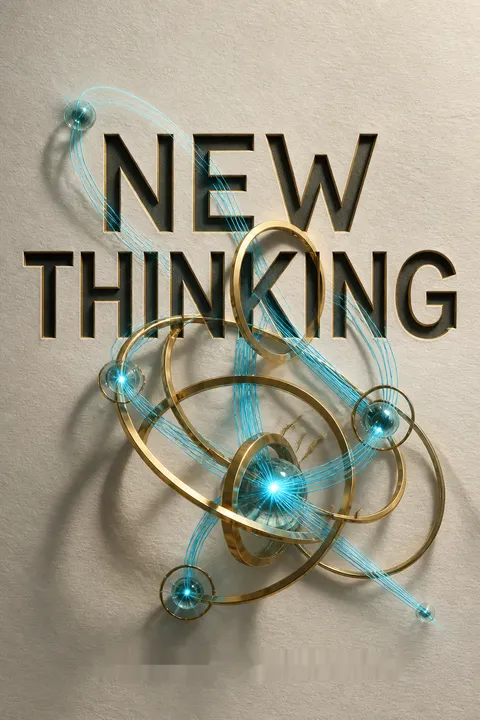


Key Takeaways
Build on yesterday's tools, because innovation compounds through feedback.
Progress has a memory. The book's central idea is that inventions rarely arrive alone. One generation's tools become the materials and starting points for the next. Steam engines improved mining, factories, and transport; electrical generators built on discoveries about magnetism; and transistors made smaller, more capable computers possible. Each advance creates new problems and opportunities, which invite further invention. James Watt's separate condenser made steam engines use about 75 percent less fuel than Newcomen's design, helping make wider industrial use practical.
A growing chain. This process is not simply a parade of isolated geniuses. New tools change what people can build, how they work, and what they expect. The book follows that chain from steam power to the connected, computational world of the 2010s.
What's striking is how closely this account resembles path dependence: once a society invests in a technology, later choices tend to build around it. Railways, power grids, and computer networks are valuable partly because many other systems already depend on them. That creates momentum, but it can also lock in awkward designs. Innovation therefore compounds, yet not always toward the best possible outcome. The useful question is not only what a new invention enables, but what infrastructure, habits, and dependencies it makes harder to change.
Connect people and machines, and distance stops dictating what can be shared.
From signals to voices. Electricity first made communication travel faster than people or ships. Wheatstone and Cooke demonstrated a working telegraph in 1837, and Samuel Morse's simpler code helped telegraphy spread. In 1861, a message could travel between San Francisco and Washington by wire, putting the Pony Express out of business. The telephone then carried speech over distance, while radio let whole audiences receive the same news, music, and drama at once.
Shared moments. Television extended that experience by adding images. The book treats these inventions as more than convenient devices: each changed who could communicate, how quickly information traveled, and what a community could experience together. A broadcast could make distant events part of ordinary life almost immediately.
Communication technologies do more than reduce the cost of sending a message. They alter the scale of coordination. A telegraph can synchronize railways and markets; radio can create a shared public audience; television can make a political event feel immediate and personal. This is a useful reminder that communication infrastructure shapes institutions, not just conversations. Yet faster transmission does not guarantee better understanding. The same channel that carries reliable information can also carry mistakes, manipulation, or panic.
Make inventions affordable and usable, and they can remake ordinary life.
Access changes adoption. Henry Ford's Model T shows how production methods can matter as much as the invention itself. By dividing assembly into specialized steps and using moving belts, Ford's factory cut production time from more than twelve hours to about ninety-three minutes. The Model T's price fell from $850 to $260, making car ownership possible for many working families. Roads, businesses, and travel habits changed with it.
Put complexity behind the curtain. George Eastman's Brownie camera applied the same principle to photography. It was simple and cheap enough for children, selling 250,000 units in its first year. The book also recounts Jonas Salk's polio vaccine, which helped make a once-feared disease rare. In each case, broad impact depended on getting a useful technology into people's hands.
These examples point to a key distinction between invention and diffusion. A breakthrough matters socially when production, distribution, and ease of use make it available beyond specialists or the wealthy. The economics of adoption often hinge on complements: cars need roads, cameras need film, and vaccines need organized delivery. The history also cautions against treating affordability as the only measure of success. Mass access can bring enormous benefits, but it can also scale environmental costs or social disruption.
War compresses invention timelines, but progress arrives with terrible human costs.
Urgency accelerates research. During World War I, aircraft evolved from fragile experiments into military tools, while submarines and machine guns transformed combat. World War II intensified the cycle. Radar research helped defend Britain, and an engineer at Raytheon noticed that radar equipment had melted his chocolate bar, inspiring the microwave oven. Jet engines, rockets, and electronic computing also advanced under wartime pressure. The transistor emerged from Bell Labs' search for a reliable alternative to power-hungry vacuum tubes.
No clean victory. The wars brought technological change alongside mass death and destruction. The atomic bombs dropped on Hiroshima and Nagasaki killed more than 200,000 people through blast and radiation. The book's title idea of progress therefore has a shadow: ingenuity can solve urgent problems while creating new instruments of harm.
War concentrates money, expertise, and political attention around problems that peacetime institutions may neglect. That can accelerate research, but it also makes the direction of innovation unusually narrow: success is often measured by military advantage, not human welfare. The same technologies can later serve civilian needs, as radar did in the microwave oven. This dual-use pattern complicates any simple celebration of wartime invention. A society should ask who sets the research agenda, who bears its costs, and whether civilian benefits justify the human price.
Imagine new uses for machines before technology can build them.
Ideas can precede hardware. Charles Babbage planned an analytical engine that could be programmed to perform different calculations. Ada Lovelace went further, imagining that such a machine might manipulate more than numbers, and wrote instructions for a calculation that it could have performed. Alan Turing's theoretical Turing machine described a general-purpose device that could follow rules to solve problems. Konrad Zuse later built a programmable computer, while wartime machines such as ENIAC brought electronic calculation into practice.
Scale enabled new possibilities. Vacuum tubes gave way to transistors, then integrated circuits and microprocessors. Gordon Moore's Law describes the expectation that the number of transistors on a chip would roughly double every eighteen months. Smaller, faster components turned computers from room-sized equipment into tools people could own and use.
The sequence distinguishes conceptual invention from engineering realization. Abstract models can clarify what a machine should do before available materials can make it practical. This is common in science and design: theory can guide experiments, while working prototypes expose assumptions that theory alone cannot settle. The story also resists the idea that progress follows a smooth line. Babbage's plans were visionary, but precision manufacturing, funding, and institutional support determined what could actually be built.
Design for people, then build the business that brings the design to millions.
Usability is a breakthrough. In 1968, Douglas Engelbart demonstrated a mouse, on-screen text editing, links, and networked collaboration. Xerox later built the Alto, a desktop computer with windows, icons, and a mouse, but did not sell it widely. Steve Jobs saw its potential and carried the graphical approach into Apple's Lisa and Macintosh. Meanwhile, Microsoft's BASIC helped make programming more accessible, and its operating system spread with IBM-compatible PCs.
Execution selects the winner. Apple's Lisa was too expensive, while the Macintosh and IBM-compatible computers reached broader markets through different combinations of design, software, and pricing. The book repeatedly shows that a compelling prototype is not enough. Products need distribution, complementary software, and a business model that lets people adopt them.
The contrast between Xerox and Apple captures how ideas move through organizations. Technical knowledge can exist inside a company without becoming a product, especially when decision-makers cannot see a market or lack incentives to take a risk. Adoption also depends on ecosystems: software attracts users, users attract developers, and compatible products can reinforce a standard. The caution is that commercial success does not necessarily mean a design is superior in every respect. Markets reward fit, timing, and distribution as well as technical quality.
Make information linkable and searchable, and discovery scales beyond local networks.
A web of knowledge. In 1945, Vannevar Bush described the Memex, a hypothetical machine for storing information and linking related material. Decades later, Tim Berners-Lee created the World Wide Web to let people link documents across CERN's network. The web became easier to use when graphical browsers let people navigate without writing code. In 1998, Stanford students Larry Page and Sergey Brin introduced PageRank, a method for ranking pages partly by how many other pages linked to them.
From access to abundance. Search, email, online communities, and stores such as Amazon changed what people could find and buy. The web grew from one site in 1991 to a global information system. Its promise echoed Bush's vision: make knowledge easier to connect, retrieve, and share.
Linking information is more than a navigation trick. It lets readers move between ideas without requiring a central authority to arrange every relationship in advance. Search then adds a second layer, deciding which connections appear most relevant. That power is consequential: ranking systems influence attention and visibility, even when their rules are technical rather than political. The web's open architecture enabled extraordinary participation, but openness alone does not guarantee accuracy, fairness, or equal access.
Put powerful tools in people's pockets, and participation becomes mass culture.
Personal devices broaden the cast. The Walkman made private, portable listening ordinary; the iPod put a large music library in a pocket; and the iPhone combined communication, software, and a touch interface in one device. Apple's App Store let outside developers add new uses, turning the phone into a platform rather than a fixed set of features. YouTube widened participation further by letting ordinary users publish video to a global audience.
Creation becomes distribution. The book traces a shift from audiences receiving broadcasts to people making and sharing their own media. Social networks, smartphones, and online video gave individuals tools once controlled by media companies. This created new careers and communities, while changing music, entertainment, and public conversation.
The move from broadcast to user-generated media changes the economics of culture. Distribution no longer requires access to a television station or record label, so niche creators can find audiences that traditional gatekeepers might overlook. Yet abundance transfers a different burden to users: attention becomes scarce, and platform design determines what is easy to discover. Participation is more democratic in one sense, but reach remains shaped by algorithms, ownership, and unequal access to devices and networks.
Let machines learn from data, but plan for the work they displace.
Learning replaces hand-coded rules. Machine learning is a branch of artificial intelligence in which systems use data to improve at a task. Deep learning uses layered artificial neural networks, computational structures loosely inspired by connected brain cells. In 2012, Geoffrey Hinton's AlexNet sharply improved image recognition in the ImageNet challenge. Later systems beat world-class Go player Lee Sedol and assisted with tasks in medicine, speech, and image analysis.
Capability changes employment. The book presents machine learning as a tool with uses far beyond consumer gadgets, from medical diagnosis to industrial systems. It also warns that automation may put an estimated 800 million jobs at risk by 2030. Past technologies eliminated particular roles while creating others, but the range of tasks machines can now perform makes the transition difficult to predict.
Machine learning shifts the bottleneck from writing explicit instructions to collecting useful data, defining success, and checking errors. That can make specialized analysis faster, but a high score on a narrow task is not the same as sound judgment in context. Employment effects also depend on policy and bargaining power, not capability alone. If productivity gains accrue mainly to owners while workers absorb disruption, technical progress can coexist with widespread insecurity.
Govern new capabilities before their benefits and harms become irreversible.
Power raises public questions. CRISPR, a gene-editing system adapted from bacteria, made it easier to alter DNA with precision. Quantum computers promise new ways to model complex systems, while blockchain proposes shared records that do not rely on one central keeper. Each technology opens possibilities, but also raises questions about safety, access, and control. The book connects innovation to society's responsibility to decide how new tools are used.
Progress is not destiny. Social media made communication immediate, yet the book also describes concerns about privacy, attention, and mental well-being. Artificial intelligence raises questions about job loss and concentration of power. The future is not determined by technical capability alone: institutions and public choices shape who benefits, who bears risk, and which uses become acceptable.
The strongest case for governance is not that innovation should stop, but that consequential technologies distribute power unevenly. Gene editing, automated decisions, and digital identity systems can affect people who had no role in designing them. Early rules can protect safety and trust, but overly rigid rules can also entrench incumbents or delay useful applications. Good governance therefore needs revision, transparency, and meaningful public input, rather than a one-time choice between unrestricted progress and blanket prohibition.
Analysis
New Thinking is best read as a popular history of technological inheritance. Its organizing claim is that innovations accumulate: steam power enables factories and railways, electrical systems support communication and computation, and digital networks create conditions for machine learning and new forms of commerce. The chronological sweep gives that claim persuasive narrative force. The reader sees not a single invention that explains modernity, but a sequence of enabling layers.
The book's greatest strength is its attention to the gap between an idea and its adoption. Babbage's computing plans precede practical computers by generations; the Xerox Alto contains familiar interface ideas but fails to become a mass product; and the Model T changes society because production drives down cost. These episodes make invention legible as a social process involving infrastructure, markets, manufacturing, and usability, not merely flashes of individual genius.
The narrative also has limits inherent to its compressed, personality-driven form. Landmark technologies are easier to tell through memorable inventors than through the many workers, institutions, and public systems that sustain them. The book does acknowledge teams and overlooked contributors, notably Rosalind Franklin, but its broad arc can still make contested histories seem more settled and inevitable than they are. A technology's later success can obscure the alternatives that failed for reasons unrelated to technical merit.
The recurring image of acceleration is compelling, yet acceleration is not a moral direction. A faster feedback loop can spread medicine, knowledge, and opportunity, but it can also magnify surveillance, conflict, or market concentration. The most useful implication is therefore not simply to admire invention. It is to ask what a technology depends on, whose problems it solves, who controls it, and how its costs are shared. The history of innovation is also a history of choices about how society organizes power.
Review Summary
New Thinking receives mostly positive reviews for its accessible overview of technological history. Readers appreciate the engaging writing style and interesting anecdotes about inventors and innovations. Some criticize the lack of depth or new information, while others find it perfect for beginners. The book covers developments from the Industrial Revolution to modern AI, quantum computing, and biotechnology. Reviewers praise Altraide's ability to explain complex concepts simply. A few note factual errors or typos. Overall, it's recommended for those curious about the evolution of technology and its impact on society.
People Also Read









Glossary
Turing machine
theoretical general-purpose computerA theoretical model of computation proposed by Alan Turing. It follows a finite set of rules while reading and writing symbols, showing how a general-purpose machine could solve many problems through instructions. The model became a foundation for computer science and a way to describe the capabilities of a computational system.
Moore's Law
prediction of chip growthAn observation associated with Gordon Moore that the number of transistors on a computer chip would roughly double every eighteen months. The book presents it as an expectation about the pace of the semiconductor industry, rather than a physical law. For decades, the trend helped explain the rapid growth in computing power.
Memex
linked personal information machineVannevar Bush's proposed information device, described in 1945, intended to store documents and let a user connect related items through associative trails. The Memex was never built as described, but its emphasis on linking information anticipated important ideas behind hypertext and the World Wide Web.
PageRank
ranking web pages by linksA method developed by Larry Page and Sergey Brin for ranking web pages. It used links between pages as a signal of their relative importance, so pages linked to by many others could rank higher in search results. PageRank helped make large collections of web information more searchable.
Artificial Neural Network
layered computational learning systemA computer system built from connected mathematical units called artificial neurons. These units process inputs and pass signals through layers, with adjustable connections that can change during training. Neural networks can learn patterns from examples, such as distinguishing objects in images, without requiring every decision rule to be written by hand.
Deep learning
learning through many network layersA form of machine learning that uses neural networks with multiple layers to identify patterns in data. Each layer can extract different features, allowing systems to perform tasks such as image recognition or speech processing. Its practical success grew as computers became faster and large data sets became available for training.
CRISPR
targeted DNA editing systemA DNA sequence system found in bacteria that helps defend against viruses. Scientists adapted its targeting and cutting abilities to edit genetic material. The technique made changing DNA faster and more accessible than earlier methods, while raising questions about safety, unintended effects, and the appropriate use of genetic modification.
blockchain
shared cryptographic record systemA decentralized ledger that records transactions in linked blocks shared among participants. Cryptographic methods help verify records and make unauthorized changes detectable. The system was introduced as a way to maintain digital assets without relying on one central authority, and its applications include cryptocurrencies and automated agreements.
quantum superposition
multiple states at onceA quantum property in which a particle or system can be described as occupying a combination of possible states until measured. Quantum computers use qubits that can represent combinations of zero and one, rather than only one definite binary value. This property supports forms of computation that differ from ordinary computers.
quantum entanglement
linked quantum statesA relationship between quantum particles in which their measured states are correlated, even when the particles are far apart. Quantum computers use entanglement alongside superposition to coordinate information across qubits. The phenomenon is central to quantum theory and has been experimentally observed, though it does not provide ordinary faster-than-light communication.
Download PDF
Download EPUB
.epub digital book format is ideal for reading ebooks on phones, tablets, and e-readers.








