

Key Takeaways
Treat tiny accidents as clues to how complex systems really work
The ball makes the point. In 2010, Giants punter Matt Dodge meant to send the ball away from DeSean Jackson. A bad snap and a slightly off-center kick sent it straight to him instead. Jackson fumbled, but the football’s strange bounce gave him a chance to recover and run for a game-winning touchdown. An American football is a prolate spheroid, longer from end to end than around its middle. Unlike a round ball, it can ricochet in surprising directions, making a loose ball a contest of chance as well as skill.
Small changes can spread. The book uses stories like this to show how unexpected events can redirect a game, a career, or a strategy. Its central invitation is to notice those accidents and ask what they reveal about the system around them.
The football’s bounce is a vivid lesson in the difference between uncertainty and pure randomness. The result is unpredictable to players, but it still follows physical rules, including the ball’s shape, spin, and angle of impact. That distinction matters in other complex systems: an event can be lawful without being practically forecastable. The story also warns against explaining outcomes solely through skill or planning. Jackson’s return required both, but first the ball had to take a forgiving bounce. A lucky outcome does not make preparation irrelevant. It shows how preparation and contingency combine.
Change a rule and you change the sport's evolutionary pressures
Football has no fixed blueprint. Early college football grew from several rough ball games, and teams adapted rules as problems emerged. The Flying Wedge, a tightly packed formation designed to overwhelm defenders, could deliver a collision comparable to a vehicle striking a person. Rising deaths helped prompt President Theodore Roosevelt to convene college leaders in 1905. Rule changes restricted mass formations and increased the yards needed for a first down, helping make room for the forward pass.
The game keeps adapting. In 1978, the NFL limited how long defensive backs could impede receivers beyond the line of scrimmage. The rule followed the success of cornerback Mel Blount, who used legal contact to disrupt routes. The resulting changes favored passing and forced defenses to adjust. Rules do not merely police football. They alter which strategies succeed.
This is evolution by institutional design. In biology, an environment makes some traits more useful than others; in football, rules create that environment deliberately. Roosevelt’s intervention shows that regulation can preserve a system by changing its incentives rather than abolishing it. Still, rules rarely produce only their intended effects. The forward pass was initially one reform among several, but it helped reshape the sport. A useful lesson for policymakers is to evaluate rules by the behaviors they reward, not just the misconduct they prohibit.
Safety gear can prevent visible injuries while increasing hidden risks
Protection changes behavior. After Cleveland quarterback Otto Graham suffered a serious facial cut in 1953, coach Paul Brown arranged a clear plastic face guard. It protected Graham’s cheek, and the design helped make face masks acceptable. But a face mask also reduced the risk of broken noses and jaws when a player led with his head. The new equipment made one kind of injury less likely while making forceful head-first contact easier.
That trade-off is called risk compensation. People may take greater risks when they feel protected. The book compares face masks to boxing gloves: gloves protect a boxer’s hands, but also make repeated head punches more feasible. Football helmets guard against skull fractures, yet they do not reliably prevent the brain from moving inside the skull during impact.
The distinction between protection and safety is crucial. A device can reduce harm from one mechanism while encouraging more exposure to another. This resembles the risk-compensation effect discussed in transportation: seat belts save lives, but their existence does not make reckless driving harmless. The analogy should not be stretched into a claim that protective gear causes injuries by itself. Equipment, technique, rules, and incentives interact. The practical question is therefore not whether helmets are good or bad, but which specific injuries a design prevents, which it leaves untouched, and how players adapt.
When your team is stronger, make opponents beat your reliable play
Lombardi prized the safer bet. In the 1960 NFL Championship Game, Green Bay repeatedly chose to go for it on fourth down near Philadelphia’s goal line. The Packers failed to score on both attempts and lost 17 – 13. Coach Vince Lombardi later blamed his own decisions, reasoning that a field goal would have secured points rather than gambling for a touchdown.
His broader method was repeatable execution. Lombardi built Green Bay around a running play called the Power Sweep, which opponents knew was coming. The Packers relied on precise blocking and disciplined practice to gain steady yardage, while limiting turnovers and avoiding high-risk passes. This resembles a maximin strategy: choose a plan that limits the damage of the worst plausible outcome. When a team has an execution advantage, it can win by making the game less volatile.
Lombardi’s approach distinguishes strategic cleverness from operational excellence. A familiar play can remain difficult to stop when its timing and execution are better than the opponent’s. This logic appears in manufacturing and military planning, where dependable performance can beat a more ambitious design that fails under pressure. But low variance is not universally optimal. A weaker team may need to accept volatility because a predictable contest favors the stronger opponent. The right level of risk depends on the matchup, the score, and the cost of failure, not a blanket preference for caution.
Turn a quarterback's field scan into rehearsed yes-or-no decisions
Bill Walsh simplified choices under pressure. After quarterback Greg Cook injured his shoulder, Walsh had to adapt his offense for Virgil Carter, who had less arm strength but processed information quickly. Instead of asking Carter to scan the whole field and improvise, Walsh assigned receivers an ordered progression. The quarterback checked the first option, moved to the next if it was covered, and continued through alternatives before the pass rush arrived.
The system made complexity manageable. Each read linked a defender’s movement to a specific choice, much like an if-then program. Short passes could then reach receivers in stride, giving them room to gain yards after the catch. The approach turned the pass into something like a handoff delivered downfield. Jerry Rice became its ideal partner by catching the ball while moving and treating the reception as the start of his run.
The offense illustrates how good procedures reduce cognitive load. Under time pressure, a short decision tree can outperform an open-ended demand to find the best answer. The same principle appears in emergency checklists and aviation protocols: experts do not eliminate judgment, they reserve it for moments when it matters. The system also depends on shared understanding. If the receiver and quarterback read the defense differently, a precise progression can produce a precise mistake. Rehearsal creates speed, but adaptability keeps the script from becoming brittle.
Change the clock to make a prepared defense play tired and uncertain
Sam Wyche attacked the pause between plays. While coaching Cincinnati, he remembered watching Olympic hurdler Renaldo Nehemiah recover after a sprint. Wyche realized that an offense could make defenders work again before they had fully recovered. His no-huddle system shortened or removed the time teams usually used to gather, call plays, and substitute players.
The tactic changed the conditions, not the playbook. Cincinnati could snap the ball before a defense replaced its run-stopping players with faster pass defenders. Repeated quick plays also accumulated fatigue. Wyche taught his offense to notice small signs, such as defenders bending forward with their hands near their knees, and to accelerate when those signs appeared. A modest shift in tempo could create mismatches and mistakes without requiring a new play.
Tempo is an underappreciated form of power because it changes what an opponent can do with the same resources. In operations research, a bottleneck can determine the performance of an entire process; Wyche made defensive substitution and recovery the bottlenecks. His strategy also shows why context matters: the offense must be conditioned and coordinated enough to sustain the pace. If it tires first, the advantage reverses. Speed is not automatically disruptive. It is useful when one side can manage the faster rhythm better than the other.
Build a specialty around the physical advantage everyone else overlooks
A damaged foot became a kicking advantage. In 1941, Ben Agajanian lost most of his toes in a workplace accident. A specially shaped boot gave him a broad, flat surface for striking the ball. He discovered that he could kick farther and more accurately than before, eventually becoming one of football’s first full-time kicking specialists. His success helped make a dedicated kicker worth a roster spot.
Other innovations came from different experience. Fred Bednarski, who had learned soccer in a displaced-persons camp after World War II, approached the football from the side and made one of college football’s first soccer-style kicks. The technique offered more control and contact through the instep. These stories show how a useful specialty can arise from an unusual body, a different sport, or a problem conventional training has not solved.
These careers complicate the idea that innovation always comes from superior natural talent. Sometimes it comes from matching a task to a feature that the standard technique ignores. This is a design principle known as affordance: a tool or body part can support actions its original user did not anticipate. The example also reveals how institutions must change before specialists can flourish. A kicker’s value is obvious only once teams accept that one player can contribute in a narrow but decisive role.
Do not mistake elite speed for the most valuable football body
Mass can outweigh a small speed edge. Newton’s momentum formula combines an object’s mass and velocity. The book applies it to NFL prospects and compares 197-pound Chris Johnson, who ran the Combine’s fastest electronically timed 40-yard dash, with 386-pound offensive tackle Aaron Gibson, who ran much more slowly. Gibson’s estimated momentum was about 8,662 pounds-mass feet per second, compared with Johnson’s 5,380.
That calculation is not a draft verdict. Momentum describes motion, not agility, endurance, skill, or the ability to change direction. Still, it helps explain football’s growing emphasis on size. The book reports that the league had 461 players weighing at least 300 pounds in 2012, up from just three in 1980. Rule changes that allowed linemen to use their hands made larger blockers more effective in pass protection.
A single metric can clarify a trade-off while also hiding what it leaves out. Momentum captures why mass matters in collisions, but it cannot tell a coach whether a player can move laterally, stay healthy, or execute a scheme. This is a familiar problem in data-driven hiring: what is measurable can quietly replace what is important. The useful move is to treat a metric as a lens, not a verdict. Football’s growing players reflect both physical selection and rules that reward particular body types.
Evaluate quarterbacks by how well they process moving information
The quarterback’s challenge is mental as well as physical. Charlie Ward, a Heisman-winning quarterback who later played professional basketball, described the need to read the defense, monitor protection, and choose a target in sequence. Repetition helps turn familiar actions into efficient routines. Neuroscience research on long-term potentiation offers one account of how repeated stimulation can strengthen connections between nerve cells.
A test score may miss the relevant skill. NFL teams used the Wonderlic, a short cognitive test, but celebrated quarterbacks have posted widely varying results. The book describes Neurotracker, a training and evaluation system in which users track selected moving objects among distractors. Its purpose is to assess information processing under visual complexity, not raw reflexes. The premise is that a quarterback must identify meaningful movement quickly while ignoring much of the surrounding activity.
This is a persuasive argument for measuring cognition in context rather than relying on generic proxies. A paper test may measure useful abilities, but it cannot reproduce the pressure, visual clutter, and movement of a game. Still, a sophisticated simulation is not automatically a valid predictor. It must show that its scores forecast performance on the field, beyond prior experience and conventional scouting. The strongest evaluation would combine physical testing, structured observation, and repeated measures of learning, rather than searching for a single magic number.
Teach tackling by moving the head away from the point of impact
Bobby Hosea rebuilt the basic technique. Worried about his young son playing football, the former player developed drills that teach tacklers to drive with their hips and torso while keeping the head out of the collision. His B.I.G. H.I.T.T.S. program begins with tackling the air, then progresses to padded targets before players practice on one another. The method aims to create muscle memory for safer body position.
The stakes are greatest for children. The book notes that young players have less-developed neck strength and brains that are still maturing. In one cited test, youth players using Hosea’s method produced 43 percent of the impact measured during a conventional tackle. That result suggests promise, not proof that the method eliminates injury. The underlying lesson is practical: teach the movement that avoids the dangerous impact, rather than merely telling players to be careful.
Hosea’s approach treats safety as a motor-learning problem. Replacing a risky habit requires more than warning language; players need repeated practice in a competing movement pattern. That insight applies well beyond sport, from laboratory procedures to workplace safety. The reported impact comparison is encouraging, but controlled tests cannot capture every speed, body size, or game situation. A safer technique deserves rigorous independent evaluation and broad testing, especially because a reduction in measured force does not establish a reduction in long-term brain injury.
Make scientists and engineers solve head injuries together
The woodpecker is not a ready-made helmet design. Its brain weighs about two grams, and its peck lasts roughly a millisecond, unlike the larger, longer impacts football players experience. Studying it clarifies why size and impact duration matter, but does not provide a direct human solution. Rams offer another clue: their flexible horns deform during collisions, lengthening impact and reducing force, much like a car’s crumple zone.
Understanding and building are different jobs. Neuroscientists study how impacts injure the brain; engineers test materials and designs that might reduce them. Helmet designer Bill Simpson made lightweight composite prototypes, but football’s existing equipment and testing systems posed barriers. The book argues that progress requires these disciplines to share evidence. It also rejects a simple call to ban helmets: they help prevent skull fractures, even if they do not solve concussion risk.
This is a case for combining mechanistic knowledge with rapid prototyping. Science can identify what needs protection; engineering can test candidate designs before every biological pathway is understood. The collaboration must also avoid treating a lower laboratory impact reading as a complete safety outcome. Concussion risk depends on forces, exposure history, individual differences, and behavior. A helmet can be improved, but it cannot make repeated head contact harmless. Equipment research belongs alongside changes to technique, rules, and the number of impacts players sustain.
Take calculated risks before conventional defenses learn your new offense
Caution can be a predictable mistake. Behavioral economist Daniel Kahneman’s prospect theory describes loss aversion: people tend to feel losses more strongly than equivalent gains. The book links this bias to coaches who choose familiar, low-risk options even when a bold move could improve a weak team’s prospects. Tony Sparano’s 2008 Dolphins took such a chance, using the Wildcat, a formation in which a running back received the snap. It helped Miami upset New England 38 – 13, though defenses adapted and the advantage faded.
Some ideas multiply the opponent’s decisions. High-school coaches Kurt Bryan and Steve Humphries created the A-11 offense, which used a rule exception to make all eleven players potential receivers. The book calculates 16,632 possible player arrangements and ball outcomes. Its broader lesson is not that every radical idea works, but that experiments can reveal options the established playbook overlooks.
A first mover can gain an advantage because opponents have not yet built an answer. The advantage is temporary, so the strategic value lies in learning quickly and adapting before imitation erases it. Loss aversion helps explain why organizations underinvest in such experiments: a visible failure is easier to blame than an invisible opportunity cost. Still, novelty is not evidence of merit. A disciplined experiment needs a clear hypothesis, a way to measure results, and permission to stop when the evidence turns against the idea.
Analysis
The book’s deepest subject is not football physics but adaptation under constraints. A ball’s shape makes its bounce hard to predict; rules alter the value of body types and tactics; equipment changes what players dare to do; and coaches redesign strategy around opponents’ reactions. The game is presented as a system in which intervention rarely ends the story. A safety rule changes behavior, an offense provokes a counter, and the counter creates a new problem. That feedback loop explains why the book’s stories connect across centuries and disciplines.
Its strongest method is translation. The authors use familiar football scenes to make abstract ideas tangible: a loose ball introduces sensitive outcomes, a quarterback’s reads resemble conditional logic, and a no-huddle offense changes the initial conditions of a play. The analogies are illuminating when treated as tools for thought, not scientific equivalences. Football is not literally quantum mechanics, and a defensive scheme does not obey the same laws as an electron. The metaphors help readers notice structure, but they can blur differences if taken literally.
The book is also historically situated. Its evidence and forecasts reflect the NFL as understood around 2013, particularly its growing concern about concussions, emerging helmet designs, and experimental offensive systems. Some anecdotes are compelling demonstrations, not controlled evidence that a technique or device reliably changes injury rates. The distinction between an intriguing mechanism and a proven intervention is especially important when discussing safety.
The lasting value is a way of looking: ask what a rule rewards, what a tool protects against, what it leaves exposed, and what unexpected advantage appears at the margins. Football’s innovations are rarely clean victories over nature. They are negotiated changes in a living system, where improvement means learning to manage trade-offs rather than imagining they can be eliminated.
Review Summary
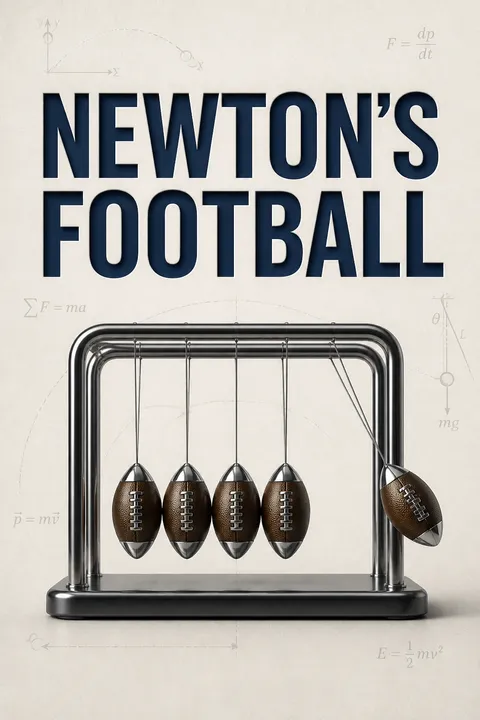
Newton's Football: The Science Behind America's Game receives mostly positive reviews, with readers praising its engaging blend of science and football. Many appreciate the book's accessible explanations of scientific concepts and their applications to the sport. Readers highlight the diverse topics covered, from physics and evolution to player safety and game strategy. Some criticize the book for not delving deep enough into certain subjects, while others find it informative and thought-provoking. Overall, reviewers recommend it to both science enthusiasts and football fans looking for a unique perspective on the game.
People Also Read


Glossary
Prolate spheroid
elongated, oval shapeA three-dimensional shape stretched along one axis, like an American football. Its length is greater than its width, unlike a sphere. This form makes the ball easier to carry and throw, but its irregular orientation and impacts also make bounces less predictable than those of a round ball.
Robustness
resistance to disruptionA system’s ability to keep functioning despite common disturbances or changing conditions. A football helmet can make the game more robust to facial cuts and skull fractures by reducing those injuries. Robustness is always specific to the threat being considered, and does not mean the system is protected from every kind of failure.
Fragility
vulnerability to failureA system’s susceptibility to a particular harmful condition, especially one that may cause severe failure. In the book’s example, helmets reduce some visible injuries but leave players vulnerable to brain movement and concussion. Robustness and fragility can exist in the same system because protection against one threat may leave another unaddressed.
West Coast offense
timed, short-pass systemA passing approach associated with coach Bill Walsh that uses carefully timed routes and an ordered progression of receiver options. The quarterback reads defensive cues and moves through those options quickly rather than scanning the whole field without a plan. Short completions can become substantial gains when receivers catch the ball in stride and run after the catch.
No-huddle offense
rapid between-play strategyAn offense that shortens or removes the meeting between plays. Sam Wyche used the approach with Cincinnati to limit defensive substitutions, create mismatches, and wear down opponents. It can also change the rhythm of a game and force defenders to respond before they have time to reset.
Zone blitz
disguised pressure and coverageA defensive scheme that combines a quarterback rush with zone coverage. Defenders may exchange roles, with a player expected to rush instead dropping back while another attacks the passer. The shifting assignments make it harder for a quarterback to predict both the source of pressure and which receivers are covered.
B.I.G. H.I.T.T.S.
head-aware tackling instructionBobby Hosea’s youth tackling curriculum, designed to keep a player’s head away from the point of impact. Training begins with movements performed without contact, then advances to padded targets and player drills. The method emphasizes driving with the hips and torso rather than leading with the head.
Neurotracker
visual tracking assessmentA training and testing system that asks users to track several selected objects moving among distractors. The task is intended to assess visual information processing under complexity, rather than simply measuring reaction speed or hand-eye coordination. The book describes its possible use in evaluating athletes, including football prospects.
Loss aversion
losses feel disproportionately costlyA pattern in decision-making in which people react more strongly to a loss than to an equivalent gain. The book connects this tendency to cautious coaching choices and uses experiments with humans and capuchin monkeys to illustrate it. Loss aversion can make a familiar, conservative option feel preferable even when a riskier strategy has greater potential value.
A-11 offense
eleven potential receiversA high-school offensive system developed by Kurt Bryan and Steve Humphries using a rule exception for scrimmage-kick formations. By arranging players to preserve receiver eligibility, it created many possible alignments and ball-handling options. California later changed the relevant rules, limiting the system’s original form.
About the Author
Other books by Allen St. John

Download PDF
Download EPUB
.epub digital book format is ideal for reading ebooks on phones, tablets, and e-readers.








