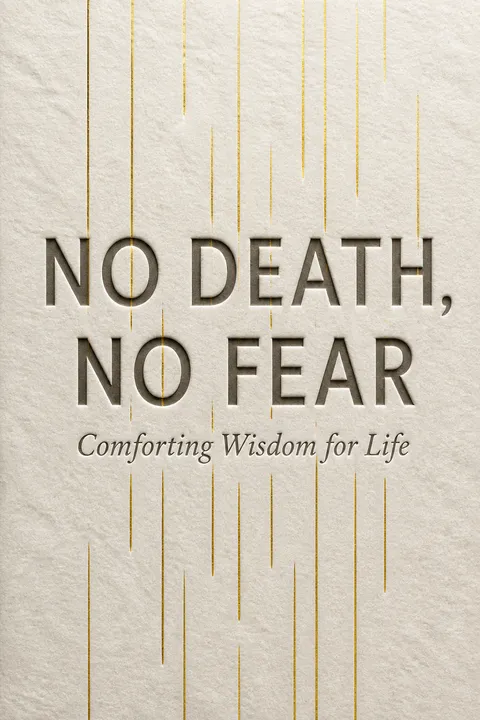


Key Takeaways
Treat birth and death as changing forms, not arrivals from nothing.
A different middle path. Thich Nhat Hanh rejects two familiar answers to death: that a permanent self survives unchanged, or that a person becomes nothing. He proposes that life is an ongoing process of transformation. A flower bud disappears in frost, then new buds emerge when conditions improve. A cloud becomes rain, and rain nourishes plants. What ceases is a particular form, not the web of conditions from which it arose.
A practice, not a proof. The claim that there is no birth or death is a Buddhist way of seeing reality, meant to loosen fear. It does not establish that personal consciousness survives bodily death. The book also acknowledges ordinary loss in the historical world, while inviting readers to explore a wider sense of continuity.
The strength of this view is that it interrupts the false choice between an immortal, unchanging self and total meaninglessness. Ecology offers a compatible image: organisms depend on flows of matter, energy, and other life rather than existing as sealed units. Yet continuity of conditions is not the same as continuity of personal awareness. Keeping that distinction clear lets the teaching comfort without asking empirical science to certify a spiritual claim.
Look for the conditions inside every person, object, and living system.
Nothing stands alone. Inter-being is the book's term for the mutual dependence that makes anything possible. A sheet of paper depends on trees, sunlight, rain, soil, workers, and tools. Remove enough of those conditions and the paper cannot exist. The same is true of a flower, a person, or a feeling. What looks like a separate object is a temporary meeting of many elements.
See the wider inheritance. A person carries biological ancestry, but also language, relationships, culture, and the effects of countless encounters. Looking at a friend this way can replace quick judgment with curiosity about the conditions shaping them. It also changes how a person treats their own body: damage to oneself affects ancestors' inheritances and future generations alike.
This relational picture resonates with systems thinking, where a system's behavior emerges from interactions rather than from one isolated part. It can deepen responsibility: consumption, health, and conduct have effects beyond the individual. But interdependence should not erase distinctions. A harmed person is not responsible for the harm done to them simply because everyone is connected. The insight is most useful when it widens care without blurring accountability.
Let even Buddhist teachings go when they harden into certainty.
Teachings are instruments. The book presents impermanence, no self, and emptiness as ways to investigate experience, not doctrines to defend as final answers. Emptiness does not mean that nothing exists. It means that nothing has an independent, fixed identity. Even this idea can become another trap if treated as the ultimate description of reality.
Notice the cost of certainty. A parable tells of a father who mistakes a charred body for his son and refuses to open the door when the living boy returns. His fixed conclusion blocks the evidence in front of him. The lesson applies to spiritual ideas, political doctrines, and personal assumptions: a useful view can become harmful when it prevents fresh attention.
This is a sophisticated form of epistemic humility. In philosophy of science, models are useful because they simplify reality, but a model is not the thing it describes. The same caution applies to contemplative concepts. Still, skepticism can become its own rigid identity, and not every truth claim is equally useful or harmful. The practical test offered here is consequential: does a belief increase understanding and compassion, or make perception narrower?
Remember impermanence before anger steals a day you cannot recover.
Change can soften conflict. The book treats impermanence not as a gloomy reminder that everything ends, but as a reason to value what is present. When anger takes hold, it suggests imagining the other person and oneself far in the future, when neither can continue this particular life. The perspective can interrupt the urge to punish, blame, or prolong a quarrel.
Keep love tended. A couple may begin with affection, then drift into frustration if neither actively nourishes the relationship. Remembering that the other person is not guaranteed to remain can prompt a kind word or a repair today. The same principle applies to children, friends, and partners: appreciation postponed until loss is appreciation offered too late.
Mortality awareness can reorder priorities by making trivial disputes look small beside finite time. This resembles research on how reminders of death can either intensify defensiveness or strengthen care, depending on a person's values and context. The book's breathing and visualization practice gives the reminder a compassionate direction. It is not a substitute for boundaries, however. Some conflicts require protection or change, not reconciliation at any cost.
Stop postponing happiness until life meets your exact conditions.
Return to what is here. The book calls the present moment one's true home. Mindful breathing and walking are ways to stop the habitual rush into regret or imagined futures, then notice what is already available: a working pair of eyes, a meal, a loved one nearby, or the ground beneath one's feet. An astronaut with only days left on the moon, the author imagines, would long simply to walk on Earth again.
Question the happiness contract. People often set conditions such as a promotion, a particular relationship, or a larger house, then add new requirements even when earlier ones are met. Listing those conditions and asking where they came from can reveal that happiness is being deferred by an assumption, not by reality itself.
The practice has a useful overlap with attention training: deliberately attending to ordinary sensory experience can counter the mind's tendency to treat the present as merely a waiting room. The astronaut story makes that shift vivid by changing the scale of what counts as precious. Present-focused living should not be confused with passivity. Some conditions really do need improvement, and mindful attention can help people act without making all well-being dependent on a perfect future.
Search for a loved one's continuation without pretending absence does not hurt.
Recognize changed forms. After his mother's death, Thich Nhat Hanh grieved for more than a year. A dream and a moonlit walk helped him feel her presence in the landscape and in his own body, which carried generations of family life. The cloud-and-rain image offers a similar way to think: the cloud is no longer visible in its old shape, but its water appears in another form.
Let grief look deeply. The practice is to notice how a person continues through habits, teachings, memories, relationships, and effects on others. That recognition can make loss less absolute. It does not require claiming that the deceased remains conscious or that grief should disappear. The book's invitation is to widen attention beyond the familiar form, not to deny the pain of its absence.
This account makes room for a powerful distinction between preserving a relationship and denying a death. Contemporary grief approaches often recognize that people maintain inner bonds with those who have died, rather than simply severing attachment. The idea of continuation can support that process through memory, values, and shared practices. Its limit matters: insisting that a loved one is present everywhere may comfort some mourners and feel invalidating to others. Grief needs invitation, not correction.
Accept the inheritance, then choose which family patterns to pass on.
Touch the whole lineage. Touching the Earth is a guided practice in which a person bows while reflecting on ancestors, descendants, and all living beings. The aim is to see that personal identity is shaped by what came before and continues through others. Ancestors may have passed on kindness and courage, as well as fear or harmful habits. Accepting their presence is not the same as approving every action.
Transform through understanding. The book asks readers to consider the conditions that shaped a parent or child, including hardship, safety, and the influence of others. Seeing those conditions can soften blame and make reconciliation possible. It also creates responsibility: inherited patterns are real, but they need not be transmitted unchanged. The practice can be repeated, since acceptance may take time.
This approach connects personal healing with intergenerational thinking. Family patterns often persist not because people consciously choose them, but because familiar responses are learned and repeated. Seeing context can interrupt that repetition. Yet compassion for a parent's circumstances does not oblige a person to restore contact or forgive before they are ready. Acceptance can mean acknowledging reality and protecting oneself. The teaching is strongest when reconciliation remains an option rather than a demand.
Your words and actions are already shaping your continuation in others.
Continue in many directions. The book compares a person to a candle whose light spreads around the room, not just downward as the candle burns away. Thoughts, speech, and actions affect children, friends, and communities. A cruel remark can remain in a child's memory; a generous act can become part of someone else's way of living. Continuation is therefore happening during life, not only after death.
Redirect what cannot be undone. A veteran who had killed five children in Vietnam remained overwhelmed by guilt. Thich Nhat Hanh urged him to use his life to help save children. The past was not erased, but the veteran could create new consequences and become someone who protected others. The story frames ethical repair as a way to transform the direction of a life.
The emphasis on present-day continuation gives mortality an ethical dimension: legacy is not a monument built after death, but a stream of effects already underway. This resembles social learning, in which behavior is transmitted through example and relationship. The veteran's story also rejects the idea that guilt alone repairs harm. Still, later service cannot cancel victims' suffering. Its value lies in accountability joined to changed conduct, not in treating good deeds as a moral refund.
Help the dying by awakening joy, not arguing them out of fear.
Bring forward what nourishes. Anathapindika, a devoted supporter of the Buddha, was seriously ill when the monk Shariputra guided him through reflections on the body, the senses, and the elements. Remembering the Buddha's community and teachings eased his distress. His tears, the story says, came from relief and gratitude. The practical lesson is to help a dying person reconnect with sources of meaning and steadiness, rather than offer abstract reassurance alone.
Be fully present. The book describes companions singing, recalling shared acts of peace, or playing familiar devotional chanting for people who were unconscious or near death. It recommends learning contemplative practices before a crisis, so family and friends can offer calm, attentive company. Such practices may comfort, but they should accompany appropriate medical care and respect the dying person's wishes.
The account treats caregiving as relational work: a familiar song or remembered achievement can orient someone toward identity and safety when illness narrows attention. This aligns with person-centered care, which takes a patient's history and sources of meaning seriously. The claims about what unconscious patients can hear remain uncertain, so the practice is best understood as a compassionate possibility, not a guaranteed effect. Presence also includes listening for medical needs, preferences, and limits.
Analysis
No Death, No Fear is a contemplative argument delivered through recurring images rather than a linear proof. Clouds, flames, flowers, paper, and waves all make the same proposition tangible: a form appears when conditions gather and changes when they do not. The repetition is deliberate. A reader is asked not merely to assent to interdependence, but to rehearse seeing it in ordinary things until the idea becomes a way of meeting grief, anger, and fear.
The book's most useful move is its refusal of a binary. It rejects both a permanent, self-contained soul and the idea that death makes a life equivalent to nothing. In their place, it offers continuity through conditions, relationships, inheritance, and action. That shift has practical consequences even for readers who do not accept the metaphysical language. A person can continue in descendants, students, memories, institutions, and effects on the world. Mindfulness then becomes a way to notice this life while it is still available, and compassion becomes the ethical expression of seeing dependence.
The boundary between spiritual insight and scientific evidence requires care. Conservation of matter, used as an analogy, does not demonstrate that an individual mind survives death. Nor does a loved one's influence being present in the living establish that the deceased remains aware. The book is most credible when its images illuminate relational existence and least verifiable when they are treated as literal accounts of postmortem persistence. That distinction does not diminish the emotional force of the practice; it makes its claims more trustworthy.
The work also resists a private, inward spirituality. Touching the Earth links personal identity with ancestors and descendants, while the account of the pirate asks readers to see both perpetrator and victim within a web of social conditions. Such recognition can widen responsibility, though it must not erase unequal power or excuse violence. The book's deepest contribution is therefore not a solution to death as a biological fact. It is a disciplined way to meet finitude with attention, relational understanding, and conduct that reduces suffering now.
Review Summary
No Death, No Fear explores Buddhist concepts of impermanence, interconnectedness, and overcoming fear of death. Readers appreciate Thich Nhat Hanh's gentle approach and accessible explanations, finding comfort in his teachings on continuation and transforming grief. Some struggle with the repetitive nature and abstract concepts, while others find profound wisdom in viewing life and death as part of a larger cycle. The book offers practical meditation techniques and insights on living mindfully, resonating with those seeking spiritual growth and a new perspective on mortality.
People Also Read


Glossary
Inter-being
Mutual dependenceThe condition in which things exist through relationships with other things, rather than through an independent, fixed essence. A flower, for example, depends on sunlight, rain, soil, and many other conditions. Thich Nhat Hanh uses inter-being to describe both the natural world and human identity, including the influence of ancestors and the effects people have on one another.
Manifestation
Appearance through conditionsThe arising of a visible or recognizable form when its necessary conditions come together. In this account, a cloud becoming rain is not creation from nothing or destruction into nothing, but transformation into another form. The term helps the author describe birth, death, and change without treating a temporary appearance as an isolated beginning or final end.
Historical dimension
Everyday time and formThe ordinary, observable dimension in which people experience bodies, relationships, change, birth, and death. It is where a wave can be called high or low and a person can be understood through a particular life story. The book does not ask readers to ignore this dimension, but to see it alongside a deeper account of interdependence.
Ultimate dimension
Reality beyond fixed conceptsThe underlying nature of reality when it is not reduced to ideas such as permanent or impermanent, same or different, birth or death. The author compares it to water beneath the changing forms of waves. It is not presented as a distant place to reach after death, but as a reality that can be touched through deep attention in the present.
Touching the Earth
Bowing with guided reflectionA contemplative practice in which a person bows to the ground while reflecting on connections with ancestors, descendants, other living beings, and reality beyond a separate self. The book describes it as a way to cultivate acceptance, gratitude, forgiveness, and freedom from fear. Its visualizations can be practiced before a tree, flower, mountain, or other chosen object.
Dharma Seals
Marks of Buddhist practiceThree teachings that Thich Nhat Hanh presents as identifying features of authentic Buddhist practice: impermanence, no self, and nirvana. Impermanence points to constant change; no self points to the absence of an independent identity; nirvana is freedom from being trapped by concepts. The author treats these teachings as practical tools for insight, not doctrines to cling to.
The eight no's
Eight released oppositesA contemplative formulation that loosens attachment to four pairs of opposing notions: birth and death, coming and going, sameness and difference, and being and non-being. The teaching does not deny everyday experience. It asks practitioners to see that these categories do not fully describe reality, and to avoid turning either side of a pair into an absolute truth.
FAQ
What's "No Death, No Fear" about?
- Exploration of Life and Death: "No Death, No Fear" by Thich Nhat Hanh explores the concepts of life, death, and the nature of existence from a Buddhist perspective.
- Comforting Wisdom: The book offers comforting wisdom for dealing with the fear of death and the grief of losing loved ones.
- Philosophical Insights: It provides philosophical insights into the nature of reality, emphasizing the interconnectedness of all things and the illusion of a permanent self.
- Practical Guidance: Thich Nhat Hanh includes practical guidance on how to live mindfully and embrace the present moment.
Why should I read "No Death, No Fear"?
- Overcome Fear of Death: The book provides tools and insights to help overcome the fear of death and embrace life more fully.
- Mindfulness Practice: It offers practical mindfulness exercises that can be integrated into daily life to enhance peace and happiness.
- Philosophical Depth: Readers interested in Buddhist philosophy and the nature of existence will find deep, thought-provoking content.
- Emotional Healing: The book is a source of comfort and healing for those dealing with grief and loss.
What are the key takeaways of "No Death, No Fear"?
- Interconnectedness: Everything is interconnected, and nothing exists in isolation. This understanding can reduce fear and suffering.
- Impermanence: Embracing the impermanence of life can lead to greater appreciation and less attachment.
- No Birth, No Death: The concepts of birth and death are illusions; life is a continuous transformation.
- Mindful Living: Practicing mindfulness can help individuals live more fully in the present moment, reducing anxiety about the future.
How does Thich Nhat Hanh explain the concept of "No Birth, No Death"?
- Transformation, Not Annihilation: Thich Nhat Hanh explains that birth and death are merely transformations, not beginnings or endings.
- Continuity of Life: Life is a continuous process, and what we perceive as birth and death are just changes in form.
- Metaphor of the Cloud: He uses the metaphor of a cloud transforming into rain to illustrate how nothing truly disappears.
- Freedom from Fear: Understanding this concept can liberate individuals from the fear of death and the sorrow of loss.
What is the practice of "Touching the Earth" in "No Death, No Fear"?
- Connection with Ancestors: "Touching the Earth" is a practice to connect with one's ancestors and descendants, acknowledging their presence within us.
- Acceptance and Forgiveness: It involves accepting both the positive and negative traits of our ancestors, leading to forgiveness and reconciliation.
- Interconnectedness: The practice emphasizes the interconnectedness of all beings and the continuity of life.
- Healing and Transformation: It is a meditative practice that can transform fear, anger, and doubt into understanding and peace.
How does Thich Nhat Hanh address the fear of death in "No Death, No Fear"?
- Understanding Impermanence: He teaches that understanding the impermanent nature of life can reduce the fear of death.
- Mindful Breathing: Mindful breathing and meditation are tools to calm the mind and face fear with clarity.
- Releasing Attachments: By releasing attachments to the physical body and material possessions, one can find peace.
- Embracing Continuation: Recognizing that life continues in different forms helps alleviate the fear of non-existence.
What are some practical mindfulness exercises from "No Death, No Fear"?
- Breathing Meditation: Focus on the breath to anchor the mind in the present moment and cultivate awareness.
- Walking Meditation: Practice walking slowly and mindfully, being fully present with each step.
- Visualization: Visualize the interconnectedness of all things, such as seeing a cloud in a piece of paper.
- Daily Reflection: Reflect on impermanence and interconnectedness to deepen understanding and reduce suffering.
What are the best quotes from "No Death, No Fear" and what do they mean?
- "Since before time you have been free. Birth and death are only doors through which we pass, sacred thresholds on our journey." This quote emphasizes the eternal nature of existence and the transformative nature of birth and death.
- "Our greatest pain is caused by our notions of coming and going." It highlights how attachment to the ideas of arrival and departure can lead to suffering.
- "You are what you are looking for." This quote suggests that fulfillment and peace are found within, not in external pursuits.
- "The miracle is not to walk on water but to walk on the Earth." It underscores the importance of appreciating the present moment and the simple joys of life.
How does Thich Nhat Hanh use metaphors to explain complex concepts in "No Death, No Fear"?
- Cloud and Rain: He uses the metaphor of a cloud transforming into rain to explain the continuity of life and the illusion of death.
- Wave and Water: The wave and water metaphor illustrates the idea of no separate self and the interconnectedness of all beings.
- Fire and Flame: The flame metaphor is used to describe the nature of transformation and the non-existence of a permanent self.
- Kaleidoscope: The kaleidoscope metaphor helps convey the idea of constant change and the beauty of transformation.
What is the significance of the "Three Dharma Seals" in "No Death, No Fear"?
- Impermanence: Everything is in a state of constant change, and nothing remains the same.
- No Self: There is no permanent, unchanging self; all things are interconnected and interdependent.
- Nirvana: Nirvana is the extinction of all concepts, leading to ultimate freedom and peace.
- Guiding Principles: These three teachings are fundamental to understanding Buddhist philosophy and are used to guide practice and insight.
How does "No Death, No Fear" address the concept of "Interbeing"?
- Interconnectedness of All Things: Interbeing is the idea that all things are interconnected and cannot exist independently.
- Mutual Influence: Everything influences and is influenced by everything else, creating a web of existence.
- Beyond Duality: Interbeing transcends dualistic thinking, such as self and other, being and non-being.
- Foundation of Peace: Understanding interbeing can lead to greater compassion, peace, and harmony in life.
What role does mindfulness play in "No Death, No Fear"?
- Present Moment Awareness: Mindfulness is the practice of being fully present and aware in each moment.
- Reducing Suffering: It helps reduce suffering by bringing attention to the present and away from worries about the past or future.
- Cultivating Peace: Mindfulness cultivates inner peace and stability, allowing individuals to face challenges with clarity.
- Foundation of Practice: It is the foundation of Thich Nhat Hanh's teachings and is essential for understanding the nature of existence.
About the Author
Other books by Thich Nhat Hanh



Download PDF
Download EPUB
.epub digital book format is ideal for reading ebooks on phones, tablets, and e-readers.








