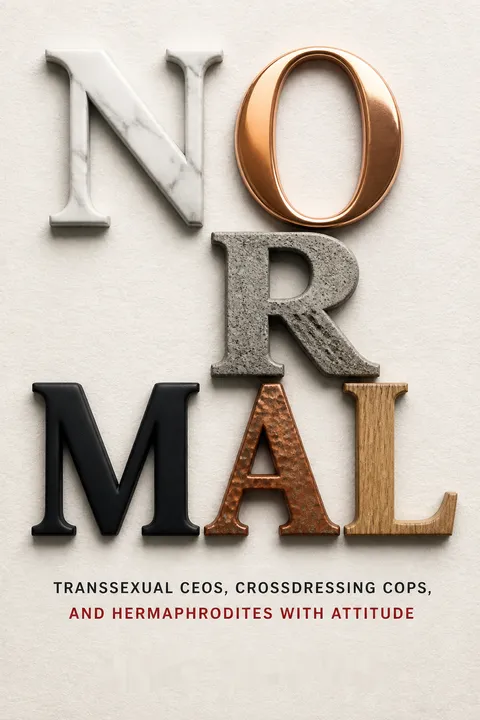


Key Takeaways
Treat "normal" as a cultural guess, not a biological verdict
Bloom begins with mistaken certainty. She expected trans men to be psychologically troubled, straight crossdressers to be closeted gay men, and intersex people to be harmed by resisting early surgery. Meeting people whose lives contradicted those assumptions changed the questions she asked. Their stories, she argues, reveal not only unfamiliar experiences but the culture’s narrow rules about what men, women, and bodies are supposed to be.
Look past the label. A person who has transitioned, wears clothes associated with another gender, or has sex characteristics outside typical categories is not reducible to that description. Bloom’s portraits show people with jobs, families, ambitions, irritations, and varied views of themselves. Their differences do not erase their ordinary human concerns.
What's striking is that the book makes curiosity a method, not a pose. Bloom exposes how a category can feel like a fact when it is really a social expectation applied to a person. This resembles a basic problem in classification: labels help organize experience, but they also hide variation inside the groups they create. The portraits make that cost visible. Still, individual stories cannot establish how common any identity or experience is. Their strength is different: they unsettle assumptions and show why listening must precede confident explanation.
Separate gender identity from whom someone loves
Orientation does not determine gender. Bloom recounts the case of Louis Sullivan, a trans man who was gay and wanted to live as a man while loving men. Clinics rejected him because they assumed attraction to men meant he should remain a woman. Sullivan challenged that logic: the sex of a person’s partner does not decide that person’s own gender.
Lived experience complicates stereotypes. Bloom also meets Lyle, who began medical transition as a teenager with his parents’ support, and other trans men with different sexual orientations, relationships, and personalities. The men did not fit her imagined picture of self-hating women seeking surgery. They understood themselves as men, while differing widely in how they expressed masculinity and what kinds of partners they desired.
This distinction is useful well beyond gender: identity, presentation, and attraction are separate dimensions, even when everyday language bundles them together. Sullivan’s story shows the practical harm of treating one dimension as proof about another. The same mistake appears whenever institutions use a person’s relationships to infer who that person must be. Clinical categories can make care legible, but they become barriers when conformity to a stereotype is mistaken for evidence. The book’s interviews support the distinction without pretending that every person uses the same language for their experience.
Choose transition around lived needs, not anatomical ideals
There is no single surgical endpoint. Bloom describes several stages and options for trans men, including chest surgery, hormone treatment, phalloplasty, which constructs a penis, and metoidioplasty, which uses testosterone-enlarged genital tissue to create a smaller penis. These procedures differ in cost, complexity, sensation, and function. At the time of Bloom’s reporting, a basic surgical package could cost about $20,000, often without insurance coverage.
The right tradeoff is personal. Lyle says surgery helped him feel more fully himself, but did not solve every problem or make its price disappear. James and Loren chose not to pursue more extensive genital surgery, valuing sensation, finances, or their sense of identity. Their choices challenge the idea that bodily authenticity must mean pursuing the most conventionally male anatomy possible.
The stories distinguish a person’s goal from a clinician’s preferred outcome. That is a central issue in informed consent: a technically possible intervention is not automatically the best intervention for a particular life. Costs also include recovery, complications, sensation, and money that could serve other priorities. At the same time, the book’s portraits are not a substitute for medical guidance, and surgical techniques and standards change. Their lasting contribution is ethical rather than prescriptive: success should be judged against the patient’s own aims, not a single cultural template.
Do not infer sexuality or identity from a dress
Crossdressing is not a diagnosis of orientation. Bloom follows heterosexual men who wear women’s clothes, often while continuing to live as husbands, fathers, professionals, and men. They describe different motives and experiences. Some call crossdressing a feminine dimension or a source of relaxation; others speak of a persistent need. The book offers no reliable count of how many such men there are. Twenty-five crossdressers among roughly four hundred passengers on one cruise is a portrait of that gathering, not a population estimate.
The explanation remains contested. Tri-Ess, a support organization for heterosexual crossdressers and their wives, presents crossdressing as an expressive gift. Clinician Ray Blanchard interprets it as an erotic compulsion. Bloom finds that sexuality can be involved, while rejecting the assumption that the men are therefore gay or secretly transsexual.
The useful lesson is restraint: clothing alone cannot reveal a person’s orientation, identity, or motive. Bloom also avoids an easy celebration in which every practice becomes self-expression and every conflict disappears. Her account is strongest when it preserves the disagreement between the men’s self-descriptions, their partners’ experiences, and clinical interpretations. One caution is that describing the behavior through the language of compulsion or fetish can flatten differences among individuals. The book offers competing lenses, not a settled explanation, and readers should keep that uncertainty intact.
Treat a partner's accommodation as a real cost, not proof of support
Couples do not experience the same event equally. Some relationships Bloom describes are joyful. Dixie and Rebecca, for example, enjoy his crossdressing together, and Rebecca sees it as part of the fun they share. Other partners feel lonely, displaced, or unsure how honestly they can speak without hurting a spouse or threatening the marriage. Kris says her husband’s crossdressing can leave her feeling that she has lost the partner she expected to have.
Support can conceal unequal labor. Wives often help with clothes, makeup, travel, and social acceptance, while the gathering remains centered on the crossdresser’s experience. Bloom does not claim every marriage follows this pattern. She does insist that a spouse’s presence or kindness should not be mistaken for uncomplicated consent, pleasure, or equality.
This is a sharp reminder that inclusion within a relationship is not the same as mutual benefit. The relevant question is not only whether a partner tolerates a practice, but whether both people can state their needs and shape the arrangement. That perspective connects intimate life to the broader problem of invisible care work: one person’s freedom may depend on another person’s accommodation. Yet the contrast between distressed couples and Dixie and Rebecca matters. It prevents the analysis from turning a recurring imbalance into a universal verdict about crossdressers or their marriages.
Delay irreversible infant surgery when appearance, not health, is at stake
Intersex describes variations in sex characteristics. Some affect health and need treatment; others concern anatomy that differs from typical male or female patterns without posing an immediate medical danger. Bloom reports that estimates depend on the definition used. One estimate she cites places intersex traits at roughly one in 1,500 births, while estimates of infants receiving genital surgery for appearance range from one to two per 1,000 births.
Appearance is not an emergency. Hale Hawbecker was born with a very small penis, and his parents declined the surgery doctors urged. Angela Moreno Lippert underwent surgery as a child, including removal of tissue that her later medical records identified as testes, as well as reduction of her clitoris. Their stories question procedures performed without the patient’s consent when the main aim is to make genitals look conventional.
The ethical distinction is between treating a health threat and treating discomfort with variation. When an intervention is irreversible and the patient cannot consent, uncertainty should raise the threshold for acting, not lower it. Bloom’s accounts make that principle concrete by showing how a family’s anxiety and a clinician’s assumptions can be mistaken for the child’s medical need. The evidence presented is historically situated, and the book does not claim that every intersex variation should go untreated. Its more precise challenge is to justify each intervention by function and health, rather than by a demand for visual conformity.
Let patients and activists test medical certainty against outcomes
Good intentions do not guarantee good practice. Bloom describes clinicians who believed early genital surgery would spare children shame, alongside intersex adults who reported lasting harm and little say in what was done to them. Cheryl Chase, who founded the Intersex Society of North America, turned her own painful history into organized advocacy. Accounts from people such as Chase and Hale helped challenge the assumption that surgery for appearance was the only humane option.
The proposed alternative is deliberation, not neglect. ISNA called for truthful communication, specialist advice, psychological support, and avoiding unnecessary irreversible procedures. Pediatrician Philip Gruppuso says doctors should be willing to wait for a diagnosis rather than act quickly to make anatomy fit a standard. In this account, patient testimony becomes evidence that clinical routines must be willing to confront.
The section captures a difficult feature of institutional change: established practice can persist because each practitioner inherits a plausible rationale, even when outcomes deserve renewed scrutiny. Activism supplies knowledge that controlled clinical routines may miss, especially about long-term consequences and consent. That does not make personal testimony interchangeable with systematic evidence. It makes testimony a signal that evidence collection and practice need review. The strongest model here is neither automatic deference to professionals nor automatic rejection of medicine, but a process in which expertise remains answerable to the people who live with its consequences.
Read human variation as nature's range, not nature's error
The categories are less tidy than the rules. Bloom closes by arguing that human bodies and gender expression vary more than cultural stereotypes allow. She cites a study in which only about one-third of women classified as “normal” scored as classically feminine. Her point is not that gender distinctions mean nothing, but that familiar ideals describe fewer people than society often assumes.
Nature does not promise symmetry. The book compares human variation with plants and animals that do not match a narrow picture of what is typical. It also emphasizes that gender identity, sexual orientation, and temperament are not interchangeable. The people Bloom met did not resolve every scientific question about biology or culture. They did make it harder to treat difference itself as proof of disorder or mistake.
The argument works best as a warning against confusing statistical averages with moral standards. A trait can be less common without being defective, and a social norm can feel natural simply because it is familiar. The comparison to other forms of biological variety helps loosen that reflex, while the human cases show why the issue is not merely abstract classification. Still, variation alone cannot decide which medical care someone needs or how a person understands their own gender. The book’s more defensible claim is that difference requires interpretation, not automatic correction.
Analysis
Normal is a narrative inquiry built from reported portraits rather than a single theory or clinical manual. Its structure moves through three settings where social rules become unusually visible: trans men negotiating identity and medical transition, heterosexual crossdressers balancing private desire and marriage, and intersex people confronting decisions made about their bodies in infancy. The connective argument is that observers often mistake the boundaries of familiar categories for facts about nature. Bloom’s own initial errors give the book a useful arc: she does not present herself as an expert who arrives with the correct vocabulary, but as a listener forced to revise her assumptions.
That method has particular force because the stories do not all point in the same direction. Some trans men seek extensive surgery, while others choose less or none. Some crossdressing couples are happy, while some spouses experience substantial loss. Intersex adults describe harm from procedures intended to protect them. The variation makes simple explanations harder to sustain. It also keeps the book from turning acceptance into a demand that everyone interpret their lives identically.
The method has limits. Interviews and vivid individual cases can expose blind spots, but cannot establish prevalence, represent every community, or settle biological causation. Bloom acknowledges missing data and uncertainty, and the book’s 2002 vocabulary and clinical context should be read historically. Its chapter on crossdressers is especially interpretive: the tension between self-description, partner impact, and the author’s account of erotic compulsion remains open rather than conclusively resolved.
The most durable contribution is therefore methodological. Ask who benefits from a category, what evidence supports an intervention, and whose experience is absent from the decision. This approach neither romanticizes every difference nor assumes that medicine is inherently coercive. It asks that care be responsive to the person, proportionate to actual need, and humble enough to revise itself when those living with its consequences speak.
Review Summary
Normal received mixed reviews, with an average rating of 3.52 out of 5. Some readers found it insightful and educational, praising Bloom's writing style and the book's exploration of gender identity. Others criticized it as outdated, transphobic, and lacking depth. The book's three sections cover female-to-male transsexuals, heterosexual male crossdressers, and intersex individuals. While some appreciated Bloom's personal journey and the book's accessibility, others felt it perpetuated stereotypes and maintained a distant, judgmental tone.
People Also Read






Glossary
high-intensity transsexual
seeks bodily transitionBloom uses this term for people whose persistent identification with a gender different from the one assigned to them motivates them to seek medical transition, including surgery. The phrase reflects the book’s clinical vocabulary and distinctions at the time of publication, rather than a universal description of transgender people or their goals.
gender dysphoria
distress about assigned genderIn the book’s clinical context, gender dysphoria refers to profound unhappiness or distress related to a person’s gender assignment or body. Bloom describes gender dysphoria clinics as gateways to assessment and surgical care. The term names distress, not a person’s sexual orientation, and its meaning has changed across clinical settings and periods.
female-to-male (FTM) transsexual
trans man in historical terminologyFTM is the abbreviation Bloom uses for people assigned female who identify and live as men, including those who seek hormones or surgery. The book’s terminology reflects its publication period. The portraits show that trans men differ in sexual orientation, presentation, relationships, and which medical procedures, if any, they want.
phalloplasty
surgical construction of a penisPhalloplasty is a multi-stage genital surgery that constructs a penis using tissue from another part of the body. Bloom describes different techniques and possible functions, including sensation or urination through the constructed penis, as well as substantial costs and physical demands. Outcomes and available techniques depend on the procedure and individual circumstances.
metoidioplasty
genital surgery using enlarged tissueMetoidioplasty, also called clitoral release in the book, uses genital tissue enlarged through testosterone treatment to create a small penis. Bloom contrasts it with phalloplasty: it generally involves less extensive surgery and preserves existing sensation, but does not create a penis suited to penile penetration. Some men she interviews prefer its tradeoffs.
intersex
variation in sex characteristicsIntersex is an umbrella term for congenital variations in sex characteristics, including chromosomes, hormones, gonads, or genital anatomy, that do not fit typical definitions of male or female bodies. The book discusses conditions with very different medical implications. It uses “hermaphrodite” in its historical title and reported language, but intersex is the term used here.
androgen insensitivity syndrome (AIS)
reduced response to androgensAIS occurs when a person’s cells cannot respond typically to androgens, hormones involved in masculinization. Bloom describes people with XY chromosomes who may develop bodies that appear female because their tissues do not respond to those hormones. The presentation varies, and diagnosis or treatment depends on the individual’s health and circumstances.
partial androgen insensitivity syndrome (PAIS)
partial response to androgensPAIS is a variation in which the body responds partly, but not fully, to androgens. Bloom describes it as one possible cause of genital anatomy that clinicians may consider ambiguous, such as a small penis or enlarged clitoris. The term refers to a specific medical condition, not to a person’s gender identity or sexual orientation.
congenital adrenal hyperplasia (CAH)
adrenal hormone variationCAH is a group of inherited conditions affecting hormone production by the adrenal glands. Bloom notes that excess androgens before birth can affect the genital development of an XX baby, sometimes producing anatomy that differs from typical female patterns. The condition’s health effects and treatment needs vary; genital appearance alone does not describe the full diagnosis.
Intersex Society of North America (ISNA)
intersex advocacy organizationISNA was an advocacy and information organization founded by Cheryl Chase to support intersex people and challenge unnecessary, nonconsensual genital surgery on infants. As described in the book, it promoted accurate information, specialist care, psychological support, and delaying irreversible procedures that were not medically necessary, while opposing shame and secrecy around intersex variations.
Tri-Ess
support group for straight crossdressersTri-Ess, formally the Society for the Second Self, is an organization described by Bloom as a family-oriented support group for heterosexual crossdressers and their wives. It frames crossdressing as an expression of a feminine dimension and emphasizes maintaining family relationships. Bloom contrasts that account with other members’ experiences and clinical interpretations.

Download PDF
Download EPUB
.epub digital book format is ideal for reading ebooks on phones, tablets, and e-readers.








