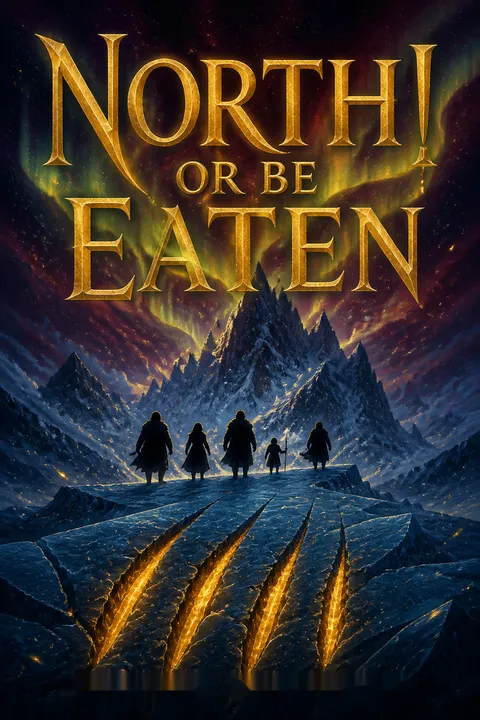


Plot Summary
The Northward Decision
Weeks of refuge in Peet’s tree house have left Janner longing for the cottage, but the changing season makes staying dangerous. His mother, Nia, decides the family must travel north toward the Ice Prairies, where the Fangs of Dang struggle in the cold. Their grandfather Podo wants a bolder course: find resistance fighters and eventually return the royal children to their homeland.
Janner, now aware that he is heir Tink’s Throne Warden, feels the burden of guarding a king who is younger and more impulsive than himself. Artham, the former hero now known as Peet the Sock Man, agrees to guide them. When the lone fendril signals summer’s end, the family packs for the road.
The departure begins as a practical response to danger, but it also forces the family to live inside the identities they have inherited. Janner’s conflict is not a hunger for status. He wants ordinary home life, yet his role assigns him responsibility for Tink, whose royal position seems absurd to both boys. Podo’s wish to return to the larger struggle clashes with Nia’s protective caution, establishing two competing definitions of care: shield the children from the war, or prepare them to confront it. The approaching autumn gives this debate a deadline. Their journey starts because safety is temporary, not because the family has agreed on what the future should be.
The Warning Arrives
While the family prepares, Oskar Reteep lies wounded in a hidden room behind room eight of Glipwood’s inn. Innkeeper Joe Shooster conceals him from the Fangs, who have already murdered Joe’s neighbor Shaggy and now threaten Joe’s wife, Addie. Their old ally Zouzab appears, but Joe realizes Oskar had tried to warn him about the ridgerunner’s treachery.
Oskar escapes on a stolen donkey and reaches the tree house just as the Fangs, trolls, and horned hounds approach. The family abandons its planned southern route and runs north. Artham stays behind to distract the pursuers, while Janner and his relatives flee with the wounded Oskar and no clear route forward.
The parallel Glipwood episode shows the cost of the family’s absence: ordinary people are left to negotiate with a regime that treats terror as entertainment. Joe’s survival depends on improvisation, not power, and his choice to hide Oskar turns private hospitality into resistance. Oskar’s warning brings the distant threat directly to the children, but it also changes the journey’s geography. The family does not simply follow its prepared plan; betrayal and pursuit force a new direction. Artham’s diversion repeats his protective role while underscoring how much the family depends on a guide whose past and abilities remain only partly accessible.
The Gully’s Hidden Mouth
The fleeing family reaches a deep forest gully, unaware that a gargan rockroach has filled its hollow with drugged animals. Their donkey refuses to descend, and the Fangs behind them leave little time to find another way. Janner returns to the animal for Artham’s satchel and recovers the water from the First Well, a healing liquid already known for changing living creatures.
Below, the rockroach’s vapor traps Nugget and the children among toothy cows, cave blats, and a horned hound. When the animals stir, Podo and Janner fight to clear a path while Tink cuts an opening overhead. The family escapes the den, but the rockroach emerges, and the Fangs capture Artham across the gully.
The gully turns the forest’s familiar dangers into a trap created by exhaustion and haste. The donkey’s refusal is an ignored warning, while Janner’s return for the satchel places him in danger for something he does not yet understand is crucial. His recovery of the First Well’s water gives the family a chance later, but the episode is not a neat reward for bravery: it also leaves Artham captive. Tink’s brief hesitation and eventual action expose the brothers’ different relationships to responsibility. Janner tends to assume command; Tink must choose to act before he feels ready. Survival is collective, and no one’s courage prevents loss.
The Bridge Above Fingap
The Fangs corner the family beside the Mighty Blapp, where the rapids and daggerfish make crossing seem impossible. Janner remembers the legendary Miller’s Bridge at Fingap Falls and persuades Podo to risk the route. A hidden stair descends behind the waterfall, but Fangs pursue them onto the narrow stone spans. Tink spots another concealed passage and helps the others cross a dangerous break in the steps.
As the family reaches the last tower, Podo throws his sword into a troll, damaging the bridge but leaving the creature alive. Nugget charges the troll and knocks it onto the weakened span. The bridge collapses between the family and its pursuers, but Nugget falls with it. Leeli’s grief leaves the family without its strongest protector.
The crossing makes protection visible as physical labor: Janner leads, Tink notices what others miss, Podo fights, and Nugget spends his strength for Leeli. Janner’s earlier anger at Tink’s pauses is exposed as a mistaken judgment when Tink’s eye for detail saves them. The bridge’s collapse is victory with a cost, not a clean escape. Nugget’s loyalty gives the children a model of courage without calculation, while Leeli’s sorrow insists that sacrifice does not become painless simply because it saves others. The family survives, but its safety has been diminished, and the road ahead will require them to carry grief rather than leave it behind.
Dragons Over the Dark Sea
At the ruins above Fingap Falls, Leeli plays her whistleharp for Nugget, and Janner and Tink see images of the dog carried beneath the sea by dragons. An ancient gray dragon also warns them of a dangerous presence seeking the children, though Podo dismisses the warning as manipulation.
Oskar recognizes the dragons’ connection to old Annieran legends, and the family settles on Dugtown as its next destination, hoping to reach a rebel contact there. Before the journey resumes, Oskar begins examining the First Book their father entrusted to Janner.
Its writing may preserve the history of Anyara, an ancient kingdom whose fall seems connected to Anniera. The book’s secrets remain unread, but its survival gives the children a reason to keep traveling.
Leeli’s music changes grief into a form of perception. The song does not erase Nugget’s loss; it lets the children witness a care beyond their own reach. The vision also makes the world feel older than the immediate conflict with the Fangs. Yet knowledge arrives in fragments: the dragon’s warning is vivid but ambiguous, and Podo’s distrust leaves the family without a shared interpretation. The First Book introduces another kind of inheritance, a physical record whose meaning is not yet legible. Music, memory, and history all promise access to what the children cannot presently see, while demanding patience rather than mastery.
A Thief Wins the Strand
Near Dugtown, a Strander girl named Maraly captures the family and brings them before her clan leader, Claxton Weaver. The Stranders threaten to kill the adults, but Podo recognizes their customs and tells how, as a young man, he won acceptance by stealing a golden token from the legendary Growlfist.
Claxton doubts the tale and orders the prisoners killed. Tink, whom Janner has unfairly judged timid, steals Claxton’s dagger and leadership token, then uses the dagger to knock him unconscious.
The clan accepts Tink as its temporary leader, and the old Strander Nurgabog offers the family limited shelter. When Fangs approach, Nurgabog sends them along the river road. Oskar’s growing work on the First Book continues while the family prepares to enter Dugtown.
The Stranders’ customs turn theft into a test of competence, revealing that authority is not always inherited or enforced through formal law. Tink succeeds by observing what Podo does and adapting it to his own speed and judgment. His achievement also answers Janner’s earlier assumptions without making the boys’ relationship simple: Janner’s shame at misreading his brother must coexist with the fear that Tink still resists his royal role. Podo’s story shows that skill can secure belonging, but not necessarily moral respectability. The family is granted passage through a dangerous society, yet its protection depends on temporary reputation and an old man’s unfinished history.
The Florid Sword
Podo leads the family through Strander tunnels beneath Dugtown while Oskar explains that the First Book may describe Anyara’s fall and the hidden power beneath the ancient kingdom. On the city streets, the masked Florid Sword kills two Fangs and draws attention away from the family.
Oskar’s contact, Ronchy McHiggins, introduces them to a guide named Migg Landers, who takes their money and then betrays them to the Fangs. Podo smashes through the Roundish Widow’s door to escape the attack. In the confusion, Janner and Tink become separated from the adults. The Fangs pursue the rest of the family while the brothers hide inside the tavern, alone in the crowded, hostile city.
Dugtown makes trust a practical risk. The rebels’ network offers the family a route forward, but its members are vulnerable to exhaustion, divided loyalties, and incomplete information. Ronchy means to help; Landers turns that hope into a trap. The distinction matters because the children cannot safely reduce the world to allies and enemies by appearance alone. The Florid Sword adds a different kind of public resistance, theatrical and disruptive, but his intervention cannot reunite the family. Janner and Tink’s separation follows from the adults’ failed plan, not from a test they chose. Their next choices will be made without the guidance they have relied on.
The Boy Called Tool
Ronchy finds Janner and Tink after the attack, feeds them, and directs them toward the family’s hidden burrow. In the city crowds, Janner insists on protecting Tink as his royal duty requires. Tink rejects the role, calls himself Kalmar, and runs away. Janner takes a wrong turn onto Tilling Court, where desperate parents and beggars capture him for an exchange with the Overseer.
The Overseer collects children for the Fork Factory, a vast workshop where they are forced to make weapons and treated as tools. Janner is assigned to repair malformed blades. He recognizes Sara Cobbler, a girl taken from Glipwood, but when he defies a cruel supervisor, the factory children beat him and the Overseer locks him in a coffinlike box.
Janner’s protective instinct becomes controlling when he treats Tink’s title as more important than Tink’s fear. The rupture is intensified by the name Kalmar: a chosen identity meant to assert independence, but also a reminder that the brothers do not agree on what freedom requires. Janner’s capture then makes the factory’s language literal. The Overseer reduces children to tools, and the institution depends on each child learning to accept that description. Janner’s instinct to resist is morally sound but tactically reckless, showing that courage without attention to consequences can put others at risk. Sara’s presence offers a connection to home inside a system built to erase it.
Sara Opens the Gate
After two days in the box, Janner uses apples to bargain with Mobrik, a ridgerunner who helps manage the factory. He persuades Mobrik to move Sara from the dangerous paring station, then plots an escape with her help. When Janner makes his break, the Overseer intercepts him and orders another confinement. He escapes again, takes the Overseer’s hat, and reaches the portcullis as Sara raises it.
She refuses to leave, convinced the streets offer no safety and that the factory at least provides food and shelter. Mobrik attacks her as Janner drives the carriage through the gate. He escapes alone, hearing Sara’s cries behind him. Her decision forces him to confront the limits of rescue when a victim cannot believe freedom is survivable.
Janner’s scheme improves because he learns to use patience, leverage, and another person’s judgment rather than simply charging at danger. Yet escape does not equal rescue. Sara has experienced a world in which every route beyond the factory seems to lead to renewed capture, so remaining is a choice made under coercive conditions, not evidence of weakness. Janner cannot make her trust a future he cannot guarantee. His departure is therefore both necessary and painful, challenging the fantasy that a good intention can undo institutional harm in one decisive act. The abandoned girl becomes a moral measure Janner will carry forward, especially when he later finds his own brother in danger.
Nurgabog’s Bad News
Janner returns to the burrow and finds Nurgabog wounded by her son Claxton. She tells him the family waited for him, then left for the Ice Prairies when the danger became too great. Tink had passed through the area and joined Claxton’s clan, only to be beaten and imprisoned after Claxton reclaimed his leadership token. The Black Carriage is due to take him away.
Nia’s letter explains why the family could not remain: Leeli needed protection, and no one knew where the boys were. Podo’s note gives Janner a route through the Barrier and the mountains. Janner initially decides to leave Tink to his own choices, but when he learns the carriage is coming, his duty and love overcome his anger. He takes the spare packs and turns back.
Nurgabog’s account corrects Janner’s private story of abandonment. His family did leave, but only after waiting and choosing Leeli’s immediate safety over a rescue they had no means to attempt. The distinction does not remove his pain; it gives that pain context. Janner’s first impulse is to protect himself from further disappointment by treating Tink’s choice as final. The Throne Warden’s role becomes meaningful only when it asks him to act for someone who has hurt and frightened him. His return is not obedience to a title alone. It is a renewed choice of relationship over resentment.
The Witch’s Nose
Janner reaches the Barrier with Maraly, who has fled her father’s clan and helped him survive the forest. They climb through the trees and cross the rough wall without meeting a Fang patrol.
In the mountains, Maraly’s practical knowledge and dagger keep them fed, while Janner’s reading helps them judge unfamiliar creatures. Rather than attack a bomnubble for its fur, Janner waits until it leaves its cave and gathers discarded pelts. The pair reach a high mountain lake, where thousands of yellow birds settle on the water beneath Mog-Balgrik, the Witch’s Nose.
A fur-clad stranger approaches with a dead bomnubble and identifies himself as Gammon, leader of the Ice Prairie resistance. He knows Janner’s name and promises to take him to his family in Kimera.
The mountain journey shifts the balance between book learning and lived expertise. Janner’s knowledge helps him avoid a needless fight, while Maraly’s fieldcraft repeatedly protects them from dangers he cannot read quickly enough. Their partnership grows through practical dependence rather than declarations of trust. Maraly’s departure from the Strand does not erase her habits or grief, and Janner’s suspicion is understandable after repeated betrayals. The birds over the lake offer a brief image of abundance without making the harsh landscape benign. Gammon’s arrival promises community and direction, but his knowledge of Janner also makes the encounter unsettling: help and surveillance can arrive in the same face.
Gammon’s False Surrender
Gammon brings Janner and Maraly to Kimera, where Janner reunites with Nia, Leeli, Podo, and Oskar. The snowbound city offers food, warmth, and a brief sense of safety. Janner learns that his family reached Kimera days earlier, and that Nia and Podo believed both boys might still survive. The reunion cannot settle his fear for Tink, whose whereabouts remain uncertain.
Janner’s visions, stirred by Leeli’s music, have shown him a figure traveling over the snow, but not enough to explain what he saw. When the family insists on searching for Tink, Gammon has them bound and gagged. He claims he must hand the royal children to the Fangs to save Skree, and sends them toward the waiting enemy.
Kimera offers a powerful contrast to Dugtown: shared meals and public welcome suggest a community organized around mutual life rather than exploitation. That refuge makes Gammon’s apparent betrayal especially destabilizing. The family is not simply tricked because it is naïve; it is trapped in a political bargain where the safety of a nation is weighed against the lives of three children. Janner’s visions provide information but no reliable interpretation, so hope and suspicion remain intertwined. The section makes loyalty difficult to evaluate by appearances. Gammon’s decision seems monstrous, but the book has already shown that leaders may conceal their intentions when spies and mass violence make open action impossible.
Wings Over Kimera
Far away, Artham is taken to the Phoob Islands, where a hooded Stone Keeper uses an ancient song and an iron chamber to transform prisoners into Grey Fangs. Artham fears losing himself to the same process, but when Tink is brought in under the false name Weaver, he chooses to act.
He sings with the transformation, breaks his cage, and emerges with wings that restore his strength and clear his mind. Artham carries the unconscious, newly changed Tink toward Kimera.
Meanwhile, Gammon reveals that his surrender was staged to mislead spies inside the resistance. He frees the family as thousands of Kimeran fighters erupt from hidden routes and use a broken river of ice to divide the Grey Fang army. The family escapes through a concealed boggan tunnel toward a ship.
Artham’s choice reverses the meaning of surrender. He does not defeat his guilt by forgetting it; he accepts the painful memory and acts while still carrying it. The transformation gives him power, but the crucial change is psychological: he stops treating self-erasure as the only alternative to shame. Tink’s fate makes the same mechanism more disturbing. The Stone Keeper presents transformation as belonging and strength, exploiting the prisoners’ exhaustion and desire for a purpose. At Kimera, Gammon’s deception serves a military strategy, but the family’s escape depends on trusting a plan whose risks they were never allowed to assess. Resistance here requires both tactical secrecy and moral accountability.
The Dragon’s Reckoning
The family’s ship enters the open sea as Grey Fangs pursue from the hidden ice harbor. Sea dragons rise around the vessel, and Janner recognizes their ancient warning: the danger they sensed was Podo, not Gnag or Gammon. Podo finally admits that he once hunted young dragons as a pirate, and that the dragons took his leg. The gray dragon summons Hulwen, its scarred daughter, whose injuries came from Podo’s attacks.
Hulwen refuses to kill him, but the elder dragon still bars his passage. Leeli consults the First Book and plays Yurgen’s Tune on her whistleharp. The dragons join her music, and the song awakens memories of their own past violence. They allow the ship to continue, while declaring that Podo must never enter their waters again.
The revelation recasts Podo’s fear of the sea as more than an old phobia. He has avoided the place where his actions can be remembered by those he harmed. The dragons’ anger is justified by real injuries, yet Hulwen’s refusal to enact revenge prevents the story from treating punishment as the only form of justice. Leeli’s song does not excuse Podo or erase the harm. It creates a space in which memory can include both the victim’s pain and the offender’s possibility of change. The First Book’s music becomes a means of recognition, not domination. Podo must accept a future bounded by consequence rather than demand that forgiveness restore everything.
The Wolf Who Was Tink
As the dragons withdraw, the transformed Tink wakes on deck with no recognition of his family and the instincts of a Grey Fang. He scratches Nia, rejects his name, and leaps overboard into the icy sea. Janner dives after him without pausing to weigh the danger. Underwater, Tink fights him with claws and teeth, but Janner keeps hold of his brother as the cold steals his breath.
Artham lifts them from the water before they drown. Janner’s choice completes the meaning of his Throne Warden role: protecting Kalmar does not mean controlling his decisions or preserving his former appearance. It means remaining beside him when recognition has vanished and the person he loves has become frightening.
The story refuses an easy restoration after the dragons’ reprieve. Tink’s body and behavior have changed, and the family cannot treat love as a switch that instantly reverses coercion. Janner’s leap is an act of recognition before his brother can recognize him in return. This is the sharpest test of his earlier conviction that protection means keeping Tink safe by directing him. Now he must risk himself without assurance that Tink will respond with affection or gratitude. The sea becomes both the site of Podo’s reckoning and the setting for Janner’s chosen loyalty. Survival is possible, but it begins in vulnerability rather than victory.
A Name Remembered
The family sails east toward the Green Hollows, with Janner and Kalmar injured and under Nia and Leeli’s care. Kalmar initially remains feral, eating raw meat and snarling whenever his mother asks his name. Janner tells him stories of their childhood: races, games, and the prank that once made Podo leap through a ceiling. At first Kalmar listens without recognizing himself.
One night he says he remembers, and in the morning he names himself Kalmar Wingfeather, son of Esben and High King of Anniera. His eyes are clear again. Podo, meanwhile, sails knowing his family still loves him after hearing the truth about his past. The voyage ends not with every wound erased, but with the family reunited and able to face what remains together.
Memory returns through shared details rather than argument or command. Janner cannot reason Kalmar back into himself; he offers a sequence of ordinary experiences that gives his brother a path toward recognition. Their childhood games matter because they establish identity as relational, held in stories others remember when the self cannot. Nia’s repeated naming also communicates love without requiring an immediate response. The ending allows recovery while preserving the cost of transformation: Kalmar’s return is not presented as proof that the ordeal never happened. Podo’s place aboard the ship similarly depends on truth rather than concealment. The family’s renewed unity rests on remembered harm, sustained care, and a future still unfinished.
Analysis
North! Or Be Eaten makes escape more complicated than reaching a place without Fangs. The Wingfeathers cross forests, a river, a criminal settlement, a factory, and the Stony Mountains, yet every refuge is morally imperfect or temporary. Glipwood’s ordinary residents suffer while the family hides; the Stranders reproduce violence among themselves; the rebel city of Kimera is built on secrecy and strategic deception. Safety is therefore not a clean opposite to danger. It depends on who is willing to bear risk for whom, and on whether survival preserves a person’s ability to choose.
Janner’s development turns on the difference between responsibility and control. He initially treats his Throne Warden role as authority over Kalmar, believing protection means steering his brother toward the right destination. Their separation exposes the flaw in that logic. Janner cannot force Kalmar to want kingship, cannot make Sara trust an escape, and cannot undo the consequences of his own decisions. His most meaningful acts come when he chooses loyalty without controlling its outcome, especially when he returns for Kalmar and dives after him in the sea.
The book also challenges simple moral categories through Podo, Artham, and the sea dragons. Podo’s past is not a colorful pirate anecdote once the dragons identify the victims of his violence. Artham’s shame is not cured by forgetting, but becomes survivable when he stops fleeing it. Hulwen’s refusal to take revenge does not declare Podo innocent; it allows mercy to coexist with a lasting boundary. The story’s moral imagination depends on memory: a wrong must be named before forgiveness can mean anything.
Finally, music and storytelling work as forms of recognition. Leeli’s songs reveal what sight cannot, while Janner’s childhood stories help Kalmar recover a self that coercion has obscured. The First Book links those intimate acts to a history larger than the family. Its magic is not mastery over the world, but a way of hearing what has been hidden. The conclusion offers reunion and hope, while leaving the consequences of violence, captivity, and transformation real.
Review Summary
People Also Read
Characters
Janner Wingfeather
The Reluctant ProtectorJanner is the eldest Wingfeather child and the Throne Warden responsible for protecting his younger brother, Kalmar. He wants the ordinary comforts of home, but danger repeatedly makes him choose between that longing and the needs of his family. Janner tends to interpret responsibility as control, especially when Kalmar resists being treated as a king. His strength lies less in fearlessness than in his willingness to act while frightened and to reconsider his judgments when another person proves him wrong. He is observant, bookish, and emotionally intense, with a conscience that grows sharper as he recognizes the costs of his choices. His central struggle is learning that protection means loyalty, not ownership.
Kalmar Wingfeather
The Unwilling HeirKalmar is Janner’s younger brother and the High King of Anniera, though he would rather draw, play, eat, and be left out of political expectations. His quickness and artistic attention often reveal capacities that others overlook, while humor helps him keep fear at a distance. Kalmar dislikes being managed by Janner, and the brothers’ conflict grows from a genuine difference in temperament: Janner reaches for duty when anxious, while Kalmar reaches for independence. He is not simply careless or childish. His discomfort with kingship reflects the impossible burden placed on a child who has little control over his own life. He remains closely tied to his family even when he resists their plans.
Leeli Wingfeather
The Song MaidenLeeli is the youngest Wingfeather child, a thoughtful musician who moves with a crutch because one leg is impaired. Her whistleharp gives her a way to shape and share emotion when ordinary speech is not enough. Leeli is often the calmest person in a crisis, but her calm is not indifference: she notices suffering and responds with practical tenderness, especially toward animals and her family. Her courage is quiet and direct. She does not need to overpower others to alter what happens around her. Leeli’s music connects personal grief to a larger history, while her insistence on seeing others as worthy of care offers a counterweight to the brutality of the Fangs and the Stranders.
Nia Wingfeather
The Protective QueenNia is the children’s mother and the widowed queen of Anniera. Years of concealment have made her careful about what she tells her children, but she is also a decisive planner who carries the practical work of keeping them alive. Her protectiveness comes from lived loss rather than timidity; she knows that hope can expose a family to danger as easily as it can sustain them. Nia struggles to balance secrecy with her children’s growing need to understand their identities. She is affectionate without being sentimental and can command a room when debate must end. Her love is expressed through preparation, hard choices, and the effort to keep the family connected even when circumstances force them apart.
Podo Helmer
The Pirate GrandfatherPodo is Nia’s father, a one-legged former pirate whose jokes and bluster conceal a shrewd knowledge of Skree’s dangerous underworld. He trains Janner to protect Kalmar and pushes the family to think beyond mere hiding. Podo’s affection is physical and rough-edged: he teases, instructs, fights, and expects the children to endure more than they think they can. He is also guarded about his past, partly because he fears what the truth will cost his family. His history gives him unusual credibility with criminals and travelers, but his old habits of silence and evasion complicate his relationships. Podo’s protective instincts are powerful, yet they are not always enough to make him face what he has done.
Artham P. Wingfeather
The Hidden Throne WardenArtham is Janner’s uncle and the family’s former Throne Warden, though trauma has left him living under the name Peet the Sock Man. His scattered speech and odd behavior can obscure the fighter and protector he once was. Artham is especially comfortable with Leeli, whose presence helps him feel less threatened by the name and memories he struggles to face. Beneath his instability lies a fierce loyalty to the Wingfeather children and a painful sense of responsibility for the past. His arc concerns the difference between forgetting pain and living with it. He is brave, but his bravery has long been entangled with shame and the fear that he has already failed those he loves.
Oskar N. Reteep
The Bookseller ChroniclerOskar is a bookseller, scholar, and old friend of the Wingfeathers. His appetite for books, food, and elaborate turns of phrase supplies humor, but his scholarship repeatedly gives the family information they need. Oskar believes old histories and legends may preserve truths that practical people dismiss, and he is particularly drawn to the First Book entrusted to Janner. His curiosity can delay action, yet it also allows him to connect the family’s immediate danger to the older history of Aerwiar. Oskar has no warrior’s strength, but he repeatedly risks himself and accepts the discomfort of travel to help the children. He sees the Wingfeathers not only as fugitives, but as people who deserve to know who they are.
Maraly Weaver
The Strander RunawayMaraly is a young Strander raised in the East Bend, where children learn to survive through sharp eyes, quicker hands, and little trust in outsiders. She is an expert with her dagger, blunt in speech, and unembarrassed by rough behavior. Beneath her toughness is a child shaped by an unstable and violent family, accustomed to treating danger as ordinary. Maraly’s independence makes her useful to Janner, but it also makes collaboration difficult: she resists being directed and expects others to prove themselves. Her connection with the Wingfeathers gives her a possible route away from the Strand, though leaving does not mean she can instantly discard its habits. She combines competence with vulnerability without allowing either to cancel the other.
Gammon
The Rebel StrategistGammon leads the resistance based in Kimera and has spent years assembling weapons, allies, and plans against the Fangs. He is disciplined, persuasive, and willing to keep secrets when he believes disclosure would endanger the rebellion. That secrecy makes him difficult to trust, even when his cause is just. Gammon’s commitment to Skree is rooted in personal loss as well as political conviction, and he measures choices by their possible effect on the people still living under Fang rule. He can inspire others, but his strategic thinking risks treating individuals as pieces in a larger conflict. His presence challenges the Wingfeathers to distinguish a necessary deception from a simple betrayal.
Sara Cobbler
The Captive GirlSara is a girl from Glipwood who has been taken to the Fork Factory and forced to work there. Janner recognizes her from an earlier visit to town, and her familiarity gives him a rare connection to the life he has lost. She has survived by learning the factory’s rules and understanding how swiftly resistance can bring punishment. Sara is not unbrave; she is cautious because she knows what escape attempts can cost. Her uncertainty about whether the world outside is safer reveals how captivity can reshape a person’s sense of possibility. She helps Janner consider escape, but she also makes him confront the limits of deciding for someone else.
Nurgabog Weaver
The Strander ElderNurgabog is an elderly Strander and Claxton’s mother, with a long history connecting her to Podo. She is sharp-tongued, practical, and difficult to impress, but she retains a capacity for attachment beneath her harsh manner. Nurgabog understands that the Strand is governed by shifting allegiances and survival bargains, not dependable kindness. Her affection for Podo makes the Wingfeathers’ safety matter to her, even when helping them carries a personal cost. She becomes an important source of information because she sees both the family’s danger and the moral choices its members face. Her tough exterior is not a lack of feeling; it is the armor of someone who has spent a lifetime among people who exploit weakness.
Ronchy McHiggins
The Listening InnkeeperRonchy owns the Roundish Widow in Dugtown and serves as one of Gammon’s contacts. Quiet and attentive, he gathers knowledge by listening to the people who pass through his tavern. Ronchy wants to help the Wingfeathers, but he misjudges the guide he hires and cannot prevent the family’s separation. His mistake does not make him indifferent; the consequences weigh on him, and he tries to help Janner afterward. Ronchy’s small acts of food, shelter, and information matter in a city where children are routinely taken and neighbors learn to look away. He represents the imperfect, local forms of courage that persist outside organized resistance.
Claxton Weaver
The Cruel Clan ChiefClaxton rules the Strander clan of the East Bend through intimidation, theft, and a reputation for violence. He values the clan’s customs when they strengthen his authority, but his leadership is not bound by any deeper loyalty to the people around him. Claxton is Maraly’s father and Nurgabog’s son, relationships that make his cruelty especially intimate. He sees the children of the Strand as resources and the Wingfeathers as intruders to be controlled. His presence demonstrates that human enemies can imitate the Fangs’ exploitation without their monstrous bodies or supernatural power.
The Overseer
The Factory MasterThe Overseer runs the Fork Factory, where kidnapped children are forced to make weapons for the Fangs. He dresses himself as a respectable authority while treating children as replaceable equipment. His power rests on confinement, punishment, and a system designed to make escape appear futile. Unlike the Fangs, he does not need supernatural strength; routine and fear do much of his work for him. The Overseer’s self-importance and appetite for control expose the ordinary human machinery behind the regime’s violence.
Mobrik
The Fruit-Hungry OverseerMobrik is a ridgerunner who works inside the Fork Factory as a manager and enforcer. His obsession with fresh fruit makes him vulnerable to Janner’s bargains, but he is not simply harmless comic relief. Mobrik has learned to survive by serving the Overseer while protecting his own small pleasures. His choices reveal how compromised people can still make limited decisions, though those decisions do not erase their participation in cruelty. He responds to Janner’s attempts at leverage because the boy recognizes the appetite that can move him.
General Khrak
The Fang CommanderKhrak commands the Fangs in Skree and answers to Gnag the Nameless. He is more calculating than the ordinary Fang soldiers and understands that the Wingfeather children matter to his ruler for reasons he does not fully share. Khrak’s confidence rests on military power and his assumption that human resistance can be managed through bargains, threats, and force. He is dangerous not because he is mysterious, but because he can think strategically while remaining committed to a brutal cause.
Plot Devices
The First Book
A buried historyJanner carries an ancient book inherited from his father. Oskar and Nia begin deciphering its Old Hollish script and discover that it may recount the fall of Anyara, the first kingdom, while also preserving music. Its pages connect the family’s present danger to the deeper history of Anniera and the Maker’s gifts. The book does not solve the family’s immediate problems, but it changes what they can understand: Leeli finds a melody in it that can reach the sea dragons. As a plot device, it turns inheritance into an active form of knowledge, with history and music becoming tools for recognition rather than simple relics.
Leeli’s Whistleharp
Music that revealsLeeli’s whistleharp is an ancient instrument passed down from Anniera. Her playing can create visions and a connection to beings beyond the immediate scene, including the sea dragons. The effect is neither predictable nor fully controllable: Janner sees images only at certain moments, and the family cannot simply command the music to reveal what it wants. The First Book later supplies a melody that the dragons recognize. The whistleharp makes emotion perceptible, allowing grief, memory, and knowledge to move between characters. It functions as a gift that must be served with humility, not a weapon that can be wielded to force outcomes.
The Water from the First Well
Healing with consequencesThe water from the First Well possesses healing power, but the amount given to a creature can produce extraordinary effects. The family has used only a little of it before Janner throws the flask into the gargan rockroach’s mouth. The water causes the predator to swell and attack the pursuing Fangs, creating the opening the family needs to escape. Its importance is established before that payoff, so Janner’s desperate choice feels both resourceful and dangerous. The water represents an old, beneficial force that cannot be treated as an ordinary tool: it can save, alter, and unleash, depending on how it is used.
The Black Carriage
Children taken from homeThe Black Carriage is the Fangs’ instrument for abducting children and transporting prisoners in narrow, coffinlike compartments. Its arrival is feared throughout Skree, and its route obscures what becomes of those who are taken. The Fork Factory reveals one destination for some captured children, while the Phoob Islands reveal another stage in the Fangs’ larger operation. The carriage turns the political occupation into a private terror for families, especially parents who know their children have been taken but cannot reach them. It also gives the story a concrete deadline whenever it is expected to arrive for a prisoner.
The Barrier and Mountain Pass
A dangerous borderThe Barrier is a rough wall built along the southern edge of the Stony Mountains to prevent Skreeans from fleeing north. Its weak construction does not make the crossing safe; patrols and the surrounding forest still threaten travelers. Beyond it, the route to the Ice Prairies runs through cold, creature-haunted mountains, including the peak called Mog-Balgrik, or the Witch’s Nose. These landscape obstacles make escape a sequence of choices rather than a simple journey north. The Barrier also reflects the Fangs’ political control: it is designed to make the idea of another life seem unreachable, even when a breach exists.
The Wingfeather Saga Series

About the Author
Other books by Andrew Peterson

Download PDF
Download EPUB
.epub digital book format is ideal for reading ebooks on phones, tablets, and e-readers.








