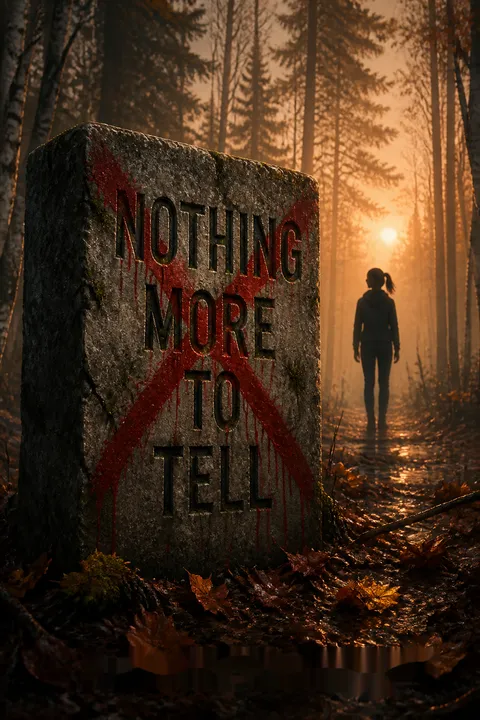


Plot Summary
The Teacher in the Folder
After losing her school newspaper position and being wait-listed at Northwestern, Brynn Gallagher returns to Sturgis with her family, feeling that the future she planned has collapsed.
She applies for an internship at Motive, a true-crime show, and wins Carly Diaz’s attention by pitching the unsolved murder of William Larkin, her beloved eighth-grade teacher. Larkin was found bludgeoned in the woods behind Saint Ambrose four years earlier. Three classmates discovered him, and the town accepted that a transient man had killed him after Larkin reported him to police.
Brynn remembers the witnesses, the school’s missing trip money, and the questions no one pursued. Carly offers Brynn the internship and invites her to develop the case, giving the young reporter a reason to return to a town she hoped to leave.
Brynn’s career setback and the murder investigation begin as one problem: she needs a story that can restore her standing, but she also believes Larkin deserves the scrutiny he never received. That overlap gives her determination a personal edge. Her first journalistic act is not detached investigation but an attempt to recover a teacher’s significance and her own lost identity. The tidy official explanation offers emotional relief to Sturgis, yet its very neatness becomes evidence of how a community can mistake closure for truth.
A Garden Reunites Old Rivals
Tripp Talbot works at Brightside Bakery and hopes to win a large college scholarship, though he assumes Saint Ambrose’s head, Mr. Griswell, will punish him for his father’s old dispute over unpaid carpentry work.
Regina Young urges him to join the committee planning a memorial garden for Larkin, and the committee pairs him with Brynn, his former friend. Their friendship ended in eighth grade when Tripp publicly humiliated her, then joined Shane Delgado and Charlotte Holbrook after they found Larkin. On Brynn’s first day back, someone defaces Larkin’s commissioned portrait.
Soon she and Tripp receive anonymous messages accusing them, Shane, and Charlotte of murder. Tripp recognizes Brynn’s name on the roster, while the shared threats make the garden project feel less like a school tribute than an invitation to reopen buried suspicions.
The garden binds the two narrators to a shared task before either is ready for renewed intimacy. Tripp’s scholarship need makes participation practical, while Brynn sees it as an investigative foothold. Their different motives create useful friction: she wants information, he wants distance from the woods. The vandalism and anonymous accusations turn a commemorative space into contested ground. Saint Ambrose’s polished language of community cannot contain the history beneath its lawns, and the first signs of hostility make its rituals look less like healing than image management.
Motive Rejects the Tidy Story
At Motive’s roundtable, Brynn presents Larkin as a gifted teacher, but senior executive Ramon d’Arturo challenges her for knowing almost nothing about the victim’s life outside school. He points out that no family came forward after Larkin’s death and recommends abandoning the case.
He also warns that a disreputable rival host, Gunnar Fox, is pursuing it. Carly rejects Ramon’s judgment and orders preliminary inquiries. Police photographs show the murder weapon was a hand-sized rock, a broken silver chain, and no prints besides Shane’s.
Brynn also revisits the class-trip theft: the money appeared in Charlotte’s locker after Larkin died, while a larger turquoise donor envelope vanished. She finds that Shane’s family company made an unusual donation to the local police foundation shortly after the murder.
Ramon’s criticism exposes the limits of Brynn’s sentimental portrait: a teacher’s influence on students does not automatically make his private life knowable. Carly’s decision to continue is both editorial defiance and a test of whether the show can investigate without a ready-made grieving family. The physical evidence complicates the town’s assumptions, while the donation raises a question about unequal access to justice. Wealth here is not merely atmosphere. It may determine which children are treated as credible witnesses and which suspicions are allowed to fade.
A Murderer on the Whiteboard
At school, Colin Jeffries projects a Gunnar Fox trailer into media class. Fox singles out Shane, whose fingerprints were found on Larkin’s murder weapon, and promises a series casting the students as possible killers. Tripp yanks Colin’s phone away before the accusation can continue, and the confrontation nearly becomes a fight.
Brynn steps between them to stop Tripp from ruining his future, but Colin’s wild swing catches her in the head. The injury sends her to the nurse and draws her uncle Nick into the secrecy around her investigation. Tripp later checks on Brynn, and their old hostility loosens into wary concern. The spectacle also confirms that the murderer texts were part of a broader campaign, not simply a school prank.
Fox’s video converts unresolved grief into entertainment and recruits the school’s class divisions as an audience. Colin’s choice to broadcast it makes public humiliation a weapon, echoing the damage Brynn suffered when a prank ruined her newspaper reputation. Tripp’s impulsive defense of his friends reveals how quickly shame can become aggression, while Brynn’s attempt to restrain him risks her own safety. Their renewed connection begins not with confession but with mutual exposure to consequences neither can control.
The Garden's Last Consultant
Brynn and Tripp seek gardening advice from Richard Solomon, Saint Ambrose’s retired groundskeeper. Their visit goes badly: Solomon mistakes them for intruders, aims a shotgun at them, then recognizes Tripp and lowers it. He refuses to help with Larkin’s memorial and says the dead teacher deserved his fate.
The remark unsettles both students, especially because Solomon had once tended the school grounds and knew Larkin. When the new groundskeeper proves hostile too, Tripp suggests trying Solomon again, this time by the front door.
Meanwhile, Brynn asks a former Eliot School colleague about Larkin’s earlier teaching job. The colleague recalls that Larkin left a prestigious post because he wanted to teach at the same school as his brother, a family connection Brynn has never heard about.
Solomon’s outburst breaks the assumption that everyone who valued Larkin remembers him as harmless. His confusion makes the statement difficult to interpret, but not easy to dismiss. At the same time, the brother clue gives Larkin a private history that contradicts the public image of a teacher without family ties. Both moments widen the inquiry beyond the three student witnesses. Brynn is learning that affection can preserve a person’s best qualities while erasing the conflicts that may explain why others saw him differently.
Solomon's House Goes Silent
When Brynn and Tripp return to Solomon’s home, they find the front door open and the house empty. They enter to check on him and discover his body beside the fireplace, blood on the mantel and a tackle box missing. Brynn calls emergency services while Tripp freezes in a traumatic replay of finding Larkin.
At the police station, Brynn’s internship becomes known to Tripp, who feels betrayed that she investigated the murder without telling him. Her parents and friends are also angry that she concealed her work and the dangers she encountered. As Brynn grieves, an Eliot colleague confirms that Larkin once spoke of a brother. Tripp, meanwhile, withdraws from school and work, overwhelmed by the return of a memory he has spent years suppressing.
The second body makes the old case physically present again, but the scene also reverses the roles of witness and rescuer. Brynn must act while Tripp becomes unable to function, and both carry away a different form of helplessness. Her secrecy has protected her access to the story but damaged the relationships she hoped would sustain her. The murder investigation’s ethical problem is now intimate: collecting facts about vulnerable people can expose them to harm, even when the reporter’s motives are sincere.
Tripp's Four-Year Lie
While drinking at his mother’s friend’s house, Tripp finds messages showing Lisa Marie Talbot has been working with Gunnar Fox. She sent the anonymous murder accusations to the students and planned to portray Tripp as a frightened witness, hoping to sell their family story.
Tripp refuses to join her scheme and later opens up to Brynn. He admits he found the missing trip money at home and believed his father had stolen it.
More painfully, he explains that after discovering Larkin dead, he saw a silver disc belonging to his father and invented a story that placed Shane and Charlotte with him throughout the woods. He thought this would protect his father. Brynn remembers her father’s car trouble that afternoon and proves Tripp’s father was with her family, not in the woods.
Tripp’s false memory is not a simple lie but a child’s attempt to make an unbearable event legible. He built a theory around a silver token and a recent argument, then organized four years of guilt around that theory. Brynn’s recollection dismantles it, showing how memory can preserve a mistaken inference more stubbornly than an observed fact. His confession also exposes the cost of silence: Tripp’s effort to protect his father may instead have shielded Shane, the witness whose account he shaped.
The Medallion Crosses State Lines
Brynn and Tripp trace the medallion to Mad Dog Tavern in New Hampshire, where its owner, Rose, recognizes the name Billy. She explains that William Larkin was once Billy Robbins, the lonely son of controlling Dexter Robbins. Billy’s stepmother Lila fled Dexter with her young son Michael, who would now be their age.
Larkin had told a former colleague he went to Saint Ambrose to find his brother, making Brynn suspect that Shane might be Michael. Rose describes Dexter as a dangerous man who could have harmed his own family. Brynn then searches nearby pawnshops and shows the medallion to a man who reacts with anger and pursues her. She and Tripp escape, but the encounter suggests Dexter may still be searching for his missing son.
The medallion turns a private keepsake into a map of hidden kinship. Its engraved name links Larkin’s public identity to an abandoned family story, while the search for Michael shifts suspicion toward the possibility of a long-term escape from abuse. Brynn’s reporting instincts now carry physical risk: the discovery gives her a lead, but it also alerts a dangerous person to her presence. Tripp’s willingness to continue with her marks a change from guarded participation to shared responsibility.
The Money Was Lisa's
After Tripp returns home, his father finds the liquor bottles Tripp emptied during his disappearance. Their confrontation becomes the first honest conversation they have had in years. Junior explains that Lisa Marie stole the class-trip money during a school concert.
He found it in her bag, brought it home intending to return it, and then avoided telling Tripp because he feared the truth would expose how little Lisa Marie had cared for her son.
Tripp had found the envelope and carried it back to school, but panic led him to leave the smaller money envelope in Charlotte’s locker and destroy the larger donor envelope. Junior acknowledges that his silence and emotional absence left Tripp to interpret the murder alone. The two begin repairing their relationship over a simple dinner plan.
This revelation disentangles theft from murder and corrects Tripp’s long-standing suspicion of his father. Junior’s failure was not criminal violence but avoidance: he believed withholding painful information was protective, while his silence left his son alone with a far worse explanation. Tripp’s act of returning the money was compromised by fear, yet it was not the theft itself. The distinction matters because the novel refuses to treat every wrong as equivalent; accountability depends on naming the specific harm rather than inheriting a family’s general shame.
Green Hands Under Blacklight
At the Winter Dance, Tripp and Brynn arrive together and share their first kiss, choosing a connection neither of them had dared to name. Ellie has coated a marker beside Larkin’s poster with ultraviolet powder to identify whoever has been defacing his image.
Under the gym’s black lights, Mason Rafferty’s palm glows. Brynn confronts him, and he reveals that Larkin was his half brother, who threatened to expose the family hiding place to Dexter. Mason says he did not kill Larkin; he vandalized the memorial images when the portrait revived his fear and anger.
Charlotte overhears the disclosure and promises to keep Mason’s identity secret. Meanwhile, Shane ends his relationship with Charlotte, whose devotion to him has shaped her place in their tightly bound group.
The dance brings private histories into a public ritual of adolescent belonging. Brynn and Tripp’s kiss offers a fragile pleasure, while Ellie’s practical trick turns the room’s lights into an instrument of evidence. Mason’s vandalism is not proof of murder; it is an expression of unresolved fear triggered by Larkin’s return to institutional memory. Charlotte’s choice to protect Mason suggests loyalty can be humane, but her history of placing Shane first leaves the meaning of her loyalties uncertain.
A Name From the Woods
After Charlotte and Shane separate at the dance, Shane tells Tripp that he heard Larkin arguing about the class-trip money in the woods and saw Nick Gallagher, Brynn’s uncle, leaving afterward. Brynn confronts Nick, who explains that an anonymous letter wrongly accused Larkin of taking the money.
Nick had met Larkin to discuss it, but left when Larkin became angry. Before they can absorb the revelation, Tripp sees the man from the pawnshop shove Ellie into a red pickup and drive away.
Brynn and Nick follow, while Tripp alerts them that the kidnapper is Dexter Robbins. Brynn tracks Ellie’s location as Nick pursues the truck through dark roads. Their attempt to recover Ellie turns a mystery investigation into an immediate rescue, with Nick driving too fast to keep the pickup in sight.
Shane’s account finally breaks the pact that has kept the witnesses’ memories sealed, but it does not provide a verdict. Nick’s presence in the woods looks incriminating until his explanation supplies a different context, demonstrating why proximity alone cannot establish guilt. The shift to Ellie’s abduction forces the characters to act before certainty is possible. Brynn’s family, previously a source of ethical caution, becomes part of the danger created by her investigation.
The Red Truck's Last Run
The chase ends when Nick’s car strikes a tree. Dexter emerges with a gun and demands to know where his son is, while Ellie remains trapped in his pickup. As he threatens Brynn, Nick suddenly reverses and drives into Dexter, knocking him out of sight and stopping the immediate danger.
Tripp frees Ellie, while Nick is taken to hospital with a serious brain injury. Dexter dies, and Nick later wakes; authorities do not charge him over the collision.
In the aftermath, Tripp finds Solomon’s missing tackle box hidden among Lisa Marie’s belongings and reports the theft, though whether she caused Solomon’s death remains uncertain. Tripp and Shane give police more truthful accounts of the old case, and Brynn returns to Motive after recovering from the shock and guilt of the rescue.
The climax is a rescue, not a solution to Larkin’s murder. Nick’s collision protects Ellie but leaves him physically vulnerable and Brynn burdened by the consequences of bringing Dexter back into their lives. The tackle box then extends suspicion toward Lisa Marie without resolving it, resisting the temptation to turn every clue into certainty. The characters begin correcting their earlier silences, yet the official and emotional aftermath remains uneven: disclosure is possible, but it cannot undo the harm already done.
Epilogue
At Saint Ambrose, Brynn tells Charlotte she believes she killed Larkin after overhearing his threats against Mason’s family and mistaking Shane for the brother Larkin had found. Brynn suspects Charlotte wrote the anonymous letter accusing Larkin of stealing the trip money, then struck him while wearing gloves. Charlotte denies the theory and warns Brynn not to repeat it.
Brynn has one piece of corroboration: the handwriting on the letter’s envelope resembles Charlotte’s writing on their old leaf-project cover page. It is not proof, but it is enough to restart the inquiry. Brynn accepts Carly’s invitation to return to Motive, choosing investigation again while acknowledging that the final answer remains unconfirmed.
The ending offers a persuasive reconstruction rather than a courtroom-grade resolution. Brynn combines motive, opportunity, a misidentified brother, and the anonymous letter, but Charlotte’s denial and the lack of direct evidence keep the case open. That uncertainty is essential: the novel has shown how confidently children and adults can build stories from partial observations. Brynn’s return to Motive signals growth because she no longer mistakes persistence for certainty. She can pursue the truth while admitting that her theory may be incomplete, and that ethical reporting requires both courage and restraint.
Analysis
Nothing More to Tell treats a murder investigation as a struggle over who gets to define the past. Brynn approaches Larkin’s death as a reporter, but her attachment to him makes the evidence personal from the start. Tripp’s narrative shows the opposite danger: guilt has made him treat an imagined version of events as more trustworthy than memory itself. Their alternating perspectives let the reader watch each character’s certainty fracture for different reasons.
The school’s class hierarchy is not background decoration. It shapes who is protected, who is suspected, and whose mistakes can be quietly managed. Shane’s family has wealth and institutional influence; Tripp’s family has little room for error. The police donation, the school’s handling of the missing money, and the casual acceptance of the students’ first account all suggest that credibility is distributed unevenly. Yet the book avoids making social position a complete explanation. Each teenager acts from fear, loyalty, or self-interest, and those motives overlap without becoming identical.
The novel also distinguishes truth from confession. Tripp’s lie originates in a child’s desperate attempt to protect his father, then traps him in years of self-punishment. Brynn’s investigative zeal has a parallel flaw: she sometimes treats other people’s histories as material before earning their trust. Both must learn that discovering facts is not the same as knowing what to do with them. The unresolved final theory about Charlotte preserves that ethical tension. A convincing explanation is not proof, and a reporter’s responsibility includes stating the difference. By the end, healing does not come from a perfectly closed case. It begins when people stop using silence as protection and accept the risks of telling what they know.
Review Summary
Nothing More to Tell received mixed reviews, with many praising its engaging mystery and likable characters, particularly Tripp. Readers enjoyed the dual perspectives and found the plot twists intriguing. Some felt the ending was abrupt or unsatisfying, while others appreciated the unpredictability. Critics noted similarities to McManus's previous works but found this book more enjoyable. The story's pacing and readability were consistently praised, though some found the characters underdeveloped. Overall, fans of McManus's work generally enjoyed this young adult thriller.
People Also Read








Characters
Brynn Gallagher
The returning reporterBrynn is an ambitious high-school journalist whose sense of self is closely tied to doing good work. Losing her newspaper position after a humiliating prank and moving back to Sturgis leave her feeling that she has been reduced to her mistakes. Reporting offers her a way to regain control, but her instinct to pursue a story can eclipse the needs of people around her. She is observant, persistent, and more emotionally perceptive than she initially believes, though she often mistakes access for understanding. Her bond with her sister Ellie and her complicated history with Tripp reveal a more vulnerable side than her professional confidence suggests.
Tripp Talbot
The guarded witnessTripp is a scholarship student who works at a bakery and hopes college will let him leave Sturgis behind. His mother’s abandonment and his father’s financial instability have made self-reliance feel safer than asking for help. He uses humor, running, and silence to manage feelings he cannot easily name. Beneath his confident appearance, he is deeply loyal and unusually attentive to other people’s needs, though guilt distorts his judgment. His history with Brynn combines friendship, embarrassment, and feelings he never expressed, making their renewed partnership both comforting and destabilizing.
Shane Delgado
The school golden boyShane is wealthy, athletic, and accustomed to being protected by his family’s influence. His relaxed charm can make him seem uncomplicated, but he is more affected by the past than he lets his friends see. He leans on familiar relationships and often lets others set the terms of difficult conversations. His long partnership with Charlotte and friendship with Tripp give him a secure place in Saint Ambrose’s social hierarchy, while his family’s power complicates how others interpret his choices.
Charlotte Holbrook
The polished loyalistCharlotte is wealthy, striking, and highly conscious of how she is seen. Having received objectifying attention from boys from an early age, she values the relationships in which she feels treated as a person, especially her bond with Shane. She can be controlling and socially exacting, but she is not simply vain or cruel; she has a real capacity for loyalty and a strong need to protect the people she considers hers. Her composure often conceals insecurity, and her devotion to maintaining closeness can make her boundaries with others unusually rigid.
Mason Rafferty
The thoughtful friendMason is one of Brynn’s few familiar friends at Saint Ambrose after her return. Tall, warm, and openly affectionate with the people he trusts, he helps make the school feel less alien to her. He admires Larkin and carries a complicated family history that he rarely discusses, partly because he wants his present life to remain stable. His sensitivity can make him retreat when old fears resurface, but his humor and closeness with Nadia and Brynn keep him grounded.
Ellie Gallagher
The sharp younger sisterEllie is Brynn’s fourteen-year-old sister, a gifted flutist with a mischievous streak and a talent for noticing what adults and older teenagers overlook. She teases Brynn but also offers direct, practical support when Brynn’s ambition turns into tunnel vision. Her playful experiments, including a clever use of ultraviolet powder, show that she enjoys solving problems in her own way. Ellie is more than a sidekick: her loyalty and clear-eyed questions repeatedly force Brynn to confront the emotional costs of her choices.
Nick Gallagher
Brynn's searching uncleNick is Brynn’s young uncle, a former Saint Ambrose teaching assistant who is still finding a professional direction. He is warm, funny, and close to Brynn, though his conflict avoidance can keep him from sharing difficult information. His uncertainty about his own life contrasts with Brynn’s drive to have a fixed purpose. He is often a supportive adult when her parents cannot be, but he also has secrets and limits of his own.
Lisa Marie Talbot
The unreliable motherLisa Marie is Tripp’s mother, a restless woman who left her family years earlier and now moves through life on her own terms. She is charismatic when it suits her and blunt in ways that can feel more selfish than honest. Her return stirs hope in Tripp even as he expects disappointment. She wants freedom from the responsibilities she associates with family, but she also seeks attention and opportunity, making her difficult for Tripp to trust.
Junior Talbot
Tripp's overworked fatherJunior is Tripp’s father, a hardworking man who takes unstable jobs and rarely knows how to discuss the painful parts of family life. He loves his son but often assumes Tripp can manage alone, a habit that leaves them emotionally distant. His practical competence and occasional flashes of anger coexist with a reluctance to explain himself. The gap between his intentions and his silence shapes much of Tripp’s understanding of home.
William Larkin
The beloved teacherLarkin is the young English teacher whose murder draws Brynn back into the life of Saint Ambrose. He encouraged students’ writing and paid close attention to their potential, making a lasting impression on Brynn and others. His public image is that of a generous mentor, but his private history is largely unknown to the students who remember him. The gap between the teacher they loved and the person they never fully knew becomes central to the investigation.
Carly Diaz
Motive's bold hostCarly hosts Motive and values initiative, directness, and a willingness to challenge conventional story choices. She recognizes Brynn’s nerve and gives her a chance despite her age and professional setbacks. Carly is ambitious about growing the show, but she resists having its editorial judgment dictated by corporate priorities. Her support helps Brynn enter the world of true-crime reporting, while her insistence on boundaries shows that encouragement is not the same as permission to ignore ethics.
Richard Solomon
The aging groundskeeperSolomon is Saint Ambrose’s former groundskeeper, remembered for cultivating an extraordinary garden and welcoming students into its quiet pleasures. In the present, age and confusion have made his behavior unpredictable. His history with the school and his knowledge of its people give him a place in the investigation, though his remarks are difficult to interpret. The contrast between his once-beautiful garden and his neglected home reflects how much has changed beyond the students’ memories.
Steven Patz
The persistent investigatorOfficer Patz interviewed the three students after Larkin’s death, early in his career as a police investigator. He is methodical and attentive to inconsistencies, though the case’s original assumptions constrain what he can establish. Years later, he still remembers the witnesses and the oddities around their accounts. His measured persistence contrasts with the students’ fear that any question from the police means they are already suspected.
Dexter Robbins
The feared family patriarchDexter is a controlling father whose influence reaches across the characters’ lives long after a family member disappears. People who knew him describe a man who expects obedience and treats his own authority as unquestionable. His presence is felt first through fragments of family history, then through the fear attached to his name. He represents the danger that can follow people who try to escape an abusive home.
Rose
The tavern's keeperRose owns Mad Dog Tavern in New Hampshire and remembers the local people who once gathered there. She is candid, observant, and protective of those who have suffered under controlling authority. Her recollections give Brynn and Tripp access to a side of Larkin that no school record preserves.
Nadia Amin
Brynn's steady friendNadia is Brynn’s friend at Saint Ambrose, a thoughtful student with a dry sense of humor. Having lost her parents young and moved countries to live with relatives, she understands how hard it can be to feel at home. She is dependable without being indulgent, and expects Brynn to show care through actions as well as apologies.
Regina Young
Tripp's bakery anchorRegina owns Brightside Bakery, where Tripp works, and offers him the steady affection and practical guidance missing elsewhere in his life. She is blunt, generous, and difficult to fool. Her bakery gives Tripp a place where routine, work, and food provide a form of family without requiring him to pretend his problems are solved.
Ramon d'Arturo
The skeptical executiveRamon is a senior Motive executive focused on the show’s growth and public appeal. He challenges Brynn’s pitch because he sees an investigative story without the personal context audiences expect. His skepticism exposes real weaknesses in her research, even when his delivery is dismissive.
Colin Jeffries
The school provocateurColin is a student who embraces the class resentment at Saint Ambrose and uses the label dreg as a badge of grievance. His hostility toward the wealthy students gives him an audience, but he channels that anger into harassment rather than understanding. He brings an outside media accusation into the classroom and makes it personal.
Ms. Kelso
The memorial organizerMs. Kelso is the Saint Ambrose administrator leading the memorial garden committee. She cares about honoring Larkin and is shaken when someone defaces the portrait and garden materials. Her faith in the school community makes the vandalism feel like a personal failure.
Plot Devices
The silver medallion
A name becomes a trailThe disc Tripp finds near Larkin’s body bears the name Billy and the emblem of a New Hampshire tavern. It first misleads Tripp into thinking his father may have been at the murder scene. Later, Brynn and Tripp use it to connect Larkin to his childhood, find Rose, and draw Dexter Robbins back into the present. Its changing meaning demonstrates how an object can preserve a fact while its owner’s interpretation remains wrong.
The memorial garden
A tribute reopens the caseSaint Ambrose’s plan to honor Larkin brings Brynn and Tripp together and gives them a legitimate reason to speak with former students and staff. The project also makes Larkin’s image visible again, provoking vandalism and unease among people who would prefer the past to stay buried. What begins as a school service project becomes the physical center of the investigation.
The missing envelopes
A theft distorts the witnessesThe class-trip money, the smaller envelope found in Charlotte’s locker, and the missing turquoise donor envelope create a parallel mystery that affects the murder investigation. Tripp’s effort to return the cash and conceal his father’s connection inadvertently places suspicion on Charlotte and shapes his false account of the woods. The later explanation distinguishes Lisa Marie’s theft from Junior’s attempt to return the money.
Motive and Gunnar Fox
Competing stories exert pressureMotive offers Brynn a path into investigative journalism, while Gunnar Fox turns the case into a sensational series and tries to recruit Tripp and Lisa Marie. Their rival approaches expose the difference between seeking corroborated facts and constructing a marketable accusation. Fox’s involvement also pressures the students into reconsidering what they have kept secret.
The marked-up posters
Fear leaves visible tracesSomeone repeatedly slashes Larkin’s face on school portraits and garden flyers. Ellie’s ultraviolet-powder test identifies the person who handled her planted marker, connecting the vandalism to a student’s private history. The marks point toward trauma and resentment, but they are not proof of murder, a distinction the story preserves.
About the Author
Other books by Karen M. McManus




Download PDF
Download EPUB
.epub digital book format is ideal for reading ebooks on phones, tablets, and e-readers.








