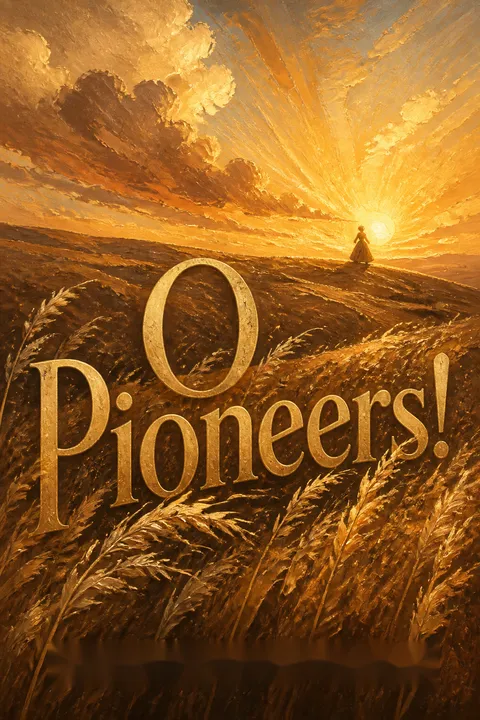


Plot Summary
The Kitten Above Hanover
On a bitter January day in Hanover, five-year-old Emil Bergson watches his kitten cling to a telegraph pole, terrified that she will freeze. His older sister Alexandra finds their childhood friend Carl Linstrum, who climbs the pole and brings the animal down. On the drive home, Alexandra tells Carl that the doctor cannot save their father, John Bergson.
The land outside town is bleak, the family future uncertain, and she admits she cannot imagine carrying on without John. Emil sleeps in the wagon with his kitten while Alexandra drives toward the homestead, already facing a burden none of her brothers can yet manage. At the store, the children have also met Marie Tovesky, a lively Bohemian girl visiting her uncle.
A Daughter Inherits the Divide
Before he dies, John gathers his children and makes Alexandra responsible for keeping the family farm intact. He believes she understands the land better than his sons, Lou and Oscar, and asks them to follow her judgment until they establish households of their own. John also tells Alexandra to protect their mother and continue improving the farm.
Lou and Oscar agree, though their strength lies in steady labor rather than planning. Their mother preserves familiar routines with gardens, food stores, and household order, giving the family a measure of stability. Alexandra accepts the charge without pretending it will be easy. Her father leaves her not a successful farm but a hard-won chance to discover what the Nebraska soil can become.
The Land's Last Wager
Six months after John's death, Alexandra takes her brothers to visit Ivar, an eccentric Norwegian farmer who lives in a sod house beside a pond. He explains that clean feed and better conditions could save their hogs, and Alexandra quietly plans to follow his advice despite Lou and Oscar's scorn for experiments. The family prospers briefly, then drought and crop failures sweep the Divide.
Their friend Carl's family decides to return to St. Louis, while Lou and Oscar argue that the Bergsons should leave too. Rather than commit them blindly, Alexandra drives south to inspect farms along the river. She finds that the richer valley land is already costly and sees greater possibility in the overlooked upland they know.
Wheat Replaces the Wilderness
Back home, Alexandra proposes borrowing against the homestead to buy neighboring acreage while prices remain low. Lou fears another mortgage; Oscar dreads returning to debt. Alexandra persuades them that holding land, not exhausting themselves in the fields, is their best chance at security, and Oscar finally agrees.
She expands the family's holdings, experiments with crops, and proves more perceptive than neighbors who sell and leave. Sixteen years later, the prairie has become a grid of prosperous farms, and Alexandra's carefully managed land is among the richest.
Emil has graduated from university and returned from his first season away. Lou and Oscar have farms and families of their own. Alexandra's success has delivered independence, but not the intimacy she once shared with Carl.
The Orchard Path Reopens
Carl returns after sixteen years, weary of engraving and unsure whether prospecting in Alaska will give him a life that feels his own. He and Alexandra resume their close, candid friendship, while he learns how the land has flourished and how Emil, newly home from university, still seems restless.
Nearby lives Marie, now married to Frank Shabata, a hardworking farmer whose jealousy and resentment make ordinary neighborly kindness difficult. Alexandra visits the Shabatas with Carl, who sees Marie's warmth and recognizes that Frank's bitterness has narrowed their marriage.
Later, Carl comes upon Emil and Marie in the pasture after they have shot ducks. Marie grieves over the birds, and Carl senses a tenderness between the young pair that Alexandra has not noticed.
Brothers Put Friendship on Trial
As Emil works beside Marie in the orchard, their familiar closeness gives way to a painful recognition of desire. He says he will leave the Divide, unwilling to remain under Alexandra's protection, and Marie cannot bring herself to admit what she feels.
Meanwhile, Lou and Oscar confront Alexandra about Carl, insisting that he wants her money and that her choices threaten family property. Alexandra refuses to surrender control of her land or private life. Carl hears of the quarrel and leaves, ashamed that he cannot face her brothers or offer the security they demand.
Emil, too, chooses a new direction: after postponing law school, he plans to work in Mexico. During the winter, his vivid letters reach home, and Marie knits him a tie while keeping her longing to herself.
Mexico Cannot Quiet the Heart
Emil returns from Mexico the following summer, and Alexandra proudly takes him to a church fair in a striking outfit from his travels. Marie, dressed for the celebration, eagerly draws him into conversation and learns about the life he has seen abroad.
During a playful blackout arranged by the young men, Emil kisses her, and the moment makes their concealed attachment impossible to dismiss. At Signa's wedding, Marie tries to leave without Emil, but he follows and asks why she once chose Frank.
Marie explains that she married him for love and cannot simply erase that past. Emil presses her to acknowledge her feelings; she finally does, while insisting she cannot abandon her husband. They part knowing Emil intends to leave again, though neither has found a way to make that separation bearable.
The Mulberry Tree's Last Evening
Emil's friend Amédée becomes dangerously ill while working his wheat harvest and dies after a late operation for appendicitis. At the church service held soon afterward, Emil finds a brief peace in the music and resolves to leave Marie without bitterness.
He rides to the Shabata orchard to say goodbye and finds her lying beneath the white mulberry tree, barely responsive. When she wakes, they embrace. Frank returns home, discovers Emil's exhausted horse, takes his rifle, and searches the orchard.
His lifelong suspicion turns what he sees through the hedge into proof of betrayal; he fires three shots. Frank flees in horror, while Marie crawls back to Emil. By morning, both lie dead beneath the tree. Their final closeness becomes the image that will remain with Alexandra.
Alexandra Carries the Survivors
Ivar discovers Emil and Marie's bodies at dawn and brings the news to Alexandra. Frank gives himself up in Omaha, pleads guilty to killing without premeditation, and receives a ten-year sentence. Three months later, grieving and exhausted, Alexandra walks to her parents' grave during a storm.
Ivar and Signa find her and bring her home; the ordeal loosens some of the fear that has kept her trapped in grief. As she recovers, Alexandra understands that her assumptions about Emil and Marie kept her from seeing their attachment, and she feels pity for Frank as well as anger.
Believing he has paid most heavily, she travels to Lincoln to visit him in prison and promises to work for his release. There she receives word that Carl has returned to Hanover.
Homeward Across the Divide
Carl has learned of the tragedy from a newspaper and rushed back as soon as he could reach Alexandra. He explains that her letter never found him, then stays beside her while she tells him what she has lost.
Walking across the fields, Carl recalls seeing Emil and Marie together long before Alexandra understood their feelings. He asks her not to judge them too harshly; both struggled against a love that could not fit the lives they had made. Alexandra admits that returning to the Divide restored a sense of freedom she feared was gone.
She and Carl choose to marry, not as an escape from the land but as companions who understand what each has carried. Alexandra also recognizes that the land belongs to no family forever. It passes through human hands, then outlasts them.
Analysis
The novel tests two rival measures of a life: what a person builds and what a person feels. Alexandra's investment in the Divide is neither blind optimism nor simple conquest. She studies what other farmers overlook, risks debt when the land is cheap, and turns patient attention into material independence. Yet her skill has a cost. The habits that make her an effective steward also narrow her understanding of emotional life. She can read soil, markets, and animal health more readily than desire, especially when the people involved are Emil and Marie.
The generational story complicates the idea that prosperity is a final reward. The land changes from hostile prairie to productive farmland, but the second generation inherits a different burden: abundance can become routine, and family duty can feel like confinement. Emil's education and travel widen his horizon without giving him a settled purpose. Carl's artistic and migratory life offers another alternative, though he experiences freedom as a lack of roots. Alexandra's eventual choice of Carl does not cancel her attachment to the land; it joins rootedness to companionship rather than treating them as opposites.
Marie and Frank's marriage shows how love can be damaged by the stories people tell themselves. Frank turns disappointment into grievance and reads attention as evidence of betrayal. Marie tries to preserve her generosity while living beside his resentment. Their tragedy is not presented as a simple contest between innocence and guilt: Emil and Marie choose a love that violates existing bonds, while Frank's possessiveness culminates in irreversible violence. Alexandra's later compassion for Frank does not absolve him. It recognizes that punishment cannot restore the dead, and that grief may still demand care for the living.
The novel's deepest continuity is the land's scale. Individual lives flare with intense consequence, but the fields pass through many hands and continue beyond them. Alexandra's mature insight is not ownership without limit, but stewardship for a time. The title's pioneers therefore include more than those who break sod. They are people attempting to make a life where the old rules have not yet settled, with no guarantee that courage will protect them from loss.
Review Summary
Most reviewers praise O Pioneers! for its lyrical prose, vivid depiction of the Nebraska prairie, and the compelling portrayal of Alexandra Bergson, a strong, independent woman navigating frontier life. Many highlight Cather's ability to evoke landscape and pioneer experience with spare yet poetic writing. Common criticisms include a slow pace, weak plot, and a controversial final section where Alexandra's reaction to tragedy feels inconsistent with her established character. The ending divides readers, with some finding it redemptive and others feeling betrayed by it.
People Also Read




Characters
Alexandra Bergson
The land's clear-eyed stewardAlexandra is the eldest Bergson child, a practical and unusually perceptive farmer whose father trusts her to guide the family. She learns to read markets, crops, and people with patient attention, and her confidence in the Divide is rooted in observation as much as instinct. Her strength can make her seem emotionally remote: she is better at solving a crisis than recognizing a private longing, in herself or others. She values independence, loyalty, and the chance to make a life that is larger than mere survival. Her relationship with Carl offers a kind of understanding she rarely finds elsewhere, while her bond with Emil carries the tenderness and responsibility of a parent as well as a sister.
Emil Bergson
The restless younger brotherEmil is Alexandra's youngest brother, raised within the practical demands of a pioneer farm but drawn toward education, travel, and a life of his own. University and time in Mexico broaden his world without easing his restlessness. He is emotionally intense, idealistic, and sometimes impatient with the limits imposed by family and place. His easy affection for Marie began in childhood, which makes the change in their relationship difficult for him to understand or control. Alexandra hopes he will have choices she and his older brothers did not, yet she can mistake his dependence on her for settled contentment. Emil's inner life is shaped by a desire to act decisively and to find a form of love that feels both absolute and honorable.
Marie Shabata
The quick-hearted neighborMarie is the lively Bohemian girl who once shared candy with Emil and later becomes Alexandra's close neighbor. Warm, curious, and quick to delight, she brings energy to farm life through friendship, work, food, and church gatherings. Her sociability is not superficial; she instinctively offers affection and attention, even when the people around her make that generosity difficult. She married Frank while young and carries both the memory of her first love for him and the strain of their increasingly unhappy household. With Emil, she shares an intimacy rooted in years of familiarity, which complicates her sense of duty and self-understanding. Marie's need for connection makes her responsive to others, but it also leaves her vulnerable to competing loyalties.
Carl Linstrum
The wandering old friendCarl is Alexandra's childhood friend, a sensitive young man who leaves the Divide to pursue engraving and later considers prospecting. Unlike Alexandra, he is uneasy with the idea that a life must be measured by land, wealth, or visible achievement. His artistic temperament makes him attentive to people and changes others overlook, though self-doubt often turns that perception inward as regret. He and Alexandra share a long history of mutual understanding, including the loneliness of their youth on the prairie. Carl is drawn to her steadiness but fears being accepted on terms that make him feel dependent. His return brings a different measure of success into the story: the value of companionship, attention, and a place where one is known.
Frank Shabata
The jealous, wounded husbandFrank is Marie's husband, a Bohemian farmer whose charm and finery as a young man give way to a combative, aggrieved manner. He works hard and wants recognition, but he interprets ordinary slights as evidence that others are against him. His jealousy grows from insecurity and becomes a habit of mind: he watches Marie for signs of affection that might reassure him, yet his suspicion helps drive her away. Frank can be generous and attractive in memory, which complicates the neighbors' judgment of the man he has become. He resents the Divide for failing to honor his ambitions, while remaining deeply tied to the place and marriage he blames for his frustration.
John Bergson
The pioneer fatherJohn is the Swedish immigrant who has spent years trying to make a living from the difficult Nebraska land. Losses and debts have taught him how little he understands, but they have not extinguished his belief that the family should hold its ground. He relies on Alexandra's intelligence and gives her authority over the farm, asking his sons to work with her. His hopes combine practical advice with a deep attachment to land as a source of permanence and inheritance.
Lou Bergson
The restless older brotherLou is Alexandra's younger brother, energetic and quick to form opinions, but less steady in execution than his older brother Oscar. He wants security and social standing, and he grows uneasy when Alexandra's independent decisions challenge his sense of what belongs to the family. His political ambitions and suspicion of outsiders reflect a need to be taken seriously. He can be affectionate toward his family, yet often mistakes control for protection.
Oscar Bergson
The steadfast farmhandOscar is Alexandra's older brother, a powerful and tireless worker who trusts routine more than speculation. His habits make him dependable in daily farm labor but resistant to new methods and long-range risks. He accepts Alexandra's authority when their father requires it, though his discomfort with debt and her independence never entirely disappears. Oscar measures worth through physical work and prefers certainty, even when that certainty limits what the family might achieve.
Mrs. Bergson
The keeper of homeThe Bergson mother is a practical, comfort-loving woman who preserves familiar customs amid the instability of frontier life. Gardening, cooking, and storing food are not small distractions to her; they are the means by which she makes a home in a place that often feels alien. She misses Sweden and resists another uprooting, while her household routines help hold the family together. Her grief is expressed through attachment to family, food, and the land where her husband is buried.
Ivar
The solitary animal healerIvar is an eccentric Norwegian farmer who prefers solitude, keeps a clean sod dwelling, and tends to animals with unusual care. His religious beliefs and unconventional habits make neighbors regard him with suspicion, but Alexandra trusts his judgment. He sees the wild land as a home shared with animals rather than a resource to be conquered. Later, he becomes a loyal member of Alexandra's household, offering practical help and a spiritual language for experiences she cannot easily explain.
Amédée Chevalier
Emil's joyful friendAmédée is Emil's close friend in the French community, a gifted baseball player and energetic young farmer. He embraces marriage and family with uncomplicated confidence, openly celebrating the ordinary life Emil finds difficult to choose. His affection for Emil is direct and good-humored, and his happiness gives Emil a picture of love that appears natural and socially accepted. Amédée's work ethic and optimism make him a vivid presence in the community.
Signa
Alexandra's loyal housekeeperSigna is a young Swedish domestic worker in Alexandra's household, shy around men but valued for her loyalty. Her marriage to Nelse reflects the practical, cautious courtship patterns Alexandra observes among her workers. When trouble comes, Signa returns to Alexandra's home and helps care for her.
Nelse Jensen
Signa's stern suitorNelse is a farmhand who courts Signa through sternness and practical attention rather than easy tenderness. He is part of the working household Alexandra has built, where labor and courtship often share the same daily spaces.
Annie Lee
Lou's status-conscious wifeAnnie is Lou's wife and the daughter of the neighbors who once shared the Divide's hardships. She is attentive to clothes, reputation, and social advancement, and encourages her family to move toward town life. Her preferences reveal how prosperity changes the settlers' sense of what counts as a respectable home.
Mrs. Lee
The old-country neighborAnnie's elderly mother, Mrs. Lee, finds comfort in Alexandra's home, where she can keep old customs and speak her native language. Her visits bring humor and tenderness, and her attachment to familiar ways echoes the older settlers' longing for the lives they left behind.
Plot Devices
The Divide
A landscape that tests beliefThe Nebraska Divide is both the setting and the central material problem of the novel. At first its droughts, storms, and uncertain yields seem to reject the settlers who try to farm it. Alexandra studies its conditions and invests when others flee; later, the transformed fields reflect the consequences of that patience. The land also shapes different ideas of freedom. Alexandra finds belonging in its work and continuity, while Carl remembers its wildness and Emil wants room beyond its routines. Its changes measure time across the story, but the land itself cannot be possessed forever by any one family.
The White Mulberry Tree
A shelter for hidden feelingThe mulberry tree stands in the Shabatas' orchard, a place where Marie can sit apart from household demands and where she and Emil speak more honestly than they can elsewhere. Its quiet shade contrasts with the social world that binds them to separate obligations. The tree's fruit and surrounding orchard also link present feeling to earlier acts of care, including Carl's work tending the trees when the land belonged to his family. Near the end, the orchard becomes the site of a fatal encounter, making the tree a powerful image of private love exposed to public judgment.
The Wild Duck
A memory of unpossessed lifeAlexandra and Emil once watch a lone wild duck enjoying the river without disturbance. The memory becomes a private touchstone they share, and it represents a kind of beauty neither sibling needs to own or explain. It also sharpens the contrast between watching a living creature and killing it: when Emil and Marie shoot ducks, Marie's distress reveals her sensitivity to the freedom she has helped destroy. The duck returns in Alexandra and Emil's recollections as a moment of happiness outside work, property, and family duty.
Letters from Mexico
Distance that sustains longingWhile Emil is away, his letters bring Alexandra and Marie vivid accounts of Mexico's streets, music, and public life. They reassure his sister that he is exploring possibilities beyond the farm, but their careful detail also gives Marie an imagined connection to the young man she misses. The letters allow intimacy to continue across distance without resolving the choices that keep Emil and Marie apart. Their physical journey home also lets Alexandra carry a small gift from Marie back to Emil, turning correspondence into a fragile bridge between two lives.
Download PDF
Download EPUB
.epub digital book format is ideal for reading ebooks on phones, tablets, and e-readers.








