

Key Takeaways
Use indirect routes when the destination is complex or still unclear
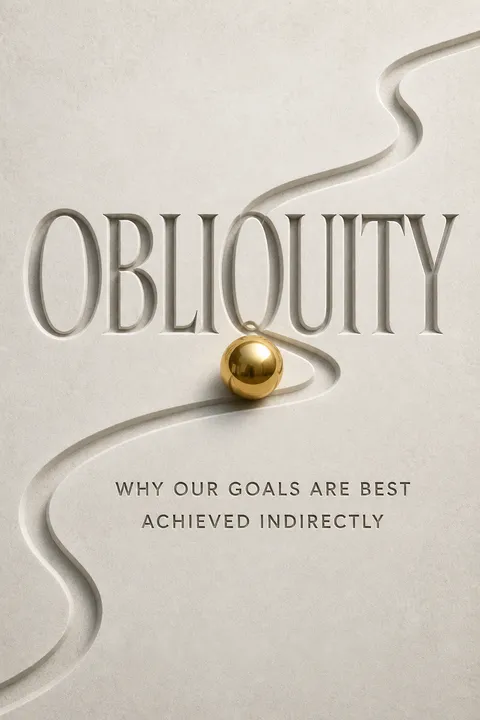
Complex aims need discovery. Obliquity is the process of pursuing a complicated objective indirectly, through experiment and adjustment. The Panama Canal takes ships southeast to travel between the Atlantic and Pacific more efficiently. Its best route is not the straightest line on a map, because geography makes the apparent shortcut longer. The same principle applies when the destination is less tangible: a fulfilling life, a healthy community, or a durable business.
Design has blind spots. St. Louis's Pruitt-Igoe housing project was built from a confident, top-down plan, yet its residents rejected the buildings and the development was demolished. Notre Dame, by contrast, took generations and many hands to build. Its shape evolved through accumulated changes rather than a single master plan.
What's striking is that indirectness here is not dithering. It is a way to keep learning when the goal, the setting, or the effects of action are not fully knowable in advance. This resembles adaptive control in engineering, where a system updates its response as conditions change. The idea also warns against mistaking clean blueprints for knowledge. Still, gradual adaptation is not automatically wise: institutions can preserve harmful customs as easily as useful ones. The practical test is whether feedback is real, whether people affected can respond, and whether the course changes when evidence warrants it.
Pursue absorbing work, not pleasant moments, to build a satisfying life
Pleasure is not the whole. Reinhold Messner reached Everest alone, from the Tibetan side, without supplemental oxygen. The climb was punishing, not pleasant, yet completing a demanding challenge contributed to deep satisfaction. Psychologist Mihaly Csikszentmihalyi calls the intense engagement of stretching one's skills against a manageable challenge flow. People in flow may not report feeling happy at that moment, but such experiences can make a life feel worthwhile.
Meaning outlasts moods. Raising children can involve exhaustion and frustration while still being regarded as a life's central achievement. This apparent contradiction makes sense if momentary pleasure, general contentment, and a broader sense of flourishing are not treated as the same thing. Robert Nozick's imagined experience machine sharpens the question: a stream of pleasant sensations may still feel like a poor substitute for actually doing and becoming something.
This distinction resembles the difference between hedonic well-being, the pleasantness of experience, and eudaimonic well-being, the sense of living in a way that develops one's capacities. It helps explain why a demanding craft, relationship, or responsibility can matter more than a comfortable afternoon. The idea is useful as a corrective to treating mood as a complete scorecard. But hardship is not inherently ennobling. Messner chose a voluntary ordeal; imposed deprivation, unsafe work, or caregiving without support should not be romanticized as hidden routes to fulfillment.
Build something worth serving; profit and wealth may follow
Purpose can produce profit. ICI once described its aim as applying chemistry responsibly. Its pharmaceutical research took years to pay off, but helped create an industry that later generated major commercial successes. After the company shifted toward a more direct emphasis on shareholder value, it reorganized and pursued acquisitions that did not restore its fortunes. Boeing, too, built its position through commitment to aviation and risky aircraft projects, including the 747, rather than by making each investment answer a tidy return calculation.
Money is often a by-product. George Merck emphasized medicine and patients before profit. Sam Walton described building a strong retailer as his central concern, while his family became extraordinarily wealthy. These examples do not show that money is irrelevant. They suggest that devotion to a worthwhile practice can sustain the capabilities, trust, and patience that financial success requires.
The argument is strongest when read as a claim about attention and time horizons, not as proof that purpose always beats financial discipline. A company that serves patients, customers, or passengers well may build reputation and capabilities that are hard to acquire through short-term extraction. This connects to intrinsic motivation: people often bring more care to work they regard as worthwhile. Yet purpose statements can also become polished camouflage. The meaningful test is whether decisions, incentives, and product choices express the stated purpose, especially when it conflicts with immediate revenue.
Let action teach you what your highest goals actually mean
Ends take shape in practice. A high-level objective is a broad aim, such as living well or building a great business. Intermediate goals translate that aim into conditions to pursue, and basic actions are the specific things people do. A cathedral stonemason can understand the task as shaping stone, building a cathedral, or serving a sacred purpose. Each level gives the work a different meaning, and the larger aim can improve the smaller actions.
Some values resist scoring. A good education might include knowledge, citizenship, and emotional development. There is no neutral formula for assigning each a precise weight. Isaiah Berlin's value pluralism is the view that important values can conflict and may not share a common measure. A numerical index can organize discussion, but its chosen measures and weights already embody judgments about what matters.
This framework helps explain why measurement cannot settle every disagreement. A metric can make trade-offs visible, but it cannot establish that one value should count twice as much as another without relying on a prior judgment. The distinction is useful in education, health care, and organizational leadership, where measurable outputs coexist with harder-to-score goods such as trust or dignity. The caution is that refusing to quantify anything can also hide choices and weaken accountability. A good practice is to use measures as partial evidence, while making the value judgments behind them explicit.
Make small moves, learn from consequences, and revise the route
Progress can be disciplined improvisation. Political scientist Charles Lindblom called practical decision-making successive limited comparison: choosing among a narrow set of nearby options, then adjusting as consequences become visible. This is not random trial and error. It is a repeated process of acting, learning, and revising. John Kay calls this process obliquity; the modest phrase muddling through can obscure how demanding it is.
Adaptation beats grand prediction. Honda did not enter the American motorcycle market through a flawless plan. Its initial push toward larger bikes struggled, while smaller Super Cub motorcycles drew interest and opened new routes to customers. The National Park Service likewise learned that extinguishing every forest fire could leave forests more vulnerable to major blazes. It moved toward allowing some natural fires to burn, then adjusted again after the devastating Yellowstone fires of 1988.
This resembles evolutionary problem-solving: variations are tried, feedback filters them, and workable changes are retained. It also explains why a plan can be intelligent without being comprehensive. Honda's story, however, should not be reduced to luck dressed up as strategy. Adaptation requires noticing unexpected signals and having the capacity to act on them. Nor is experimentation harmless in every setting. When errors are irreversible or costs fall on vulnerable people, small trials need safeguards, monitoring, and a clear willingness to stop.
Treat incentives as interventions: people change the measure you reward
Actions change the setting. At Marks & Spencer, Simon Marks introduced inexpensive, good-quality meals for employees after noticing a worker's family struggling. The policy expressed what sort of company he wanted to build, and employees could respond differently to a gesture of trust than to a benefit presented as a calculation to improve retention. How an organization acts shapes how people interpret its motives, which then shapes their response.
Targets can corrupt feedback. Goodhart's law describes how a measure can lose its usefulness once it becomes a target. When British ambulance services faced an eight-minute response-time target for life-threatening emergencies, reporting and dispatch behavior could be distorted by pressure to meet the number. The book also points to the Irish potato famine: households relied on a crop that worked for each family, but society's dependence on one crop magnified the damage when blight arrived.
A target is not a neutral measuring stick once people know rewards or penalties depend on it. This is a classic problem in mechanism design: rules shape behavior, and behavior reshapes the data used to judge the rules. The Marks example adds a subtler point, since people infer whether they are trusted or merely managed as instruments. Multiple indicators can reduce fixation on one number, but no dashboard can replace shared judgment about purpose. At the same time, values alone are insufficient where outcomes affect safety or fairness. They need observable checks.
Use models as maps, not as proof that the world is predictable
Every model leaves things out. A London Underground map can help someone navigate between stations but cannot decide whether the Underground is the sensible way to reach a nearby address. John Kay recounts following the map from Paddington toward Lancaster Gate when walking would have been simpler. The map was not defective; it answered a narrower question than the traveler needed to ask.
Risk is not all uncertainty. Financial models such as value at risk estimate losses using historical patterns and assumptions about how asset prices move together. They can be useful under familiar conditions, but they cannot reliably describe shocks outside the model's experience. A model's result may be mathematically correct while remaining irrelevant to the real decision. Franklin's gambit is the habit of assembling reasons after settling on the decision, then presenting them as if analysis produced it.
The map analogy captures a vital distinction between uncertainty inside a model and uncertainty about whether the model fits the situation. Contemporary model-risk practice makes a similar distinction: parameter uncertainty concerns estimated values, while structural uncertainty concerns the model's assumptions and boundaries. The second is harder to calculate and easier to ignore. Models remain valuable for clarifying mechanisms, comparing scenarios, and exposing assumptions. The danger begins when precision is mistaken for scope. Decision-makers should ask not only whether the calculation is sound, but also what real-world conditions it leaves outside the frame.
Trust trained judgment, but demand evidence that the expertise works
Skill exceeds explanation. David Beckham could curve a football into the goal without solving the physics equations describing its flight. Experienced paramedics likewise make effective judgments through patterns learned in practice. Researcher Gary Klein found that experienced paramedics and even lay observers distinguished novices from professionals in training videos more successfully than instructors who focused on rule-following. Michael Polanyi's term tacit knowledge describes know-how people can use more fully than they can explain.
Rules are a beginning. Novice chess players benefit from explicit principles, but stronger players know when a standard rule does not fit the position. The book's point is not that intuition is magical or beyond scrutiny. Beckham's goals and paramedics' effectiveness provide evidence that their skill is real. Good judgment grows from training, repeated feedback, and exposure to varied cases, not from a confident feeling alone.
This account aligns with research on expertise showing that practitioners recognize familiar patterns rapidly, then use deliberate analysis when a case falls outside those patterns. Such fluency is valuable precisely because conscious calculation is slow and working memory is limited. But intuition is reliable only in environments with learnable patterns and useful feedback. A firefighter receives rapid evidence about whether a response worked; a political forecaster may not. The relevant question is not whether a judgment feels intuitive, but whether its source has a track record under conditions resembling the present problem.
Judge decisions by evidence and reasoning, not the outcome alone
Success rewrites its own story. David Beckham's famous curved goal was explained afterward through sophisticated physics, but he did not calculate those equations before kicking. The result can be described precisely without proving that the scorer consciously designed it that way. John Kay calls the mistaken inference from outcome to intentional design the teleological fallacy.
Reputation follows results. ABB, a celebrated engineering conglomerate in the 1990s, was praised for its decentralized structure and admired chief executive. When its finances collapsed, commentators described many of the same traits as flaws. The organization had not suddenly transformed; the outcome had changed the lens through which observers interpreted it. A favorable result may reflect skill, luck, or both, just as failure does not by itself prove every decision was foolish.
This is a warning about hindsight bias and the halo effect, the tendency to let a visible result color judgments about the people and processes associated with it. It matters in hiring, investing, and policy review because a lucky success can reward a poor method, while a sound decision can meet bad luck. The remedy is not to ignore outcomes, since outcomes contain information. Instead, separate the quality of the decision given what was knowable at the time from the quality of the result, then update the assessment when repeated evidence accumulates.
Keep the purpose firm while changing tactics as reality pushes back
Commitment is not a timetable. Admiral James Stockdale survived seven years as a prisoner in North Vietnam. He later observed that prisoners who pinned their hopes on a specific release date often lost heart when it passed. The Stockdale paradox pairs commitment to a high-level aim with an honest view of present constraints. It avoids both denial and premature surrender.
Good judgment stays plural. Franklin Roosevelt described his governing style as persistent experimentation: try a policy, acknowledge failure, and try another. Isaiah Berlin's hedgehog and fox contrast adds a useful lens. A hedgehog organizes thought around one big idea; a fox draws on many perspectives. A study by Philip Tetlock found that fox-like experts made better political forecasts on average, although confident hedgehogs often drew more public attention.
The distinction between stable purpose and revisable tactics is useful whenever action unfolds amid shifting conditions. It protects resolve from becoming attachment to a failed plan. The fox image also helps explain why intellectual flexibility can improve forecasting, especially when evidence is mixed and the future is open. Yet flexibility without a core commitment can become opportunism, and persistent experimentation can impose real costs. A sound approach makes the aim explicit, marks which tactics are provisional, and sets conditions for reconsidering them rather than treating every change as either weakness or wisdom.
Analysis
Obliquity is a theory of decision-making for problems whose boundaries, goals, and causal pathways cannot be fully specified in advance. Its central move is to reject the fantasy that every meaningful objective can be translated into a single score and pursued by optimizing a complete menu of choices. Instead, people learn what they value while acting, and their actions alter both the environment and other people's responses. That account connects personal fulfillment, organizational purpose, market coordination, artistic creation, and political judgment without reducing them to one formula.
The book's strongest contribution is not the slogan that indirect routes are better. It is the diagnostic distinction between closed problems and open ones. Sudoku has a fixed rule set and one verifiable answer. A business, a community, or a life does not. This distinction helps explain why models are powerful in bounded settings yet misleading when their assumptions are smuggled into changing human systems. It also clarifies why expertise often appears intuitive: practice can compress complex patterns into judgments that practitioners cannot fully verbalize.
The account also needs a boundary. Adaptation can preserve injustice, and institutions may call a lack of accountability 'complexity' when it benefits those in power. Iteration is not a substitute for explicit rights, safety limits, or evidence about who bears the cost of experimentation. Nor should measurement be abandoned. The better implication is plural: use numbers where outcomes are measurable, trust trained judgment where feedback supports it, and keep assumptions visible where uncertainty is deep.
This makes obliquity less a rejection of rationality than a richer conception of it. Rational action includes knowing when calculation helps, when a model has left out the decisive feature, and when a goal itself needs reconsideration. The practical discipline is to pair a clear sense of purpose with modest claims about control, then learn from consequences without confusing persistence with proof that the original plan was right.
Review Summary
Obliquity receives mixed reviews, with an average rating of 3.64 out of 5. Readers appreciate the book's central idea that complex goals are often best achieved indirectly. Many find the concept thought-provoking and applicable to various aspects of life and business. However, some criticize the writing style as repetitive and lacking in practical advice. The book draws comparisons to works by Malcolm Gladwell and Nassim Nicholas Taleb, with readers praising its engaging examples but noting that it could have been more concise and focused.
People Also Read







Glossary
Obliquity
indirect problem-solvingA way of pursuing complex aims through adaptation, experimentation, and discovery rather than by specifying every step in advance. It is useful when goals are imprecise, actions change the environment, other people respond unpredictably, or knowledge is incomplete. It does not mean acting randomly or abandoning a purpose.
Franklin's gambit
reasons after decidingThe practice of constructing or selecting reasons to justify a decision that has already been made. It resembles formal analysis, but the desired conclusion shapes the objectives, evidence, and options presented. Kay uses the term to distinguish post hoc rationalization from an honest attempt to let evidence guide a choice.
Successive limited comparison
incremental option comparisonCharles Lindblom's description of practical decision-making through repeated comparisons among a limited set of nearby options. Rather than surveying every possibility and calculating a single optimum, decision-makers make a modest change, observe the consequences, and adjust. Kay treats this as a disciplined form of adaptation, not as careless improvisation.
Value pluralism
many irreducible valuesThe view, associated in the book with Isaiah Berlin, that human goods such as liberty, fairness, education, and flourishing may conflict and cannot always be ranked on one shared scale. People can reasonably disagree about priorities without one side simply making a calculation error. This challenges the idea that every important choice has one measurable optimum.
Goodhart's law
targets distort measuresThe principle that a measure can become less reliable when it is turned into a target. Once rewards or penalties depend on a number, people may change their behavior or reporting to improve the number rather than the underlying outcome. The resulting data can no longer serve as an impartial guide to performance.
Tacit knowledge
know-how beyond explanationPractical knowledge that people can apply more effectively than they can fully describe in words. It develops through practice and recognition of patterns, as when an experienced paramedic assesses a situation or a skilled athlete executes a difficult movement. Tacit knowledge is not automatically trustworthy; its reliability depends on demonstrated performance and appropriate feedback.
Stockdale paradox
resolve without false optimismA stance named for Admiral James Stockdale's account of surviving captivity in North Vietnam. It combines firm commitment to an important long-term aim with an unsentimental recognition of immediate constraints. Stockdale's account warns against tying hope to specific predictions that may repeatedly fail, while also rejecting despair.
Hedgehog and fox
one idea versus manyIsaiah Berlin's contrast between thinkers organized around one central idea, the hedgehogs, and thinkers who draw on many perspectives, the foxes. Kay uses the distinction to discuss judgment under uncertainty. Tetlock's forecasting study, as presented in the book, found that fox-like experts tended to make better predictions, while more confident, hedgehog-like experts often attracted greater attention.
FAQ
What's "Obliquity: Why Our Goals Are Best Achieved Indirectly" about?
- Indirect Achievement: The book explores the concept that goals are often best achieved indirectly rather than through direct pursuit. This approach is termed "obliquity."
- Complex Objectives: It argues that complex objectives, such as happiness or business success, are often achieved through indirect means.
- Real-World Examples: The author, John Kay, uses various real-world examples from business, politics, and personal life to illustrate how oblique strategies can lead to success.
- Philosophical and Practical Insights: The book combines philosophical insights with practical advice, challenging conventional wisdom about goal-setting and achievement.
Why should I read "Obliquity: Why Our Goals Are Best Achieved Indirectly"?
- Challenge Conventional Thinking: It challenges the traditional notion that direct approaches are always the best way to achieve goals.
- Broaden Perspective: The book provides a broader perspective on decision-making and problem-solving, applicable to various aspects of life.
- Practical Applications: Readers can apply the concept of obliquity to improve personal and professional decision-making.
- Engaging Stories: The book is filled with engaging stories and examples that make complex ideas accessible and relatable.
What are the key takeaways of "Obliquity: Why Our Goals Are Best Achieved Indirectly"?
- Indirect Paths to Success: Success in complex areas is often achieved through indirect paths rather than direct approaches.
- Complexity and Uncertainty: The world is too complex and uncertain for direct methods to always be effective.
- Adaptation and Iteration: Successful problem-solving often involves adaptation, iteration, and learning from experience.
- Value of Obliquity: Embracing obliquity can lead to more effective decision-making and better outcomes in various fields.
What is the concept of "obliquity" as explained by John Kay?
- Definition: Obliquity is the idea that complex goals are often best achieved indirectly.
- Examples: The book provides examples from business, such as how companies like ICI and Boeing achieved success through indirect means.
- Philosophical Basis: The concept is rooted in the understanding that objectives are often imprecise and multifaceted.
- Practical Implications: It suggests that focusing on broader objectives rather than specific targets can lead to better results.
How does John Kay illustrate the "profit-seeking paradox"?
- Paradox Explanation: The paradox is that the most profitable companies are not necessarily the most profit-oriented.
- Company Examples: Kay uses examples like ICI and Boeing, which succeeded by focusing on broader goals rather than just profit.
- Oblique Strategies: These companies achieved profitability through oblique strategies, such as innovation and customer satisfaction.
- Long-Term Success: The paradox highlights that long-term success often comes from pursuing a range of objectives, not just financial ones.
What are some real-world examples used in "Obliquity" to illustrate its concepts?
- Business Success: Companies like ICI and Boeing are discussed as examples of achieving success through indirect means.
- Historical Events: The book references historical events, such as Napoleon's campaigns, to illustrate the unpredictability of direct strategies.
- Personal Fulfillment: Stories of individuals like mountaineer Reinhold Messner show how personal goals are often achieved obliquely.
- Economic Systems: The book discusses how market economies outperform planned economies through decentralized, indirect processes.
What role does complexity play in the concept of obliquity?
- Complex Systems: The book argues that complex systems are too intricate for direct approaches to be effective.
- Unpredictable Interactions: Interactions within complex systems are often unpredictable, requiring adaptive strategies.
- Iterative Learning: Success in complex environments often involves iterative learning and adaptation rather than fixed plans.
- Indirect Solutions: Oblique approaches are better suited to navigate the complexities and uncertainties of real-world problems.
How does "Obliquity" relate to decision-making and problem-solving?
- Iterative Process: Decision-making is often an iterative process that involves adapting to new information and circumstances.
- Limited Options: The book suggests that focusing on a limited set of options can lead to better decision-making.
- Judgment and Experience: Effective problem-solving relies on judgment and experience rather than rigid adherence to rules.
- Oblique Decision-Making: Embracing obliquity in decision-making can lead to more innovative and effective solutions.
What are the best quotes from "Obliquity" and what do they mean?
- "Goals are often best achieved without intending them." This quote encapsulates the central thesis that indirect approaches can lead to success.
- "We know more than we can tell." This highlights the importance of tacit knowledge and intuition in decision-making.
- "Evolution is smarter than you are." It suggests that adaptive processes can yield better results than planned strategies.
- "The route to profit was an oblique one." This emphasizes that financial success often comes from pursuing broader objectives.
How does John Kay address the concept of rationality in "Obliquity"?
- Rationality Redefined: The book challenges traditional notions of rationality, suggesting that it involves more than logical processes.
- Tacit Knowledge: Rational decision-making often involves tacit knowledge and intuition, not just explicit reasoning.
- Complexity and Uncertainty: Rationality must account for the complexity and uncertainty inherent in real-world problems.
- Oblique Rationality: The book proposes that oblique approaches can be more rational than direct methods in complex situations.
How can the concept of obliquity be applied to personal life?
- Personal Goals: Individuals can achieve personal goals more effectively by focusing on broader objectives rather than specific targets.
- Adaptation and Flexibility: Embracing adaptation and flexibility can lead to personal growth and fulfillment.
- Indirect Paths: Pursuing indirect paths can open up new opportunities and lead to unexpected successes.
- Life Satisfaction: The book suggests that life satisfaction often comes from pursuing meaningful activities rather than direct pursuit of happiness.
What are the limitations of direct approaches as discussed in "Obliquity"?
- Oversimplification: Direct approaches often oversimplify complex problems, leading to ineffective solutions.
- Lack of Flexibility: Rigid adherence to direct methods can hinder adaptation and innovation.
- Unintended Consequences: Direct strategies can lead to unintended consequences due to the complexity of real-world systems.
- Misguided Focus: Focusing solely on specific targets can distract from broader, more meaningful objectives.
About the Author
Download PDF
Download EPUB
.epub digital book format is ideal for reading ebooks on phones, tablets, and e-readers.








