

Key Takeaways
Severe OCD can detonate overnight, turning an honor student into a prisoner
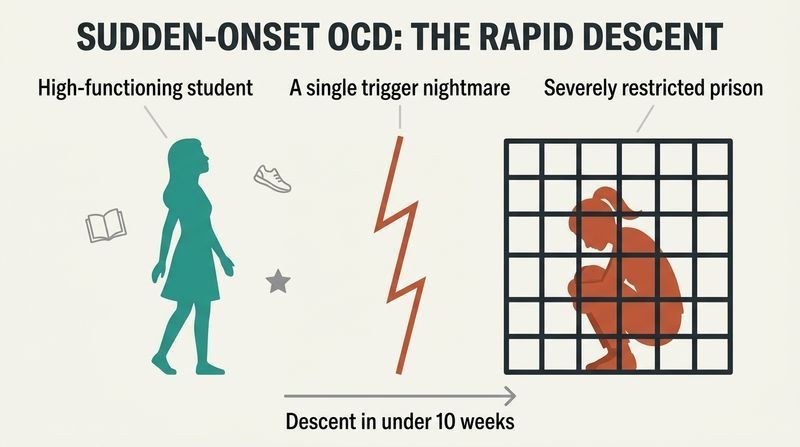
A single nightmare rewrote her life. Allison Britz was a fifteen-year-old top-ten student, cross-country runner, and voted Most Intellectual, worrying about prom dates and chemistry tests. Then one October night she dreamed vividly of dying from brain cancer. She woke convinced it was not a dream but a warning. Within ten weeks she was tiptoeing to avoid sidewalk cracks, counting steps aloud, starving herself, sleeping naked on a hallway rug, and unable to brush her hair or wear her own clothes.
This is sudden-onset OCD. Contrary to the stereotype of lifelong tidiness, her symptoms erupted almost instantly and escalated daily. The speed is the point: mental illness does not always creep in. It can seize a bright, high-functioning teenager and hollow her out in weeks.
What's striking is how the memoir dismantles the pop-culture image of OCD as fussy hand-washing. Clinicians recognize a subtype sometimes linked to adolescence and, in rarer cases, to post-infectious triggers (PANDAS). The abruptness Britz describes maps onto research showing OCD frequently emerges around puberty, when the brain's threat-detection circuitry is remodeling. Her case is a useful corrective for anyone who assumes a straight-A, athletic, socially connected kid could not be quietly disintegrating. High achievement can be camouflage, not immunity. The disorder does not care about your GPA or your five-year plan.
OCD hijacks the brain's meaning-making, forging certainty from pure coincidence

Randomness became prophecy. The morning after her cancer nightmare, Allison's alarm played a hit song with the lyric "it's all in my head." To a healthy mind, coincidence. To hers, confirmation the universe was signaling her tumor. A forgotten childhood rhyme, "step on a crack, break your mother's back," mutated into the airtight conviction that cracks cause brain cancer and avoiding them cures it.
The logic feels ironclad from inside. She invoked Newton (every action has an equal and opposite reaction) to justify her rituals. Part of her knew it was absurd (everyone steps on cracks without dying), yet the terror overrode reason. OCD does not need evidence. It needs only a frightening "what if" too costly to ignore, and the anxious brain supplies the rest.
This illustrates what cognitive scientists call apophenia, the tendency to perceive meaningful patterns in noise, weaponized by anxiety. The brain is a prediction machine that hates uncertainty, and OCD exploits that hatred. Notably, Britz retained insight: she could see the irrationality even while obeying it. That coexistence of doubt and compulsion is a hallmark distinguishing OCD from psychosis. The intelligence that made her a strong student worked against her here, generating ever more elaborate justifications. Smart, imaginative minds can build more convincing prisons, a reminder that reasoning power without emotional regulation can amplify suffering rather than relieve it.
Every ritual that soothes anxiety secretly feeds the monster that created it

Relief is the trap. Each time Allison hopped over a crack, hit her safe step count, or bartered away a sandwich, her dread briefly evaporated. That relief taught her brain that the ritual worked, so the next intrusive thought demanded a bigger ritual. Cracks led to counting steps, which led to sacrificing food, which led to banning pencils, clothes, towels, her toothbrush, and eventually her bed.
The obsession-compulsion loop is self-reinforcing. An obsession (uncontrollable fear) triggers a compulsion (a repetitive act that eases it). The temporary calm is a reward that strengthens the whole cycle. By November she had eaten almost nothing for days, carried rotting lunches to "honor" her mother, and stood on one foot for hours. Obedience never bought peace. It only raised the ransom.
This is the engine of OCD, and it mirrors operant conditioning: negative reinforcement (removing discomfort) is among the most powerful ways to cement a behavior. The cruel twist is that the very act meant to create safety manufactures the next threat. Behavioral economists would call it a losing arms race with escalating stakes. The same mechanism underlies addiction, avoidance in phobias, and reassurance-seeking in anxiety generally. Understanding it reframes recovery: the goal is not to perform rituals better but to sever the reward link entirely, tolerating the discomfort until the brain learns the feared catastrophe never arrives.
Secrecy is OCD's accomplice, so isolation lets the disorder metastasize
She guarded the illness like a sacred duty. Allison hid everything behind lies about blisters, food poisoning, tutoring, and scoliosis. She screamed at her mother, drove away her best friend Sara, and rejected Jenny's cookie of concern in a packed cafeteria. She believed her "messages" were special, chosen, not hers to share. That secrecy meant no one could interrupt the spiral.
Concealment cost her everything social. She skipped practice, abandoned homecoming, ate alone behind the cafeteria dumpsters, and turned down the queen bee's birthday invitation. The more bizarre her behavior grew, the harder she worked to hide it, which only deepened her loneliness. She wanted Jenny's persistent concern more than anything, yet pushed it away. The disorder thrives precisely where shame keeps sufferers silent.
The memoir captures a paradox central to adolescent mental illness: the fear of being seen as crazy prevents the disclosure that could bring help. Research on help-seeking consistently finds stigma and shame as the largest barriers, especially for high-achieving teens whose identity depends on appearing capable. Britz's belief that her thoughts were "sacred" added a layer few sufferers face, but the underlying dynamic is universal. Her friend Jenny's blunt refusal to disappear models something powerful: sometimes the most loving act is stubborn, uncomfortable persistence rather than polite distance. Concern that keeps knocking can be a lifeline.
Naming the illness robs it of its mystical, unquestionable authority
A waiting-room pamphlet cracked the spell. For months Allison reframed her monster as God, praying, reading the Bible at 2 a.m., and performing a football-celebration hand gesture to show gratitude. Believing the commands were divine made disobedience feel like blasphemy. Then, stealing glances at a psychiatrist's brochure, she read that OCD involves persistent unwanted thoughts, repetitive actions, and invented rules to control anxiety. The description was a mirror.
Self-recognition became the hinge of recovery. She smuggled the pamphlet out, then handed it to Dr. Adams and said, "I think I have this." Attaching a clinical label to the chaos transformed "secret messages of survival" into "symptoms of a treatable disorder." The thoughts did not vanish, but their claim to sacred, unarguable truth did. You cannot fight an enemy you have mistaken for a god.
There is real cognitive science behind why labeling helps. Affect labeling, putting feelings into words, measurably reduces amygdala activity, as Matthew Lieberman's neuroimaging work has shown. Naming a thought as "an OCD symptom" creates psychological distance, a technique formalized in Acceptance and Commitment Therapy as cognitive defusion. Britz's religious reinterpretation is poignant and clinically recognized (scrupulosity is a common OCD theme), but the deeper lesson generalizes: externalizing the disorder as a distinct "it" rather than "me" is often the first move toward reclaiming agency. The pamphlet did not cure her. It gave her a name to push against.
Face the fear without the ritual, and anxiety collapses on its own
Exposure Response Prevention is the core treatment. Dr. Nelson, a plain, horse-loving psychologist in Teva sandals, introduced ERP: deliberately expose yourself to a trigger while refusing the compulsion that normally follows. She held up a pencil (which Allison believed caused cancer) and asked her only to stare, not pray, not hold her breath, not stand on one foot.
Anxiety peaks, then always falls. Using a 1-to-10 temperature scale, Allison started at a nine, brain screaming, then reported her rating every thirty seconds. Within two minutes, with nothing changing except time, she dropped to a three. The fear had no staying power once she stopped feeding it. Progress compounded: soon a pencil started at a six, then a four. Eventually she held one, wrote with it, and threw it triumphantly across the chemistry lab.
ERP is the gold-standard, evidence-based treatment for OCD, and the memoir dramatizes its mechanism vividly: habituation and, more precisely, inhibitory learning. The brain predicts catastrophe; exposure without ritual delivers repeated disconfirming evidence until a new, safer expectation is learned. What the vivid pencil scenes show is that the feared spike is self-limiting; the body cannot sustain peak alarm indefinitely. One nuance worth flagging: modern ERP research emphasizes that the goal is learning to tolerate uncertainty rather than simply waiting for anxiety to drop, since chasing the drop can itself become a subtle ritual. Britz's recovery honors both.
Fighting an intrusive thought is boxing: every resistance shrinks its muscle
Dr. Nelson framed recovery as a war of attrition. Each time you obey OCD, its biceps grow and it becomes a stronger opponent. Each time you defy a thought, you land a punch that weakens it. The fight is not won in one round. It is won by refusing, over and over, to throw the fight.
Homework made the punches routine. Between sessions Allison sought out pencils to stare down, then calculators, then spent Christmas gift cards she had banned. Her mother became her training partner on a mall shopping trip that doubled as exposure therapy. The reframe mattered psychologically: she was no longer a helpless vessel receiving divine commands but a fighter with a strategy, a corner, and a coach who celebrated each round with a high five.
The boxing metaphor does real therapeutic work by restoring agency and a sense of progress, both protective against the learned helplessness that deepens anxiety disorders. Framing symptoms as an opponent you can outlast converts passive dread into active challenge, echoing how sports psychology reframes pain as a signal to push through rather than stop. The danger of any war metaphor is that "fighting" thoughts can slide into suppression, which research shows backfires (try not to think of a white bear). The book threads this needle: the fight is not to banish thoughts but to refuse the rituals, letting the thoughts simply exist and fade.
Conquer a few core fears and unrelated ones quietly die on their own
Not every item on the danger list needs its own battle. Allison's list ran three pages: apples, pennies, blue pens, grass, the color green, her cat, toilet paper. Dr. Nelson promised that as she loosened the grip of key obsessions, others would vanish without direct treatment, calling it collateral damage from ERP.
She saw it happen. Days after conquering pencils, she accidentally stepped on a sock (long banned as cancerous) and felt nothing. She wore socks the next day to prove it. Milk, orange juice, khakis, and a horse sweatshirt drifted back into the "safe" category unprompted. The parking lot air, once thick with green cancer fumes, smelled clean. Beating a handful of central fears generalized, teaching her brain a broader lesson: these thoughts were noise, not truth.
This generalization effect is well documented in exposure therapy. When the brain updates its core rule ("my intrusive thoughts do not predict real danger"), that learning transfers to situations never explicitly rehearsed. Cognitively, she was not defeating each fear individually but revising the underlying belief that generated all of them. This is why skilled ERP targets representative fears rather than an exhaustive checklist, an efficient use of therapeutic effort. The practical takeaway for anyone facing tangled anxieties: you rarely need to solve every instance. Attack the load-bearing ones, and the scaffolding of smaller fears often collapses along with them.
Recovery means managing OCD for life, not being cured of it
Progress is not the same as erasure. After triumphing over pencils and socks, Allison expected to become her old self. Instead a newly purchased shirt attacked her mid-homework, and she nearly tore it off before Dr. Nelson's voice in her head reminded her: this is just OCD. She learned the hard truth that the disorder tends to be lifelong, ebbing and flowing, worse on some days than others.
The goal shifts from cure to control. Dr. Nelson was blunt: you have OCD, for better or worse, and you must do the best you can with what you've got. Allison mourned the overachiever she could no longer be, then chose a new identity: a girl who, despite the buzzing in her head, keeps moving forward. She went on to captain cross-country, graduate with honors, and attend college, carrying her OCD with her.
This is perhaps the memoir's most mature and honest note, resisting the tidy recovery-arc convention that mental-illness narratives often force. Chronic-illness psychology increasingly favors an acceptance model over a cure model: outcomes improve when patients stop waiting to be "fixed" and instead build a workable life alongside the condition. The grief Britz describes, mourning a former self, is real and underdiscussed; identity loss is a legitimate secondary wound of serious illness. Her reconstruction of self around resilience rather than perfection reflects what researchers call post-traumatic growth, finding a new, sometimes sturdier identity forged through the ordeal rather than despite it.
The turning point was not a breakthrough but finally accepting help
She could not think her way out alone. For months Allison believed she was the sole guardian of secret truths, uniquely chosen, uniquely responsible. That isolation nearly killed her: she dropped to ninety-five pounds and slept naked on a rug to avoid "cancer" sheets. The desperate phone call to her mother, sobbing that she had nothing safe to wear, was the moment she stopped fighting solo.
Rescue came from a chain of ordinary people. Her persistent mother, her childhood doctor with his ready business cards, the sweet psychiatrist Dr. Adams, and above all the beige, horse-obsessed Dr. Nelson who made her laugh and taught her to box her thoughts. Even classmate Jenny, who defended her to a teacher and accepted an OCD pamphlet with "thanks for telling me." Accepting help, not heroic solitude, was what saved her.
The memoir quietly argues against the myth of the self-rescuing sufferer, a myth especially corrosive for perfectionists trained to handle everything themselves. Social support is one of the most robust predictors of recovery across mental health conditions. What stands out is the ordinariness of her rescuers: no dramatic intervention, just a mother who kept showing up, a friend who refused to gossip and instead asked directly, and a therapist whose warmth mattered as much as her technique. The therapeutic alliance, the trusting bond between patient and clinician, is itself one of the strongest predictors of good outcomes, sometimes rivaling the specific method used.
Analysis
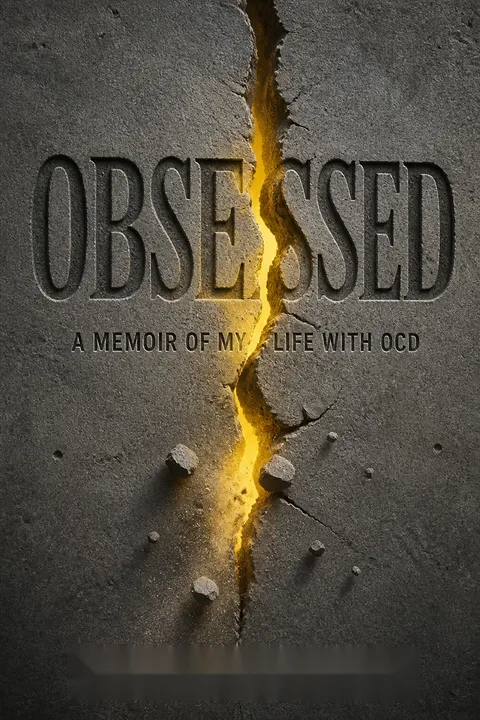
Obsessed is a first-person memoir, not a self-help manual, yet it functions as one of the most vivid lay explanations of OCD and its treatment available. Its power lies in dramatization: Britz makes the reader inhabit the interior logic of the disorder, where a radio lyric becomes prophecy and a hair dryer becomes a death threat. This inside-out perspective is the book's chief contribution and its chief difficulty to summarize, because the horror is not in any single ritual but in the relentless, escalating accumulation of them over ten weeks.
Structurally the book splits cleanly at its midpoint. The first half is descent: the mechanics of obsession, compulsion, secrecy, and social collapse. The second half is recovery, anchored by two clinical ideas that give the memoir its instructional backbone: the obsession-compulsion reinforcement loop, and Exposure Response Prevention as the evidence-based way to break it. Britz is unusually faithful to the actual science. ERP, the temperature scale, the trigger-obsession-compulsion chart, and the boxing-as-attrition metaphor are all recognizable, legitimate tools, which makes the book quietly educational beneath its narrative surface.
What elevates it above a symptom catalogue is the religious dimension. Her reframing of intrusive commands as messages from God (scrupulosity) shows how OCD colonizes a person's deepest values, making resistance feel like betrayal. This raises the stakes beyond germs and counting into the territory of meaning and identity.
The memoir's honesty about outcome is its ethical strength. It refuses the cure fantasy, insisting OCD is lifelong and manageable rather than defeatable. For readers, the enduring lessons are practical and humane: intrusive thoughts are not truths, rituals are the disease rather than the solution, naming an illness disarms it, anxiety faced without ritual always subsides, and asking for help is strength, not surrender. It is a teenager's story that doubles as a competent primer on one of the most misunderstood disorders in psychiatry.
Review Summary
Obsessed receives mostly positive reviews, with readers praising its raw depiction of OCD and the author's bravery in sharing her story. Many found it eye-opening and educational, dispelling misconceptions about OCD. Some criticized the writing style as repetitive or simplistic. Readers appreciated the honest portrayal of mental health struggles and treatment. The book's impact on readers' understanding and empathy for those with OCD was frequently mentioned. Some cautioned that the content could be triggering for those with anxiety or OCD.
People Also Read

FAQ
What is Obsessed: A Memoir of My Life with OCD by Allison Britz about?
- Personal account of OCD: The memoir details Allison Britz’s struggle with obsessive-compulsive disorder (OCD) during her high school years, focusing on her intrusive thoughts, compulsions, and the impact on her daily life.
- Unique symptoms and rituals: Allison’s OCD manifests in unusual ways, such as a fear of cancer from everyday objects, compulsive counting, and elaborate avoidance rituals.
- Journey to diagnosis and recovery: The book follows her path from confusion and isolation to seeking professional help, receiving a diagnosis, and engaging in therapy.
- Themes of hope and resilience: Despite severe challenges, Allison’s story is ultimately one of survival, gradual healing, and the importance of support.
Why should I read Obsessed: A Memoir of My Life with OCD by Allison Britz?
- First-person insight into OCD: The memoir offers a rare, honest perspective on living with OCD, especially symptoms beyond the typical germ-related fears.
- Mental health awareness: It raises awareness about adolescent mental illness, helping to break stigma and foster empathy.
- Inspiration and encouragement: Allison’s journey from debilitating fear to recovery provides hope for those facing similar struggles or supporting loved ones.
- Accessible explanation of treatment: The book demystifies therapeutic approaches like Exposure Response Prevention (ERP), making them understandable for readers.
What are the key takeaways from Obsessed: A Memoir of My Life with OCD by Allison Britz?
- OCD is complex and diverse: The memoir highlights the wide range of OCD symptoms, including fears of harm, compulsive rituals, and avoidance behaviors.
- Support is crucial: Family, friends, and professional help play vital roles in Allison’s journey toward healing and acceptance.
- Therapy is challenging but effective: Exposure Response Prevention (ERP) therapy is depicted as difficult but essential for managing OCD.
- Hope and resilience matter: Allison’s story emphasizes that recovery is possible, even when OCD feels overwhelming.
What are the most impactful quotes from Obsessed: A Memoir of My Life with OCD by Allison Britz and what do they mean?
- “Fighting OCD is like boxing. Each time you go against a thought, it’s a punch to its strength.” This metaphor highlights the ongoing, active struggle required to weaken OCD’s grip.
- “You have obsessive-compulsive disorder. For richer or poorer, for better or worse. That’s just how it is.” This quote reflects acceptance of OCD as a chronic condition that must be managed, not cured.
- “It’s just OCD. Just like pencils and calculators. Just like socks and sidewalk cracks.” Marks a turning point where Allison recognizes her fears as symptoms, helping her regain control.
- “I’m not anorexic. I have OCD.” Clarifies the importance of accurate diagnosis and understanding of mental illness.
How does Allison Britz describe her OCD symptoms and compulsions in Obsessed?
- Intrusive thoughts about harm: Allison is plagued by persistent fears that everyday objects or actions will cause cancer or death to herself or her family.
- Compulsive rituals: She engages in behaviors like counting steps, tiptoeing to avoid cracks, standing on one foot, and bartering food to prevent perceived harm.
- Avoidance of objects and colors: Items such as pencils, calculators, certain clothes, and even colors like green become sources of terror, leading to avoidance and distress.
- Religious compulsions: Allison incorporates prayers and ritualized gestures into her routines, intertwining her OCD with spirituality.
What is the significance of the “monster” or “protector” in Allison Britz’s experience with OCD?
- Source of intrusive thoughts: Allison refers to a mysterious presence—the “monster” or “protector”—that delivers cryptic warnings and commands she feels compelled to obey.
- Dual role: This entity is both terrifying and protective, as Allison believes following its rules will keep her and her family safe from harm, especially cancer.
- Physical and emotional impact: The “monster” communicates through physical sensations and vivid imagery, intensifying her anxiety and compulsions.
- Driving force behind rituals: Its demands lead to strict adherence to rituals, making daily life exhausting and isolating.
How does OCD affect Allison Britz’s academic and social life in Obsessed?
- Academic decline: Once a top student, Allison’s compulsions and anxiety cause her grades to suffer, and she struggles to complete assignments and exams.
- Social isolation: Her behaviors, such as counting steps aloud and avoiding certain objects, make her appear strange to peers, leading to gossip and loss of friendships.
- Challenges with accommodations: Receiving special accommodations at school helps but also makes her feel different and isolated.
- Gradual improvement: Through therapy, Allison slowly regains the ability to participate in class and rebuild relationships.
What role do Allison Britz’s parents and friends play in her journey in Obsessed?
- Parental concern and involvement: Her parents are deeply worried and actively seek medical and psychological help for Allison, though they often struggle to understand her condition.
- Family tension: The emotional toll of OCD leads to moments of frustration, misunderstanding, and conflict within the family.
- Friendship challenges: Allison loses many friends due to her behaviors and isolation but experiences moments of reconnection, such as with her friend Jenny.
- Support as foundation: Ultimately, the love and support from family and friends are crucial to her progress and recovery.
How does Allison Britz interpret the connection between OCD and her fear of brain cancer in Obsessed?
- Origin in a nightmare: Allison’s OCD begins after a vivid dream about being diagnosed with brain cancer, which she interprets as a warning from her protector.
- Symbolic associations: She links specific objects, actions, and even numbers to cancer risk, believing that following her protector’s rules can prevent illness.
- Compulsions as survival: Her rituals are framed as life-or-death necessities, making her OCD behaviors feel essential for survival.
- Psychological impact: This belief system intensifies her anxiety and blurs the line between OCD symptoms and genuine health fears.
What is Exposure Response Prevention (ERP) therapy, and how is it used in Obsessed: A Memoir of My Life with OCD by Allison Britz?
- Definition and purpose: ERP is a cognitive-behavioral therapy that exposes patients to anxiety triggers while preventing their usual compulsive responses, aiming to reduce anxiety over time.
- Application in Allison’s treatment: Her therapist, Dr. Nelson, guides her through confronting feared objects and situations without performing rituals.
- Process and challenges: ERP is described as a difficult, anxiety-provoking process that requires persistence, but each exposure weakens OCD’s hold.
- Homework and progress: Allison practices ERP outside therapy sessions, gradually regaining control and reducing her compulsions.
How does Allison Britz’s relationship with religion and spirituality develop in Obsessed?
- Seeking meaning and comfort: Allison turns to religion for comfort, interpreting her protector’s messages as divine guidance.
- Ritualized religious practices: She incorporates Bible reading, prayer, and specific gestures into her daily routines, sometimes as compulsions.
- Conflict with faith: As therapy progresses, Allison struggles to reconcile her religious beliefs with the understanding that her thoughts may be symptoms of OCD.
- Nuanced integration: The memoir suggests a balance between maintaining spirituality and recognizing the need for medical treatment.
What resources and advice does Allison Britz recommend for those struggling with OCD, as shared in Obsessed: A Memoir of My Life with OCD?
- Professional help is essential: Allison emphasizes the importance of seeking therapy and professional support for managing OCD.
- Support organizations: She recommends resources such as Active Minds, Mental Health America, NAMI, NIMH, and the International OCD Foundation for information and community.
- Encouragement to reach out: The memoir encourages readers not to struggle in silence and to connect with support networks.
- Hope for recovery: Allison’s story and advice underscore that with help, progress and healing are possible.
Download PDF
Download EPUB
.epub digital book format is ideal for reading ebooks on phones, tablets, and e-readers.








