

Plot Summary
Stormlight and a Golden Offer
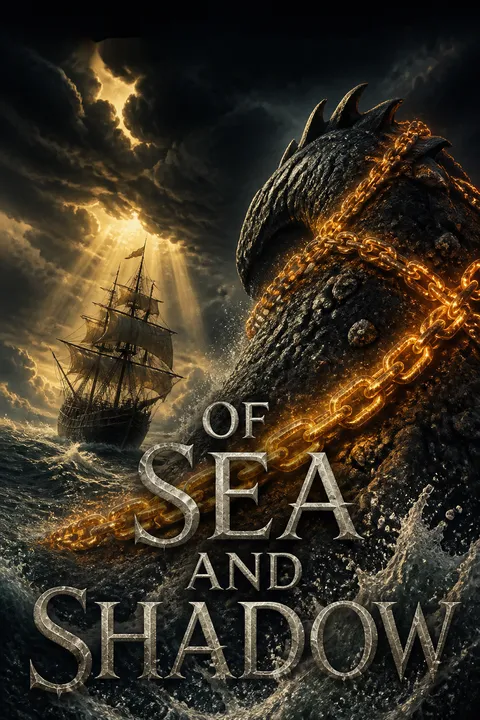
Captain Calder Marten drives his living ship, The Testament, into a storm to capture a lightning-winged Kameira. His gunner misses the creature’s head, so Calder calls up the chained Lyathatan, an ancient sea monster that seizes and tears apart their prey. The crew salvages enough glowing fluid to earn a fortune, but the ship is badly damaged.
Below deck, Calder’s wife, Jyrine, discovers a message burned into the hull by Navigator Guild Head Cheska Bennett. Two Witnesses want Calder to carry them to an island and recover a relic, with a reward large enough to buy him a fleet. The message also ties the mission to the dead Emperor and the Empire’s future, making a profitable voyage suddenly dangerous.
Calder’s first instinct is to measure danger against profit, but the episode shows that his control is never absolute: the ship obeys him, while the storm and the Lyathatan retain their own scale of power. Even the Kameira hunt turns a missed shot into a costly survival problem. The burned message changes the meaning of the adventure. Calder’s appetite for wealth gives him a reason to accept, while the reference to the Emperor ensures that money is not the only force drawing him forward.
The Quill and Copper Key
Thirteen years earlier, twelve-year-old Calder helps his father, Rojric, pose as a wealthy buyer to verify an alleged Imperial relic. Calder Reads the quill and confirms it once belonged to the Emperor, so the pair return that night to steal it. They find the safe empty and the Imperial Guard waiting.
Rojric is arrested, while Calder hides a copper key in his shirt by focusing his Intent until the guards overlook it. They send him to his estranged mother, Alsa Grayweather, rather than prison. Reading the key gives him disturbing glimpses of the Emperor’s private dungeon and cruelty. His new home offers safety and education, but Calder’s secret key keeps him bound to his father’s fate.
Calder’s childhood talent makes objects into witnesses, but knowledge does not automatically give him power over the people who control them. The key becomes both a practical tool and a private promise: he can protect it, yet cannot reach his father. Rojric’s criminal mentorship has taught Calder to improvise and disguise himself, while Alsa’s household introduces a more institutional kind of authority. The boy is caught between two parents whose incompatible worlds shape his skills, his distrust, and his enduring belief that a clever plan can undo an unjust system.
A Watchman and a Partner
At Alsa’s home, Calder meets Jyrine Tessella, the daughter of a Watchman, and their shared lessons grow into a close alliance. When Calder sneaks to the docks, he discovers that Alsa’s Blackwatch is building The Testament to travel the Aion Sea. Guild Head Bliss exposes the Elders as present threats, then admits Calder to the Blackwatch.
While he helps construct the ship, he sees prisoners leap from Candle Bay Prison and concludes that Rojric is suffering there. Jyrine helps him investigate, including the prison’s defenses and its Reader detector. Together they plan to exploit Blackwatch authority, use the copper key on Rojric’s cell, and escape by water, though neither has a reliable boat or a safe route out.
Calder’s membership in the Blackwatch converts his curiosity about danger into responsibility, but he remains a boy who wants to solve every problem through boldness. Jyrine gives that impulse a collaborator rather than merely cheering it on: she contributes tactics, courage, and an appetite for improvisation. Their alliance is intimate because it is built through shared risk, yet the prison plan already shows its weakness. They are acting on incomplete knowledge, and their confidence in cleverness obscures how little control they have over the consequences.
The Ship Breaks Free
Jyrine reaches Rojric’s cell disguised as a Blackwatch officer and uses the copper key to open its door. When the window will not open, she cuts it free with green fire from her earrings. Calder’s improvised raft fails, leaving him and his companions stranded below the prison as guards close in.
In freezing water, he summons the Great Elder Kelarac and bargains away the copper key for help. The Lyathatan arrives, hauling The Testament toward shore. Calder’s Reading Awakens the ship into a single living vessel, which obeys him and tears open the prison. He rescues Rojric and Jyrine, but his desperate solution has destroyed the facility and killed people inside it.
The rescue is the moment Calder’s private resourcefulness becomes a power with public costs. His Reading does not merely open a door; it Awakens a ship capable of demolishing a prison. The bargain with Kelarac also establishes that every rescue has a price, even when the payment seems small beside the lives saved. Calder’s gift is inseparable from his impatience: he can make the world answer him, but he cannot yet predict who else will be crushed when it does.
A Crown Bought with Grief
The Emperor puts Calder on trial for the prison’s destruction, the dead and injured, and the escape of dangerous prisoners. He confirms that The Testament has made Calder a Soulbound Navigator, then transfers the boy into the Navigators’ service to repay the damage. Rojric is brought into the hall and executed by Jarelys Teach’s ancient sword, leaving Calder to watch the father he risked everything to save die at the Emperor’s command.
Alsa is placed in Bliss’s custody. Calder’s grief hardens into political ambition: he decides that the Empire cannot remain under a ruler who treats people as disposable instruments. He enters the life of a Navigator with a new purpose beyond earning money or crossing the Aion.
The Emperor’s judgment exposes the difference between legal authority and moral legitimacy. Calder did destroy the prison, and people died, but the court’s procedure offers no meaningful reckoning with the abuse that drove Rojric toward despair. The execution turns the boy’s rescue into another defeat and teaches him that power can preserve injustice as efficiently as it can break a wall. Calder’s ambition grows from grief, but it also carries danger: he has seen what happens when one person claims the right to decide the Empire’s fate.
The Chronicler’s Price
Years later, Calder receives the two Witnesses, Naberius Clayborn and his Silent One, Tristania. Naberius once managed the Imperial treasury and now wants a relic from an island linked to Nakothi, the Dead Mother. He offers ten thousand goldmarks and argues that the Empire needs a new Emperor to hold its regions together. He also warns that the Consultants may oppose the expedition.
Calder accepts, despite Quartermaster Andel Petronus’s concern about the danger and the lack of details. His crew includes the reserved alchemist Petal, the gunner Dalton Foster, and Urzaia Woodsman, a former arena fighter. Calder’s wife Jyrine is expected to travel with them, giving the voyage the shape of a family undertaking as well as a political gamble.
Naberius appeals to Calder through the same combination that has always moved him: enormous stakes and enormous payment. Yet Calder’s decision is not simply greed. The promise of a new Emperor touches the grievance left by Rojric’s execution, and the mission offers a chance to shape the political order he once could only resent. Andel’s hesitation provides a counterweight, but Calder’s captaincy depends on taking responsibility for choices others cannot make for him. The crew’s varied expertise gives his ambition practical reach while making each risk communal.
The Wife’s Burning Secret
During the first night in Candle Bay, Calder wakes to find Jyrine fighting a black-clad assassin named Shera with green fire. Jyrine’s warning about something awakening confirms she has kept a larger mission from him. Shera drugs Jyrine and pushes her overboard before Calder and the crew can stop her.
Calder is incapacitated by a poisoned needle, then Reads the deck and learns that Jyrine had been defending Naberius from Shera. Naberius identifies the attacker as a Consultant and insists that she does not take prisoners, but Calder refuses to accept that Jyrine is dead. He turns The Testament toward the Gray Island, where the Consultants operate, putting his wife’s recovery ahead of the hired voyage.
The attack collapses Calder’s distinction between home and work: the person he trusted most is suddenly a combatant with a concealed life, and the ship’s deck becomes evidence of both her loyalty and her secrecy. His anger is real, but it cannot settle into certainty because he does not know whether Jyrine survived. That uncertainty makes love and suspicion operate at once. His decision to pursue Shera is protective, yet it also abandons the agreed route, putting the entire crew inside a conflict they did not choose.
The Heart Beneath Flesh
On Nakothi’s island, Calder finds Alsa leading a Blackwatch camp and learns why Naberius wants the relic: the Emperor’s immortality came from carrying Nakothi’s heart, and the group hopes to use another one to empower a successor. The Blackwatch digs a second heart from the island’s living flesh. Consultants attack while it is being removed, and Shera steals it amid the chaos.
Nakothi’s corpse-born Children erupt from the ground, forcing the survivors into a fortified shelter. Naberius claims he can quiet them by using his knowledge of their nature, then kills Tristania and throws her body beyond the wall. The Children fall silent, allowing the remaining crew and Watchmen to escape toward The Testament as reinforcements arrive.
The heart makes the Empire’s political problem bodily: continuity depends on an Elder’s organ, not on a neutral system of succession. The rescue plan therefore risks repeating the old Emperor’s dependence under a new name. The Consultants’ attack and the Children’s emergence strip away the language of orderly politics, leaving people to make immediate decisions about who may be sacrificed. Naberius’s treatment of Tristania is the starkest revelation of his priorities. The crisis does not merely expose a dangerous relic; it tests whether the proposed ruler can distinguish the Empire from his own ambition.
The Guard Turns Its Guns
After the survivors meet with the Guild Heads aboard Cheska’s ship, they agree that Calder should carry Naberius toward the Gray Island. The Chronicler privately orders Jarelys Teach to load Imperial Guards onto The Testament and execute Calder’s crew, since he wants Calder’s ship but distrusts its captain.
Bliss warns Calder in time. While Urzaia breaks free below deck, the others turn on their guards; Calder uses The Testament’s living wood to tilt the ship and block gunfire.
He and Urzaia leap for The Eternal, taking Naberius hostage, while the Lyathatan lifts Calder across the gap. Bliss confronts Teach and buys their escape. Calder now holds the future Emperor captive and must reach the Gray Island before the other Guilds decide his fate.
The attempted execution converts the abstract question of imperial succession into a direct contest over bodies and ships. Naberius wants Calder’s vessel but not his consent, an echo of the old Emperor’s habit of treating people as resources. Calder survives because the crew acts as a collective rather than a set of obedient employees. His use of the ship is both tactical and relational: The Testament protects the people whose labor helped make it alive. Bliss’s intervention prevents the conflict from becoming a battle between Guild Heads.
The Crown Opens the Cells
At the Gray Island, Consultant Kerian confirms that Jyrine is alive and unharmed, but offers only a supervised visit in exchange for Calder leaving without Naberius or the heart. Calder reveals the Emperor’s golden crown, an artifact he has kept hidden since his youth. Its Intent compels loyal Imperial citizens, so he orders the Consultants to guide him through their island headquarters and toward the prisoners.
In the cells, Jyrine’s neighbor Lucan studies the Heart and speaks with her about the Sleepless. Meanwhile, an unseen transmission gives Jyrine a cold iron band and instructions to use it when Nakothi’s power rises. Calder’s use of the crown gets him access to Jyrine, but the artifact’s authority is coercion, not trust.
The crown gives Calder a way through an institution built on secrecy, yet it does so by reproducing the obedience he despises in the Emperor. His command secures movement, not understanding. Meanwhile, Jyrine’s cellmate treats her beliefs as material for inquiry, and the iron band turns her confinement into a waiting game with forces she cannot fully control. The island’s apparent hospitality is thus double-edged: the Consultants can negotiate in good faith while keeping prisoners, and Calder’s power can open their doors without resolving the emotional breach between husband and wife.
A Marriage Rewritten
In the prison corridor, Calder finds Jyrine and demands an account of her life. She reveals that she has been Soulbound since childhood and that the Sleepless trained her, sent her to study with Alsa, and wanted her to guide Calder toward their cause. Jyrine admits she helped him break Rojric out and encouraged him to take The Testament, though she insists she chose him for herself as well.
Calder Reads her hand and senses both truth and something she still conceals, then leaves without taking her. His refusal leaves Jyrine alone with the iron band. Elsewhere, Naberius escapes his restraints and follows the Heart’s influence, while Lucan prepares a bronze blade for Awakening.
The revelation makes their marriage neither a simple deception nor an innocent romance. Jyrine’s actions served a political project, but her attachment to Calder was not merely assigned; the two motives coexist and resist clean judgment. Calder has spent much of the journey treating uncertainty as a reason to pursue, but here he converts injury into distance. Leaving Jyrine protects him from an answer he cannot bear, while also repeating the abandonment he fears. Their conflict is not only about what she hid, but about whether trust can survive mixed motives.
The Heart’s Three Calls
After leaving Jyrine, Calder Reads the island and senses three crises gathering: Naberius has recovered Nakothi’s heart, Lucan is Awakening a lethal blade, and Jyrine is using her iron band to summon help. He chooses to reach Urzaia first, who is fighting Meia, Shera’s formidable companion.
As Nakothi’s Handmaiden rises over the island, Calder throws the Heart into the sea to disrupt Naberius’s attempt to bind it. He then meets Kelarac in a vision. The Elder marks Calder’s arm, deepening his bond with the Lyathatan, and gives him a weapon suited to fighting Nakothi’s lesser spawn. The gifts improve Calder’s odds, but Kelarac’s influence tightens around him with every bargain.
Three different uses of Intent converge: Naberius seeks to bind the Heart, Lucan gives an old weapon a new purpose, and Jyrine calls beyond the prison. Calder’s Reading makes him aware of the danger but cannot let him control every outcome. His choice to save Urzaia before resolving the other crises shows a shift from abstract strategy toward personal obligation. Yet he answers danger by bargaining with Kelarac, whose help comes with an accumulating claim. Calder’s agency grows, but so does the network of powers that can shape it.
The Handmaiden Breaks Through
Calder reaches the underground arena as Urzaia fights Meia and Shera. Lucan arrives with his newly Awakened blade, Syphren, and Shera uses it to strike Urzaia’s Vessel, draining the power that sustains him. The Handmaiden tears open the arena roof. Calder orders The Testament’s cannons to fire, using Shuffles to carry his commands across the island, then cuts a path through Nakothi’s creatures.
Urzaia dies from his wounds after telling Calder he defeated Meia. Jyrine escapes her cell through a void passage and receives her Vessel, but Calder reaches the prison too late to find her. He captures the injured Meia instead, leaving the island with a prisoner, no wife, and a crew diminished by Urzaia’s death.
The climax refuses to make power equivalent to rescue. Calder can coordinate a ship’s artillery across an island and kill Nakothi’s spawn, yet he cannot undo Syphren’s effect or arrive before Jyrine escapes. Urzaia’s final pride rests on a precise victory, not on survival; his arena identity gives him a measure of meaning even as his body fails. Jyrine, meanwhile, acts for herself and leaves the prison without waiting for Calder. The result is emotionally uneven by design: Calder saves lives, but not the relationships he hoped to recover.
A Mortal Claims the Crown
As The Testament sails back toward the Guild Heads, Andel tests Naberius’s remaining sanity, then shoots him when the Heart’s influence leaves no hope of safe custody. Calder brings the Chronicler’s memory candles and the Emperor’s crown to the council, offering himself as a successor.
He argues that a mortal ruler could serve the Empire without binding himself to Nakothi’s heart or seeking the old Emperor’s unnatural lifespan. The Guild Heads do not settle the question before the meeting ends, and Calder has not yet secured the throne. Returning to his ship, he learns that Meia has escaped. Urzaia is dead, Jyrine remains beyond his reach, and the political crisis he hoped to solve now follows him aboard.
Calder’s proposal is a direct answer to the two rulers whose power has shaped his life: the dead Emperor, who treated mortality as weakness, and Naberius, who let the Heart turn him into its instrument. Choosing a finite life is not a guarantee of wise rule, but it rejects the premise that unity requires an immortal master. Andel’s execution of Naberius complicates that hope, showing how quickly protection can become irreversible judgment. Meia’s escape ensures that the final image is not coronation but unfinished consequence.
Analysis
Of Sea and Shadow makes power feel less like a possession than a relationship with a history. Calder’s Reading depends on the Intent accumulated in objects, so a ship, a key, or a weapon carries the purposes of those who made and used it. This principle gives magic an ethical dimension: every tool can extend a person’s agency, but it can also preserve violence or obedience long after its original owner is gone. The Emperor’s crown is therefore not merely a relic. It is a working remnant of a political system that can still compel people to act.
The novel sets Calder’s intimate life against the same problem of interpretation. Jyrine’s concealment does not erase her love for him, but neither does affection make her choices transparent or harmless. Calder’s suspicion is justified, yet his decision to leave her shows how easily self-protection becomes its own form of abandonment. Their marriage is shaped by competing loyalties rather than a simple division between truth and lies.
Naberius’s plan reveals the political temptation at the center of the story: when an empire appears close to collapse, people may accept a dangerous ruler because stability seems more urgent than freedom. The Heart promises a shortcut to unity, but it makes the would-be ruler answer to an alien power. Calder’s final proposal rejects that shortcut in favor of mortal succession, a vulnerable alternative that does not guarantee peace. His choice matters precisely because it is not a magical cure. The novel’s sharpest question is whether leadership can preserve a society without turning its people into instruments. Calder has learned to command ships, artifacts, and even Guild members, but the story leaves him confronting the harder task of exercising authority without becoming another Emperor.
People Also Read


Characters
Calder Marten
The calculating sea captainCalder is a Reader, able to sense and shape the Intent left in objects, and a captain whose ship responds to his will. He is quick-minded, acquisitive, and fond of turning a dangerous situation into a negotiation. His childhood taught him disguise and improvisation; his later life among the Navigators taught him that command means carrying other people’s risks as well as his own. Calder dislikes being treated as a tool, yet his ambition can tempt him to use others in the same way. He relies on humor and strategic calculation to keep fear at bay. Beneath both is a stubborn desire to protect his crew and to build a political order less cruel than the one that formed him.
Jyrine Tessella Marten
Calder’s daring wifeJyrine is Calder’s wife and closest companion, a lively, daring woman drawn to risk and discovery. She helps navigate their voyages and meets danger with an appetite that can make Calder’s caution seem almost comic. Her warmth is not passivity: she has strong convictions, makes independent decisions, and does not wait for someone else to authorize her actions. Jyrine’s family history and Vandenyan heritage connect her to a world beyond Calder’s ship, while her affection for him gives their partnership genuine emotional weight. She values loyalty, but also believes that a larger purpose can justify secrecy, a tension that shapes how she relates to the people she loves.
Andel Petronus
The captain’s steady counterweightAndel is Calder’s quartermaster, oldest traveling companion, and clearest source of practical dissent. He dresses formally even on a storm-tossed deck and uses dry wit to keep fear from taking over a room. His loyalty is not obedience: he believes a second-in-command must challenge a captain whose decisions endanger the crew. A former Luminian, Andel carries a religious seriousness that informs his instinct for mercy, though he is not sheltered from violence or grief. He understands that a crew is a shared responsibility, not an extension of its captain’s will. Calder trusts him precisely because Andel will say what others are reluctant to say.
Urzaia Woodsman
The smiling arena fighterUrzaia is The Testament’s enormous Izyrian cook, a former arena fighter whose scars and missing eye tell only part of his story. He treats food, danger, and battle with the same direct pleasure, and his broad humor helps the crew endure long stretches at sea. Beneath the cheer is a disciplined Champion trained to prepare himself for combat and to measure his worth through protection and victory. Urzaia is loyal to Calder, but his sense of duty can become self-blame whenever someone under his protection suffers. His strength comes from a Kameira Vessel, a source of power that makes him formidable while demanding constant control.
Naberius Clayborn
The treasury’s ambitious ChroniclerNaberius is a Witness Chronicler and former keeper of the Imperial treasury. Handsome, polished, and comfortable around wealth, he presents political ambition as a practical answer to a fractured Empire. His work has given him access to records and resources few people possess, and he knows how to make urgency sound like necessity. Naberius is also a skilled Reader, accustomed to interpreting traces of the past and using information as leverage. He expects others to understand the scale of his plans, but often mistakes confidence for trustworthiness. His relationship with Tristania reveals how much he depends on a loyal partner, even as he insists on directing the course of events.
Alsa Grayweather
Calder’s guarded motherAlsa is Calder’s mother and a senior Blackwatch officer, a capable Reader whose precise control contrasts with her son’s improvisational style. She is disciplined, well educated, and accustomed to working inside institutions that require secrecy. Her protectiveness often arrives in the form of training and rules rather than tenderness, which leaves Calder unsure how much of her life she is willing to share. Alsa is not simply an agent of authority: she has her own judgment about what the Empire needs and what its dangers demand. Her relationship with Calder carries the strain of years apart, along with an effort to recognize the resourceful, difficult person he has become.
Bliss
The unpredictable Blackwatch headBliss leads the Blackwatch and carries the Spear of Tharlos, a powerful Elder artifact. She appears young, speaks with unnerving frankness, and moves through danger according to a private logic that even her closest officers cannot always follow. Her unusual manner is not mere eccentricity; she observes people and institutions from an angle that makes ordinary assumptions seem provisional. Bliss can be unsettlingly casual about threats, yet she is attentive to the forces gathering around the Empire. She values Alsa’s competence and recognizes Calder’s potential, though she rarely explains her reasoning in the order others expect. Her authority rests as much on power as on an unsettling refusal to behave predictably.
Shera
The cold-eyed ConsultantShera is a highly trained Consultant operative, skilled with blades, needles, and the patient timing of an assassin. She approaches violence as work rather than performance, keeping her emotions tightly controlled and her movements economical. That discipline makes her difficult for Calder to read and harder for him to predict. Shera works within a Guild built around information, strategy, and discreet intervention, yet she is not merely a tool of its leadership. Her choices suggest a person constrained by obligations she did not necessarily choose. She is a formidable opponent because she combines preparation with a willingness to abandon any advantage that no longer serves her purpose.
Rojric Marten
Calder’s resourceful fatherRojric is Calder’s father, a streetwise thief and confidence artist who teaches his son how to disguise intentions and read a room. His affection for Calder is clear, though he often expresses it through partnership in risky schemes rather than stability. Rojric’s criminal skills give Calder confidence, but his choices also place the boy in danger and expose him to powerful authorities.
Cheska Bennett
The irrepressible Navigator chiefCheska heads the Navigator’s Guild and captains The Eternal. Brash, fast-moving, and extravagantly dressed, she treats danger as a familiar business expense and enjoys keeping Calder off balance. Her confidence is matched by real expertise at sea, and she can command respect without adopting the restraint expected of a Guild leader.
Dalton Foster
The guarded master gunnerFoster is the ship’s elderly gunner, a renowned gunsmith who prefers firearms to conversation. He carries grief from the violence that destroyed his family life and keeps his remaining attachments carefully guarded. His bluntness can seem hostile, but he remains attentive to the crew and proves dependable when danger becomes immediate.
Petal
The anxious ship alchemistPetal is The Testament’s self-taught alchemist, shy and watchful beneath her unruly hair. She communicates more easily through potions and practical work than through conversation. Her caution can look like fear, but she repeatedly brings useful knowledge to the crew, and her unusual attempts to comfort others reveal a sincere, if awkward, generosity.
Tristania
Naberius’s silent protectorTristania is Naberius’s Silent One, a bandage-wrapped bodyguard trained to communicate without speech. She moves with startling speed and protects her charge with a mix of vigilance and restraint. Her attention often turns toward people the rest of the crew overlooks, including the withdrawn Petal. Beneath her concealed appearance is a disciplined, perceptive presence.
Lucan
The curious island prisonerLucan is a prisoner on the Gray Island who shares a wall with Jyrine. He is observant, knowledgeable about Readers and artifacts, and inclined to treat conversation as a way to gather evidence. His curiosity makes him receptive to arguments that others would dismiss, but he keeps his own motives guarded.
Meia
Shera’s formidable companionMeia is a powerful black-clad operative who fights alongside Shera. Her combat style draws on unusual physical capabilities, and she can meet an experienced Champion with force and agility. She is direct in the field and difficult to intimidate, a practical presence among the Consultants’ covert operatives.
Jarelys Teach
The armored Imperial commanderTeach leads the Imperial Guard and serves as one of the Empire’s most formidable military authorities. Her altered body and ancient executioner’s sword make her a frightening presence, but she is also disciplined and attentive to political consequences. Teach prizes order and institutional continuity, even when those priorities put her at odds with Calder.
Plot Devices
Intent and Reading
Objects remember their useEveryone leaves Intent in objects through repeated use, but Readers can perceive and deliberately shape it. Calder Reads wood, weapons, and other materials to sense their histories or strengthen their purpose. The ability makes practical work possible, from repairing The Testament to concealing the copper key, but it can also overwhelm him with visions or cause mental injury when he pushes too far. Intent is the story’s magic system and its central metaphor for how past choices remain embedded in the present.
The Testament and Lyathatan
A ship bound to a sea monsterThe Testament is an Awakened Navigator vessel bound to Calder, allowing him to sense and command its wood, ropes, and sails. Its chains also bind the Lyathatan, an ancient Elderspawn that can pull the ship through the Aion and fight creatures beyond human strength. The arrangement makes Calder exceptionally capable at sea, but the Lyathatan remains an ancient being with its own purposes. The ship therefore embodies both Calder’s authority and its limit: it obeys him, yet its power depends on a bargain he cannot fully understand.
Imperial artifacts
The Emperor’s will persistsObjects personally used by the Emperor absorb extraordinary Intent. The copper key can open locks, while the golden crown can compel people who regard themselves as loyal Imperial subjects. Calder keeps such artifacts as practical tools and as leverage against institutions that would otherwise control him. Their power is not neutral: the crown’s effectiveness depends on obedience to the Empire, reproducing the authority Calder hopes to challenge. The artifacts let the Emperor’s influence survive his death in material form.
Nakothi’s Heart
Immortality with an alien costThe heart of Nakothi, the Dead Mother, preserved the Emperor’s life and becomes the prize at the center of Naberius’s succession plan. Its influence promises power and rebirth, but it erodes the judgment of people who draw too close. The relic links the Empire’s political crisis to the Elder threat: a ruler may gain the power to hold the Empire together while becoming less human in the process. Its recovery, theft, and attempted Awakening drive the conflict across the Gray Island.
Chronicler’s candles
Memory preserved in waxWitness Chroniclers store their experiences in specially prepared candles, then relive those memories by burning the wax. Naberius uses a case of these candles to preserve his observations and knowledge of the Imperial treasury. The candles make memory tangible but not automatically trustworthy: they preserve what the Chronicler experienced, while interpretation remains a human act. Their presence also gives Calder a possible way to recover information and value after Naberius can no longer provide it.
The Elder Empire: Sea Series






Download PDF
Download EPUB
.epub digital book format is ideal for reading ebooks on phones, tablets, and e-readers.








