

Key Takeaways
Treat recipes as models of matter, not commands to obey
Cooking is applied science. McGee’s central claim is that cooking becomes more adaptable when cooks understand what ingredients do, rather than merely repeat instructions. Most foods are mixtures of four main molecular groups: water, proteins, carbohydrates, and fats. Heat, acidity, and physical handling change their structures, producing the textures and flavors a recipe depends on.
Curiosity improves judgment. McGee’s own investigation began with a practical puzzle: why do beans cause digestive discomfort? Research led him to the sugars that gut bacteria ferment. Similar questions explain why eggs set, cut fruit browns, and bread rises. Recipes remain useful shortcuts, but understanding their mechanisms helps cooks adjust when ingredients, equipment, or conditions differ.
The book offers a powerful kind of scientific literacy: not memorizing chemistry, but learning to ask what a cooking step is accomplishing. That resembles model-based reasoning in engineering, where a simplified account helps predict what happens when conditions change. The limitation is equally useful to remember. Molecular explanations can clarify why a sauce thickens, but they cannot decide whether its flavor is pleasurable or culturally meaningful. The cook still needs senses, practice, and judgment.
Choose heat by the texture you want, not the clock
Heat changes structure. Cooking speeds molecular motion until proteins unfold and bond, starch granules swell, and connective tissue softens. The desired result depends on the food. Egg white begins setting around 145°F, while yolk sets around 158°F. Meat muscle fibers lose moisture as they heat, but tough collagen takes sustained heat to dissolve into gelatin. Quick cooking suits tender cuts; prolonged, moist cooking suits collagen-rich cuts.
Timing is only an estimate. A thick steak’s surface can dry out while its center is still rare, and thickness, starting temperature, fat, bones, and pan conditions all affect cooking time. McGee therefore emphasizes observing the food and, where useful, measuring its internal temperature. Gentle heat gives a wider margin for stopping before a tender cut dries out.
This is a lesson in process control, not merely culinary technique. A clock measures elapsed time, while the cook cares about the state of the material. The distinction appears in many crafts: a temperature, texture, or other endpoint is often more informative than a fixed duration. There is a safety tradeoff, though. Sensory cues can help protect quality, but they are not always reliable indicators of pathogen destruction, especially in ground meat. Precision matters most when texture and safety goals diverge.
Build texture by controlling proteins, starches, and cell walls
Different structures behave differently. Egg proteins unfold with heat and form a network that traps water; overcooking tightens that network and squeezes water out. Starch granules absorb water and swell during cooking, helping thicken sauces and soften grains. When cooked starch cools, its molecules reassociate in a process called retrogradation, which firms bread and leftover rice. Plant foods depend on cell walls and internal water pressure: a well-hydrated vegetable is crisp, while a wilted one is limp.
Technique follows material. Bread needs a gluten network strong enough to hold gas bubbles. Pastry needs fat to interrupt that network, keeping the result flaky or crumbly. A potato’s starch content helps determine whether it falls apart into a fluffy mash or holds its shape in a salad.
Texture is not decoration added after flavor. It is a physical signal that tells the eater how a food was built and transformed. The same ingredient can feel crisp, creamy, elastic, or brittle because its internal structures differ. This makes McGee’s account useful beyond cooking: it shows how material properties constrain design. A caution follows. The categories simplify real foods, which contain multiple structures at once, so they work best as guides for diagnosis rather than rigid labels.
Flavor is chemistry, memory, and plant defense in disguise
Aroma does much of the work. Taste supplies basic sensations such as sweetness, sourness, saltiness, bitterness, and savoriness. Smell distinguishes the many volatile molecules that make an apple unlike a pear. Many herbs and spices are plants’ chemical defenses. Used in tiny quantities, their irritating compounds become appealing seasonings rather than overwhelming weapons. Crushing, heating, or drying changes which aromas escape and how they develop.
Browning creates new flavor. The Maillard reactions occur when amino acids and sugars react, producing many of the roasted aromas associated with browned bread, coffee, and meat. Caramelization changes heated sugar on its own, creating color, bitterness, and new aromas. These processes deepen flavor, but they are not always desirable: they can overwhelm delicate ingredients, and the source text notes that some products of high-heat cooking raise health concerns.
The striking idea is that pleasure can emerge from a plant’s attempt to repel its predators. Cooking and dilution turn defensive chemistry into culinary possibility. The account also connects flavor with memory: a volatile molecule can make a dish evoke fruit, grass, flowers, or smoke. That richness is difficult to reduce to a formula. Chemical analysis can name compounds and suggest affinities, but a flavor’s significance still depends on experience, expectation, and culture.
Let useful microbes preserve food and create flavors time cannot fake
Fermentation redirects decay. Certain microbes consume food sugars and produce substances that discourage less desirable organisms. Lactic acid bacteria, for example, turn milk sugar into acid, helping preserve milk while creating yogurt’s tartness and thick texture. Similar organisms transform cabbage into sauerkraut. Fermentation is not simply spoilage: it is a controlled microbial change that can make food safer, longer-lasting, and more complex in flavor.
Time changes the ingredients. Cheese makers combine milk, salt, rennet, and microbes, then manage moisture and temperature as enzymes break proteins and fats into flavor-producing fragments. Different molds help create the distinctive interiors of blue cheeses and the rinds of Brie. Industrial cultures make results more predictable, while traditional mixed cultures can preserve a wider range of local character.
Fermentation is a useful example of ecological management: a cook does not remove all microbial life, but favors organisms whose activity produces a desirable environment. That is more subtle than the familiar idea that preservation means sterilization. It also explains why standardization has a cost as well as a benefit. Narrower cultures improve predictability, but can reduce variation. The book’s account is strongest when it treats microbes as collaborators, while still recognizing that control and hygiene matter.
Respect how grains store energy before milling, soaking, or cooking
Seeds are concentrated provisions. Grains, legumes, and nuts package energy and building materials for a future plant. Their differences explain why they need different treatment. Grain starch granules swell in hot water, while legume seed coats slow water absorption and can lengthen cooking. Nuts store much of their energy as oil, which makes them rich and flavorful but vulnerable to rancidity.
Processing can unlock or alter value. Milling removes bran and germ for lighter flour, but also removes fiber, oil, vitamins, and flavor. Wheat’s gluten proteins make elastic bread possible; rice lacks that network and relies on starch. In the Americas, alkaline cooking of corn, called nixtamalization, softens the hull, helps form cohesive dough for tortillas, and makes niacin more available to the body.
The seed is a compact biological design, and cooking is a way of negotiating with that design. Milling favors convenience and refined texture; whole grains retain more of the seed’s original complexity. Nixtamalization is especially revealing because a processing method can affect flavor, handling, and nutritional availability at once. The broader lesson is not that less processing is always better. It is that processing choices have multiple consequences, some visible in the bowl and others in the body.
Match meat and fish methods to muscle, age, and fragility
Meat is muscle with a history. A hardworking shoulder contains more connective tissue than a tenderloin, so it generally benefits from slow, moist cooking that converts collagen into gelatin. Modern meat often comes from younger, leaner animals and can dry out more readily than the mature, fattier meat for which many traditional recipes were developed. Browning adds flavor, but does not seal in juices.
Fish needs gentler handling. Fish muscle has delicate connective tissue and proteins adapted to cold water. It can become dry at lower temperatures than meat, and cooked flesh breaks apart easily. Fish is also highly perishable, so freshness and cold storage matter. McGee links cooking choices to food safety too: contaminated surfaces differ from ground meat, where grinding can distribute bacteria throughout the product.
This takeaway joins anatomy to ethics and supply chains. A cut’s cooking behavior reflects how an animal moved, how it was raised, and when it was slaughtered. Fish adds a further constraint: exquisite texture depends on careful harvest and handling, while wild stocks face pressure from industrial fishing. The account is useful because it resists a single ideal of tenderness. A tougher, more flavorful cut is not inferior; it asks for a different method.
Choose foods that preserve place, season, and biological variety
Food carries its origins. The flavor of milk and cheese can reflect animal species, breed, feed, season, microbes, and aging. Summer-pastured animals can produce more complex milk than animals fed uniform stored feed. Traditional cheeses developed around local climates and practices; large-scale production favors consistent inputs and predictable products, but often reduces distinctive regional character.
Control has tradeoffs. Aquaculture can provide reliable, carefully handled fish, yet some operations pollute surrounding waters or depend on wild fish for feed. Farmed fish may also be softer and blander than wild fish. McGee asks readers to consider how foods are produced, not just how they taste. His 2004 account describes a changing food system, so claims about current availability and environmental impact require up-to-date information.
The book treats flavor as evidence of relationships among organisms, landscapes, and human skills. That view anticipates what contemporary food systems analysis calls provenance: the route from ecology and labor to the plate. It also complicates the idea that consistency equals quality. Uniformity can improve safety and access, while obscuring seasonal variation and local expertise. Neither traditional nor industrial production is automatically virtuous; the useful question is what each system preserves, and what it sacrifices.
Design sauces as stable dispersions, not decorative liquids
A sauce is structured liquid. Cooks thicken water-based liquids with particles, dissolved molecules, oil droplets, or air bubbles. An emulsion is a mixture in which droplets of one liquid are dispersed through another; mayonnaise, for example, holds oil droplets in a water-based phase, with egg-yolk molecules helping keep them apart. Starch thickens by swelling in hot liquid, while gelatin creates a network that can set into a jelly.
Stability depends on balance. Adding oil too quickly can make an emulsion split. Too much heat can curdle egg-based sauces, while too much cooling can solidify butter in a butter sauce. In fondue, wine contributes water and acid that help keep cheese proteins dispersed. A sauce’s consistency is an engineered outcome, not merely a finishing flourish.
Sauces make invisible chemistry especially legible: a glossy mayonnaise or a broken hollandaise shows whether droplets remain separated or have regrouped. This is interface science translated into a practical craft. The value of the model is diagnostic: instead of blaming a recipe, the cook can ask whether heat, acidity, or the ratio of phases destabilized it. But stability alone is not the goal. A technically sound sauce still needs the right flavor, texture, and proportion for its dish.
Control sugar crystals to turn sweetness into texture and form
Sugar is a building material. Cooking syrup removes water and raises its sugar concentration. Cooling then determines whether sugar molecules form large crystals, many tiny crystals, or no crystals at all. Large crystals make coarse candy; abundant small crystals produce creamy fudge. Glucose and corn syrup interfere with sucrose crystallization, helping create smooth textures. Heat can also transform sugar through caramelization, creating color and a flavor far more complex than sweetness alone.
Chocolate has its own crystal rules. Cocoa butter can solidify into different crystal forms. Tempering means melting chocolate, cooling it to encourage stable crystal seeds, then gently warming it so unstable crystals melt away. Properly tempered chocolate becomes glossy and snaps cleanly; uncontrolled cooling can leave it dull, soft, or mottled.
Confectionery is a striking case of culinary precision because tiny changes in temperature and agitation alter the whole material. The cook is not simply sweetening food, but directing crystallization, viscosity, and light reflection. This connects the pastry kitchen to materials science: structure determines whether a substance pours, snaps, melts, or coats. The chapter’s pleasures are not separate from its chemistry. They depend on mastering it, while remembering that sweetness itself is best understood within a broader diet.
Analysis
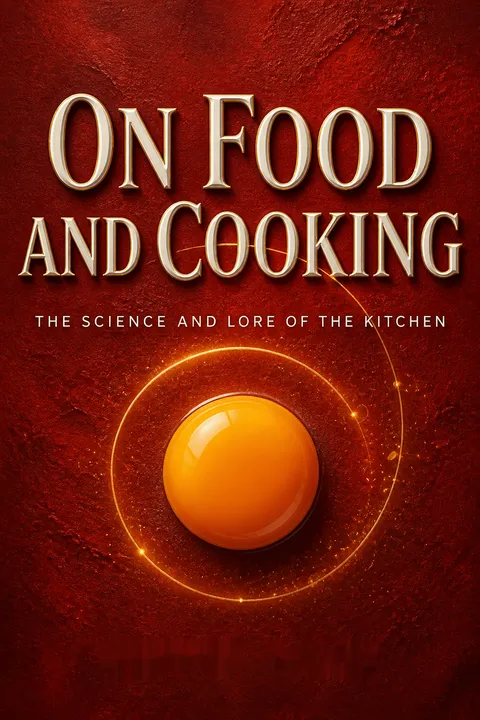
On Food and Cooking is both a reference work and an argument for intellectual curiosity at the stove. Its organizing move is to connect familiar kitchen outcomes to the biological and chemical structures that produce them. Milk curdles because of casein behavior; bread rises because gluten traps gas; meat dries because heated proteins contract; a sauce thickens because particles, molecules, droplets, or bubbles obstruct flow. These are not isolated facts. Together they form a practical grammar for adapting technique to ingredients.
The book’s unusual strength is its refusal to separate science from history and culture. Cheese is simultaneously concentrated milk, a microbial ecology, and a record of pasture and craft. Sugar is a chemical with precise phase behavior, but also a commodity whose global expansion relied on enslaved labor. The result is a model of food knowledge that includes mechanism, sensory experience, and human consequence.
Its scope creates a summarizing challenge. A chapter-by-chapter digest would reproduce an encyclopedia rather than preserve the book’s governing insight. The more useful compression is to follow recurring questions: What is this food made of? What changes it? How does that change affect texture, flavor, safety, and the cook’s choices? The strongest takeaways therefore cross ingredient categories rather than treating milk, meat, grains, and vegetables as unrelated subjects.
The work also has a historical boundary. Its second edition dates to 2004, and some nutritional, safety, and production claims reflect the knowledge and debates of that moment. Its enduring contribution is less a set of final health prescriptions than a method of asking better questions. Chemistry can explain why a procedure works, but it cannot determine which flavor a culture values, or whether the conditions of production are acceptable. McGee’s deepest lesson is that a more knowledgeable cook gains freedom, while still needing judgment about pleasure, risk, and responsibility.
Review Summary
On Food and Cooking is highly praised for its comprehensive, scientific approach to food and cooking. Readers appreciate its encyclopedic nature, covering topics from ingredients to techniques. Many find it fascinating and informative, noting its ability to explain the "why" behind cooking processes. While some find it dense or textbook-like, most reviewers consider it an invaluable resource for understanding food science. The book is often described as engaging, well-researched, and a must-have for food enthusiasts and professionals alike.
People Also Read
Glossary
Molecular gastronomy
Science applied to culinary qualityA field of inquiry that brings cooks, food scientists, and basic scientists together to understand how foods are made and experienced. In McGee’s account, it is not merely laboratory cooking: it studies the physical and chemical processes behind culinary quality, while drawing on the practical knowledge of cooks.
Maillard reactions
Browning between sugars and amino acidsA family of reactions that begins when sugars and amino acids interact under heat. The reactions produce many new aroma compounds and brown pigments, contributing characteristic roasted, toasted, and savory flavors to foods such as bread crust, coffee, and seared meat. They differ from caramelization, which begins with sugars alone.
Retrogradation
Cooling starch firms its structureThe gradual reassociation of starch molecules after cooked starch cools. As the molecules form more orderly groupings, the starch becomes firmer and may release water. Retrogradation helps explain why cooked rice and bread harden during storage, and why reheating can temporarily soften them again.
Nixtamalization
Alkaline treatment of cornA traditional corn-processing method in which kernels are cooked or soaked in alkaline water, often made with lime. The treatment softens and loosens the hull, helps produce cohesive masa for tortillas, and makes more of the corn’s niacin available for human absorption.
Terroir
Place expressed through a cropThe combined influence of a vineyard’s or growing region’s soil, water, elevation, slope, orientation, and local climate on a crop and the food made from it. In wine, terroir describes how grapes from different places can produce distinctive qualities, even when the same variety is used.
Emulsion
One liquid dispersed in anotherA mixture in which droplets of one liquid are suspended throughout another liquid that does not naturally mix with it. Mayonnaise is an oil-in-water emulsion. Emulsifiers such as egg-yolk lecithin coat droplets and help prevent them from joining together and separating from the continuous liquid phase.
Koji
Mold-grown grain fermentation starterA preparation, used especially in Japanese food production, made by growing Aspergillus oryzae on cooked grain, commonly rice. The mold supplies enzymes that break starches and proteins into smaller components. Koji is used in making sake, miso, and other fermented foods, and differs from Chinese mixed-mold preparations.
Malolactic fermentation
Bacteria soften wine acidityA secondary fermentation in which bacteria convert malic acid in wine into lactic acid. Because lactic acid tastes less sharp, this process can reduce a wine’s apparent tartness. It also produces aroma compounds, including diacetyl, which can contribute a buttery note.
Tempering
Controlled cocoa-butter crystallizationA chocolate-working process that melts all cocoa-butter crystals, cools the chocolate to encourage stable crystal forms, and gently warms it again to remove unstable forms. Proper tempering helps chocolate set with a glossy surface and a firm snap rather than a dull, soft, or mottled finish.
FAQ
What's On Food and Cooking about?
- Scientific Exploration: On Food and Cooking by Harold McGee explores the scientific principles behind cooking, explaining how ingredients interact during preparation.
- Diverse Topics: The book covers a wide range of subjects, including dairy, eggs, meats, vegetables, and cooking methods, with detailed information on their chemistry and biology.
- Culinary Lore and History: McGee weaves historical context and cultural significance into the narrative, making it a rich guide to food traditions.
Why should I read On Food and Cooking?
- Enhances Cooking Skills: The book provides a deeper understanding of how ingredients work, allowing for more creativity and confidence in the kitchen.
- Scientific Approach: It merges science with cooking, making it suitable for both home cooks and culinary professionals, explaining the "why" behind techniques.
- Comprehensive Resource: Serving as a reference for practical advice or academic study, it’s a valuable addition to any culinary library.
What are the key takeaways of On Food and Cooking?
- Understanding Ingredients: Emphasizes the importance of knowing ingredient properties, such as how milk proteins coagulate when heated.
- Cooking Techniques Explained: Explains various methods and their scientific basis, like why certain techniques yield better textures and flavors.
- Flavor Chemistry: Explores flavor compounds and their interactions, noting that "flavors are something like chemical chords."
What are the best quotes from On Food and Cooking and what do they mean?
- "Whenever we cook we become practical chemists.": Highlights cooking as both an art and a science, where understanding chemical reactions leads to better outcomes.
- "Food is an infinitely rich subject.": Emphasizes the depth and complexity of food, suggesting endless learning opportunities in the culinary world.
- "Cooking is a way of transforming what the Earth offers us into more concentrated forms of pleasure and nourishment.": Reflects the transformative power of cooking, elevating raw ingredients into something more enjoyable and nutritious.
How does On Food and Cooking explain the Maillard reaction?
- Browning Process: The Maillard reaction involves chemical reactions between proteins and sugars when heated, resulting in browning and rich flavors.
- Temperature Sensitivity: Occurs at temperatures above 250ºF (120ºC), essential for achieving desirable flavors in cooked foods.
- Flavor Complexity: Produces hundreds of flavor compounds, contributing to the complexity and appeal of grilled meats and baked goods.
What is the significance of fermentation in On Food and Cooking?
- Preservation Method: Fermentation preserves food, enhances flavors, and improves digestibility, transforming ingredients into products like yogurt and cheese.
- Microbial Action: Relies on microorganisms converting sugars into acids, gases, or alcohol, adding unique flavors and textures.
- Cultural Importance: Highlights fermentation's role in traditional food practices across various cuisines, connecting food, culture, and history.
How does On Food and Cooking explain the role of thickeners in sauces?
- Texture Enhancement: Thickeners like starch and gelatin improve sauce texture, making them richer and more appealing.
- Flavor Dilution: While enhancing texture, thickeners can dilute flavor intensity by binding flavor molecules.
- Cooking Techniques: Explains methods like reducing liquid to concentrate flavors without thickeners, enhancing overall taste.
What is the significance of ripening in fruits as discussed in On Food and Cooking?
- Transformation Process: Ripening changes fruits from inedible to delicious, involving biochemical changes that enhance sweetness and reduce acidity.
- Role of Ethylene: Ethylene gas triggers ripening, leading to sugar production and aroma development.
- Climacteric vs. Nonclimacteric Fruits: Distinguishes between fruits that continue ripening after harvest and those that do not, aiding in proper selection and storage.
How does On Food and Cooking address the topic of food safety?
- Microbial Growth: Emphasizes understanding spoilage factors like temperature and moisture, essential for safe food handling.
- Preservation Techniques: Discusses methods like canning and fermentation to prevent spoilage and ensure safety.
- Storage Recommendations: Provides practical advice on storing food safely, including optimal temperatures and conditions.
How does On Food and Cooking explain the importance of salt in cooking?
- Flavor Enhancement: Salt is crucial for enhancing overall dish flavor, making it more palatable.
- Chemical Interactions: Interacts with proteins and other ingredients, affecting texture and flavor profiles.
- Preservation: Plays a role in food preservation, inhibiting spoilage bacteria while allowing beneficial bacteria to thrive.
How does On Food and Cooking explain the process of making cheese?
- Cheese Production: Outlines steps from curdling milk to aging cheese, explaining the use of rennet as an early biotechnology venture.
- Microbial Influence: Discusses bacteria and molds' roles in developing cheese flavors and textures.
- Diversity of Cheeses: Emphasizes the variety of cheeses shaped by local ingredients and traditions, inspiring connoisseurship.
How does On Food and Cooking define the concept of terroir?
- Environmental Influence: Terroir refers to unique environmental conditions affecting food flavor and quality, particularly in wine and cheese.
- Cultural Significance: Emphasizes the connection between place and culinary identity, enriching appreciation of regional foods.
- Flavor Expression: Discusses how terroir contributes to distinct flavors, encouraging sourcing ingredients that reflect their local environment.
About the Author
Other books by Harold McGee
Download PDF
Download EPUB
.epub digital book format is ideal for reading ebooks on phones, tablets, and e-readers.








