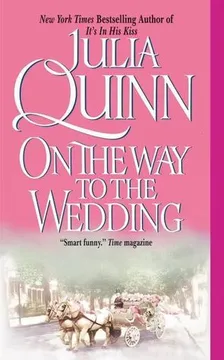


Plot Summary
Prologue
The story opens on a summer wedding day, with Gregory Bridgerton running through London toward a church where he believes the bride must not marry. He arrives breathless, interrupts the ceremony, and moves toward her as the congregation watches.
The narrative then turns back two months, to the house party where Gregory first mistakes sudden certainty for lasting love and meets the woman he has not yet learned to see.
The opening makes urgency the reader's first experience of Gregory's romance, then withholds the bride's answer and rewinds to expose how little he understands his own certainty. That structure turns the wedding into a question rather than a simple destination: what has made Gregory run, and what has made the bride reach the altar at all? His public interruption also establishes the story's central pressure, the collision between private desire and the social consequences of acting on it.
Gregory Meets Hermione
At twenty-six, Gregory Bridgerton has no profession or settled purpose, but he believes his large, happily married family proves that true love exists. His elder brother Anthony presses him to choose a direction; Gregory jokes that he might join the clergy, then admits he would rather wait for the right woman.
Arriving late at Aubrey Hall, he sees Hermione Watson from behind and is overwhelmed by the certainty that she is that woman. Her friend Lucy Abernathy notices his attention, though Gregory first kisses Lucy's hand and treats her as a courteous route to Hermione.
When Hermione declines to dance, he escorts Lucy instead, barely registering her disappointment. His first certainty is real, but it is attached to an image he has not yet tested.
Gregory's belief in love is both generous and unexamined. He has seen marriage work for his siblings, but he mistakes their outcomes for a guarantee that his own recognition will be immediate and mutual. His attention fixes on Hermione before he knows her, while Lucy's familiarity with being overlooked makes her a keen observer of his error. The scene establishes the novel's distinction between loving an idea and understanding a person.
Lucy Plans the Match
Lucy already knows Hermione is devoted to Mr. Edmonds, her father's secretary, despite the certainty that Hermione's parents will reject the match. Lucy herself is practically promised to Lord Haselby through an arrangement made by her guardian, Uncle Robert, and considers him acceptable because he is kind and respectable.
She tells herself she is not interested in romance, then decides Gregory would make a far better husband for Hermione than a penniless secretary. At Aubrey Hall, hostess Kate pairs Gregory with Hermione for a village outing and Lucy with Neville Berbrooke.
Gregory tries to charm Hermione as they walk, but she answers politely and remains distracted. Lucy watches his predictable attentions and begins planning how to make him stand out.
Lucy treats marriage as a problem that can be solved with good judgment: choose a suitable man, prevent a friend from making a disastrous match, and accept the future already chosen for herself. Her practical confidence conceals a hunger to be noticed that she rarely admits, even to Hermione. By trying to direct Gregory toward her friend, she preserves her familiar role as the helpful observer and avoids asking what she might want.
Advice Beneath the Flowers
During the village picnic, Lucy sees that Gregory's lavish devotion is repeating the same pattern that has failed with Hermione's other admirers. She draws him aside and advises him to stop treating Hermione like an untouchable prize.
Later, Gregory confronts Lucy in the library after his attempt to follow her advice leaves him feeling ignored. Their argument turns unexpectedly intimate: he speaks of love as an overwhelming recognition, and Lucy recalls that Hermione described falling for Mr. Edmonds in much the same way.
Gregory realizes Hermione may already have experienced the very certainty he assumed was his own. Lucy is struck by his earnestness, while he begins to notice her intelligence and candor. He still wants Hermione, but the conversation gives his certainty its first crack.
The library conversation changes the terms of Gregory's pursuit. Lucy is not merely a source of information about Hermione; she can challenge his assumptions and make him examine them. Their exchange also exposes Lucy's own defensive pragmatism: she cannot imagine surrendering control to a feeling as powerful as the one Gregory describes. Neither recognizes that their conversation is already creating the kind of attention they each claim to seek elsewhere.
Richard Brings News
Gregory's attempts to speak with Hermione begin to improve after he draws her into an amusing breakfast conversation. She laughs with him and admits she is confused by a small spark of interest, though her feelings for Mr. Edmonds remain unresolved.
Then Lucy's brother Richard, the Earl of Fennsworth, arrives at Aubrey Hall. He explains that Uncle Robert wants Lucy home to discuss an important family matter, and admits the marriage arranged for her may soon proceed.
Lucy is startled by how immediate her future has become, though she insists Haselby is a suitable match. Gregory, meanwhile, notices Richard's unusual attention to Hermione and suspects his friend is in love with her. Lucy dismisses the possibility and believes Richard has another romantic interest.
The two courtships move in opposite directions. Hermione begins to question a love story she had treated as settled, while Lucy confronts the fact that her own future may be decided without her participation. Gregory's ability to notice Richard's longing contrasts with Lucy's refusal to see it, suggesting that her confidence in reading everyone else does not extend to interpreting her own emotional life.
The Orangery Discovery
At Aubrey Hall's masked ball, Lucy dances with Gregory and delights in the ease of their partnership. Hermione has slipped away with Richard, and when they cannot be found, Lucy guesses they may be in the orangery, where her brother feels most at home among the flowers.
Gregory and Kate search with her. Gregory finds Richard hiding and tackles him, while Kate discovers Hermione among the plants. Hermione admits that her feelings changed during their walk, and the families quickly agree that she and Richard must marry.
Lucy is shocked that her closest friend and brother have concealed so much, while Gregory is left to watch Hermione choose someone else. The discovery ends his first imagined romance and places Lucy beside him in a moment neither knows how to interpret.
The orangery turns the private, cultivated world of Richard's interests into the setting where Hermione's choice becomes public fact. Lucy's first response is protective, but she cannot prevent the discovery from forcing everyone into a social resolution. Gregory's disappointment is real, yet the scene also loosens his attachment to a fantasy. The two people who remain outside the new engagement are now emotionally closer than either has acknowledged.
A Kiss in Darkness
After the ball, Gregory finds Lucy alone in a quiet corridor and asks why she seemed so shaken by Hermione and Richard's engagement. As she struggles to explain her fear of change, he kisses her. The kiss awakens a response she had never expected and leaves Gregory equally shaken, though he does not yet understand what it means.
The next morning, Richard tells Lucy that Uncle Robert intends to settle her marriage to Haselby soon. At breakfast, Hermione admits she is uncertain about her feelings for Mr. Edmonds and Gregory, which gives Lucy hope that her matchmaking may have worked. But Lucy's private experience with Gregory has already made her old certainty about marriage feel less secure, even as the formal arrangement draws closer.
The kiss gives Lucy an experience that cannot be managed as an abstract argument. Her body contradicts her belief that love is optional or excessive, while Gregory's response remains obscured by his recent fixation on Hermione. The timing sharpens the conflict: Lucy's awakening arrives just as family duty becomes concrete. The scene makes desire consequential before either character has found language or freedom to act on it.
Haselby's Supper Table
In London, Lucy asks for a meeting with her intended after her wedding is set for the following week. At supper, Lord Davenport examines her manners, health, and knowledge as if assessing an asset, while Haselby is more considerate and quietly resists his father's humiliating behavior.
Lucy sees that Haselby may be pleasant, but the prospect of becoming his wife feels increasingly bleak. When Gregory returns to London, he finds Lucy feeding pigeons in Hyde Park. Their easy banter returns at once, and he learns that she is to marry in days.
He persuades his sister Daphne to invite Lucy to a ball, giving her one evening in society before the wedding. Lucy accepts the invitation, though she knows that spending time with Gregory will make her feelings harder to contain.
The supper makes marriage's public and private dimensions visible at once. Davenport treats Lucy as a means to family advantage, while Haselby's courtesy offers relief without answering her deeper unease. Gregory's return restores the comfort of their friendship, but it also makes that comfort dangerous. Lucy is no longer merely being escorted through a predetermined future; she can feel the cost of it.
The Ballroom Confession
At Daphne's ball, Gregory sees Lucy and realizes that the force he once mistook for love with Hermione is now directed toward the woman who has been beside him all along. His sister Hyacinth notices his urgency and arranges a private meeting, even repairing Lucy's torn dress to give her a plausible excuse to leave the ballroom.
Alone, Gregory tells Lucy that he loves her and asks her to become his wife. Lucy accepts, admitting that she loves him too, and for a brief moment they can imagine a life chosen for themselves. Hyacinth helps them return without attracting notice. The promise is fragile, however: Lucy is still engaged to Haselby, and she must face Uncle Robert before she can act on her decision.
Gregory's second recognition is not simply a replacement for the first. It grows from remembered particulars: Lucy's wit, her habits, and the trust formed through their conversations. Hyacinth's intervention matters because it creates a temporary space outside society's surveillance. Lucy's acceptance is an act of desire, but it does not erase the structures that have governed her choices since childhood.
The Guardian's Threat
Lucy goes to Uncle Robert expecting to end her engagement, but he reacts with fury when she says she will not marry Haselby. He reveals that Lord Davenport has been blackmailing him with supposed evidence that Lucy's father committed treason, and claims Lucy's marriage is the final payment that will protect the family.
He warns that Richard could lose his title and fortune if the secret becomes public. Lucy does not know whether the accusation is true, but she cannot risk her brother and Hermione's future on a guess. When Gregory later asks her to leave with him, she refuses to abandon the wedding. She has chosen love privately, yet feels compelled to sacrifice it for the people she has spent her life protecting.
Robert's threat exploits Lucy's defining strength, her loyalty, by making self-sacrifice seem like the only honorable choice. The alleged treason shifts her decision from personal preference to a burden carried for an entire family. Because the accusation is not yet verified, fear fills the space where evidence should be. Lucy's obedience is not passivity so much as a moral calculation made under coercion.
The Night Before
On the eve of the wedding, Gregory secretly reaches Lucy's room and asks her to abandon the ceremony. She tells him she cannot leave Haselby waiting at the church, even though she loves Gregory. Their farewell turns into a night together, and they confess their love before dawn.
Gregory asks her to signal if she is in danger and promises he will help. Lucy insists she must confront the wedding herself. After leaving the house, Gregory waits nearby with his brother Colin for a sign.
Instead, he watches the bridal carriage depart with Lucy inside. He believes she has chosen Haselby, but the absence of a signal leaves him uncertain whether she acted freely. His waiting ends in helplessness, and his only remaining chance is to intervene at the church.
The night together is both an expression of agency and a temporary reprieve from coercion. Lucy chooses Gregory without pretending that desire resolves the danger to her family. Gregory, who once expected love to arrange itself, now waits for evidence and offers protection, yet he still cannot act without understanding her constraints. The carriage makes her apparent choice public while leaving its true cause hidden.
The Church Says No
As Lucy begins her wedding vows at St. George's, Gregory bursts into the church and publicly begs her not to marry Haselby. He declares his love and proposes before the assembled guests. Haselby leaves the decision to Lucy.
She wants to accept, but she remembers the threat to Richard and the family name, so she refuses Gregory and completes the marriage ceremony. Gregory is dragged from the church as Lord Davenport and the guests close around the couple. Lucy's choice looks like a rejection of love, and Gregory cannot understand it.
The wedding is followed by a lavish reception where Lucy performs the role of a bride while avoiding the people closest to her. Her silence preserves the secret, but leaves Gregory convinced she has freely turned away.
The public proposal makes private coercion impossible to see. To the congregation, Lucy appears to choose rank and security over Gregory; in fact, she believes she is protecting Richard from ruin. Her refusal is therefore both a real decision and a constrained one. The scene tests Gregory's romantic conviction against a world where love alone cannot neutralize inherited shame or a guardian's power.
The Bride Disappears
During the reception, Gregory slips into Lucy's room, carries her to an unused washroom, and ties her there so they can speak without being discovered. Lucy explains the blackmail and the accusation against her father. Gregory leaves her for an hour while he seeks help from Hermione, Richard, and Haselby, who agree to investigate Lord Davenport and free Lucy from the arrangement.
When Gregory returns with Hermione, the washroom is empty. Lucy's uncle has found her, cut her bindings, and taken her elsewhere in the house. Gregory and Hermione begin searching, using their knowledge of Fennsworth House to narrow the likely hiding places. The wedding has become a race against Robert, who still intends to force Lucy into obedience.
Gregory's abduction is ethically uneasy, even though he believes it protects Lucy. His urgency risks repeating the control he wants to undo, and Lucy's explanation forces him to replace romantic assumptions with attention to material danger. The alliance with Hermione, Richard, and Haselby widens the problem from a lovers' conflict into a shared investigation. Robert's second abduction shows that he will use force when persuasion fails.
The Gun in the Study
Gregory finds Lucy tied and blindfolded in Robert's room, with her uncle holding a gun near her. He keeps his own weapon trained on Robert and tries to delay him until help arrives. Under pressure, Lucy recognizes that Robert may have invented her father's treason to conceal his own vulnerability.
Gregory confirms that Richard and Haselby are questioning Lord Davenport. When the others rush into the room, Robert swings his gun toward them and fires; Lucy falls beneath him but is not wounded.
Gregory shoots Robert in the shoulder, stopping him. Lucy then confronts her uncle, whose evasions confirm that he had lied about her father. The family now knows the marriage was enforced through blackmail, not a verified charge against the late earl.
The confrontation replaces inherited accusation with immediate evidence: Robert's weapon, his shifting story, and his attempt to control Lucy's body. Gregory's marksmanship, previously a source of teasing, becomes consequential under pressure. Yet the decisive change is not the shot alone. Lucy names the lie and her family hears it, turning a secret that isolated her into a fact they can challenge together.
A Marriage Unmade
With Robert wounded and exposed, Richard takes control of the family response and arranges for his uncle to leave the country. Gregory warns Lord Davenport that he cannot continue the blackmail without implicating himself, and Davenport backs down. Haselby agrees to pursue an annulment, relieved to be free of a marriage neither of them wanted.
Lucy is no longer required to protect the family by surrendering her future, and Gregory can openly stand beside her. The two kiss amid the bewildered guests, while Richard and Hermione return to the question of a new wedding. Lucy's loyalty remains intact, but it no longer requires her silence or self-erasure. The immediate danger is over, and she can choose a life with Gregory.
The resolution does not make the social order disappear; it changes who is allowed to define the facts. Richard's authority replaces Robert's coercion, Haselby uses his position to release Lucy, and Davenport loses leverage when secrecy is no longer guaranteed. Lucy's love becomes possible not because duty proves meaningless, but because her family finally shares the risk she had carried alone.
Epilogue
Years later, Gregory and Lucy have eight children and are expecting another. Gregory has learned that childbirth frightens him more than he expected, but Lucy faces each birth with growing ease. When their eighth child arrives, a twin surprises everyone.
Gregory counts the children and realizes that his life has become fuller than anything he once imagined. Lucy's practical care and his enduring devotion have built a noisy household where love is not merely a sudden certainty, but a daily, shared life.
The epilogue answers Gregory's early longing for a settled purpose without turning domestic life into a still tableau. His large family is chaotic, bodily, and often alarming to him, while Lucy meets its demands with practiced steadiness. Their life confirms that the novel's ideal of love is not exhausted by recognition or marriage: it survives in repeated acts of care, humor, and mutual accommodation. Gregory's final abundance is measured in relationships, not status.
Analysis
The novel contrasts two kinds of certainty. Gregory begins by trusting the shock of recognition, while Lucy trusts the stability of arrangements, family duty, and sensible compromise. Each form of certainty fails when treated as complete knowledge. Gregory's first romantic conviction fastens on Hermione before he knows her; Lucy's belief that she can be content with Haselby ignores both her desire and the coercion surrounding the match. Their relationship deepens when they attend to one another as particular people, through jokes, advice, shared attention, and moments of vulnerability.
The book also examines how social power can make an apparent choice misleading. Lucy's decision at the altar looks voluntary to the congregation, but it is shaped by a threat against her brother and family. The revelation that Robert's account of her father's treason is a lie shows how easily duty can be used as a weapon when one person controls the information. Lucy's virtue is not obedience itself; it is her effort to protect people she loves. Her growth comes when she allows them to share that responsibility rather than carrying it alone.
Gregory's development follows a parallel movement from expectation to action. He starts out assuming that love will arrive and make his future clear. When Lucy is endangered, he must do more than believe in love: he must listen, seek help, and accept that good intentions do not automatically justify his decisions. The story's happy ending rests not on romance defeating society in the abstract, but on a network of people using their influence to challenge coercion. Love becomes durable when recognition is joined to responsibility.
Review Summary
People Also Read









Characters
Gregory Bridgerton
The hopeful youngest sonGregory is a cheerful, sociable younger son who has watched his siblings find loving marriages and expects the same certainty for himself. Because his life has required little struggle, he initially trusts sudden feeling more than sustained knowledge and has not yet found a purpose beyond waiting for love. He is generous and loyal, with a teasing manner that often conceals a serious desire to be regarded as a grown man by his family. His interest in Hermione begins as an idealized conviction; his friendship with Lucy challenges him to notice character, accept uncertainty, and take responsibility for what he wants.
Lucy Abernathy
The practical loyalistLucy is Hermione's closest friend and the younger sister of Richard, Earl of Fennsworth. Raised under a distant guardian, she has learned to value order, usefulness, and self-control; she is observant, witty, and generous, though she often makes other people's happiness her task. Her expected marriage to Lord Haselby appears sensible to her because she distrusts overwhelming romantic claims and has little practice imagining a future shaped by her own wishes. Lucy's affection for Hermione is profound, and her loyalty to her family is equally strong. Her practical intelligence makes her an effective adviser, even when she fails to recognize what her own heart is telling her.
Hermione Watson
The beautiful romanticHermione is a viscount's daughter and Lucy's dearest friend. Her beauty attracts attention before most people have learned anything about her, while her private nature makes her difficult for admirers to know. She believes that love arrives with unmistakable force and becomes attached to Mr. Edmonds, her father's secretary, despite the social barriers between them. Hermione is not frivolous: her loyalty to Lucy is steady, and she takes her own feelings seriously. Her experience gives Lucy and Gregory a first, imperfect model of love, while her reserve and awkwardness on the dance floor complicate the polished image society assigns her.
Richard Abernathy
Lucy's devoted brotherRichard is Lucy's older brother and the Earl of Fennsworth. He spent much of his youth away at school and university, but he and Lucy share an affectionate history shaped by their isolated childhood home. He is thoughtful, especially around flowers and the natural world, and carries himself with more seriousness than his age might suggest. Richard's care for Lucy can be easy to mistake for ordinary family duty, while his friendship with Hermione gives him a life beyond his title. He is not quick to impose himself, but he becomes protective when Lucy's well-being is at stake.
Arthur Haselby
The considerate fiancéArthur Haselby is Lucy's intended husband, the son and heir of the Earl of Davenport. He is reserved, dryly observant, and far more considerate than his father, though he initially accepts a family arrangement without challenging it. His manner suggests a man who has learned to preserve his independence through quiet humor rather than open confrontation. Haselby treats Lucy with civility and recognizes the difference between a legal match and a genuine partnership.
Robert Abernathy
Lucy's austere guardianRobert is Lucy and Richard's uncle and guardian, responsible for the family after their father's death. He is cold, economical with affection, and deeply conscious of duty, household position, and the family's future. Lucy has spent years adapting herself to his reserve, rarely challenging his decisions directly. His authority has shaped her sense that obedience is safer than asking what she wants.
Lord Davenport
The controlling family patriarchLord Davenport is Haselby's father and a powerful peer who expects his household to serve its name and interests. He is blunt, domineering, and accustomed to treating social obligations as instruments of control. At supper he scrutinizes Lucy's suitability with little regard for her comfort, establishing the pressure that surrounds her proposed marriage.
Violet Bridgerton
The matchmaking motherViolet is Gregory's perceptive mother, devoted to her children and their happiness. She is an accomplished hostess and matchmaker, but her warmth is paired with sharp psychological insight. Violet understands that her children need room to make their own choices, even when she cannot resist helping them toward a good outcome.
Hyacinth Bridgerton St. Clair
The meddling younger sisterHyacinth is Gregory's youngest sister, now married to Gareth St. Clair. She is clever, outspoken, and intensely curious about other people's affairs. Her confidence can make her tactless, but she is also quick to recognize when someone needs practical help. Hyacinth knows how to bend the rules of a social gathering without appearing to break them.
Kate Bridgerton
The shrewd hostessKate is Anthony Bridgerton's wife and the hostess of the Aubrey Hall gathering. Intelligent and brisk, she reads social situations quickly and is comfortable organizing people as well as parties. Her humor can be dry, but she takes responsibility when a guest's safety or reputation is at stake.
Anthony Bridgerton
The formidable eldest brotherAnthony is Gregory's eldest brother and the Viscount Bridgerton. He is disciplined, protective of the family, and inclined to press Gregory toward a more purposeful life. His authority can feel paternal to his younger brother, though it grows from genuine concern and a strong sense of responsibility.
Colin Bridgerton
The steady older brotherColin is one of Gregory's older brothers, known in the family for an easy manner and a talent for understanding people without pressing them. He offers Gregory companionship and practical support when the crisis becomes too large to face alone.
Mr. Edmonds
Hermione's devoted secretaryMr. Edmonds is the secretary employed by Hermione's father and the object of Hermione's romantic hopes. His position and limited means make him an unsuitable match in the eyes of her family, placing him at the center of Hermione's conflict between affection and social expectation.
Plot Devices
Love at first sight
Certainty as a false compassGregory interprets an immediate physical and emotional response to Hermione as proof that she is his destined partner. The same intensity later recurs when he sees Lucy, forcing him to question whether the feeling itself is trustworthy. The contrast separates romantic conviction from knowledge of another person. Gregory's relationship with Lucy grows through attention, humor, and shared vulnerability, showing that a dramatic first impression may signal longing without identifying its proper object.
Lucy as matchmaker
Friendship redirects courtshipLucy initially treats Gregory as a promising husband for Hermione and offers tactical advice based on years of observing her friend's suitors. Her efforts place her in sustained conversation with Gregory, first as adviser and later as confidante. The device creates comic misdirection while revealing Lucy's own intelligence and emotional needs. Her attempts to arrange another person's happiness bring her close to a relationship she had not permitted herself to imagine.
The masked ball
Privacy inside spectacleThe masks and crowded celebration briefly loosen the rules governing who may speak, dance, and leave a room together. The ball brings Hermione and Richard's private attachment into view, while also giving Gregory and Lucy an opportunity for honest conversation away from their usual roles. The event's mixture of concealment and public observation mirrors the characters' predicament: feelings can be hidden for a time, but social consequences follow once they become visible.
The arranged betrothal
Duty constrains desireLucy has long been expected to marry Haselby, a match made by the adults responsible for her future. At first she accepts the arrangement as practical and largely harmless. As her feelings for Gregory deepen, the engagement becomes a concrete limit on her choices. The marriage plot also intersects with money, rank, and family reputation, showing how a private promise can function as a public contract that a young woman may find difficult to undo.
The treason accusation
Blackmail disguised as dutyRobert tells Lucy that her father committed treason and that Lord Davenport possesses written proof. He uses the threat of disgrace and financial ruin to make Lucy believe she must marry Haselby to protect Richard. The accusation's true status becomes central to the crisis, and its apparent evidence gives coercion the appearance of family obligation. The device forces the lovers to investigate whether Lucy's sacrifice is necessary or built on a lie.
Bridgertons Series

About the Author
Other books by Julia Quinn







Download PDF
Download EPUB
.epub digital book format is ideal for reading ebooks on phones, tablets, and e-readers.








