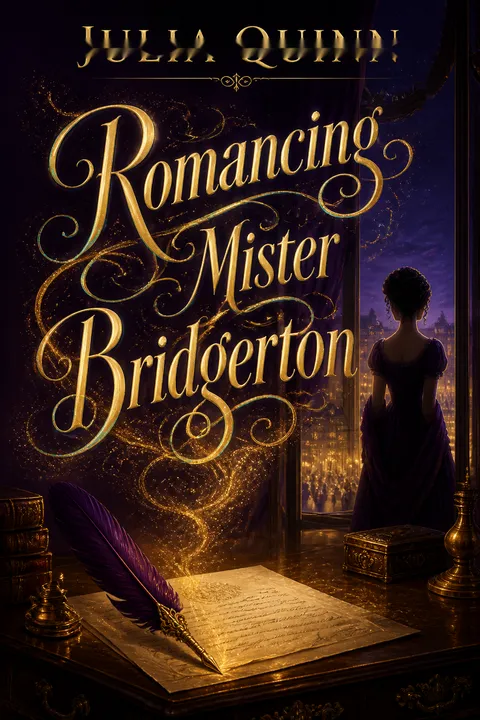


Plot Summary
Prologue
At sixteen, Penelope Featherington falls in love with Colin Bridgerton after her loose bonnet knocks him from his horse into a puddle. He laughs instead of blaming her, and she begins to cherish every conversation they share. London society, however, sees a shy, unfashionably dressed girl, not the observant, funny person Penelope knows herself to be.
When the new gossip sheet Lady Whistledown mocks her gowns, Penelope bears the humiliation in silence. Years later, overhearing Colin declare he will never marry her wounds her deeply. She hides that hurt and continues to live near the Bridgertons, loving Colin from the edges of his life.
The prologue establishes the gap between Penelope’s inward self and the social identity assigned to her. Her love begins not with courtship but with Colin’s generosity after an accident, so kindness becomes the measure by which she interprets him for years. Yet his public rejection shows how little intimacy protects her from the marriage market’s brutal sorting. Lady Whistledown’s early mockery helps make Penelope an object of scrutiny before she has any power over the terms of that scrutiny. Her silence is not emptiness. It is a form of observation that will eventually become authorship.
Colin Comes Home
In 1824, Colin returns to London after traveling in Cyprus and tells his brother Anthony he will stay for the season. The journeys satisfy his appetite for escape, but they have not given him the sense of purpose he envies in Anthony, the viscount, and Benedict, the artist.
Penelope, now twenty-eight and long considered a spinster, remains close to Colin’s family through her friendship with his sister Eloise. Her mother, Portia, hopes to secure a grand match for their youngest daughter Felicity, even though Felicity favors Mr. Albansdale.
Portia’s plans sharpen Penelope’s awareness that her own future is expected to revolve around caring for her mother. Colin’s return brings the old friendship back into daily reach, while his private dissatisfaction sets a second change in motion.
The story begins with two forms of stalled adulthood. Colin has wealth and social ease but lacks work that feels his own; Penelope has intelligence and wit but has learned to live as if society has already judged her future. Their circumstances are not equivalent. Colin’s restlessness comes with freedom of movement, while Penelope’s spinsterhood is treated as a family resource for Portia’s old age. The contrast gives their renewed proximity its force: each has mistaken the other’s visible role for the whole person. Colin returns searching for direction, not romance, while Penelope has trained herself to expect nothing from him.
A Thousand-Pound Challenge
At a Bridgerton gathering, Colin and Penelope fall back into easy teasing. He asks her to dance, and their exchange reveals the dry wit she rarely shows to strangers. When guests complain that the season is dull, Penelope points out that they are amusing themselves by announcing their boredom.
Lady Danbury, a formidable countess, then offers a thousand pounds to anyone who identifies Lady Whistledown. Pressed for her own theory, Penelope publicly names Lady Danbury. Instead of taking offense, the countess enjoys Penelope’s nerve and hints that people may be more than their reputations suggest.
Penelope leaves the encounter newly alert to her own courage. The prize sets London hunting for the anonymous writer, while Lady Danbury’s approval nudges Penelope beyond the quiet role she has accepted.
The challenge turns gossip into a public contest, but its deeper effect is on Penelope’s sense of agency. She does not become confident because the room suddenly welcomes her; she discovers that she can act even while uncomfortable. Her guess about Lady Danbury is playful, yet it is also a small refusal to treat rank as a reason for silence. The countess recognizes what the rest of society overlooks: Penelope’s intelligence is not absent, only usually concealed by shyness and habit. The prize also raises the danger surrounding the hidden columnist, converting a familiar social amusement into a mystery people have a financial and reputational stake in solving.
The Journal on the Table
While waiting for Eloise at Number Five, Penelope sees Colin’s open travel journal and reads a passage describing Cyprus. Colin returns, catches her, and erupts at the invasion of his privacy.
As he gathers his things, he slices his palm on a letter opener; Penelope tends the wound and, once he is calmer, tells him how vividly his writing brought the island to life. Her praise surprises him because he has never thought of himself as a writer. He admits that travel cannot fill every hour and that he wants a purpose beyond being called charming.
Penelope argues that he can choose a new direction rather than complain about his advantages. Their talk ends in a quarrel: she sees his freedom more clearly than he does, and he leaves hurt by her judgment.
The journal makes Colin’s inner life legible before he is ready to share it. Penelope’s breach is real, and his anger is justified, but the scene also creates the first exchange in which she evaluates his work rather than his charm. Her attention gives him an unfamiliar kind of recognition; his writing may matter beyond the private pleasure of recording a journey. Their disagreement exposes unequal social freedom. Penelope sees options Colin can exercise at will, while Colin experiences those same options as meaningless without a calling. Neither is entirely wrong, but each initially hears the other’s pain as a rebuke.
An Apology in Music
At the annual Smythe-Smith musicale, Penelope and her sister Felicity sit near the struggling performers so no crueler guests can mock them. Lady Danbury notices that Penelope understands the cellist’s discomfort and again encourages her to trust her own judgment.
Colin arrives with his hand bandaged, seeks Penelope out, and apologizes for complaining about his life to someone with fewer choices. She tells him his frustration is real, then urges him to publish the travel journals she has glimpsed.
Colin resists, unsure that anyone would read them, but he keeps returning to her suggestion. Their conversation repairs the hurt from the journal incident and gives Colin a possible use for the talent he has kept private. For the first time, he treats Penelope’s opinion as more than friendly reassurance.
The musicale’s awkward performance gives Penelope a mirror: she recognizes the cellist’s discomfort because she knows what it is to be watched while feeling inadequate. Her compassion is active, not sentimental; she chooses a seat where her presence can protect someone else. Colin’s apology also marks a shift from self-absorption toward perspective-taking. He does not abandon his dissatisfaction, but he accepts that it landed carelessly on Penelope. Her suggestion that he publish his journals turns their relationship into an exchange of serious judgment and creative possibility, a foundation more durable than his familiar charm.
The Kiss She Asks For
After noticing ink on Eloise’s fingers and learning that she sometimes shuts herself away to write, Colin becomes convinced his sister may be Lady Whistledown. He visits Penelope, who rejects the theory because Eloise could not keep such a secret from her for years.
Colin argues that a rumor alone could ruin Eloise, then uses Penelope as an example of how scandal can damage a woman regardless of truth. His warning awakens a longing Penelope has hidden since girlhood: she asks him to give her a first kiss.
Colin is startled, then gives in, and the kiss transforms their familiar friendship into something bodily and uncertain. His shame afterward wounds her, and he leaves without explaining his reaction. Penelope is left with a cherished memory and no assurance that he wanted it.
The scene joins the novel’s two central questions: who controls a public story, and who is allowed to desire openly. Colin’s fear for Eloise recognizes the injustice of scandal, but he can imagine its consequences most clearly when a woman he loves is exposed. Penelope’s request is a rare act of direct self-advocacy, shaped by the knowledge that propriety may otherwise deny her even a single romantic experience. Colin’s retreat shows how desire can unsettle a man who relies on social ease to manage every encounter. The kiss changes their relationship, but not yet their shared understanding of it.
Cressida Claims the Column
At a ball hosted by the Earl and Countess of Macclesfield, Cressida Twombley publicly claims to be Lady Whistledown. Lady Danbury refuses to accept her word and asks Penelope what she thinks. Though the crowd’s attention leaves Penelope visibly frightened, she says Cressida is lying and explains that the real writer has no reason to seek recognition.
Cressida demands an apology, but Penelope refuses to retreat. Lady Danbury insists on proof before paying the promised reward, giving Cressida a fortnight to produce it. Colin watches Penelope stand her ground and takes her hand. The public claim turns the contest into a direct threat, while Penelope’s refusal to let Cressida define the truth pushes her closer to exposing her own secret.
Cressida’s claim is an act of social theater: she wants the prestige and money attached to a hidden author while avoiding the labor that produced the column. Penelope’s response matters because she defends not simply an idea but the integrity of work whose author cannot safely claim it. She remains frightened, yet no longer lets fear dictate her answer. Lady Danbury’s demand for proof delays the verdict and makes evidence central, an irony in a society that often treats rumor as sufficient evidence against women. Colin’s support is quiet, but the handclasp signals that he is beginning to see Penelope’s courage in public.
A Secret at St. Bride’s
The morning after Cressida’s claim, Penelope travels alone in a hired hack to St. Bride’s Church, where she leaves a coded message for her publisher. Colin follows her, finds the note, and reads her final column refuting Cressida. He realizes that Penelope is Lady Whistledown. In the carriage home, he is furious that she risked the journey and kept the secret, while Penelope insists she cannot let Cressida take credit for her work.
Their argument lays bare how long Penelope has been invisible to society and how little Colin understood her achievement. His anger gives way to desire and a renewed tenderness; when they reach her house, he asks her to marry him. Penelope accepts, though neither has resolved the danger her authorship creates.
The church is both a practical checkpoint in Penelope’s clandestine work and the place where secrecy stops protecting her. Colin’s discovery is ethically complicated: he has violated her privacy, yet what he learns is not merely gossip but the scale of a life she has built beyond his notice. Penelope’s refusal to surrender credit is not vanity. It is a defense of authorship against a rival who has spent years diminishing her. The proposal arrives before their conflict is settled, so romance does not erase the imbalance between them. Instead, it commits Colin to learning who Penelope is, including the parts he cannot control.
The Wrong Featherington
Colin brings Penelope home to ask Portia for her hand, only to find the Featherington family assembled for its weekly meeting. Portia mistakes his intentions and summons Felicity, convinced he wants the younger daughter.
Colin rejects the assumption sharply and makes clear that Penelope is the woman he chose. Felicity helps deflect her mother’s attempts to send Penelope away, while Colin refuses to let the family treat her as an afterthought. Portia finally embraces Penelope and admits she will miss the daughter she had expected to keep beside her, but says she is pleased for her.
Penelope accepts Colin’s proposal. The comic confusion reveals the depth of Portia’s misjudgment, while Colin’s public insistence gives Penelope a kind of recognition she has rarely received at home.
The family meeting compresses Penelope’s old wound into a comic scene: even at the moment of her proposal, her mother initially assumes another daughter must be the intended bride. The misunderstanding is funny because it is plausible. Portia has habitually valued marriage as status and strategy, while Penelope’s own worth has remained difficult for her to see. Colin’s anger serves as protection, but also as a corrective to the family’s hierarchy. Felicity’s small act of solidarity makes the sisters’ bond visible. Portia’s eventual embrace does not undo years of neglect, yet it permits affection to coexist with regret and marks Penelope’s departure as a real change for them both.
The Column Falls Early
At the engagement ball, newsboys distribute Penelope’s final column days before she intended it to appear. The paper again calls Cressida an impostor, and the room erupts in speculation.
Colin is furious that Penelope published without telling him, but he dances with her until they can leave the crowd and confront the breach in private. Penelope argues that she could not let Cressida claim her work; Colin warns that the column puts her at risk. As his anger loosens, he recognizes that his protectiveness has become personal.
They kiss, and their intimacy deepens into a declaration of love and a first night together before their wedding. The rushed publication leaves the identity unresolved in society, however, and Cressida still has a reason to investigate.
The premature distribution literalizes the loss of control that has shadowed Penelope’s authorship. She has managed a secret for years through careful timing and a trusted publishing arrangement, but one mistake turns private choice into public spectacle. Colin’s anger is not simply prudence; it exposes his emerging attachment, though his instinct is still to manage the danger for her. Their reconciliation matters because he begins to recognize love without requiring Penelope to become less determined. Yet the intimacy does not solve the public problem. The scene grants emotional resolution while leaving the plot’s external threat active, preventing romance from functioning as a substitute for consequence.
A Marriage Still Uneasy
After a hurried wedding, Colin and Penelope settle into married life, but discussion of Lady Whistledown still makes him distant. Penelope fears he is ashamed of her work, especially when he refuses a honeymoon so he can remain in London in case her identity becomes public.
She begins editing his travel journals, giving the writing the serious attention he once gave hers. Colin admits that he is jealous: she has a body of work and a purpose, while he has kept his own writing private.
Penelope explains how her father’s solicitor helped launch the column and how she saved its earnings, sharing the history she has carried alone. Colin encourages her to use the money and accepts her help with his journals. Their honesty turns rivalry into mutual creative support.
Marriage does not instantly dissolve the couple’s misreadings. Penelope interprets Colin’s guardedness as shame, while he has been unable to name envy without feeling diminished by it. Their conflict is rooted in the culture’s narrow recognition of achievement: her success is anonymous, his potential success still unrealized. The journals provide a reciprocal practice of attention. Penelope becomes an editor rather than merely an admirer, and Colin must let another person judge his work. Her account of Whistledown also reframes the column as labor, enterprise, and financial independence, not simply a clever disguise. Love deepens when each can acknowledge what the other has built.
Cressida Names Her Price
Cressida visits Penelope and shows her the final column, whose phrasing about a broken heart connects it to Penelope’s public response at the Macclesfield ball. She has pieced together enough to threaten exposure and demands ten thousand pounds.
Penelope refuses to pay, knowing Cressida could keep returning for more, then tells Colin what happened. He promises to handle the threat and rejects Penelope’s idea of asking Lady Danbury to impersonate the columnist. He seeks Anthony’s counsel and arranges for the Bridgertons to keep Penelope close at Daphne’s ball.
Penelope goes despite her fear, uncertain what Colin plans. Cressida’s leverage forces the couple to choose between purchasing silence and controlling the truth themselves; Colin decides that protection may require a public revelation.
Cressida’s blackmail converts an old social injury into material leverage. She does not need perfect proof; she has a plausible chain of clues and understands that reputation can be damaged by suggestion alone. Penelope’s refusal to pay protects more than money. It rejects a future in which Cressida owns the value of her work and can repeatedly monetize her fear. Colin’s response also changes from private management to collective action: he draws on Anthony and the Bridgerton family rather than asking Penelope to surrender her identity. Their plan is not yet revealed to Penelope, preserving tension while emphasizing the marriage’s new central question: how can they face public judgment together?
Lady Whistledown Takes the Balcony
At Daphne’s crowded ball, Colin leads Penelope to a balcony overlooking the guests. Rather than begin with her secret, he publicly praises her intelligence and declares his love, then reveals that his wife is Lady Whistledown.
Penelope fears the room will condemn her, but Lady Danbury begins applauding, followed by Anthony, the Bridgertons, and the Featheringtons. The crowd joins them. Colin’s announcement deprives Cressida of the power to expose Penelope on her own terms, while Penelope finally receives recognition for work she has carried out in secret.
The couple leaves together before the celebration can turn into interrogation. The revelation does not erase the years of concealment or guarantee universal approval, but Colin’s open pride changes the first public response from accusation to admiration.
The balcony reverses the usual mechanics of scandal. Instead of allowing rumor to define Penelope before she can speak, Colin supplies a frame of love and respect, then names her achievement. His intervention is protective, but it also risks repeating the pattern of speaking for her; what makes it different is that Penelope has chosen not to deny her work, and his declaration supports rather than replaces her claim. The applause is a social reprieve, not proof that the culture has become fair. Still, the scene makes recognition communal: people who once consumed the column as entertainment now confront the person behind it. Penelope’s authorship moves from hidden labor to acknowledged identity.
Epilogue
A year later, Colin brings Penelope the first published volume of his travel writing, An Englishman in Italy. Penelope celebrates the book and notes that further volumes are planned, including accounts of Cyprus and Scotland. She is pregnant and, after completing the work of editing his journals, has begun a novel of her own.
Colin praises her new project, while Penelope names it The Wallflower, drawing on the life she once thought would never change. The book’s happy ending is not only their marriage: both have found ways to make private experience into work they can share.
The epilogue resolves Colin’s search for purpose through publication, but it avoids making achievement a solitary triumph. Penelope edits and encourages him, while he takes her own writing seriously and welcomes her novel. Their partnership is therefore creative as well as romantic. The pregnancy gestures toward a future family, yet it does not erase Penelope’s independent work or return her to the passive role society once assigned her. Naming the novel The Wallflower transforms the label that confined her into material she can shape. The story ends with both characters moving from private talent toward public authorship, each helping the other become legible on their own terms.
Analysis
Romancing Mister Bridgerton makes visibility its central romantic and social problem. Penelope is present in every room but rarely regarded as a person with an interior life. Her writing reverses that relation: she observes the ton while it assumes she is harmlessly forgettable. The column gives her a voice and income, yet anonymity also denies her the recognition attached to authorship. Her eventual insistence that Cressida cannot claim the work is therefore not a sudden appetite for fame. It is a refusal to let social invisibility become literal erasure.
Colin’s parallel struggle concerns purpose. His charm supplies him with easy approval, but that approval traps him in a role he did not choose. Penelope’s journals and her response to his writing help him recognize that his desire for a legacy is not vanity; it is a need to make something that can exist beyond the moment. Their romance becomes convincing when admiration runs both ways. She sees a writer in him before he does, and he gradually learns to see the intelligence and courage beneath her practiced reserve.
The novel also distinguishes protection from understanding. Colin often wants to shield Penelope from social consequences, but protection can become another form of control when he assumes he knows what she should risk. Penelope’s resolve forces him to take her work seriously, not merely to keep her safe. Their most meaningful reconciliation comes through shared honesty about envy, ambition, money, and fear.
The ending offers social applause, but it does not pretend that acclaim repairs every inequity. Instead, the public revelation changes who gets to frame Penelope’s story. Her reputation is no longer authored solely by gossip, and Colin’s pride supports rather than substitutes for her achievement. Their happy ending rests on a partnership in which love makes room for two independent callings.
Review Summary
Romancing Mister Bridgerton receives mixed reviews. Many readers love Colin and Penelope's romance, praising their wit and chemistry. Penelope is often highlighted as a strong, relatable character. Some criticize Colin's behavior, finding him immature or jealous. The Lady Whistledown reveal is divisive, with some enjoying the twist and others feeling it was mishandled. The book's humor and emotional depth are frequently mentioned positives. Overall, it's considered one of the better entries in the Bridgerton series, though not without its flaws.
People Also Read










Characters
Penelope Featherington
The overlooked observerPenelope is a thoughtful, bookish woman whose quiet manner hides a quick wit and an unusually attentive eye. Years on the edge of London society have taught her to notice how people behave when they assume she is not listening. Her friendship with Eloise gives her a place where she can speak freely, while her complicated affection for Colin makes her cautious about hoping for more. Penelope is generous without being meek; she often protects others from ridicule, though she struggles to defend herself with the same ease. Her central tension is between the person she knows herself to be and the diminished version society repeatedly reflects back to her.
Colin Bridgerton
The restless charmerColin is a popular, wealthy younger son whose humor makes people comfortable and conceals his uncertainty about what he should do with his life. He travels often, drawn to new places and the sense of possibility they offer, but returning home always matters to him too. His close family ties keep him grounded, even as he resists their expectations about marriage. Colin is more perceptive than his reputation suggests, but his habit of smoothing over discomfort can delay honest self-examination. He values being liked and must learn that charm is not the same as purpose, while his long familiarity with Penelope has kept him from seeing her clearly.
Eloise Bridgerton
The steadfast confidanteEloise is Penelope’s closest friend and Colin’s outspoken sister. Curious, stubborn, and quick to pursue an idea, she shares Penelope’s dislike of being managed toward marriage. Their long friendship gives Penelope a rare space for candid thought and laughter. Eloise is loyal, but her confidence in her own opinions can make her intrusive, especially when she believes she has identified a mystery worth solving.
Portia Featherington
The matchmaking motherPortia is a socially ambitious widow who measures security through marriage prospects and hopes one of her daughters will make a celebrated match. Her constant schemes can make her insensitive to Penelope’s needs, even though she loves her daughters and fears being left alone. Portia’s warmth often emerges through practical concern rather than understanding, creating a bond with Penelope that contains both affection and resentment.
Lady Danbury
The sharp-eyed meddlerLady Danbury is an elderly countess with a cane, a cutting tongue, and little patience for polite evasions. She enjoys provoking the ton, but her sharpness is matched by a keen ability to recognize intelligence and courage in people others overlook. She takes a particular interest in Penelope, offering blunt encouragement rather than delicate reassurance.
Cressida Twombley
The polished tormentorCressida is an elegant, influential society woman who knows how to use beauty, confidence, and public attention to her advantage. Her old hostility toward Penelope is rooted in the social power she enjoys and the ease with which she can make another woman feel small. Cressida is calculating rather than impulsive, and she understands that reputation can be used as leverage.
Violet Bridgerton
The family anchorViolet is the widowed matriarch of the Bridgerton family. Warm and affectionate, she wants her children to find fulfilling marriages, though her matchmaking can become persistent. She welcomes Penelope as a longstanding friend of the family and provides a contrasting example of maternal care to Portia’s more strategic approach.
Anthony Bridgerton
The dutiful viscountAnthony, Colin’s eldest brother, carries the responsibilities of the Bridgerton title and estate. Direct and dependable, he is accustomed to protecting the family and making difficult decisions. His concern for Colin can sound like pressure, but it comes from a genuine desire to see his brother settle into a life that satisfies him.
Felicity Featherington
The favored youngestFelicity is Penelope’s youngest sister, admired by their mother for her beauty and social ease. She is also affectionate and perceptive enough to understand when Penelope needs support. Her friendship with Hyacinth connects the Featherington and Bridgerton households, while her bond with Penelope reveals a warmer side of their family.
Hyacinth Bridgerton
The relentless investigatorHyacinth is the youngest Bridgerton daughter, clever, outspoken, and difficult to distract once a question catches her attention. She enjoys puzzles and social intrigue, often turning a casual discussion into a determined investigation. Her confidence contrasts with Penelope’s reserve, though both women share a sharp eye for what other people miss.
Daphne Bridgerton
The warm-hearted duchessDaphne is Colin’s elder sister, a sociable and generous woman who is comfortable in both her family and her role as a duchess. Her affectionate bond with Colin allows him to seek her perspective on marriage and love. She offers practical sympathy without claiming to have simple answers.
Simon Basset
The steady dukeSimon is Daphne’s husband and the Duke of Hastings. A respected host and member of the Bridgerton family circle, he lends his house and influence to family occasions. His calm presence contrasts with the bustle of the large family around him.
Benedict Bridgerton
The artist brotherBenedict is Colin’s older brother, an artist whose paintings have earned public notice. His creative direction provides a point of comparison for Colin’s uncertainty about his own ambitions. He is part of the close-knit Bridgerton family and is often away from London.
Prudence Featherington
The elder FeatheringtonPrudence is one of Penelope’s older sisters. Married and socially established, she remains part of the family gatherings where Portia’s attention and expectations shape the household.
Philippa Featherington
The practical sisterPhilippa is Penelope’s other older sister, married to the good-natured Nigel Berbrooke. She is a familiar presence at family meetings and helps convey the lively, often chaotic character of the Featherington household.
Penelope’s father’s solicitor
The first confidantPenelope’s late father’s solicitor discovers her early writing and recognizes its potential. He helps arrange the practical means for it to reach readers, becoming an important professional ally while keeping her identity protected.
Plot Devices
Lady Whistledown’s Society Papers
A society-wide mirrorThe anonymous gossip sheet records the marriage market, reputations, fashions, and scandals of London’s elite. Its sharp observations entertain readers while shaping the very social judgments it reports. Because the author’s identity remains hidden, the column gives its writer unusual freedom and makes every public claim about its authorship potentially dangerous. The reveal that Penelope is behind it is a central spoiler.
The private publishing network
Secrecy made practicalPenelope’s writing reaches the public through a discreet arrangement involving her father’s solicitor, a publisher, and delivery boys. A coded note left at St. Bride’s Church lets her contact the publisher without appearing at his office. This system makes an unlikely long-term secret workable, but it also depends on trusted intermediaries and correct timing. When the final column is distributed early, the network’s fragile logistics help turn a private decision into public upheaval.
Lady Danbury’s reward
A mystery with a priceLady Danbury offers a thousand pounds to anyone who identifies Lady Whistledown. The reward transforms casual speculation into a focused hunt, giving ambitious or curious members of society a reason to scrutinize one another. It also puts pressure on the hidden writer: Cressida makes a public claim, and Penelope must decide whether protecting her secret is worth letting a rival take credit. The prize brings the private and public plots into direct collision.
Colin’s travel journals
A private talent exposedColin’s journals record landscapes, encounters, and the emotional effect of travel. They begin as private keepsakes, but Penelope’s response reveals that his descriptions have genuine power and might be read by others. The journals give Colin a route toward purpose and a creative identity beyond his social charm. They also create an exchange between the couple: Penelope becomes his reader and editor, while her own experience with writing helps him risk publication.
The marriage market
Status as public pressureLondon society treats marriage as a woman’s main route to security and influence, while allowing men such as Colin far greater freedom to delay commitment or travel. Penelope’s status as a spinster and Portia’s matchmaking make that imbalance personal. The social rules also amplify rumor: a woman can be harmed by an accusation even when it is untrue. This pressure shapes Penelope’s restraint, Colin’s assumptions about her safety, and the cost of revealing a public identity.
FAQ
Synopsis & Basic Details
What is Romancing Mister Bridgerton about?
- Unrequited love and hidden identity: The story centers on Penelope Featherington, a long-time wallflower secretly in love with the charming and popular Colin Bridgerton, who sees her only as a friend and his sister's confidante.
- A society mystery unfolds: Against the backdrop of London's bustling social season, the ton is consumed by the mystery of Lady Whistledown's identity, a prolific gossip columnist whose sharp wit has chronicled their lives for over a decade.
- Personal journeys intersect: As Colin returns from his travels seeking purpose beyond his charm, and Penelope grapples with her place in society and her enduring feelings, their paths converge, leading to unexpected revelations and a challenge to their long-held perceptions of each other.
Why should I read Romancing Mister Bridgerton?
- Deep character development: The novel offers a compelling look at characters who feel overlooked and struggle with self-worth, providing a relatable emotional core often missed in surface-level society narratives.
- Intriguing mystery element: Beyond the romance, the long-running mystery of Lady Whistledown's identity provides suspense and drives significant plot points, culminating in a dramatic reveal.
- Subversion of expectations: It challenges typical romance tropes by focusing on a heroine who is not conventionally beautiful or popular, and a hero who must look beyond the obvious to find love and purpose, offering a fresh perspective on finding happiness.
What is the background of Romancing Mister Bridgerton?
- Regency London society: The story is set within the strict social hierarchy and customs of early 19th-century London, where marriage is paramount for women and social standing dictates opportunities.
- Influence of gossip press: The narrative heavily features the impact of anonymous society papers, highlighting the power of gossip and public opinion in shaping reputations and driving social intrigue during the era.
- Bridgerton family context: As the fourth book in a series, it builds upon the established world and characters of the Bridgerton family, exploring the dynamics of a large, close-knit aristocratic family navigating societal pressures.
What are the most memorable quotes in Romancing Mister Bridgerton?
- "I'm sick of being thought an empty-headed charmer.": Colin Bridgerton's frustrated confession to Penelope reveals his deep-seated insecurity about his public persona and longing for substance, highlighting his internal conflict.
- "I don't want to die without ever having been kissed.": Penelope Featherington's vulnerable plea to Colin encapsulates her desperation for experience and recognition, marking a pivotal moment of daring self-expression after years of invisibility.
- "I love you. I adore you. I worship the ground you walk upon.": Colin's passionate public declaration to Penelope, made at the height of scandal, serves as a powerful testament to his love and pride in her, defying societal judgment.
What writing style, narrative choices, and literary techniques does Julia Quinn use?
- Witty and conversational tone: Quinn employs a light, humorous, and often anachronistic narrative voice, particularly through Lady Whistledown's columns and character dialogue, making the historical setting accessible and entertaining.
- Dual perspective focus: The narrative primarily alternates between Penelope and Colin's points of view, offering deep insight into their individual thoughts, feelings, and misunderstandings, enriching the emotional complexity.
- Integration of external text: The inclusion of Lady Whistledown's Society Papers throughout the novel serves as a unique structural device, providing social commentary, advancing the plot, and maintaining the central mystery.
Hidden Details & Subtle Connections
What are some minor details that add significant meaning?
- Penelope's yellow dresses: The recurring mention of Penelope's mother forcing her to wear unflattering yellow gowns ("like nothing more than an overripe citrus fruit") symbolizes her mother's lack of understanding and Penelope's feeling of being misjudged and overlooked by society, contrasting sharply with her later choice of flattering colors like green and blue.
- Colin's ink-stained fingers: Eloise's observation of Colin's constant ink stains, initially dismissed as evidence of her own writing, subtly foreshadows his hidden passion for writing in his journals, revealing a deeper, more intellectual side beneath his charming exterior.
- Lady Danbury's cane: Lady Danbury's ever-present cane is not just a prop for her age; it becomes an extension of her sharp personality, used for emphasis ("thumping her cane"), direction ("poked her cane"), and even accidental plot points (knocking over a violin), symbolizing her forceful and impactful presence in society.
What are some subtle foreshadowing and callbacks?
- Early mentions of Colin's travels: Colin's frequent trips abroad are initially presented as a charming quirk or avoidance tactic, but his journal entries reveal they are a search for purpose and material for his writing, subtly foreshadowing his eventual path as an author.
- Lady Whistledown's comments on Penelope: Lady Whistledown's early, harsh comments about Penelope's appearance and wallflower status ("least inane of the Featherington sisters") serve as painful callbacks that fuel Penelope's insecurity but also highlight the columnist's keen, albeit sometimes cruel, observation, making the reveal of her identity more impactful.
- The Berkeley Square "dance": Penelope's spontaneous, joyful "dancing" in Berkeley Square, interrupted by Colin, foreshadows her burgeoning confidence and willingness to break free from her constrained life, a moment of self-expression that catches Colin's attention and marks a shift in their dynamic.
What are some unexpected character connections?
- Lady Danbury's maternal side: Despite her formidable public persona, Lady Danbury shows unexpected maternal warmth and insight towards Penelope, recognizing her hidden depth and encouraging her ("Isn't it nice... to discover that we're not exactly what we thought we were?"), revealing a softer side and a shared understanding of feeling unseen.
- Colin's reliance on Anthony: Colin, the seemingly self-possessed charmer, immediately turns to his older brother Anthony for help and counsel when faced with Penelope's blackmail threat, highlighting the deep bond and reliance within the Bridgerton family, even among the adult siblings.
- The Featherington sisters' dynamics: While often presented as a unit, subtle interactions reveal distinct personalities and relationships, such as Felicity's genuine affection and support for Penelope ("I say, you're very clever, did you know that?") contrasting with Prudence and Philippa's more self-absorbed or oblivious behavior, showing Penelope's true allies within her own family.
Who are the most significant supporting characters?
- Lady Danbury: Her challenge to unmask Lady Whistledown is the catalyst for the central mystery's resolution, and her unexpected mentorship and belief in Penelope's intelligence significantly boost Penelope's confidence and self-perception.
- Eloise Bridgerton: As Penelope's best friend, Eloise provides unwavering loyalty and emotional support, serving as a crucial confidante (though unknowingly of Penelope's biggest secret) and offering insights into the Bridgerton family dynamics and Colin's character.
- Portia Featherington: Penelope's mother, though often exasperating and focused on social climbing, serves as a constant reminder of the societal pressures Penelope faces and the lack of familial validation she often experiences, highlighting Penelope's resilience and independent spirit.
Psychological, Emotional, & Relational Analysis
What are some unspoken motivations of the characters?
- Colin's need for purpose: Beyond his stated desire for a legacy, Colin's constant travel and restlessness are driven by a deep-seated fear of being perceived as shallow or without substance, a motivation he struggles to articulate but which fuels his search for meaning and makes him sensitive to Lady Whistledown's descriptions of him as merely "charming."
- Penelope's desire for visibility: While she claims comfort in her wallflower status, Penelope's secret life as Lady Whistledown is fueled by a powerful, unspoken need to be seen, heard, and acknowledged for her intelligence and wit, a stark contrast to her public invisibility.
- Cressida's pursuit of validation: Cressida's desperate claim to be Lady Whistledown and subsequent blackmail are motivated not just by financial need, but by a deep-seated insecurity and a craving for the admiration and power she believes the columnist's identity holds, stemming from her own fading social relevance.
What psychological complexities do the characters exhibit?
- Penelope's dual identity: Penelope navigates the psychological complexity of living a double life, maintaining a shy, unassuming public persona while harboring a sharp, confident, and influential secret identity, leading to internal conflict and a struggle with authenticity.
- Colin's imposter syndrome: Despite his popularity and charm, Colin suffers from a form of imposter syndrome, feeling that his public image is a facade and that he lacks the true accomplishments and purpose of his brothers, leading to restlessness and dissatisfaction.
- Portia Featherington's misplaced priorities: Portia exhibits the psychological complexity of a mother whose love for her daughters is overshadowed by her obsession with social status and advantageous marriages, leading her to inadvertently undermine Penelope's self-esteem while genuinely believing she is acting in her best interest.
What are the major emotional turning points?
- Penelope overhearing Colin: The moment Penelope overhears Colin declare he would "certainly not going to marry Penelope Featherington!" is a devastating emotional turning point that shatters her long-held dreams and forces her to confront the reality of his feelings (or perceived lack thereof).
- The first kiss: Penelope's bold request for a kiss and Colin's unexpected response mark a significant emotional turning point, shifting their relationship from platonic friendship to romantic possibility and forcing both characters to re-evaluate their feelings and perceptions.
- Colin's discovery of Lady Whistledown: Colin's realization that Penelope is Lady Whistledown is a major emotional shock, initially causing anger and a sense of betrayal, but ultimately leading to a profound shift in his respect and admiration for her, deepening his love.
How do relationship dynamics evolve?
- Penelope and Colin's friendship to romance: Their relationship evolves from a comfortable, albeit unequal, friendship (where Colin dances with her partly out of pity) to a passionate romance fueled by mutual respect, intellectual connection, and a shared understanding of hidden depths.
- Penelope and Eloise's evolving friendship: Their close bond is tested by Penelope's secret and Eloise's near-discovery, but ultimately strengthens as they navigate Penelope's engagement and Eloise confronts her own feelings about spinsterhood, demonstrating the resilience of their loyalty.
- Penelope and her mother's complex bond: The dynamic between Penelope and Portia shifts from one of frustration and misunderstanding to a moment of genuine maternal pride and affection upon Penelope's engagement, highlighting the underlying love despite their differing values and expectations.
Interpretation & Debate
Which parts of the story remain ambiguous or open-ended?
- The full extent of Lady Whistledown's network: While Penelope explains her initial setup with the solicitor and publisher, the precise details of how she maintained such a vast network of information gathering and distribution for over a decade remain somewhat generalized, leaving room for interpretation on the practicalities of her operation.
- The ton's long-term reaction: While the immediate reaction to Colin's announcement is applause and admiration, the text leaves slightly ambiguous the lasting impact on Penelope's social standing and whether the initial acceptance truly translates into full, scandal-free integration into the highest echelons of society.
- Colin's writing success: The epilogue confirms Colin's first book is published, but the long-term trajectory of his writing career and whether it ultimately fulfills his deep-seated need for purpose and legacy is presented as a hopeful beginning rather than a fully realized conclusion.
What are some debatable, controversial scenes or moments in Romancing Mister Bridgerton?
- Colin reading Penelope's journal: Colin's decision to read Penelope's private journal without her permission, even after she explicitly asked him not to, is a debatable moment regarding boundaries and trust, sparking reader discussion on whether his curiosity justifies the invasion of privacy.
- Colin's initial anger at Penelope's secret: Colin's intense anger and feeling of betrayal upon discovering Penelope is Lady Whistledown, particularly his focus on the risk to her reputation rather than her accomplishment, is controversial for some readers who feel his reaction is disproportionate and self-centered.
- Cressida's blackmail attempt: Cressida's discovery of Penelope's secret and subsequent demand for money presents a morally controversial situation, forcing Penelope into a difficult choice and highlighting the darker side of societal pressures and desperation.
Romancing Mister Bridgerton Ending Explained: How It Ends & What It Means
- Public declaration and acceptance: The novel ends with Colin publicly revealing Penelope as Lady Whistledown at a grand ball, defying Cressida's blackmail threat. This bold act, supported by the Bridgerton family and surprisingly met with applause from the ton (led by Lady Danbury), averts scandal and transforms Penelope's secret into a celebrated achievement.
- Mutual understanding and love: The revelation forces Colin and Penelope to confront their insecurities and hidden feelings. Colin realizes his jealousy of Penelope's accomplishment stemmed from his own search for purpose, while Penelope understands his anger was rooted in fear for her safety. Their love deepens through this honesty, built on mutual respect and acceptance of their true selves.
- New beginnings and shared purpose: The epilogue shows Penelope and Colin happily married and expecting their first child. Colin has published his first travel book, encouraged by Penelope, who is now writing a novel. The ending signifies their individual growth, their partnership in pursuing their passions, and the triumph of their unconventional love story over societal expectations and past insecurities.
Bridgertons Series

About the Author
Other books by Julia Quinn








Download PDF
Download EPUB
.epub digital book format is ideal for reading ebooks on phones, tablets, and e-readers.








