

Plot Summary
Prologue
In 1824, Jasper Arlesey,2 the carefree younger son of Earl Harlow, slips home after a night of gambling and pleasure. His elder brother13 Baine13 has always carried the family’s expectations, while Jasper2 has treated freedom as his birthright.
Then the family steward calls Jasper2 by Baine’s13 title: Baine13 has died, and Jasper2 is now heir. Their father meets the news with a bitter judgment that Jasper2 should have been the one lost. Jasper2 inherits not triumph but a burden of guilt that will shape the life he builds under another name.
The opening makes inheritance feel less like a prize than a sentence. Jasper’s freedom depended on Baine’s existence, so the title arrives attached to a death he cannot undo and a father’s accusation he cannot escape. His later life as Cross, a powerful man who refuses aristocratic society, grows from this collision between privilege and shame. The prologue also establishes the book’s central tension: responsibility can be chosen, but guilt often disguises itself as responsibility and persuades a person that self-denial is the only honest form of love.
A Proposal at the Angel
In March 1831, with only fourteen days before marrying the Earl of Castleton,3 Lady Philippa Marbury1 walks alone into The Fallen Angel, London’s notorious gaming club. Pippa1 is clever, scientifically minded, and uneasy about vows she does not understand, especially those concerning sex and motherhood.
She finds the club’s owner, Cross,2 asleep beside his accounts, corrects his arithmetic, and calmly asks him to teach her about physical intimacy. He refuses, alarmed by her frankness and by the danger to her reputation. Pippa1 explains that she has promised to marry Castleton,3 a decent man who welcomes her interest in running his estate, but she wants to know what marriage will require before she enters it.
Pippa’s request is not simply erotic curiosity. She approaches marriage as a consequential system whose rules have been withheld from her, then tries to recover agency through observation. Her scientific vocabulary protects her from the vulnerability of asking what she wants as a woman, while Cross immediately recognizes that her inquiry threatens the neat division between knowledge and desire. His refusal establishes their unequal starting positions: he possesses experience and power, while she has a deadline and the courage to ask directly.
Weighted Dice, Unequal Terms
After Cross2 rejects her, Pippa1 explores the empty club and opens its door to Digger Knight,4 a rough rival who mistakes her for a willing companion and grabs her. Cross2 intervenes, then learns that Knight4 has information about his estranged sister.5 Pippa’s1 dangerous visit has brought her into a feud she does not understand.
When Cross2 orders her home, she admits she had considered wagering with the dice. He explains that a wager against oneself carries no real risk, then offers a genuine one: a winning roll earns his answers, while a loss sends her home and forbids her from approaching another man. Pippa1 calculates her poor odds, rolls, and loses. Cross2 sends her away without giving the knowledge she wanted.
The dice make chance look measurable, but the wager is also a lesson in who gets to set the terms. Cross can protect Pippa by limiting her choices, yet his protection already resembles control. Pippa accepts the gamble because she treats her promise as binding, even when the bargain disadvantages her. Her mathematical confidence cannot correct the deeper imbalance: Cross knows the club, the rules, and the risks, while she is wagering her remaining freedom on a man she barely knows.
The Ballroom and Balcony
At the Marbury betrothal ball, Pippa’s1 younger sister Olivia12 describes kissing her own fiancé, Viscount Tottenham, and leaves Pippa1 newly aware that other brides know more than she does. Pippa’s1 dance with Castleton3 is an awkward tangle of steps and dog talk; when she touches his hand, he pats it absently, confirming that their courtship has little physical charge.
Later, Pippa1 hides on a balcony and overhears Cross2 pleading with a woman named Lavinia,5 who blames him for failing her in the past. Cross2 recognizes Pippa1 when she accidentally reveals herself. He gives her spectacles back, teases her about her injured toe, and explains temptation with unnerving intimacy, then sends her back to the ball.
The ball turns Pippa’s abstract concern into a lived comparison. Castleton offers kindness and a workable future, but their touch produces politeness rather than longing. Cross, by contrast, draws her into a private conversation simply by noticing how her mind works. Her encounter with Lavinia also punctures her belief that Cross is emotionally unattached. Pippa now has evidence that desire can be specific and destabilizing, but she still interprets it as information to gather rather than a choice she may have to make.
Knight's Ten-Thousand-Pound Trap
Cross2 visits Knight4 after learning that his sister5 Lavinia’s5 husband, Baron Dunblade, owes the gaming-house owner ten thousand pounds. Knight4 threatens Lavinia5 and her children, then demands that Cross2 marry his estranged daughter,6 Meghan,6 whom he calls Maggie,6 in exchange for leaving them alone. Cross2 refuses at first, but recognizes that Knight4 is exploiting the family he has avoided for seven years.
With his partners at The Fallen Angel, Cross2 devises a plan to draw Knight’s4 biggest gamblers away during the club’s annual Pandemonium, when outsiders may enter. He also goes to the Marbury ball to see Lavinia.5 She rejects his attempt to help, carrying years of anger over his absence and his failure to protect her.
Cross’s public authority cannot repair his family’s private history. He can calculate debts, read gamblers, and design a raid, but Lavinia’s distrust reveals the limit of competence as atonement. Knight turns that weakness into leverage, framing marriage as a price Cross must pay to protect others. The Pandemonium plan lets Cross regain strategic control, yet it does not resolve the underlying belief that his family’s suffering is his personal debt. His instinct is to manage danger for everyone except himself.
The Prostitute's Lesson
After learning from Olivia12 that betrothed couples may experiment before marriage, Pippa1 returns to The Fallen Angel. Its partner Temple8 lets her in, and she asks to speak with Sally Tasser,7 a prostitute who works at the club. Pippa1 wants practical instruction and offers to pay.
Cross2 finds her with Sally7 and tries to send both women away, but Pippa1 points out that her wager barred questions to other men, not to women. Her bluntness unsettles Sally,7 who recognizes that Pippa1 is seeking knowledge rather than mocking her. When Cross2 sees that Pippa1 will continue without him, he agrees to teach her himself. He sets their first lesson for the following evening.
Pippa’s insistence exposes how little legitimate instruction society gives women about the marriage they are expected to enter. She treats Sally as a knowledgeable person rather than a scandalous object, and that respect changes the encounter’s power dynamic. Cross’s offer is partly protective, but jealousy and attraction shape it too. His decision to teach Pippa brings him closer to the desire he has spent years suppressing, while preserving his illusion that he can keep the lessons safely under his control.
The Hidden Side of the Angel
Cross2 takes Pippa1 to the women’s side of the club and teaches her hazard, using the game to explain how risk can become its own reward. When he leaves her alone in a locked room, she discovers that the dice have been weighted to control her results. She escapes through a passage concealed behind a painting and emerges in Cross’s2 office during his confrontation with Lavinia.5
There, Lavinia5 reveals that she is Cross’s sister,5 not his former lover. Pippa1 also learns that he has lied about their wagers. Furious, she demands the answers he owes her and asks to begin with kissing. Their closeness deepens, but Cross2 still tries to keep her at a distance.
The hidden passage gives Pippa the means to move through a world designed to keep her contained. Her escape is both practical and psychological: she refuses to accept the locked room as the price of being protected. The weighted dice expose Cross’s paternalism in concrete form. He has not merely bent the game; he has decided that his judgment outweighs her consent. Lavinia’s identity further complicates Pippa’s assumptions, but the deeper revelation is that Cross’s apparent control depends on managing what other people are allowed to know.
A Mask, An Earl, A Kiss
For Pandemonium, Pippa1 receives a silver mask and sapphire gown designed to fit over her spectacles. At the crowded club, she confronts Cross2 about the weighted dice and learns that he is Jasper Arlesey, Earl Harlow,2 though he has hidden his title behind the name Cross.2 They share an intense private encounter, then Pippa1 returns to the floor and plays cards with a masked woman while learning that Cross2 has avoided women’s beds for years.
When Cross2 finds her, she uses his given name and they kiss openly, drawing the room’s attention. Knight4 interrupts to announce that Cross2 has asked Maggie6 to marry him. Pippa1 sees Cross2 fail to deny it, and the celebration becomes the first clear proof that her feelings can be wounded.
The mask lets Pippa enter a public space without surrendering her identity, while Cross’s concealed title shows how thoroughly he has divided his lives. Calling him Jasper briefly collapses that separation and makes their attraction visible to others. Knight then weaponizes public spectacle, turning a private sacrifice into a public engagement. Pippa’s heartbreak is sharpened by the fact that Cross has finally kissed her, only for the same moment to reveal that he intends to bind himself to another woman.
Cross's Buried Guilt
That night, Cross2 climbs into Pippa’s1 bedroom and explains why he believes he killed his brother.13 Seven years earlier, he refused to chaperone his youngest sister Lavinia,5 then slept with the woman Baine13 had hoped to court. Baine13 took Lavinia5 to Almack’s instead, and their carriage crashed, killing Baine13 and leaving Lavinia5 badly injured.
Their parents blamed Cross,2 and he fled to Knight’s4 gambling rooms, where Knight4 stopped his attempt to destroy himself. Now Knight4 knows Pippa’s1 identity and threatens to ruin her, so Cross2 has agreed to marry Maggie6 to protect her. Pippa1 listens without condemning him. They spend the night together, but Cross2 leaves before she wakes, still convinced that sacrifice is the only way he can atone.
Cross’s guilt rests on a counterfactual: if he had acted differently, Baine and Lavinia would have been safe. Pippa cannot erase the accident, but she refuses to accept his assumption that moral responsibility means endless punishment. Their intimacy makes the conflict harder, not easier. Cross can accept being desired in a single night, yet he cannot imagine being chosen for a lifetime. By leaving before Pippa wakes, he repeats the original wound of absence while telling himself that he is protecting her.
Castleton's Gentle Release
Two days after Cross2 leaves her, Pippa1 visits Castleton3 and ends their engagement. She tells him she has fallen in love with someone else, although she does not expect that love to be returned. Castleton3 responds without cruelty. He admits that he had hoped they might grow to love one another, but accepts that she cannot make the wedding vows honestly.
Pippa1 then asks for his assistance with what comes next. She returns to The Fallen Angel and recruits Temple,8 Sally,7 and Castleton3 for a plan against Knight.4 She understands that Cross2 is preparing to marry Maggie6 not because he wants a new life, but because he believes he must save Pippa1 by surrendering his own.
Castleton’s response gives Pippa something rare in her social world: a choice that does not require humiliating the person she refuses. He is not the villain of her decision; his kindness makes the separation more painful and more ethical. Pippa’s honesty now demands action rather than mere confession. By asking Castleton to help, she turns a failed engagement into cooperation and rejects Cross’s claim that protecting her means deciding her future without her.
Knight's Tables Turn
On the night before the wedding, Pippa1 disguises herself as a young man and enters Knight’s4 gaming hell with Temple’s8 help. She uses what Cross2 taught her about weighted dice, then works with Sally7 and the others to tamper with the tables so the gamblers win instead of lose. Castleton3 joins the operation and loudly warns that Knight4 may not have enough money to pay them.
The players surge toward the cashiers, turning the club into a riot. Cross2 finds Pippa1 beneath a hazard table after she is knocked down and struck in the face. He shelters her, then tells her she is already ruining her life by loving him. Pippa1 answers that she has chosen him. Cross2 still insists he is not an option, and she accepts his rejection.
Pippa converts the very mechanisms Cross once used to manage her into tools for collective leverage. Probability becomes intervention: she does not hope the gamblers win, she changes the conditions that determine who profits. But her scheme also has bodily consequences. The riot injures her and makes Cross confront the danger created by his world. His refusal afterward is not a lack of feeling; it is the final expression of his belief that love must be earned through self-denial.
The Debt Comes Due
The next morning, Cross2 learns that Pippa1 returned home bruised and silent. Chase9 has bought Knight’s4 debts for three hundred thousand pounds, giving Cross2 control of the rival club and removing Knight’s4 immediate leverage. His partners challenge the claim that Pippa1 will be happier without him, and Cross2 finally admits that he cannot heal from losing her.
He hurries to St. George’s, where Olivia’s12 wedding to Tottenham is underway. Pippa1 is not at the altar: she has already ended her engagement to Castleton and is waiting outside the church. Cross2 arrives before she can leave, no longer willing to mistake self-punishment for honor. His choice to go to her turns the morning from a rescue plan into a chance to speak plainly.
The purchase of Knight’s debts resolves the external machinery of coercion, but it cannot settle Cross’s emotional debt to Baine. His partners’ intervention matters because they refuse to let his sacrifice pass as noble when it is also self-destructive. Pippa’s absence from the altar is the consequence of a choice made before Cross arrives; she has not waited to be rescued into a life she rejected. He must meet her as an equal, not as the guardian who decides what she can survive.
The Proposal Outside Church
Outside St. George’s, Cross2 tells Pippa1 that he loves her and admits he had believed himself unworthy of happiness. Pippa1 tells him that she needs him as much as he needs her, and that the life he fears will corrupt her is the life she freely chooses. Inside, Olivia12 and Tottenham complete their ceremony while the congregation watches the couple outside.
Cross2 proposes to Pippa1 in public, using his title and his own name rather than hiding behind Cross.2 She accepts. Their union begins not with a lesson imposed by society, but with the honest choice both had struggled to make. Cross2 asks Pippa1 to lead him out of the private hell he built from grief; she makes clear that their future will be shared.
The church steps reverse Cross’s defining pattern. He once left his family after accepting blame for an accident he could not control; now he returns to the public world and risks being seen choosing love. Pippa’s acceptance is not a reward for his suffering or a rescue from scandal. It is an informed decision made after she has tested her assumptions about marriage, desire, and duty. His proposal therefore completes the book’s movement from private guilt toward mutual responsibility.
Epilogue
Four months after their wedding, Cross2 wakes in the Harlow town house and finds Pippa1 working in the indoor garden she has made from Baine’s13 former rooms. The Royal Horticultural Society has invited her to present her rose research, and she names her new bloom for Cross’s brother.13
She also tells Cross2 she is expecting a child. Knight4 has lost his club, and Maggie6 has married Castleton.3 Cross,2 once convinced he could never deserve a family, holds Pippa1 and their coming child while she cheerfully insists that her scientific work is not finished.
The ending gives Cross a legacy that does not depend on replacing Baine or paying for the past. Pippa’s rose honors his brother without making Cross’s life a memorial to guilt, while the garden transforms a room associated with absence into a place of growth. Her pregnancy makes their intimacy consequential, but the scene refuses to reduce her identity to motherhood: she is still pursuing scientific recognition and still speaking of further research. Cross’s happiness comes not from winning a wager, but from accepting a future he once believed he had no right to claim.
Analysis
The novel asks what happens when a person mistakes self-punishment for moral responsibility. Cross2 believes the deaths and injuries in his family prove that he is unworthy of love, so he tries to repair the past by protecting others and refusing a future for himself. His competence strengthens the belief: he can manage a casino, outthink Knight,4 and arrange other people’s safety, which lets him treat emotional avoidance as a virtue. Pippa’s1 directness disrupts that system because she does not accept his conclusions without evidence. She sees that his protection can become another form of control, whether he rigs dice, locks her in a room, or chooses whom he will marry on her behalf.
Pippa’s1 scientific curiosity is not a comic quirk added to a conventional romance. It is her method of claiming knowledge in a culture that expects women to consent to marriage without being taught what it entails. Yet the story also shows the limits of treating life as an experiment. Pippa1 can learn the mechanics of desire, but she cannot calculate what love will cost or guarantee. Her development lies in learning to act despite uncertainty, not in abandoning reason. She ends the engagement because she cannot honestly speak vows she does not believe, then risks herself to prevent Cross2 from surrendering his life to guilt.
The gambling plot gives these emotional choices a concrete structure. Knight4 manipulates debt and reputation; Cross2 answers with strategy; Pippa1 turns the tables by altering the games and organizing a rush for payment. Chance is never entirely neutral when someone controls the rules. The same is true of social convention: the people with power define what counts as propriety, then punish those who challenge it. The romance resolves when Cross2 stops treating love as something he must earn through suffering and Pippa1 chooses him with full knowledge of his world. Their partnership does not erase the past. It gives both characters a future that is chosen rather than imposed.
Review Summary
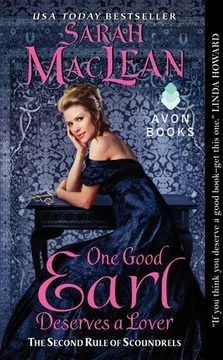
Reviews for One Good Earl Deserves a Lover are predominantly enthusiastic, averaging 4.02/5 stars. Most readers adore Pippa, the bespectacled, scientifically-minded heroine who propositions the brooding Cross to educate her about carnal matters before her marriage. Fans praise the slow-burning sexual tension, witty dialogue, and a particularly memorable seduction scene. Critics, however, find Pippa's persistence annoying, Cross's self-flagellation exhausting, and the premise unbelievable. Nearly all readers agree Pippa is the story's standout element, with many calling her one of historical romance's best heroines.
People Also Read
Characters
Philippa Marbury
The daring bluestockingPippa is the scientifically curious daughter of the Marquess of Needham and Dolby, known in her family and society for being unusual. She studies anatomy, horticulture, mathematics, and anything else that promises a clear answer, often using exact language where others would rely on implication. Her candor is not a lack of feeling; it is her way of refusing to let fear or convention distort what she knows. Pippa is conscientious about promises and initially treats marriage as a duty she can prepare for through research. Her curiosity gradually forces her to distinguish information from understanding, and social obedience from a choice she can make for herself.
Jasper Arlesey, known as Cross
The guarded gaming lordCross is the brilliant, controlled owner of The Fallen Angel, a man whose public reputation suggests a rake and whose private habits are organized around work, calculation, and distance. He took the name Cross to keep his aristocratic identity and painful history at arm’s length. His instinct is to protect people by controlling risks, a strategy that makes him effective in a gaming hell and difficult in intimate relationships. He carries deep guilt about his family and believes that denying himself happiness is a form of atonement. Pippa1 unsettles him because she sees past his competence and engages the mind he has built his life around.
Lord Castleton
The decent intended groomCastleton is Pippa’s1 kind, somewhat awkward fiancé. He values her intelligence, enjoys dogs, and is willing to give her room to help manage his estate. Though he cannot match her quickness or kindle the desire she seeks, he does not punish her for recognizing that truth. His steadiness gives Pippa1 a genuine alternative to the danger surrounding Cross2, and his respect for her decisions prevents the broken engagement from becoming a contest of possession.
Digger Knight
The rival hellkeeperKnight owns a competing gaming hell and understands that information, debt, and reputation can be used as weapons. He is calculating beneath a coarse, jovial manner and uses Cross’s2 family loyalties to force a bargain. His relationship with Cross2 is tangled with old debts and a history neither man interprets in the same way. Knight treats his daughter’s6 future as leverage, revealing a paternal authority that values title and advantage over her wishes.
Lavinia Dunblade
Cross's estranged sisterLavinia is Cross’s2 younger sister, a peeress living with the consequences of family decisions and a marriage that leaves her vulnerable to debt. Proud and direct, she resists being treated as a helpless dependent, especially by the brother2 whose absence shaped her sense of abandonment. Her cane is part of her daily life, not a definition of her character. Lavinia’s anger gives Cross’s2 guilt a human voice and forces him to confront the difference between intending to protect family and actually being present for them.
Meghan Knight, called Maggie
The unwilling heiressMaggie is Digger Knight’s4 daughter, raised away from his gaming world and brought into the marriage negotiations as a means of gaining status. She is reserved but not passive, and she recognizes that her father’s4 ambitions do not necessarily reflect her own. Her position reveals the gendered bargain at the heart of the plot: a woman’s marriage can be treated as currency by men who claim authority over her future.
Sally Tasser
The knowing club workerSally is a prostitute who works at The Fallen Angel and helps Cross2 manage the women associated with the club. Experienced in reading men and protecting her own interests, she is neither a simple confidante nor a prop in Pippa’s1 education. She speaks frankly about the realities of her work and expects to be judged by her own choices. Her interactions with Pippa1 expose the difference between the respect Pippa1 intends and the condescension women in Sally’s position often encounter.
Temple
The formidable partnerTemple is a powerful partner in The Fallen Angel, physically imposing and capable of handling both a fight and the club’s complicated private arrangements. He is loyal to Cross2 but does not merely echo him, and he recognizes Pippa’s1 determination even when it creates danger. His access to the club’s hidden rooms and his willingness to assist the plan make him a practical ally, while his dry humor offers a counterweight to Cross’s2 relentless self-control.
Chase
The unseen information brokerChase founded The Fallen Angel and works through information, wagers, and connections among London’s powerful men. He often knows more than Cross2 would like, but his knowledge serves the club and its partners rather than mere gossip. He cautions Cross2 against underestimating Knight4 and later challenges Cross’s2 belief that separation is best for Pippa1. His quiet influence shows that the gaming hell’s power rests as much on intelligence and alliances as on money.
Penelope Marbury
Pippa's protective sisterPenelope is Pippa’s1 eldest sister and the wife of Michael Bourne11, a partner in The Fallen Angel. She is affectionate and protective, but her own experience of a love match makes her advice difficult for Pippa1 to accept at first. Penelope understands more about the club and its private world than their mother would approve, yet she does not try to force Pippa’s1 choices. Her marriage offers Pippa1 an example of a relationship that does not fit conventional expectations.
Michael Bourne
The formidable brother-in-lawBourne is Penelope’s10 husband, a wealthy and once notorious man who shares ownership of The Fallen Angel. He is protective of Pippa1 and expects Cross2 to take her safety seriously, but he also understands the risks of Knight’s4 influence. His devotion to Penelope10 complicates Pippa’s1 assumptions about marriage, demonstrating that a partnership can grow from a match that looked unlikely to outsiders.
Olivia Marbury
The confident youngest sisterOlivia is Pippa’s1 youngest sister, beautiful, socially adept, and openly delighted by her engagement to Viscount Tottenham. Her willingness to discuss kissing and courtship gives Pippa1 information her older relatives have avoided sharing. Olivia’s confidence can shade into self-absorption, but she is not ashamed of wanting pleasure or affection. Her impending marriage to a rising politician makes her the family’s most conventional success, even as her candidness helps Pippa1 question what a bride is expected to know.
Baine Arlesey
The exemplary elder brotherBaine is Cross’s2 older brother and the model heir against whom their family measured the younger son. Responsible and respected, he represents the life Cross2 believes he failed to honor. His presence in Cross’s2 memories is inseparable from the demands of inheritance and family duty.
Trotula
Pippa's loyal spanielTrotula is Pippa’s1 beloved spaniel and constant companion. She follows Pippa1 into awkward and dangerous situations, responds warmly to Cross2, and provides Pippa1 with uncomplicated affection in a world full of social rules and difficult decisions.
Plot Devices
Wagers and weighted dice
Risk with loaded termsGames at The Fallen Angel turn probability into both entertainment and leverage. Cross2 uses a dice wager to make Pippa1 accept a limit on her investigations, then secretly weights the dice to control the result. Pippa’s1 training in mathematics lets her detect the pattern and later recognize how easily the club’s games can be manipulated. The device links the romance to its central question of consent: a wager is not fair merely because both people appear to agree when one party controls the rules and the evidence.
The secret passageways
Escape through hidden wallsCross2 designed concealed routes throughout The Fallen Angel so its owners could move unseen or escape danger. Pippa1 first encounters one when Temple8 guides her through the club, then discovers another after Cross2 locks her in a private room. The passage lets her reach Cross’s2 office and encounter the family conflict he had kept from her. Its practical purpose becomes an image of the story’s larger movement: Pippa1 repeatedly refuses the role of a person who must wait behind a locked door until someone else decides she is safe.
Pandemonium
A night of open doorsOnce a year, The Fallen Angel admits outsiders for a night of gambling and spectacle. Cross2 plans to use the event to draw Knight’s4 most valuable players away from their usual club and demonstrate his control over the market. Pippa’s1 invitation brings her into the same room as Cross2, Knight4, and the men whose wagers can threaten Knight’s4 solvency. The event shifts the conflict from private bargaining to public action, giving Pippa1 a crowded stage on which both desire and reputation become impossible to hide.
Pippa's scientific journal
A mind in the marginsPippa1 records observations about plants, animals, anatomy, and her own experiences in a private journal. Its entries frame her doubts about marriage and show how she turns unfamiliar feelings into questions she can examine. The journal’s precise manner contrasts with the uncertainty of desire, which cannot always be isolated or measured. It also tracks Pippa’s1 intellectual life beyond romance: her experiments with roses matter on their own, and her ambition to share that work remains part of the future she wants.
Reputation and engagement
Society's narrow choicesPippa’s1 impending marriage to Castleton3 and Cross’s2 public identity as a rake make reputation a tangible source of pressure. Knight4 knows that evidence of Pippa1 at a gaming hell could damage her prospects and uses that threat to coerce Cross2. Engagements also shape what each character believes can be changed: Pippa1 initially treats her promise as binding, while Cross2 accepts a marriage he does not want as a form of protection. The device makes the lovers’ choices costly, rather than allowing desire alone to resolve their conflict.
About the Author

Download PDF
Download EPUB
.epub digital book format is ideal for reading ebooks on phones, tablets, and e-readers.








