

Key Takeaways
Use options to define risk and shape exposure, not to manufacture an edge.
A contract, not ownership. An option gives its buyer the right, but not the obligation, to buy or sell an asset at a set price before a deadline. A call provides the right to buy; a put provides the right to sell. Buying an option limits the loss to the premium paid, while selling an unhedged option can expose the seller to very large losses. Options can also provide leverage, protection for stock holdings, or strategies that profit from volatility or a price staying within a range.
Structure is not advantage. The authors recount trading Apple during a rise from about $390 to $700 in 2012, using call options instead of purchasing the shares outright. They report a 51% return on their trading capital. The example shows how options can amplify a well-timed position, not that leverage itself predicts success. The book’s central claim is that position size, trade selection, and loss control matter more than the instrument.
With an out-of-the-money option, predict direction, distance, and deadline.
Being right is not enough. An out-of-the-money option has no intrinsic value: the stock has not yet reached the strike price that would make the option worth exercising. Its price depends largely on the possibility of a sufficiently large move before expiration. The trader must get the direction, size, and timing of that move right, while also overcoming time decay and any volatility premium.
Choose the easier bet carefully. An in-the-money option already has intrinsic value, so its price generally tracks the stock more closely. The book presents this as a simpler way to trade a directional view: less of the option’s price depends on time and expected volatility. The trade-off is a higher purchase price. Far out-of-the-money options are cheaper, but low-cost contracts can behave like lottery tickets when the needed move is improbable.
Use the Greeks to see what can move your option besides the stock.
Five changing exposures. The Greeks describe how an option price may react to different forces. Theta estimates time decay, which speeds up as expiration approaches. Delta estimates price sensitivity to the underlying stock; it is also used as a rough guide to the chance of expiring in the money, but it is not a guaranteed probability. Vega measures sensitivity to changing volatility. Gamma measures how quickly Delta changes. Rho measures sensitivity to interest rates, which the book treats as less important in its trading examples.
Events alter the equation. Before earnings, an option can carry extra value because a large move is expected. If the event passes and the move is smaller than priced in, that volatility premium can fall sharply, even when the stock moved in the predicted direction. A useful check is to ask whether the expected move can overcome both time decay and the price of expected volatility.
Check the bid-ask spread before judging whether a trade is profitable.
Liquidity has a price. The bid-ask spread is the gap between the price buyers offer and sellers request. Entering and exiting a thinly traded option can consume a meaningful part of the position before the stock moves at all. The book favors heavily traded stocks and funds, near-the-money strikes, and expirations with active markets, where spreads tend to be narrower.
Small gaps add up. One contract usually represents 100 shares. A spread of $0.10 per share therefore creates about $10 of friction on entry and another $10 on exit, before commissions. At a $1 spread, that round trip can cost roughly $200 per contract. A winning forecast may still produce a poor result if the contract is costly to trade, or if liquidity deteriorates as the option moves deep in the money.
Size each option position so a total loss stays survivable.
Leverage magnifies mistakes. The book recommends risking no more than 1% of trading capital on a single option trade. For an account of $30,000, that means limiting the amount at risk to about $300. An option bought for that amount can expire worthless, so the cap should reflect the full premium at risk, not a hoped-for stop price.
Plan the exit around the stock. Options can move too quickly for a stop based only on the contract’s price to work as intended. The authors suggest using important levels on the underlying stock chart to decide when the original trade idea has failed. This rule does not make a strategy profitable; it limits the damage when a forecast is wrong. Small, repeatable losses leave a trader better able to withstand losing streaks and keep following a tested plan.
Hedge short options before a market surge turns small income into ruin.
Premium comes with obligations. An option seller receives money upfront but takes on the contract’s other side. If the position moves against the seller, closing it can cost much more than the initial premium. The book warns especially against naked options, which lack a protective position and can carry extreme risk. A short put can lose heavily if the stock collapses; a short call can face theoretically unlimited losses if the stock keeps rising.
A spread sets a ceiling. In the book’s example, a trader sells a $100 call for $3 and buys a $105 call for $1. The net credit is $2 per share, or $200 per contract. The farther-out call limits the maximum loss to $300 per contract, before costs. The hedge reduces the potential reward, but it also replaces an open-ended risk with a defined worst case.
Treat weekly options as deadlines, not cheap lottery tickets.
A short clock changes the bet. Weekly options expire quickly, leaving little time for a forecast to work. The authors favor using them for short-term trades in liquid, in-the-money contracts, where the position behaves more like a leveraged stock substitute. Buying a far-out-of-the-money weekly option may seem inexpensive, but the stock must make a sufficiently large move within just a few days or the contract can expire worthless.
Keep size familiar. The book advises using roughly the same exposure as in a comparable stock trade. Someone accustomed to trading 100 shares should not leap to ten option contracts simply because each contract costs less than the shares it represents. A winning streak can make short-dated leverage feel deceptively safe. The option’s limited premium does not prevent repeated oversized losses from draining an account.
Lock in option gains before expiration erodes a winning trend.
A winner still has a clock. Options do not have to be held until expiration to produce a profit. When a directional option rises substantially, the book recommends considering a sale and, if the trend still looks attractive, buying a new contract with a strike closer to the current price or a later expiration. This process is called rolling. It can secure gains while maintaining some exposure to the trend.
Re-entry is a new risk. The authors describe selling an appreciated contract and using part of the proceeds for a replacement option, rather than letting a large open gain remain exposed to a reversal. They favor doing this when liquidity is good and warn against treating the next contract as risk-free simply because the earlier trade won. A roll involves a new purchase, new costs, and a fresh chance of loss.
A high option-selling win rate does not prove a profitable edge.
Expiration statistics mislead. The book challenges the claim that sellers win because 90% of options expire worthless. It cites figures that about 10% of contracts are exercised and roughly 55% to 60% are closed before expiration. Those figures do not reveal whether the early closures made money; a contract can be bought back at a profit or at a loss. The authors estimate that about 30% to 35% expire worthless, but that still does not establish which side earns more.
Measure the whole trade. A seller may collect many small gains and then face a large loss during a sharp move. A buyer may lose many small premiums while occasionally capturing a large move. The relevant comparison is net profit after losses, trading costs, and risk, not the percentage of trades that appear to win. The book’s practical test is whether a trader has a repeatable advantage and controls the size of losing trades.
Recognize that covered calls exchange some upside for premium.
The trade has two sides. A covered call pairs stock ownership with a call sold against those shares. The seller keeps the premium, but may have to sell the shares at the strike price if the stock rises beyond it. The book stresses the downside in a falling market: the premium may be small compared with the stock’s losses, while the call can limit gains if the stock later rebounds or continues climbing.
Judge the exchange, not the label. The authors oppose covered calls as a default strategy because they can cap strong gains while leaving much of the stock’s downside intact. That critique highlights the payoff shape, but does not make the strategy inherently wrong for every investor. A covered call deliberately trades away some upside for premium income. Whether that is worthwhile depends on the investor’s goals, the strike, the premium, and the risk of holding the shares.
Analysis
The book’s most useful contribution is not a menu of clever option structures. It is a repeated insistence that an option is a time-limited exposure whose apparent cheapness can hide several simultaneous risks. A trader may be directionally correct and still lose because the move arrives too late, is too small, or fails to compensate for a decline in expected volatility. That is the book’s strongest mental model: every option position is a forecast about more than price.
Its examples also reveal a tension in how leverage is presented. The Apple story makes capital efficiency vivid, while the repeated warnings about position size acknowledge that leverage can turn efficiency into fragility. Limited loss on a purchased contract is valuable, but it does not make the trade low-risk if the trader repeatedly spends too much on contracts that expire worthless. Similarly, a strategy that wins often can remain dangerous if occasional losses are much larger than its gains.
Some claims need careful interpretation. Delta is a useful sensitivity estimate and a rough probability proxy, not a promise about an option’s final outcome. A high percentage of worthless expirations cannot by itself prove that selling options is profitable, just as a high win rate cannot show whether gains exceed losses. The book is right to redirect attention toward the full distribution of outcomes, but its own numerical guidance, including the 1% sizing rule, should be treated as a proposed discipline rather than a universal law.
The practical value of the guide is therefore strongest as a checklist for learning: understand the contract, identify the exposure, inspect liquidity, define the worst case, and practice before committing meaningful capital. Its strategies are starting points, not evidence of a durable trading edge. That distinction keeps the book’s central lesson intact: options can tailor risk, but no contract can substitute for a sound process.
Review Summary
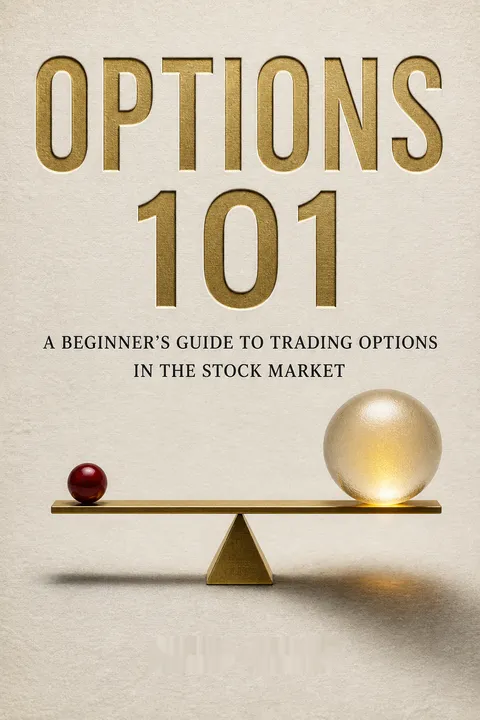
Options 101 receives an overall rating of 3.88 out of 5 across 93 reviews. Readers generally appreciate its concise, straightforward approach to explaining option basics. One reviewer recommends it specifically for midterm traders, while others highlight its value for beginners. The book is praised for its quick, to-the-point style, with readers noting they absorb best practices efficiently. It is particularly recommended for new option traders, especially option buyers, with reviewers appreciating its clear and brief explanations.
People Also Read




Glossary
Option
time-limited trading contractA contract giving its buyer the right, but not the obligation, to buy or sell an underlying asset at a specified strike price by a specified expiration date. A call gives the right to buy; a put gives the right to sell. The buyer’s maximum loss is generally the premium paid, while a seller accepts the contract’s obligations.
The Greeks
option price sensitivitiesA group of measures describing how an option’s price may respond to changes in time, the underlying asset’s price, volatility, and interest rates. The book discusses Theta, Delta, Vega, Gamma, and Rho. These measures help traders identify exposures, but they are estimates that change as market conditions and the option itself change.
Theta
sensitivity to passing timeTheta estimates how much an option’s value may decline as time passes, all else being equal. Options lose time value as expiration approaches, and the book emphasizes that this erosion can accelerate in the final weeks and days. Theta is especially important for buyers, who need the underlying asset to move enough before the contract expires.
Delta
price sensitivity to the assetDelta estimates how much an option’s price may change for a one-unit move in the underlying asset. Call Delta is positive and put Delta is negative. The book also treats Delta as a rough indication of the chance of expiring in the money, but it is not a guaranteed probability or a fixed value.
Vega
sensitivity to volatilityVega estimates how much an option’s price may change when implied volatility changes. Higher expected volatility can make options more expensive, while falling volatility can reduce their value. The book uses earnings as an example: a volatility premium may disappear after the announcement, even if the stock moves in the predicted direction.
Gamma
rate of Delta changeGamma estimates how much an option’s Delta changes when the underlying asset moves. It can cause an option’s exposure to the stock to grow or shrink as the price approaches or moves away from the strike. The book describes gamma scalping as buying low-Delta options in hopes that a favorable move increases Delta and the option’s value.
Rho
sensitivity to interest ratesRho estimates how an option’s price may respond to a change in interest rates. The book includes it among the Greeks but gives it less practical emphasis than Theta, Delta, Vega, and Gamma, noting that it was often less influential in the low-rate environment discussed in the text.
Iron Condor
hedged range-bound options tradeAn options position built by selling an out-of-the-money call and put while buying farther-out-of-the-money options to limit risk. The intended profit comes when the underlying asset stays within a chosen range through expiration. The book stresses that the position still requires monitoring because a strong move toward a protective strike can threaten the trade.
Credit Spread
premium sale with a hedgeA position that sells one option and buys another option with the same expiration but a farther strike, collecting a net credit at entry. The long option limits the short option’s potential loss. In the book’s example, a trader sells a $100 call and buys a $105 call, reducing the maximum risk in exchange for limiting the possible profit.
Implied volatility
market-priced expected movementThe volatility reflected in an option’s market price. It represents the market’s expectation of how much the underlying asset may move over the option’s remaining life, including uncertainty around events such as earnings. When the event passes, this expected-volatility component can fall, reducing the option’s price independently of the stock’s direction.
Rolling
replacing an option positionClosing an existing option position and opening a new one, often with a different strike price or expiration date. The book presents rolling a profitable directional option as a way to secure gains while keeping some exposure to a continuing trend. The replacement contract is a new trade with its own cost, risks, and expiration.
Weekly options
options with near-term expirationOptions that expire within a short period, often within the same week. Their limited lifespan can make them useful for short-term trading, but leaves little time for the underlying asset to move as expected. The book warns against buying far-out-of-the-money weeklies as lottery-like bets or selling them without a hedge.
About the Author
Other books by Steve Burns



Download PDF
Download EPUB
.epub digital book format is ideal for reading ebooks on phones, tablets, and e-readers.








