

Key Takeaways
Treat schools as engines that make racial hierarchy, not neutral ladders out of it
School helps build race. Eve Ewing argues that race is not a biological fact but a political system continually made and maintained. She calls its sorting machinery the “Race Machine ”: it reduces people’s varied histories and identities to categories that carry unequal power. Schools are among the places where this sorting becomes ordinary, shaping children’s ideas about who is intelligent, troublesome, or suited to lead.
Two foundations endure. The book traces that machinery to Indigenous dispossession and African chattel slavery, the “original sins” that helped form the nation. Thomas Jefferson’s writings show how education and racial hierarchy were linked from the republic’s beginnings: he proposed schooling for selected White boys while arguing that Black people were intellectually inferior and Native people destined to disappear. Schools, Ewing contends, do not merely reflect society’s racial order. They help reproduce it.
The useful shift here is from asking whether a school is fair in isolation to asking what social order its routines help reproduce. That is a systems question: categories become durable when many institutions repeat them, even without a single designer directing the whole process. The metaphor of a machine makes those connections visible. Its risk is implying a seamless, all-powerful system. The book’s own histories show conflict, adaptation, and resistance, so the machine is better understood as powerful but continually contested.
Ask whose citizenship each school system was built to produce
School had different assignments. For White children, schooling often aimed to create a unified citizenry. As European immigrant groups arrived, schools encouraged them to adopt dominant language and customs. The Pledge of Allegiance, school lunches, kindergartens, and organized playgrounds all gained traction partly as tools of Americanization. The boundaries of Whiteness expanded, and schools helped newcomers cross them by teaching a common national identity.
Other children faced other purposes. During Reconstruction, Black communities fought for education, yet many White-led programs treated schooling as a way to “civilize” freedpeople and prepare them for controlled labor. Native schooling pursued a more explicitly eliminative goal: breaking Indigenous ties to language, family, and nation. These histories are not interchangeable, Ewing stresses. Native peoples are also sovereign nations facing ongoing colonization, not simply another racial minority.
This comparison makes assimilation look less like a universal school mission than a selective offer of belonging. Some groups were pressured to join the national story; others were denied full citizenship or targeted for erasure. That distinction helps explain why a policy described as “common” can have sharply unequal effects. The account also invites care with broad categories: immigrant histories differed, and Black and Native experiences cannot be collapsed into one template. A useful test for any reform is who gets to define belonging, and on what terms.
Question benevolence when help demands obedience, labor, or cultural erasure
Good intentions can govern. After emancipation, some teachers and aid societies described their work as rescuing Black people from ignorance and vice. Textbooks urged freedpeople to be patient, industrious, and forgiving, even toward former enslavers. The Hampton Institute trained Black teachers for manual labor, while its founder argued that Black political power was dangerous. Education could offer real opportunity, but its charitable language often concealed a demand for social compliance.
For Native children, force was explicit. General Richard Henry Pratt turned Fort Marion, a prison for Native men, into a school organized around military discipline and surveillance. He went on to found Carlisle, where children were renamed, had their hair cut, and were sent to work for White families. Students resisted in many ways, including running away and keeping their languages alive. Ewing’s point is not that every educator shared one motive, but that benevolence can serve coercive institutions.
The distinction between stated motive and institutional effect is crucial. A caring individual can still work inside a system that takes control of children’s bodies, labor, or cultural identity. This resembles a broader problem in public policy: judging a program by good intentions can obscure who holds power and who bears the cost. The histories also caution against flattening all educators into villains. Individual care mattered, but it could not by itself undo structures designed around assimilation and control.
Interrogate the test before treating its score as a child’s capacity
Testing inherited a hierarchy. Early race scientists used skull measurements and statistics to claim that Black and Native people were naturally inferior. Alfred Binet designed tests to identify children who needed help, not to establish fixed intellectual worth. Lewis Terman adapted Binet’s work for mass classification, while eugenicists used results to sort people into supposedly fit and unfit groups. During World War I, Army Alpha and Beta tests were given to more than 1.7 million people, including recruits asked questions about unfamiliar books, cars, and farming terms.
The numbers traveled. Carl Brigham helped turn military testing into the SAT, then later rejected racial comparisons based on his own tests. Yet the idea that scores reveal innate ability persisted. Ewing notes that test items can reflect unequal experience, and that some SAT trial questions were discarded when Black students outperformed White students.
A score is not a transparent window into ability. It is an inference built from selected tasks, conditions, and comparison groups. That distinction matters whenever measurements allocate opportunities, because institutions can mistake consistency for neutrality. At the same time, rejecting a biased test does not mean abandoning assessment altogether. Schools still need ways to notice learning needs and provide support. The more defensible response is to ask what a measure captures, what it misses, and whether its consequences are proportionate to its limits.
Make room for knowledge that tests and official records cannot count
Intelligence depends on what counts. Ewing argues that standardized tests privilege narrow, culturally specific forms of knowledge while presenting them as universal. In one study she describes, Pueblo elders understood giftedness partly as generosity, endurance, and using one’s abilities for the community. None of the school’s 560 students had been formally identified as gifted. A Diné specialist, meanwhile, challenged a deficit assessment by pointing out that a boy could expertly butcher a sheep, knowledge the school’s measures had overlooked.
Absence can be manufactured. Native students often appear as an asterisk in education data because samples are judged too small. Ewing calls attention to the consequences: if a community cannot be counted, its needs can vanish from policy discussions. She also points to community-based learning, where students and teachers learn together and knowledge is evaluated through relationships and contribution, not scores alone.
This argument reaches beyond curriculum into the politics of evidence. Every measure defines what becomes visible, and visibility influences which problems institutions recognize. Community knowledge is not merely an enriching addition to an otherwise complete system; it can challenge the system’s definition of competence. Still, celebrating local knowledge should not require romanticizing any community as internally uniform. The stronger approach is plural standards of evidence, examined openly, with learners’ own contexts treated as sources of insight rather than noise.
Replace reflexive punishment with responses that restore agency and safety
Prison logic enters school. Ewing calls the “school-prison nexus” the web of policies and assumptions linking education with incarceration. A school may reproduce prison-like control without a jail inside it: surveillance, rigid movement rules, removal from class, and the presumption that some children are inherently dangerous. She recounts offering students a poetry-film field trip as an alternative to visiting Cook County Jail. Those who chose the jail returned distressed; one student confided that her father was incarcerated there.
Exclusion teaches a lesson. Suspension and expulsion remove students from learning, and Black and Native students experience them disproportionately. Ewing frames exclusion as a small-scale form of disappearance: the institution removes a child rather than addressing the conditions behind the conflict. She contrasts punishment with Indigenous justice traditions that emphasize restitution and restoring relationships, while warning that replacing suspension with a new technique is not enough if the underlying reliance on punishment remains.
The field-trip story shows why safety cannot be measured only by whether a student follows rules. An intervention can be orderly for adults and harmful for children. Restorative approaches offer a different starting point: identify the harm, hear those affected, and seek repair without reducing a young person to a permanent threat. Such practices require time, trust, and safeguards; they are not a cure-all. Their value lies in widening the options beyond removal and retaliation.
Measure educational promise against inherited wealth, not diplomas alone
Degrees do not erase accumulated advantage. The typical White family holds about eight times the wealth of the typical Black family. Even among households led by college graduates, median White wealth is more than three times median Black wealth. A degree can improve opportunity, but it does not cancel differences in family support, inherited assets, employment discrimination, or the value assigned to neighborhoods.
The playing field is materially uneven. In one hiring study, equally qualified Black men were half as likely as White men to receive a job offer. Homes in majority-Black neighborhoods have also been valued lower than comparable homes elsewhere. Such disparities affect what families can invest in education and what they can pass on. Ewing argues that educational fairness cannot be judged only by school access or graduation rates; it must also be judged by the economic outcomes students inherit and encounter.
The focus on wealth corrects a common analytical mistake: treating education as if it starts each student at the same financial baseline. Wealth can absorb shocks and fund choices that income or credentials alone cannot. This does not make education irrelevant; it clarifies why schooling cannot shoulder the whole burden of equalizing society. Evaluations of education should therefore track both learning and material outcomes, while recognizing that neither a diploma nor a single mobility statistic fully describes a person’s possibilities.
Challenge the labor roles schools quietly assign by race
Schooling can sort workers. Ewing connects vocational tracking to racial capitalism, the idea that capitalism has historically relied on racialized extraction and unequal access to wealth. Black and Native students have been steered away from advanced courses and toward lower-wage work. In the post-emancipation South, some officials explicitly designed schools to keep Black children near plantation labor. Native boarding schools taught manual work and sent students to labor for White households and farms.
The university story continues the pattern. The Morrill Act helped establish land-grant universities using nearly eleven million acres taken from Native nations. Those institutions generated opportunity for generations of students, while Native enrollment remains very low. The book asks readers to see both sides of the promise of education: schools can open doors, but they can also direct some students toward leadership and others toward service, while wealth built through dispossession sustains the institution itself.
The phrase “somebody’s got to mow the lawn” captures how economic hierarchy can be presented as natural rather than chosen. Schools help make that order feel earned when tracking distributes different curricula and expectations. Yet not every flexible instructional group is a permanent track; targeted support can help when students move freely as needs change. The key distinction is whether grouping expands access or quietly fixes a student’s future role.
Build learning through care, sovereignty, and relationships across difference
A different education must be made. Ewing rejects the idea that better techniques alone can repair institutions shaped by racial domination. She brings abolition, which means building alternatives to systems organized around punishment, into conversation with Land Back, which calls for Indigenous sovereignty and renewed relationships with land. Both demand more than symbolic gestures: they ask who controls resources, knowledge, and the conditions of learning.
Braiding offers a model. A braid keeps distinct strands connected through attention and mutual dependence. Ewing uses it to imagine teaching grounded in care, shared knowledge, and accountability. Black and Native solidarity, she argues, is not automatic: the histories are connected but not identical, and communities have also harmed one another. Solidarity is built through ongoing choices, honest engagement with conflict, and practices that support people’s daily lives.
The braid is compelling because it refuses two easy answers: forced sameness and isolated struggle. It suggests that durable cooperation requires distinct identities to remain visible while people work in relation. That principle can guide institutional design as well as personal alliance: share authority, make care material, and allow communities to define what learning serves. The challenge is scale. Intimate practices cannot substitute for changes to land, funding, or governance, but they can shape how those changes are pursued.
Analysis
Original Sins is a history of schooling, but its deeper subject is how a nation makes its preferred social order seem educationally reasonable. Its central argument moves through three linked claims: schools help construct racial categories, convert those categories into expectations about intelligence and conduct, and direct people toward unequal positions in the economy. The argument gains force by repeatedly joining an official ideal to its institutional history. Public education promises citizenship and mobility, while particular practices have cultivated assimilation for some, labor discipline for others, and Indigenous erasure for still others.
The book’s strongest method is to connect large structures to ordinary school life. The Pledge, lunchroom, playground, test, haircut, classroom rule, and field trip become evidence of how political assumptions enter children’s routines. Archival voices and personal stories make these mechanisms concrete without treating present-day harm as a simple survival of old language. The result is a history of continuity through changing forms, not a claim that every teacher or school acts with identical intent.
That distinction also matters for reading the book critically. Its three-part account of inferiority, punishment, and economic subjugation is a persuasive organizing map, but the categories overlap: testing can discipline, tracking can shape economic outcomes, and cultural erasure can occur through both curriculum and data practices. The book’s descriptive ambition is therefore broader than a single causal model. It is most convincing when it shows how institutional arrangements compound, rather than suggesting that any one school practice explains a population’s outcomes.
The conclusion offers a political ethic rather than a policy checklist. Care, abolition, Land Back, and braiding ask readers to imagine education beyond the familiar school’s assumptions about ownership, authority, and knowledge. This vision does not resolve every practical conflict between universal public provision and Indigenous sovereignty. It does, however, set a demanding standard: reform must alter who decides, whose knowledge counts, and who benefits, not merely make the existing system more efficient.
Review Summary
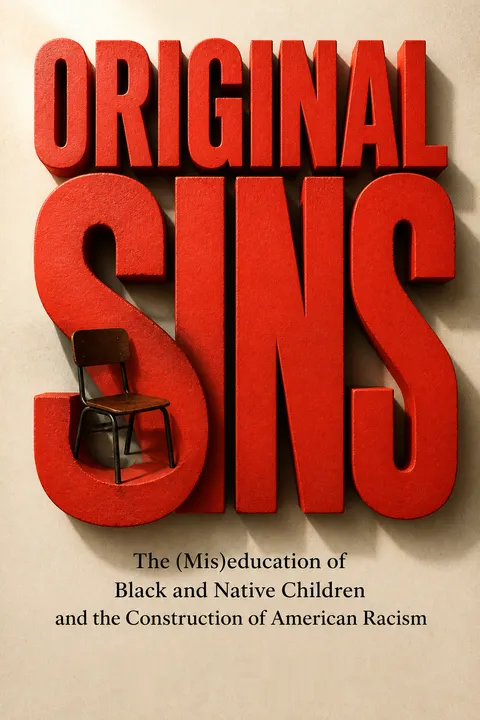
Original Sins by Eve L. Ewing is a powerful examination of how the American education system perpetuates racism against Black and Native children. Ewing argues that schools were designed to reinforce white supremacy, not to provide equal opportunities. The book covers the history of racist educational practices, from Indian boarding schools to modern disciplinary policies. Reviewers praise Ewing's thorough research, accessible writing, and compelling arguments. While some found the content difficult to digest, many consider it essential reading for educators and anyone interested in understanding systemic racism in education.
People Also Read





Glossary
Race Machine
racial sorting systemEwing’s metaphor for the social processes that classify people into racial categories and attach unequal power to those categories. The machine turns human complexity into simplified group labels. Schools are one place where its categories and expectations become familiar, shaping how people interpret identity, ability, behavior, and belonging.
racial formation
making and remaking raceThe historical process through which racial identities are created, experienced, changed, and sometimes dismantled. In the book, racial categories are neither timeless nor biologically fixed. They are produced through laws, institutions, social meanings, and resistance, with schools helping transmit and normalize their consequences.
settler colonialism
colonization that replaces inhabitantsA form of colonization that seeks to displace or eliminate the original inhabitants while establishing a new society on their land. Ewing uses the concept to explain why Indigenous disappearance is not merely a past event: policies, institutions, and stories can continue to undermine Native sovereignty, relationships to land, and cultural continuity.
Gospel of intellectual inferiority
myth of unequal innate intelligenceEwing’s name for the recurring belief that Black and Native people are inherently less intellectually capable than White people. The book traces this belief from racial pseudoscience into intelligence testing, school expectations, and measures of giftedness, showing how apparently objective judgments can carry older assumptions into contemporary institutions.
school-prison nexus
school and prison entanglementThe network of historical, institutional, and everyday connections between schools and prisons. It includes more than physical features such as police or metal detectors. Surveillance, exclusion, strict bodily control, and assumptions about dangerousness can bring carceral practices into school life even when a student is never incarcerated.
carceral logics
punishment as social controlAssumptions that safety and social order are best achieved through surveillance, containment, weapons, and punishment. In schools, these assumptions can make exclusion seem like the natural response to conflict and can treat certain children as inherently troublesome. Ewing contrasts this reflex with approaches centered on care, repair, and restored relationships.
racial capitalism
capitalism organized through racial hierarchyThe idea that capitalism has developed through racialized systems of dispossession, exploitation, and unequal access to wealth. In Ewing’s account, slavery and the seizure of Indigenous land helped generate American prosperity, while schools have helped normalize unequal labor roles and opportunities as if they reflected individual merit.
survivance
active presence despite erasureA term associated with Chippewa scholar Gerald Vizenor that joins survival with resistance and continuing presence. Ewing uses it to describe people sustaining stories, relationships, and cultural practices despite efforts to erase them. Survivance emphasizes not only what communities endure, but also their ongoing agency and capacity to create.
FAQ
1. What is Original Sins: The (Mis)education of Black and Native Children and the Construction of American Racism by Eve L. Ewing about?
- Central argument: The book explores how American education systems have historically constructed and perpetuated racism, focusing on the (mis)education of Black and Native children.
- Historical context: Ewing traces the roots of American racism to two "original sins": Indigenous genocide and chattel slavery, showing how these foundational violences shaped schools and society.
- Interconnected oppression: The book highlights the entangled histories and experiences of Black and Native peoples, arguing that their educational and social outcomes are shaped by overlapping systems of oppression.
- Schools as sites of control: Ewing demonstrates that schools have functioned as instruments of social control, discipline, and erasure, embedding carceral logics and racial capitalism into educational practices.
2. Why should I read Original Sins by Eve L. Ewing?
- Transformative perspective: The book challenges common assumptions about race and schooling in America, offering a critical lens on how education perpetuates systemic racism.
- Historical and contemporary relevance: Ewing connects past injustices to present-day issues like the school-to-prison pipeline, racialized discipline, and wealth inequality.
- Intersectional approach: The work bridges Black and Native studies, emphasizing solidarity and shared struggle while respecting distinct histories.
- Vision for change: Ewing offers hopeful frameworks for abolitionist teaching and educational transformation rooted in care, community, and justice.
3. What are the key takeaways from Original Sins by Eve L. Ewing?
- Education is not neutral: Schools have actively constructed and maintained racial hierarchies, rather than serving as equalizers.
- Three pillars of racism: The book identifies intellectual inferiority, discipline and punishment, and economic subjugation as core ideas cultivated in schools to govern Black and Native children.
- Carceral logics in education: Ewing details how punitive, prison-like practices are embedded in schools, disproportionately affecting marginalized students.
- Call for abolition and care: The book advocates for educational systems grounded in care, relationality, and liberation, moving beyond reform to systemic transformation.
4. What are the "original sins" discussed in Original Sins by Eve L. Ewing?
- Definition and significance: Ewing uses "original sins" to describe the foundational violences of Indigenous genocide and chattel slavery that shaped American society and education.
- Moral and structural impact: These sins are not just historical acts but ongoing structures that create and justify racial hierarchies and dehumanization.
- Enduring legacy: The afterlives of these original sins continue to shape institutions, including schools, through persistent inequalities and exclusion.
- Role of schools: Educational systems have played a central role in furthering these original sins by shaping identities, norms, and access to power.
5. How does Eve L. Ewing define and critique the "Race Machine" in Original Sins?
- Metaphor for racial sorting: The "Race Machine" is a metaphor for how society sorts people into racial categories, assigning social meaning and hierarchy.
- Social construction of race: Ewing emphasizes that race is not biological but constructed and maintained by institutions, especially schools.
- Racism as technology: Racism operates as a technology that powers the Race Machine, systematically upholding hierarchies that benefit those in power.
- Impact on children: Schools serve as laboratories for the Race Machine, embedding racial identities and inequalities from an early age.
6. What are the three pillars of American racism cultivated in schools, according to Original Sins by Eve L. Ewing?
- Intellectual inferiority: The belief that Black and Native people are inherently less intelligent, used to justify unequal opportunities and outcomes.
- Discipline and punishment: The idea that Black and Native bodies require heightened control, leading to disproportionate discipline and carceral practices in schools.
- Economic subjugation: The notion that Black and Native people are destined for specific labor roles, denying them agency over their economic futures.
- Active construction: These pillars are not just reflections of society but are actively constructed and normalized within educational institutions.
7. How does Original Sins by Eve L. Ewing explain the historical purposes of schools for White, Black, and Native children?
- Schools for White children: Designed to create unified citizens of a White republic, assimilating European immigrants into a cohesive White identity.
- Schools for Black children: Functioned as instruments of social control, promoting obedience and preparation for subservient labor rather than leadership or full citizenship.
- Schools for Native children: Aimed at forced assimilation and cultural erasure, often through boarding schools and military-like discipline.
- Ideological underpinnings: These differentiated purposes reflect the racial hierarchies established by early American leaders and perpetuated through policy.
8. What is the "gospel of intellectual inferiority" in Original Sins by Eve L. Ewing?
- Definition: The pervasive ideology that Black and Native people are innately less intelligent than White people, shaping assumptions about achievement and potential.
- Historical roots: This belief was legitimized by 19th and 20th-century scientific racism, including craniometry and eugenics.
- Contemporary impact: The ideology persists through biased testing, underrepresentation in gifted programs, and low teacher expectations.
- Epistemic harm: It delegitimizes Black and Native ways of knowing, reinforcing a narrow, White-centric definition of intelligence.
9. How does Eve L. Ewing critique standardized testing and IQ tests in Original Sins?
- Cultural bias: Standardized and IQ tests often rely on culturally specific knowledge, disadvantaging Black, Native, and immigrant students.
- Roots in scientific racism: These tests were originally designed to justify racial hierarchies and social control, not to objectively measure intelligence.
- Perpetuation of inequality: Despite critiques, such tests remain central to educational policy, influencing tracking and access to opportunities.
- Call for epistemic diversity: Ewing advocates for recognizing multiple forms of intelligence, including Indigenous and Black epistemologies.
10. What is the "school-prison nexus" and how does Original Sins by Eve L. Ewing describe carceral logics in education?
- Definition of school-prison nexus: The intertwined relationship between schools and prisons, where punitive and carceral logics are embedded in school policies and practices.
- Carceral logics explained: These are beliefs and practices rooted in the prison system—surveillance, containment, punishment—applied within educational settings.
- Impact on students: Black and Native children are disproportionately disciplined, criminalized, and excluded, echoing historical patterns of control.
- Normalization of control: Carceral logics make harsh discipline seem necessary and inevitable, limiting imagination for care-based alternatives.
11. How does Original Sins by Eve L. Ewing connect wealth, land, and racial capitalism to educational inequality?
- Wealth as racism indicator: Wealth disparities reflect the long-term impact of systemic racism, with White families holding significantly more wealth than Black and Native families.
- Historical roots: The accumulation of White wealth is tied to the exploitation of enslaved Black people and the dispossession of Native lands.
- Land-grant universities: Institutions of higher education benefited from stolen Indigenous lands, embedding settler colonialism into American education.
- Limits of education as equalizer: Schooling alone cannot close racial wealth gaps due to structural barriers in employment and wealth accumulation.
12. What alternative visions for education and social change does Eve L. Ewing propose in Original Sins?
- Abolitionist teaching: Ewing advocates for education rooted in abolitionist principles—solidarity, care, creativity, and healing—rejecting punitive approaches.
- Land Back and Indigenous sovereignty: She emphasizes restoring Indigenous relationships to land and knowledge as central to transformative education.
- Schools for us: The book calls for schools that celebrate Black and Indigenous languages, histories, and cultures, fostering love and community.
- Braiding metaphor: Ewing uses braiding as a metaphor for interconnectedness and resilience, encouraging collaborative, holistic approaches to teaching and learning.
Bonus: What are some of the best quotes from Original Sins by Eve L. Ewing and what do they mean?
- On original sin: “Leading scholarship considers [slavery] both America’s original sin and its foundational institution... But can we imagine an American Eden that is not cultivated by its original caretakers? Exiled from the American origin story, Indigenous peoples await the telling of a history that includes them.” This highlights the erasure of Indigenous genocide in dominant historical narratives.
- On race and power: “In our society dominant discourse tries never to speak its own name... White people are endowed with the privilege of believing that race is something other people are burdened with.” This underscores how Whiteness operates as an invisible norm sustaining supremacy.
- On intellectual production: “A ‘good’ book, a ‘smart’ person, or a ‘convincing’ intellectual is defined by their ability to smash their foes... But this view on intellectual production occludes the many other pathways through which we might make knowledge.” Ewing critiques competitive academic culture and advocates for collaborative knowledge-making.
Download PDF
Download EPUB
.epub digital book format is ideal for reading ebooks on phones, tablets, and e-readers.








