

Key Takeaways
Treat originality as a learnable choice, not a rare personality type
Originality becomes action. The book defines originality as introducing an idea that is unusual in its field and could make that field better. Creativity supplies the novel, useful idea; an original takes initiative to bring it into the world. This distinction matters because originality is not reserved for fearless geniuses. It is a way of responding to familiar problems with fresh eyes, then doing something about what those eyes reveal.
Warby Parker began when four students questioned why glasses cost so much and whether customers could buy them online. Friends said the idea would never work, but the founders tested it and launched anyway. Within a month, sales exceeded their first-year target. Their story frames the book’s central argument: change starts when people stop treating the existing arrangement as inevitable.
The distinction between inventing and advancing an idea keeps creativity from becoming a spectator sport. Novelty alone can be clever but useless; action without novelty can simply preserve familiar routines. The book’s definition asks for both usefulness and initiative, which makes originality practical rather than mystical. Its emphasis on choice is empowering, though not every person has equal access to time, money, authority, or safety. Treating originality as learnable should widen opportunity, not imply that structural barriers disappear when someone becomes more courageous.
Question the default before accepting the life it quietly assigns you
Defaults look natural. In a study of customer-service workers, people who used Firefox or Chrome stayed in their jobs 15 percent longer and missed work less often than people using the computers’ preinstalled browsers. The browser did not cause better performance. Choosing to change it signaled a willingness to question defaults and improve an unsatisfying situation. The book calls a fresh view of something familiar vuja de.
That same habit can expose the human choices hidden inside institutions. Warby Parker’s founders compared expensive glasses with a smartphone and asked why the simpler product cost more. At Google, a 90-minute workshop encouraged employees to treat job duties as flexible. Six weeks later, participants reported higher happiness and performance, and were 70 percent more likely than peers to gain a promotion or move into a desired role.
Defaults are powerful partly because they spare people the effort of reconsidering every choice. That convenience becomes costly when a default is mistaken for a law of nature. The browser example is memorable because the signal is tiny, but it should not be read as proof that a browser predicts an individual’s character. Its stronger use is as a prompt: where might a small act of initiative improve a larger pattern? The workplace examples also suggest that people often have more room to reshape a role than formal job descriptions imply.
Generate enough rough ideas to let one genuinely good idea emerge
Selection is the bottleneck. A review of more than 1,000 proposed products and ventures found that 87 percent were unique. The harder problem is recognizing which unusual ideas are promising. Creators often overrate their own work, while managers and test audiences can reject novelty because it does not resemble familiar successes. In research on circus acts, creators judging one another predicted audience response about twice as accurately as managers and test viewers.
Quantity improves the odds of finding something worth keeping. Shakespeare wrote 37 plays, including celebrated works and much less admired ones. At Upworthy, staff were encouraged to draft at least 25 headlines for a video because the first options tended to be conventional. The practical loop is to produce variations, share them with people who understand the craft, and use real audience response to refine the strongest candidates.
This approach treats creative work less like a lightning strike and more like a search process. More attempts create more chances to discover a strong direction, while outside feedback helps correct the creator’s inevitable attachment to a favorite. The choice of evaluator matters: distant managers may overvalue precedent, while peers can recognize craft and potential. Peer judgment is not infallible, and audiences can reward familiarity over long-term value. A robust process therefore uses feedback as evidence, not as a substitute for judgment.
Protect your experiments with safety nets instead of betting everything
Risk can be distributed. A risk portfolio means taking a bold chance in one area while keeping stability in another. In a study following more than 5,000 Americans who became entrepreneurs, founders who kept their jobs while starting a business had 33 percent lower odds of failure than those who quit first. They were less confident and more risk-averse, but that caution helped them test their ideas without putting everything at stake.
Warby Parker’s founders remained in school or held internships while developing the company. They also reduced customer risk with a home try-on program, letting shoppers test frames before buying. That adjustment helped solve a practical obstacle to online sales. The point is not to avoid risk. It is to identify which uncertainties can be tested or reduced before making an irreversible commitment.
Risk management is often mistaken for weak conviction, but the examples show how safeguards can make experimentation more durable. A day job, a reversible pilot, or a customer trial buys information while limiting the cost of being wrong. This is especially useful when a new idea has many unknowns. The strategy has limits: some opportunities require concentrated time or resources, and safety nets are unequally available. The useful question is not whether to be bold or cautious, but where caution can preserve the capacity to keep trying.
Earn credibility, then make dissent easier for skeptics to hear
Influence needs standing. CIA analyst Carmen Medina initially pushed for faster online information sharing and was ignored. She had little status in the organization, so her effort to exercise power without earning respect prompted resistance. Years later, she built credibility by working on information security, then used her authority to support Intellipedia, a shared intelligence wiki. Her idea became easier to hear when it was connected to the agency’s mission and her record showed she could advance it.
When pitching to skeptical audiences, it can help to acknowledge an idea’s weaknesses instead of performing certainty. Entrepreneur Rufus Griscom listed reasons not to invest in his company, which shifted investors from suspicion toward problem-solving. Repeating an unfamiliar proposal in brief, spaced conversations can also build comfort. Research described in the book found that liking generally rose with repeated exposure, often across 10 to 20 encounters.
The advice combines two forms of persuasion: establish why the speaker is worth hearing, then lower the audience’s defenses. Acknowledging weaknesses is persuasive only when the idea has real merit and the audience can discover those weaknesses independently. Repetition works similarly: familiarity can make an idea less threatening, but it cannot make a bad proposal sound good forever. Medina’s path also reveals a tension between earning access within a system and challenging the system. Credibility can open doors, but institutions should not make it the price of every dissenting voice.
Delay creative commitment long enough for better options to surface
Some delay is incubation. In an experiment, students asked to postpone a business proposal by playing simple computer games produced ideas rated 28 percent more creative than those who started immediately. The benefit came when they had already begun thinking about the task but had not settled on a solution. Putting the problem aside briefly kept alternatives active instead of locking them into the first workable answer. This is strategic procrastination, not an excuse to abandon deadlines.
Martin Luther King Jr. prepared the March on Washington speech late, but his eventual improvisation was not spontaneous from a standing start. He had spent years delivering speeches and testing versions of the dream theme. An unfinished task can remain mentally active, a phenomenon called the Zeigarnik effect. The useful combination is partial progress, room for incubation, and a prepared store of material to draw on.
The counterintuitive lesson is not that delay reliably improves work, but that premature closure can narrow the search. A pause has value when the mind remains engaged and the task is personally meaningful. Without those conditions, postponement simply consumes time. King’s example also guards against romanticizing last-minute inspiration: improvisation depended on extensive prior practice. Strategic delay works best when there is still enough time to test, revise, and finish the work.
Enter after the market teaches you what pioneers had to learn
First is not always best. A comparison of hundreds of brands across 34 product categories found that 47 percent of first movers failed, compared with 8 percent of later entrants. Pioneers captured an average of 10 percent of the market, while settlers averaged 28 percent. Early entrants can shape a category, but they also pay to teach customers what the product is, discover operational mistakes, and wait for the market to mature.
Warby Parker entered eyewear e-commerce after customers had grown accustomed to buying other products online. Its founders believed the idea would have been harder to sell earlier. Waiting can be especially valuable when customer behavior, technology, or regulation remains uncertain. Being a settler is not copying blindly. It means learning from the first version of a market, then offering something more useful or better suited to what people now understand.
The pioneer-settler comparison challenges a cultural preference for being first, but timing is not a universal formula. Patents and network effects can reward early entry, and later entrants still need a meaningful advantage. The deeper lesson is to separate originality from chronology. A new idea can be original because it solves a problem better, even when earlier attempts helped reveal the problem. Waiting is strategic when it produces information, not when it becomes a polite name for hesitation.
Match your creative method to the clock it actually needs
There are different creative clocks. Conceptual innovators begin with a clear theory or bold design and work to execute it. Experimental innovators learn through repeated trials, adjusting their ideas as evidence accumulates. In studies of Nobel Prize-winning economists, conceptual innovators did their most influential work at an average age of 43, while experimental innovators peaked around 61. The book argues that these are different routes, not a ranking of talent.
A conceptual breakthrough can arrive early, before habits of thought harden. Experimental work often depends on years of observation and revision. Robert Frost’s most frequently reprinted poems were largely written after age 40, while Einstein’s major conceptual advances came much earlier. Recognizing the method can prevent a false deadline: not every creator needs an early flash, and not every mature expert should keep repeating a first success.
This distinction offers a better account of creative aging than the simple story that originality fades with time. Experience can constrain a thinker who relies on one early theory, yet deepen the perception of someone who keeps testing and revising. The categories are useful as tendencies, not fixed identities; many projects combine both styles. Their practical value is diagnostic: when progress stalls, a creator can ask whether the work needs a sharper concept or more patient experimentation.
Recruit allies with familiar values, shared methods, and manageable asks
Coalitions need translation. Women’s suffrage leaders Lucy Stone, Susan B. Anthony, and Elizabeth Cady Stanton shared a goal but split over tactics and alliances. Stone later built cooperation with the conservative Woman’s Christian Temperance Union by connecting voting rights to protecting the home from alcohol abuse. That familiar framing helped bring new groups into the cause. An argument about equal rights could motivate committed supporters, while a more accessible pitch reached potential allies.
Groups can also divide over small differences and exclude people who share their broader purpose. The book calls this horizontal hostility. It advises avoiding chronically ambivalent relationships, where support and undermining come from the same person, and looking for former opponents who have genuinely changed their minds. Starting with a modest request or common method can create room for a larger alliance without forcing every partner to share the same convictions.
Coalition-building is not just a matter of finding people who agree. It requires deciding which disagreements can be tolerated, which tactics can be shared, and how to describe a goal without erasing its purpose. Familiar framing can open a door, but it can also narrow a movement if the original justice claim is softened beyond recognition. The suffrage example shows both the reach and the cost of strategic translation. Durable alliances need an honest account of what partners share and what they do not.
Give children moral reasons and room to invent their own paths
Freedom needs a compass. Birth order research in the book links younger siblings with more risk-taking, including a study where younger brothers were 10.6 times more likely than older brothers to attempt stealing a baseball base. But birth order shifts probabilities; it does not determine a child’s character. The more actionable finding is that children benefit when adults give them room to explore while explaining how choices affect other people.
In a study of people who rescued Jews during the Holocaust, rescuers more often remembered parents who explained why behavior was wrong and how it harmed others. Other research found children were more generous when praised as helpful people, rather than only for a single helpful act. Mentors and stories can widen a child’s sense of possible roles, especially when the usual family or classroom niches feel crowded.
This account avoids treating rebellion as automatically virtuous. Children need autonomy to develop initiative, but explanations about consequences help direct initiative toward moral action rather than harm. Identity-based praise can strengthen a prosocial self-image, although praise should not become a rigid label that makes mistakes feel like personal failure. Birth-order patterns are also difficult to isolate from family circumstances. The strongest practical message is not to engineer a child’s position in the family, but to offer choices, principled guidance, and varied models of what a life can look like.
Build cultures where real dissent outranks comfortable consensus
Cohesion is not the culprit. Polaroid had a strong culture built around originality, yet leaders dismissed digital photography because they believed customers would always want printed pictures. The company had developed digital technology but delayed launching it until competitors crowded the market. The problem was not that colleagues were close. It was overconfidence and the reputational cost of challenging established beliefs.
Bridgewater Associates tried a different model: employees were expected to express disagreement, including with senior leaders. Google’s Canaries, trusted employees known for raising concerns, gave teams a way to test policies before rollout. The book also recommends asking people to identify problems before demanding solutions. Authentic dissent can make groups reconsider assumptions, even when the dissenter’s own proposal is wrong.
A strong culture can coordinate effort without enforcing sameness, provided its shared commitment includes questioning its own assumptions. The distinction is especially important because calls for unity often disguise a demand for agreement. Yet radical transparency is not automatically healthy: public scoring and constant critique can turn candor into pressure or surveillance. The useful test is whether dissent improves inquiry and decision quality, and whether people can challenge leaders without retaliation. Procedures matter more than a founder’s personal promise to welcome criticism.
Turn anxiety into energy and anger toward those who need protection
Emotion can be redirected. When people are nervous but have not committed to acting, focusing on what might go well can build excitement. Once commitment is firm, anticipating what could go wrong can help with preparation. Lewis Pugh used this shift before a dangerous swim at the North Pole: after a disastrous practice swim shook his confidence, he stopped relying on worst-case planning alone and recalled the people and environmental purpose behind the attempt.
Anger also needs direction. In an experiment, people who replayed an insult while hitting a punching bag became more aggressive than those who used distraction or sat quietly. Civil-rights organizers instead trained participants to focus on people harmed by injustice, turning anger toward protection and repair. Small acts of humor and even one visible ally can make resistance feel less lonely and frightening.
Emotional regulation here is not suppression. It is choosing a response that fits the moment: preparation for committed action, encouragement when resolve is uncertain, and empathy when anger threatens to become retaliation. The distinction helps explain why generic advice to calm down or vent can fail. Still, positive reframing cannot remove real danger, and anger may be an accurate signal of injustice. The goal is not to make discomfort disappear, but to keep it from choosing an ineffective response on a person’s behalf.
Analysis
Originals presents originality not as a personality trait but as a sequence of social and cognitive tasks: notice a default, generate alternatives, judge them under uncertainty, communicate them to skeptical people, and build enough support to change a system. Its recurring stories make that sequence vivid. Warby Parker represents low-cost experimentation, Seinfeld exposes false negatives, Medina shows how authority and status shape voice, and Polaroid illustrates how a culture that once enabled invention can later block adaptation.
The book’s most useful corrective is its refusal to equate originality with recklessness. Keeping a job, delaying a decision, entering a market after pioneers, and testing a proposal are not retreats from ambition. They are ways to preserve options while gathering evidence. This makes originality less heroic and more operational. The account also recognizes that ideas succeed through audiences, alliances, and institutions, not merely through individual brilliance.
Its research stories require careful handling. Many findings are correlational, drawn from particular industries, historical cases, or small experimental tasks. The birth-order argument is explicitly probabilistic and especially vulnerable to confounding family differences. A figure such as the pioneer failure rate clarifies a pattern but cannot forecast every market. Likewise, the striking Bridgewater model raises questions about whether public scrutiny and employee scoring can be replicated without creating coercive pressure.
The larger tension is between personal agency and structural permission. The book offers tactics for speaking up, but a worker cannot individually repair retaliation, discrimination, or unequal access to authority. Its advice is strongest when paired with institutional responsibility: leaders must design channels that make dissent safe, evaluate ideas fairly, and protect people who surface inconvenient facts. Under those conditions, originality becomes not a demand that everyone be fearless, but a collective capacity to question, test, revise, and act.
Review Summary
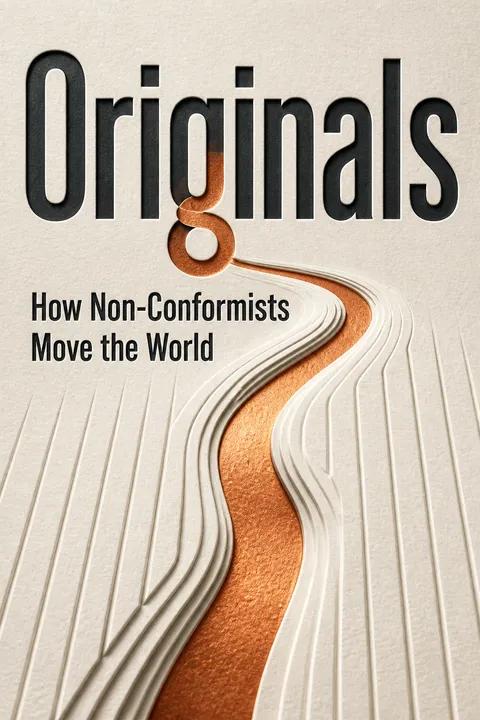
Originals offers insights on creativity, risk-taking, and non-conformity. Readers appreciate Grant's research-backed approach and engaging storytelling, drawing parallels to Malcolm Gladwell's style. The book challenges conventional wisdom on success and originality, providing valuable lessons for entrepreneurs and creatives. However, some criticize its structure, lack of cohesion, and occasional oversimplification of complex topics. While many found it thought-provoking and useful, others felt it lacked originality itself. Overall, the book received mixed reviews but was generally well-received for its exploration of innovative thinking and practical advice.
People Also Read









Glossary
Originality
Useful novelty put into actionThe introduction and advancement of an idea that is relatively unusual within a particular field and has the potential to improve it. Creativity produces something novel and useful; originality also involves taking initiative to make the idea real. It is therefore both a quality of an idea and a pattern of action.
Vuja de
Freshly seeing the familiarA way of looking at a familiar situation as if encountering it anew. That changed perspective can expose assumptions, reveal why an arrangement exists, and make alternatives easier to imagine. The book uses the term to describe the curiosity that helps people question defaults rather than accepting them as natural or permanent.
Risk portfolio
Balancing risk across lifeA strategy of taking a substantial risk in one area while maintaining stability in another. An entrepreneur might test a new venture while keeping a job, or an employee might pursue change while building credibility through reliable work. The security in one domain can make experimentation in another more sustainable.
Creative forecasting
Predicting an idea’s likely successThe practice of estimating how well a novel idea will perform before its success is known. Creators can be overconfident, while managers and audiences may reject unfamiliar ideas too quickly. The book argues that peers who create in the same domain often make more accurate forecasts because they understand the craft without being personally invested in the idea.
Idiosyncrasy credits
Earned latitude to deviateThe freedom a person gains to depart from group expectations after earning others’ respect through contributions. These credits are granted through demonstrated value, not simply claimed through rank. They help explain why a respected employee may be able to challenge norms that would bring a less established colleague criticism.
Tempered radicalism
Moderating change to gain supportThe practice of pursuing ideas or values that challenge convention while presenting them in forms that are less threatening to mainstream audiences. A tempered radical may connect a disruptive goal to familiar concerns, make a modest initial request, or reveal a larger vision gradually. The aim is to build support without abandoning the underlying purpose.
Horizontal hostility
Conflict between similar groupsHostility that develops between groups pursuing a broadly shared cause because each group treats differences in methods, identity, or commitment as evidence that the other is not legitimate. More radical members may condemn moderates as sellouts. Such conflict can fragment a movement and divert energy from its common objective.
Zeigarnik effect
Unfinished tasks stay mentally activeThe tendency for incomplete or interrupted tasks to remain more accessible in memory than completed tasks. The book connects this effect to creative incubation: leaving a problem unresolved can keep it active in the mind while a person considers alternatives. This does not mean all procrastination helps; delay is useful only when it supports further thought and work.
Conceptual innovators
Creators led by a clear ideaInnovators who begin with a defined concept, theory, or design and then work to execute it. Their approach can yield striking breakthroughs relatively early, before accumulated expertise hardens into fixed habits of thought. The book contrasts them with experimental innovators, who develop ideas through prolonged trial and revision.
Experimental innovators
Creators who learn through trialsInnovators who begin with a problem but not a complete solution. They test possibilities, learn from results, and gradually shape the work through revision. This method can require years of experience, but it may sustain originality by producing discoveries rather than repeatedly applying one early insight.
Defensive pessimism
Using worry to prepareA strategy in which an anxious person imagines adverse outcomes and plans how to prevent or manage them. It can improve preparation when the person is already committed to acting. When commitment is uncertain, however, dwelling on failure may amplify fear and discourage action, so a more encouraging frame can be more useful.
Idea meritocracy
Best reasoning guides decisionsA decision-making culture in which ideas are judged by the quality of their reasoning rather than by the speaker’s rank or popularity. People are encouraged to challenge one another and disclose how confident they are. The model aims to surface disagreement, though its quality depends on fair processes and credible ways to assess evidence.
FAQ
What's Originals: How Non-Conformists Move the World about?
- Exploration of Originality: The book by Adam M. Grant explores how non-conformists drive change and innovation across various fields, challenging the status quo.
- Role of Dissent: It emphasizes the importance of dissenting opinions in enhancing decision-making and preventing groupthink, which can stifle creativity.
- Practical Framework: Grant provides actionable strategies for individuals and organizations to foster originality, including methods for generating and voicing new ideas.
Why should I read Originals: How Non-Conformists Move the World?
- Inspiration for Change: The book offers insights into cultivating originality and challenging conventional thinking, making it ideal for those seeking personal or professional growth.
- Research-Backed Insights: Grant combines storytelling with research findings, providing a grounded understanding of the psychological and social dynamics of originality.
- Applicability Across Fields: The principles outlined can enhance innovation and effectiveness in business, education, and other creative fields.
What are the key takeaways of Originals: How Non-Conformists Move the World?
- Embrace Procrastination: Strategic procrastination can foster creativity by allowing for divergent thinking and idea exploration.
- Value of Dissent: Encouraging dissenting opinions can lead to better decision-making and innovation, as it prevents groupthink.
- Coalition Building: Successful originals create coalitions by balancing radical ideas with moderate approaches to attract allies.
How does Adam M. Grant define originality in Originals?
- Originality as Action: It's not just about generating new ideas but also about implementing them effectively.
- Influence of Environment: Originality is shaped by social context and supportive relationships, which can enhance creative potential.
- Rejecting Defaults: It involves questioning established norms and exploring alternatives, requiring curiosity and a willingness to challenge beliefs.
How does Originals address the myths surrounding creativity?
- Creativity is Learnable: Grant argues that creativity can be developed through practice and the right mindset, debunking the myth of it being an innate trait.
- Role of Failure: Failure is often a stepping stone to success, with many great originals facing setbacks before achieving their goals.
- Diversity of Thought: Embracing diverse perspectives leads to more innovative solutions, challenging the notion of conforming to a single viewpoint.
What role does procrastination play in fostering originality according to Originals?
- Divergent Thinking: Procrastination allows for divergent thinking, leading to the exploration of a wider range of ideas.
- Incubation Period: Delaying tasks can serve as an incubation period, where ideas mature and evolve before being finalized.
- Flexibility and Improvisation: It keeps individuals open to improvisation, allowing adaptation based on new insights or feedback.
How can I build coalitions to support my original ideas as suggested in Originals?
- Temper Your Message: Make your message appealing to a broader audience without diluting its core essence to attract allies.
- Find Common Ground: Identify shared goals and values with potential allies to facilitate collaboration.
- Engage with Opponents: Converting adversaries into allies can strengthen movements and initiatives.
What strategies does Adam M. Grant suggest for effectively communicating original ideas in Originals?
- Start with Weaknesses: Presenting the downsides of your idea can build trust and make your audience more receptive.
- Use Familiar References: Incorporate familiar concepts or analogies to help your audience relate to your ideas.
- Iterate and Gather Feedback: Continuously refine your ideas based on feedback to enhance their viability.
How can I foster originality in my organization according to Originals?
- Encourage Dissent: Create an environment where employees feel safe to voice their opinions and challenge the status quo.
- Implement Innovation Tournaments: Organize competitions to generate new ideas, allowing employees to pitch concepts and receive feedback.
- Focus on Cultural Contribution: Prioritize candidates who enhance the organization's culture with diverse perspectives.
How does Originals suggest managing fear and anxiety when pursuing originality?
- Transforming Fear into Motivation: Use defensive pessimism to anticipate failures and prepare thoroughly, managing anxiety.
- Reframing Emotions: Reframe anxiety as excitement to activate proactive behavior.
- Focus on the Victim: Channel emotions into constructive actions by focusing on victims rather than the source of anger.
What is groupthink, and how does it relate to Originals?
- Definition of Groupthink: A psychological phenomenon where the desire for harmony leads to irrational decision-making.
- Impact on Originality: Groupthink stifles creativity as individuals may conform to dominant opinions rather than express original ideas.
- Preventing Groupthink: Encourage dissent, appoint authentic dissenters, and foster a culture valuing diverse opinions.
What are some practical strategies for generating original ideas mentioned in Originals?
- Question the Default: Challenge existing norms and ask why they exist to explore new possibilities.
- Increase Idea Quantity: Generate a larger number of ideas to enhance the likelihood of finding original solutions.
- Seek Diverse Feedback: Solicit input from peers to refine and improve ideas, leading to more innovative outcomes.
About the Author


Download PDF
Download EPUB
.epub digital book format is ideal for reading ebooks on phones, tablets, and e-readers.








