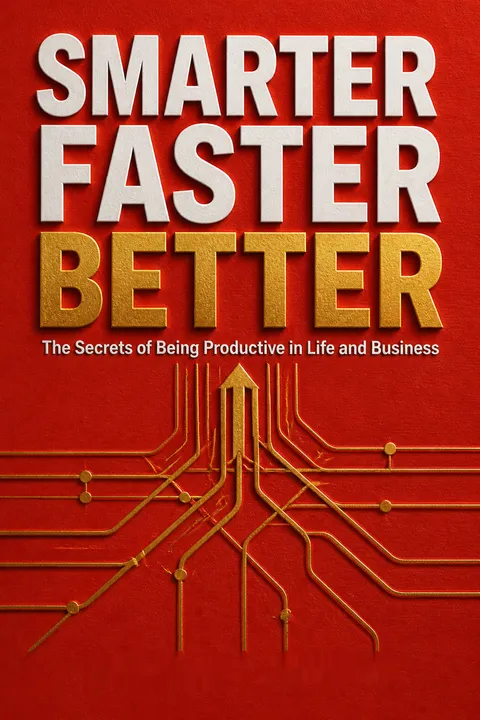


Key Takeaways
Treat productivity as better choices, not more hours at the desk
Busy is not the measure. Charles Duhigg begins by admiring surgeon and writer Atul Gawande, whose crowded life seems to explain his success. Then he learns Gawande is busy that week because he has planned a concert with his children and a short trip with his wife. The distinction is revealing: productivity is not simply doing more. It is choosing how to spend energy and time on rewards that matter, while avoiding needless strain and waste.
The book carries this idea through eight settings, from Marine boot camp to an FBI investigation and a struggling school. The tools differ, but the recurring task is the same: notice choices that usually pass unexamined. Better attention, goals, decisions, teamwork, and learning can make meaningful work more achievable without turning every hour into work.
What's distinctive is the book's refusal to equate output with virtue. A person can clear an inbox efficiently while neglecting the work or relationships that give the day value. That makes productivity partly a question of ethics: whose goals count, and what costs are acceptable? The approach is strongest when it asks readers to examine the choices behind their routines. Its limit is that personal choice cannot erase structural constraints. A worker with little control over shifts or workload cannot simply choose a more humane schedule. The ideas are most useful when paired with honest recognition of both agency and constraint.
Turn chores into choices tied to something you actually care about
Start with agency. Psychologists use the term internal locus of control for the belief that one's actions can influence what happens. Duhigg links that belief to motivation: even a small decision can make a task feel self-directed rather than imposed. In a guessing-game experiment, participants stayed engaged when they chose their own answers, although the game was rigged and their choices could not change the outcome.
Marine recruits practiced making decisions in situations where instructions were incomplete. During a difficult obstacle, one team found a way to coordinate despite being unable to hear commands. They also learned to connect exertion to a personal reason, such as building a better life for family. In nursing homes, residents who made small choices about meals or furniture were more active and engaged than peers who simply accepted the schedule. The task matters more when it expresses both control and purpose.
The useful insight is that motivation can be cultivated through experience, not merely summoned through self-talk. A small, genuine choice may help a person cross the threshold into action, while a personally meaningful reason helps sustain effort after novelty fades. This resembles autonomy-supportive teaching, where students receive structure without having every move dictated. The distinction between choice and meaningful control matters, though. Offering trivial options while withholding consequential authority can feel manipulative. The strongest application gives people real discretion, then helps them see how a demanding task connects to a value they themselves endorse.
Build teams where dissent is safe and airtime is shared
The group changes the people. Google's Project Aristotle examined 180 teams and found no reliable recipe based on assembling particular personalities or backgrounds. What mattered more was how colleagues interacted. Psychologist Amy Edmondson calls psychological safety a shared belief that people can speak up, admit mistakes, and take interpersonal risks without humiliation or punishment.
A hospital study first seemed to show that cohesive teams made more errors. The puzzle resolved when researchers saw that safer teams reported more mistakes, while punitive teams concealed them. Google and the early Saturday Night Live team illustrate the same principle: colleagues need not be best friends, but members need a voice and enough social sensitivity to notice one another. Effective teams also need meaningful work, clear roles, and dependability. The key is not constant agreement. It is making disagreement survivable and useful.
Psychological safety is often mistaken for comfort or consensus. The stronger interpretation is that a team can tolerate candor without turning every challenge into a threat to belonging. This is especially important in complex work, where errors are inevitable and hidden errors become harder to correct. Shared airtime is a practical diagnostic: a brilliant discussion dominated by one expert may still be wasting the knowledge around the table. Yet equal speaking time is not a mechanical quota. Expertise and urgency sometimes require asymmetry. The deeper test is whether quieter members can contribute when their information matters, and whether leaders respond without retaliation.
Rehearse what you expect so emergencies do not hijack attention
Attention needs a map. A mental model is an internal picture or story of how a situation works and what is likely to happen. It helps a person decide which signals deserve attention. Without one, an unexpected crisis can trigger cognitive tunneling, a narrowing of attention onto whatever is most obvious, even when it is misleading.
On Air France Flight 447, automation disengaged after ice disrupted airspeed readings. The pilots struggled to interpret alarms and screens, and failed to respond to the plane's stall. On Qantas Flight 32, Captain Richard de Crespigny had rehearsed possible emergencies with his crew. When a catastrophic engine failure damaged many systems, he simplified the plane in his mind to its basic functions, focused on what still worked, and landed safely. The practical lesson is to imagine likely obstacles before they arrive, then revise the picture when evidence contradicts it.
Mental rehearsal connects attention to expertise: practice builds patterns that help people recognize which details matter. It also explains why preparation is not just memorizing procedures. It is learning what a situation should look like, so anomalies stand out. The caution is that a model can become a trap if it is treated as reality rather than a provisional guide. Captain de Crespigny's useful move was not merely having a mental picture, but simplifying and updating it under pressure. In everyday work, rehearsal should therefore include a question such as, what evidence would show that this plan is wrong?
Break ambitious goals into steps without mistaking checklists for purpose
Pair reach with traction. Specific, measurable, realistic goals with a clear timeline can turn vague intentions into action. In one study, experienced typists who set concrete targets increased output from an average of 95 lines an hour to 112 within a few weeks. But precise targets can also trap people in easy, measurable work.
General Electric addressed this tension by pairing practical targets with stretch goals, ambitions large enough to force new thinking. A factory aiming to cut engine defects by 70 percent had to rethink hiring, training, and workflow, not just inspect more carefully. The opposite danger appears in the Yom Kippur War: Israeli intelligence chief Eli Zeira clung to a confident assessment that Egypt would not attack, even as warning signs accumulated. A strong goal system needs both concrete next steps and regular checks that the goal itself remains sound.
Goals direct attention as much as effort. A clear target reduces ambiguity, but once people are rewarded for hitting a metric, the metric can displace the underlying purpose. This is a familiar problem in institutions: what is easy to count can become a poor stand-in for what matters. The book's pairing of ambition and tractable steps offers a useful counterweight, while Zeira's failure shows why plans need a mechanism for reconsideration. Stretch goals should not become demands for miracles. Their value depends on resources, learning, and permission to revise a target when evidence changes.
Give front-line workers authority, then prove management has their backs
Move decisions toward evidence. Lean manufacturing, adapted from Toyota's production practices, gives authority to workers closest to a problem and treats stopping a process to correct a defect as responsible action. At the NUMMI factory in California, former GM workers had once been discouraged from halting the assembly line. After Toyota partnered with GM, workers could pull a cord to stop production when they spotted a problem. Productivity and attendance improved sharply, and workers began taking pride in the cars they built.
Trust made the authority credible. During a downturn, NUMMI cut executive pay and reassigned workers rather than laying them off. The FBI used similar principles when rebuilding its Sentinel case-management system: small teams tested working software frequently and let people closest to a problem shape solutions. In a kidnapping investigation, the system surfaced a lead, but agents' discretion to pursue it helped locate and rescue the victim.
Decentralization works because knowledge is distributed: the person nearest a defect often sees details that a senior manager cannot. It also makes accountability more concrete, since authority and responsibility travel together. Yet empowerment without support is just risk transfer. Workers will not report problems if doing so threatens their jobs, and junior staff will not experiment if every failed attempt is punished. The cases suggest that trust must be demonstrated through policy and repeated behavior, not slogans. Autonomy also needs boundaries, especially where safety, law, or large financial consequences are involved.
Make creative breakthroughs by recombining familiar ideas under useful pressure
Novelty has ingredients. Research on scientific papers found that many influential studies combined mostly familiar material with a smaller number of unusual connections. Innovation brokers help make those connections by carrying ideas between groups or fields. Broadway choreographer Jerome Robbins used a related method on West Side Story, joining established theatrical forms in an unexpected way.
Disney's Frozen shows how personal experience can supply the missing ingredient. The team struggled to make both sisters sympathetic until songwriter Kristen Anderson-Lopez drew on her own experience of feeling judged while trying to be a good parent and professional. That emotional connection helped produce the song that clarified Elsa's character. The process also needed revision: when the team became stuck, changing the director's authority altered the conversation. A little pressure or disruption can loosen settled assumptions, but too much can overwhelm a team.
Creativity here is less a lightning strike than a practice of translation: take a useful idea, feeling, or technique from one setting, and test it in another. That view makes innovation more teachable without pretending it can be guaranteed. The ecological analogy in the book, moderate disturbance can open space for new growth, is suggestive rather than proof that creative teams obey the same law as forests. Its practical value lies in the middle ground: stability lets people build, while occasional dissent, deadlines, or a shift in authority can challenge premature agreement. Pressure helps only when people still have room to experiment.
Treat forecasts as odds, update them with evidence, and learn from failures
Replace certainty with calibration. Probabilistic thinking means treating the future as several possible outcomes with different chances, rather than as one hoped-for result. In the Good Judgment Project, people who received training in probability and forecasting became more accurate, with the book reporting gains of up to 50 percent. A basic practice is to combine relevant estimates, then adjust as evidence arrives.
Poker player Annie Duke applies this logic at the table. A bet is not a promise of victory; it is a decision about whether the odds justify the cost over repeated plays. She folded a strong pair against Greg Raymer, who later confirmed that he held kings. Her decision was sensible even though observers initially thought she had misread him. Forecasts improve when people examine failures as well as successes, because success-only examples distort the assumptions used to predict what comes next.
This approach separates decision quality from outcome quality. A reasonable wager can lose, and a careless one can win, so judging choices only by what happened encourages superstition and hindsight bias. Probabilities offer discipline without pretending to provide certainty. They also make disagreement more precise: two people can compare assumptions instead of arguing over whether an outcome is simply likely. The method depends on calibrated inputs, however. A numerical estimate can create false authority if its evidence is weak or its reference class is poorly chosen. Recording predictions and checking them against results helps expose that weakness.
Make information harder to skim so it becomes easier to use
Handling beats receiving. Information blindness is the failure to absorb or act on data when there is too much to process. In one study of retirement plans, participation fell as choices multiplied: 75 percent of workers enrolled when offered two plans, compared with 53 percent when offered sixty. More data did not automatically produce better decisions.
Cincinnati teachers had access to dashboards and reports but often did not use them. In the Elementary Initiative, teachers copied student results onto index cards, sorted them into groups, and tested different lessons. This laborious handling helped reveal patterns and guided classroom changes. One teacher's students' reading proficiency rose from 38 percent to 72 percent in a year. The same principle applies to personal learning: compare, summarize, test, or explain information instead of merely collecting it. The extra effort can turn a stream of facts into usable knowledge.
The insight resembles active learning: people understand information more deeply when they retrieve, organize, and apply it, rather than simply encounter it. The data room's physical cards made comparisons visible and gave teachers a shared object to discuss. This is a persuasive design lesson for organizations that invest in dashboards but not in the habits needed to interpret them. Still, friction is not automatically beneficial. Manual work can waste time or introduce errors, and the book itself describes a schoolwide improvement with multiple causes. The useful goal is productive effort: make the reasoning visible, not the paperwork heavier.
Analysis
The book's architecture is a sequence of nested decisions. Individuals need to believe they can act; groups need norms that make action and candor safe; organizations need to place authority near information; and learners need processes that convert incoming facts into judgment. Across these settings, productivity is less a matter of speed than of cognitive design. Choices, rehearsal, goal structure, and data handling shape what people notice and what they do next.
The narratives are memorable partly because they turn abstract claims into visible scenes: a recruit improvising across an obstacle, a factory line stopping for one bolt, or teachers sorting cards by student performance. These examples reveal mechanisms, not universal recipes. A choice can motivate, but too many options can paralyze. Ambition can provoke innovation, but a target detached from resources can demoralize. Psychological safety can surface mistakes, but it does not replace technical competence. Delegation can unlock expertise, but it requires accountability and trust. The strongest synthesis is that useful systems do not eliminate judgment. They make judgment more likely to happen at the right time. A checklist can translate an ambition into steps, yet Zeira's story shows that procedure can also harden into dogma. Automation can reduce routine burden, yet Flight 447 shows the danger of leaving people unprepared for exceptions. Data can inform instruction, yet it becomes actionable only when teachers interpret it. The book's practical challenge is therefore not to adopt more tools, but to build habits and institutions that preserve agency, invite correction, and keep goals open to revision.
Review Summary
Smarter Faster Better receives mixed reviews. Many praise Duhigg's storytelling and insightful anecdotes, finding the book engaging and informative. Readers appreciate the practical advice on productivity and decision-making. However, some criticize the book for lacking cohesion and presenting familiar ideas. Several reviewers note that while individual chapters are interesting, the overall narrative feels disjointed. Some find the concepts difficult to apply personally. Despite these critiques, many readers still recommend the book for its thought-provoking content and well-researched examples.
People Also Read










Glossary
Internal locus of control
Belief in personal influenceA person's belief that their choices and actions can affect outcomes in their life. Someone with a stronger internal locus of control is more likely to credit effort for success and examine their own actions after failure, rather than treating outcomes as entirely determined by luck or outside forces. The book presents it as a capacity that can be strengthened through practice.
Psychological safety
Safety for interpersonal riskA shared belief among team members that the group is safe for speaking up, admitting mistakes, asking questions, or offering ideas without being humiliated or punished. It does not require agreement or friendship. In the book's account, it supports learning because people can expose problems and challenge one another while maintaining mutual respect.
Cognitive tunneling
Attention narrowed under pressureA narrowing of attention that can occur when a person shifts abruptly from relaxed or automated activity into a stressful situation. The mind may lock onto the most obvious stimulus, even when other information is more important. The book uses the Air France crash to illustrate how tunnelled attention can obstruct judgment during an emergency.
Mental models
Internal maps of situationsInternal representations of how a situation works and what is likely to happen. They help people organize information, anticipate events, and decide what deserves attention. The book describes experts as using experience and rehearsal to build models that make important patterns easier to recognize, while emphasizing that models should be revised when facts conflict with them.
Need for cognitive closure
Desire for definite answersA psychological preference for a firm judgment over ambiguity or uncertainty. It can support decisiveness and follow-through, but an excessive need for closure can cause people to settle too quickly on an explanation and resist information that challenges it. The book connects this tendency to Eli Zeira's confidence that Israel's enemies would not attack.
SMART goals
Structured, trackable objectivesA goal-setting approach in which objectives are defined in concrete terms, made measurable and feasible, and tied to a timeline. The book presents this structure as a way to convert broad intentions into plans and feedback. It also warns that precise goals can direct effort toward trivial or easily counted tasks unless their importance is examined.
Stretch goals
Ambitions beyond current plansHighly ambitious objectives that initially lack a clear route to completion. They can challenge complacency and prompt experimentation, as in GE's effort to sharply reduce engine defects. The book argues that stretch goals work best alongside smaller, concrete steps. If an ambition appears impossible or lacks resources, it may create panic rather than innovation.
Probabilistic thinking
Reasoning in degrees of likelihoodA way of making decisions by considering several possible outcomes and estimating how likely each is, rather than treating the future as certain. It involves identifying what is known, updating estimates when new evidence appears, and accepting that a sound choice can still produce a bad result. The book illustrates it through geopolitical forecasting and poker.
Bayesian psychology
Updating beliefs with evidenceThe book's label for the human ability to make predictions by combining prior assumptions with observations. A person begins with an estimate based on relevant experience, then adjusts it as new information arrives. The process can work quickly and intuitively, but poor assumptions or biased experience can distort later predictions.
Lean manufacturing
Improvement led by front-line workersA management approach associated in the book with Toyota's production system. It reduces waste and gives workers close to a process authority to identify and address problems, including stopping production when quality is at risk. Its effectiveness depends not only on procedures, but on a culture in which workers can raise concerns without punishment.
Innovation brokers
Connectors of separated ideasPeople who move ideas between groups, disciplines, or industries and combine them in new ways. Their advantage comes from seeing how a solution that works in one setting might address a problem elsewhere. The book argues that brokerage is not limited to rare creative geniuses; broader experience and attention to connections can help people develop it.
Disfluency
Effortful processing of informationA feeling of difficulty or extra effort while processing information. In the book, manipulating data, writing notes by hand, comparing options, or explaining an idea can create useful disfluency because it prompts more active thought than passive exposure. The concept does not mean that all friction helps; effort is valuable when it deepens understanding.
Information blindness
Overload that blocks actionThe tendency to stop absorbing or using information when the volume becomes overwhelming. The book illustrates it with retirement plans: participation declined as the number of options grew. Information blindness can be reduced by organizing data into manageable comparisons or questions, so people can interpret it rather than avoid it.
Engineering design process
Structured problem-solving sequenceA method for addressing a problem by defining it, gathering relevant information, generating alternative solutions, testing them, and revising based on results. In a Cincinnati high school class, students used the process to break a personal dilemma into evidence and options. Its value is not a guaranteed answer, but a way to slow down and reconsider a decision from fresh angles.
FAQ
What's Smarter Faster Better about?
- Focus on Productivity: The book explores the science of productivity, focusing on why some individuals and organizations achieve more than others.
- Eight Key Concepts: It delves into motivation, teams, focus, goal setting, managing others, decision making, innovation, and absorbing data.
- Real-World Examples: Charles Duhigg uses case studies from various fields to illustrate how these principles can be applied effectively.
- Framework for Improvement: Provides a framework for readers to improve productivity by recognizing and implementing specific strategies.
Why should I read Smarter Faster Better?
- Enhance Your Productivity: Offers scientifically-backed strategies to improve efficiency and effectiveness in both personal and professional contexts.
- Understand Human Behavior: Provides insights into motivation and decision-making processes, beneficial for personal and professional relationships.
- Engaging Narrative: Duhigg's storytelling approach makes complex concepts accessible and engaging, blending research, anecdotes, and practical advice.
What are the key takeaways of Smarter Faster Better?
- Motivation and Control: A sense of control is crucial for motivation, driving individuals to work harder.
- Psychological Safety in Teams: Teams perform better when members feel safe to express ideas without fear of judgment.
- Focus and Mental Models: Mental models help maintain focus and navigate complex situations effectively.
How does Smarter Faster Better define motivation?
- Control as a Key Factor: Motivation is influenced by the feeling of control over one’s actions and environment.
- Biological Imperative: The need for control is a biological imperative, enhancing effort and overcoming challenges.
- Practical Applications: Strategies include making choices that reinforce a sense of control, empowering individuals to achieve their goals.
What is the concept of "psychological safety" in Smarter Faster Better?
- Definition: Psychological safety is a shared belief that the group is a safe place for taking risks.
- Impact on Performance: Teams with psychological safety perform better due to open communication and collaboration.
- Examples: Illustrated through organizations like Google, where trust and support enhance team dynamics.
What specific methods does Smarter Faster Better recommend for improving productivity?
- Use of Mental Models: Visualizing tasks and anticipating challenges helps maintain focus and clarity.
- Setting SMART Goals: Emphasizes Specific, Measurable, Achievable, Relevant, and Time-bound goals for motivation and progress tracking.
- Embrace Disfluency: Engaging with information in a challenging way leads to deeper understanding and retention.
How does Smarter Faster Better address decision-making?
- Bayesian Thinking: Introduces Bayesian reasoning for updating beliefs based on new information, improving decision accuracy.
- Cognitive Biases: Discusses how recognizing biases can enhance forecasting abilities and rational choices.
- Practical Strategies: Techniques include creating mental models and practicing probabilistic thinking for better risk assessment.
What role do teams play in productivity according to Smarter Faster Better?
- Psychological Safety is Key: Teams perform better when members feel safe to share ideas and take risks.
- Diversity Enhances Performance: Diverse teams bring different perspectives, leading to creative solutions.
- Effective Communication: Clear communication and mutual respect are essential for maintaining a productive team dynamic.
What is the difference between SMART goals and stretch goals in Smarter Faster Better?
- SMART Goals Defined: Specific, Measurable, Achievable, Realistic, and Time-bound objectives provide clear direction.
- Stretch Goals Explained: Ambitious targets push individuals beyond comfort zones, encouraging innovative thinking.
- Importance of Both: Combining SMART and stretch goals leads to greater overall success by providing structure and inspiration.
How does Smarter Faster Better suggest we improve our focus?
- Build Mental Models: Visualizing tasks and outcomes helps maintain focus and clarity.
- Practice Disfluency: Engaging with information in a challenging manner enhances understanding and retention.
- Set Clear Goals: Establishing specific and achievable goals directs focus and energy toward meaningful tasks.
What role does innovation play in Smarter Faster Better?
- Culture of Experimentation: Encourages experimentation and risk-taking to foster innovation.
- Case Studies: Examples from companies like Disney and Pixar illustrate successful innovative environments.
- Balancing Risk and Reward: Emphasizes the importance of balancing potential risks with rewards to unlock new possibilities.
What are the best quotes from Smarter Faster Better and what do they mean?
- “Productivity is about making certain choices in certain ways.”: Highlights that productivity is about informed decisions leading to meaningful outcomes.
- “The way we choose to see ourselves and frame daily decisions…separate the merely busy from the genuinely productive.”: Emphasizes the role of mindset in achieving true productivity.
- “The best teams succeed when everyone feels like they can speak up.”: Underscores the significance of psychological safety in team dynamics for better collaboration and innovation.
About the Author

Download PDF
Download EPUB
.epub digital book format is ideal for reading ebooks on phones, tablets, and e-readers.








