

Key Takeaways
Build income that keeps paying after the work shifts upfront
The trade changes shape. Richards defines passive income as money earned with little to no ongoing work, not money earned without effort. It takes upfront labor, capital, or both to build an asset or system, then comparatively little maintenance. Her own path gives the argument a face: she and her husband bought rentals, published books, and sold print-on-demand designs. They reported earning more than $10,000 a month within about two and a half years, against roughly $7,000 in monthly expenses.
Freedom is the measure. The goal is not necessarily to stop working. It is to make a paycheck less decisive in choosing how to spend time. Richards's result is a personal case, not proof that beginners can reliably reproduce her speed or income. Even a low-maintenance stream still involves risk, upkeep, or both.
The book's most useful distinction is between building an income source and maintaining it. That is familiar in software, publishing, and other asset-based businesses: a product can keep earning after its creator stops repeating the original labor, but it still needs distribution, updates, or support. This framing prevents the phrase passive income from sounding like effortless income. The further test is resilience. A stream that needs a platform, tenant, or supplier to keep cooperating may be low-labor without being secure. Reduced dependence on one employer is valuable, but it is not the same as being free of economic risk.
Treat retirement as a choice, not a birthday or a giant account
Retirement means agency. Richards uses the term Nest Egg Theory for the familiar plan of saving a large pool of money, leaving work around age 65, and drawing down savings afterward. She argues that this route feels less attainable than it did for earlier generations. Her comparison points to larger homes, more years spent in retirement, rising college costs, fewer traditional pensions, and workweeks that often exceed 40 hours. The book cited estimates of $2 million or more as a retirement target, while noting that many households had far less saved.
Context matters. These figures and forecasts come from a 2019 book and should not be treated as current projections. Richards's underlying point is broader: retirement is a condition of having choices, not simply reaching a particular age or account balance.
Reframing retirement around agency is a powerful move because it shifts attention from a distant finish line to the conditions a person wants money to provide. The historical comparison also makes financial advice feel less like a personal failing and more like a response to changing costs and institutions. But the argument should not turn into a false choice between passive income and saving. Retirement accounts, diversified investments, public benefits, and income-producing assets can complement one another. The book's sharp critique is most persuasive as a case for adding options, not as proof that conventional saving has become useless.
Price your time before trading it for small savings
Compare in one currency. Richards argues that time is finite while money can, in principle, be earned again. She cites a study of more than 4,000 Americans in which people who prioritized time reported greater happiness and life satisfaction on average. Her practical tool is to estimate an hourly value by dividing total weekly income by all hours spent earning it, including side work.
Use the number carefully. In her example, a person earning $800 across 43 work hours values each hour at about $18.60. A four-hour task therefore represents about $74 of time. Paying a niece $50 to do it may be the better exchange, provided those freed hours are used meaningfully. The point is not to outsource everything, but to notice what a seemingly cheap choice costs in time.
This is an accessible application of opportunity cost, the value of the best alternative given up when choosing one option. It can expose odd bargains, such as spending an hour to save a few dollars. Yet an hourly wage is only a rough decision aid: leisure is not necessarily convertible into paid work, and household tasks can carry emotional or practical value beyond their market price. The strongest use of the calculation is not to declare every unpaid hour wasteful, but to make tradeoffs visible. Time can be spent resting, caring for others, or building an asset, and each may be worth more than the saved cash.
Choose an income stream by fit, not by hype
Separate building from upkeep. Richards calls the creation period Stage 1: the time, money, or work required to make an income source viable. Stage 2 begins once it is operating and concerns the effort needed to maintain it. A book may take months to write and promote, then require occasional marketing. A rental may need substantial setup, then become less demanding with a property manager.
Test the whole proposition. The Factors of SCRIMP is Richards's comparison tool. It asks whether a stream can scale, how much control or regulation it faces, what it costs to start, whether customers need it, and how much work it takes to maintain. A course may scale online but depend on a platform. A portfolio can be easy to maintain but require substantial capital. Compare the burdens, not just the promised return.
This framework usefully treats income ideas as operating models rather than lifestyle fantasies. It directs attention to dependencies that promotional stories often hide: customer acquisition, regulation, platform rules, capital, and ongoing service. The stage distinction also helps reveal why a venture may be exhausting before it becomes low-maintenance. One important addition is to ask how fragile the stream is under stress. A business dependent on one platform or one tenant has a different risk profile from several unrelated sources. A high score on scalability does not automatically compensate for low control or an unreliable market.
Make one useful creative asset, then market it relentlessly
Create for a real audience. Royalties can come from books, music, photographs, digital downloads, designs, courses, software, or other creative work. The basic idea is to create something once and sell access repeatedly. Richards recommends starting from existing strengths, then checking whether buyers actually want the product. For a book, she suggests studying competing titles, rankings, prices, and reviews rather than assuming a good idea will find readers.
Distribution is part of creation. Richards spent under $600 to launch her first book, Money Honey, which she says sold or was downloaded more than 10,000 times. Author Hal Elrod's book continued selling strongly during a year when cancer treatment left him unable to do much promotion, after an earlier period of intensive marketing. These stories show both the upside of an established audience and the work required to build one.
A repeatable creative asset can separate income from each additional hour of labor, but the asset alone rarely creates demand. Marketing, trust, timing, and access to readers are part of the product's economics. The book's case studies illustrate how an audience can compound the reach of a work, while also creating survivorship bias: visible successes do not show how many launches earned little. A sound approach treats early publication as a test, not a guaranteed annuity. Small experiments, honest claims, and a clear customer problem can limit wasted effort while preserving the possibility of long-lived royalties.
Portfolio income buys passivity only after substantial capital is invested
Capital does the work. Portfolio income includes interest, dividends, and investment distributions. Unlike a book or a vending machine, it may require little ongoing labor once money is invested. But the income depends heavily on the amount invested and the return, neither of which is guaranteed. Richards illustrates the scale with a hypothetical 4% yield: $250,000 would generate about $833 a month before taxes and other effects.
Returns carry risk. A single dividend-paying company can cut payments or fail, while bonds and savings products offer different yields and inflation risks. Funds that hold many investments can spread exposure, but they cannot eliminate market downturns. The author sees portfolio income as a possible destination after building wealth through other sources, or as one component of a broader mix.
This category makes the book's time-versus-capital tradeoff especially clear. Investment income is comparatively hands-off because capital is doing the work, not because the underlying assets are risk-free. Diversification can reduce company-specific risk, but it cannot prevent broad market declines or guarantee purchasing power. The example of a 4% yield is a scale illustration, not a promise of a stable return. For readers comparing streams, the relevant question is not simply which one is most passive. It is whether the capital could be lost, how income changes over time, and whether the investor can tolerate volatility without selling at a bad moment.
Use rental property’s cash flow, not appreciation alone, to test a deal
Count the real costs. Richards favors rental property because it can generate monthly income while tenants help pay down a mortgage, and because ownership may offer tax advantages. Her example is a $100,000 home renting for $1,200 a month, with estimated monthly costs of $870 and cash flow of $330. The calculation depends on including items such as vacancy, repairs, taxes, insurance, management, and financing, not just comparing rent with the mortgage.
Lower the entry barrier carefully. House hacking means living in one unit of a multi-unit property while renting the others. The BRRRR method means buying, renovating, renting, refinancing, and repeating, using recovered equity toward another purchase. Both can reduce the cash needed, but leverage increases risk. A property manager can reduce daily labor, yet management fees and oversight still belong in the numbers.
Real estate combines income, debt, operations, and a physical asset, which makes it more controllable than a stock in some ways and more demanding in others. The book's emphasis on cash flow is a useful safeguard against buying solely on hopes of rising prices. Still, a spreadsheet is only as good as its assumptions: repairs arrive unevenly, vacancies can last, and local rules or financing terms can change. House hacking and refinancing can accelerate growth, but they also increase exposure to debt and local market conditions. Conservative estimates and adequate reserves matter as much as a promising projected return.
Physical machines and online sales work only when access and demand are real
Match the offer to its setting. Coin-operated income comes from machines such as vending machines, ATMs, arcade games, car washes, or laundromats. Their success depends on location, foot traffic, operating costs, and permission to use the site. A vending machine is not automatically profitable because snacks sell; it needs a place where customers want them and prices that make sense.
Online does not mean effortless. Affiliate links, ads, and dropshipping can reach wider markets, but they depend on audiences, advertising partners, suppliers, or platforms. Richards warns that ordinary dropshipping can become a constant search for trending products, while competition pressures prices and profits. Across both physical and online models, the practical work is to research demand, calculate costs, check rules, and plan who handles maintenance or fulfillment.
These examples widen the reader's idea of an income-producing asset beyond investments and creative work. They also expose a common business principle: access to customers is often more valuable than the machine or website itself. A high-traffic location, trusted audience, or dependable supplier can make a modest product viable, while a clever product without distribution may earn nothing. The tradeoff is dependency. A location owner can end an agreement, an online platform can change its rules, and a supplier can fail. These streams are best assessed as small operating businesses whose labor can be reduced, not erased.
Track your resources, set a target, and build one stream before quitting
Start with your actual numbers. Richards asks readers to calculate monthly expenses, debt, savings, and the income needed for the life they want. If the target includes travel, health coverage, or higher housing costs, include those too, plus a margin for uncertainty. She also recommends tracking time in 15-minute intervals for two days. Her own exercise revealed about three hours a day going to television and social media, a personal finding rather than a universal estimate.
Choose a first move. Decide whether time or capital is easier to free up, narrow the options to a few plausible streams, then compare them using the SCRIMP questions. Begin with one, learn from the results, and avoid leaving a job before replacement income is reliable. The book also stresses that sound budgeting, debt management, and basic financial stability come first.
The closing process is strong because it converts an expansive menu into a decision under constraints. Tracking time and money is a form of measurement: it replaces a vague sense of scarcity with evidence about where resources actually go. The personal time audit is useful as a prompt, but it should not imply that every reader has large discretionary blocks to reclaim. Caregiving, disability, multiple jobs, and financial insecurity can sharply limit flexibility. In those cases, the most realistic first step may be a modest, low-cost experiment rather than a dramatic lifestyle overhaul. The core discipline is progress without betting the household's stability.
Analysis
The book's central contribution is not a single secret investment. It is a change in the unit of financial planning: instead of asking only how large a retirement account must become, readers are asked what kinds of assets or systems could produce cash without requiring equal hours of work. The five income categories make that question concrete, and the distinction between building and maintaining an income source prevents the word passive from hiding the labor involved.
Its strongest practical advice is also its least glamorous: test demand, account for every cost, and choose a model that fits available time and capital. The examples make entrepreneurship feel more accessible by showing paths that do not all require a large investment. At the same time, the book's confident promise of broad accessibility sits uneasily beside its own evidence. A successful author, experienced property investor, or online business owner may have advantages in skills, timing, networks, and risk tolerance that a new entrant does not. A personal case can inspire, but it cannot establish a typical outcome.
The book is also a 2019 snapshot. Its retirement projections, interest rates, platform examples, and tax descriptions are tied to the period in which it was written. Readers should treat those as context, not current financial guidance. More fundamentally, its categories are not equally predictable: a rental property, a bestselling book, and a high-yield investment expose their owners to different kinds of uncertainty. Diversification across income sources may help, but each source still needs its own analysis.
The most durable takeaway is therefore not that everyone can retire quickly. It is that income can be designed in more than one way, and that the design process starts with clear goals, honest arithmetic, and a willingness to do concentrated work before expecting reduced maintenance. That is a more realistic promise than effortless wealth, and a useful challenge to the assumption that every dollar must come from another hour at work.
Review Summary
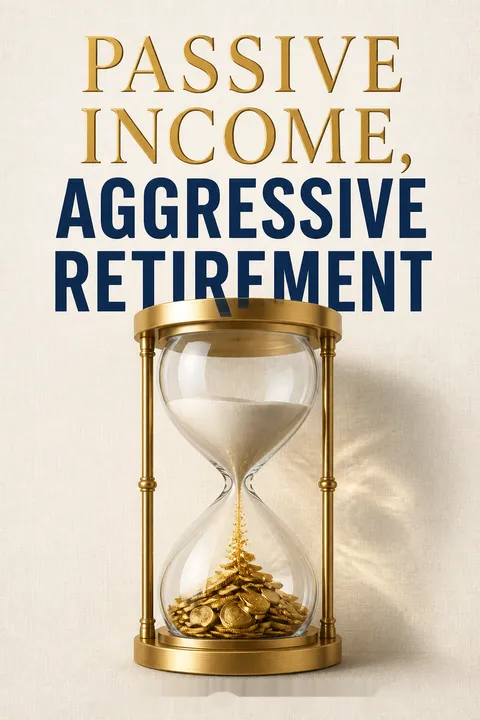
Passive Income, Aggressive Retirement receives mostly positive reviews for its accessible approach to financial independence through passive income streams. Readers appreciate Richards' enthusiasm, practical advice, and diverse strategies presented. Many find the book inspiring and informative, particularly for those new to passive income concepts. Some criticize the focus on real estate and perceive certain ideas as oversimplified. Overall, reviewers commend the book for its motivational content and actionable tips, though a few question the feasibility of early retirement as described.
People Also Read








Glossary
Nest Egg Theory
Save a retirement lump sumRichards's name for the traditional retirement approach: accumulate a large pool of savings during working years, then use it to pay living expenses after leaving work. She argues that this model is difficult and uncertain for many people because of changing costs, long retirements, market risk, and reduced access to pensions.
Stage 1
Build the income sourceThe upfront period required to create a potential income stream. It may involve substantial time, money, or both, such as writing and marketing a book, buying and preparing a rental property, or setting up a machine-based business. Richards emphasizes that this stage is active work, even when the resulting income may later require less maintenance.
Stage 2
Maintain the income sourceThe period after an income source has been created and launched. Richards uses the term to focus on the work needed to keep revenue coming in, such as occasional promotion, property oversight, or restocking. A stream is more passive when it needs relatively little effort during this stage, though it may not be entirely hands-off.
Factors of SCRIMP
Compare income stream tradeoffsRichards's framework for evaluating possible passive income sources. It considers scalability, control and regulation, upfront investment, market demand, and the work required for maintenance. The framework helps readers compare options with different constraints, such as a royalty product that needs time and marketing versus portfolio income that needs substantial capital.
House hacking
Live in one rented property unitA real estate strategy in which an owner lives in one part of a multi-unit property and rents out the remaining unit or units. Rental income can offset housing costs and may help the owner qualify for financing terms available to people buying a primary residence. The strategy still involves property, tenant, financing, and market risks.
BRRRR method
Recycle property investment equityA real estate approach whose name represents Buy, Rehab, Rent, Refinance, and Repeat. An investor purchases and renovates a property, rents it out, then refinances to access some of the equity and potentially use that capital for another purchase. The method can reduce the need to save a fresh down payment each time, but depends on costs, valuations, financing, and rental performance.
Download PDF
Download EPUB
.epub digital book format is ideal for reading ebooks on phones, tablets, and e-readers.








