

Plot Summary
A Kingdom in the Clouds
Peer Gynt, a strong young farmer with little patience for work, tells his widowed mother, Åse, an elaborate story about riding a reindeer over a mountain precipice.
She recognizes the tale as someone else’s and sees how far his inventions have carried him from the farm’s real troubles: unpaid debts, neglected fields, and dwindling property. Peer answers her scolding with grand promises of future greatness. When Åse mentions that Ingrid of Hegstad, a wealthy farmer’s daughter who once liked him, is marrying Mads Moen, Peer abruptly decides to attend the wedding.
He carries his protesting mother across a river, then strands her on a mill roof to keep her from following and exposing him. His fantasy has become a way to outrun both poverty and shame.
The Bride Leaves Hegstad
At the wedding, the guests mock Peer for his lies and recent brawl with the smith, Aslak. The new arrival Solveig, a devout young woman, catches his attention; he asks her to dance, but his drunken bragging and threats frighten her away. When Mads asks for help reaching his locked-in bride, Peer instead slips off with Ingrid.
He carries her up the mountainside, leaving the wedding in uproar and the Hegstad household demanding his punishment. Ingrid has been willing to escape her marriage, but Peer’s act is not a promise of life together. He has turned the wedding into a stage for his own appetite, while Solveig has seen enough of him to distrust the charm beneath his swagger.
Ingrid Abandoned
The next morning, Peer rejects Ingrid despite her offer of the Hegstad farm and the life she hoped they might share. He insists that she is not the woman he wants, then leaves her alone in the mountains. As the farmer and local men pursue him, Peer treats the chase as exhilarating proof that he is finally living boldly.
He joins three sæter girls whose lovers have deserted them, boasting himself into their company, then staggers through the mountains in a fever of drink, fear, and imagined grandeur. Åse searches for him with Solveig and Solveig’s parents, fearing both the law and the mountains will claim him. Their search does not stop Peer’s flight, but it draws Solveig into Åse’s stories about the son she still hopes to understand.
The Troll King’s Price
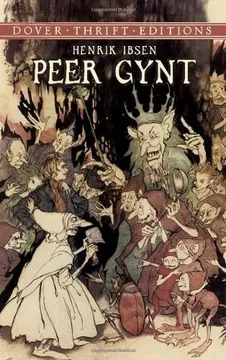
A green-clad woman leads Peer to the Dovrë King’s hall and claims him as her intended husband. Peer welcomes the royal match until the king requires him to abandon the human world, accept troll customs, and have his sight altered so the trolls will look beautiful to him. Peer has already accepted a tail and the king’s mead, but refuses a change he could never undo.
The troll court turns violent; distant church bells scatter the attackers and bring Peer back to the mountainside. In the dark, an invisible force called the Boyg blocks his way, defeating each attempt to fight by making every route circle back. Solveig’s religious presence helps drive it off. At dawn, Peer sends her sister Helga to ask Solveig not to forget him.
Solveig Comes to the Hut
After Hegstad takes the Gynt farm, Peer builds a rough shelter in the forest and tries to live by his own labor. He watches a young man cut off a finger to evade military service, a practical act of self-mutilation that Peer cannot reconcile with his own habit of imagining deeds instead of doing them. Then Solveig arrives, having left her family to join him.
Peer is overjoyed until an old troll woman appears with an ugly child, claiming Peer fathered it during his earlier mountain revels. She offers to disappear if he sends Solveig away. Peer cannot confess or welcome Solveig with this claim between them, so he leaves to fetch an unnamed burden and tells her to wait. Solveig stays in the hut, while Peer chooses another detour.
Åse’s Last Ride
Peer returns to the valley when Åse is dying, although his life is still forfeit there. She worries about him, but explains away his misdeeds as the result of drink and bad luck, protecting the image of her boy even as her own strength fails. Peer avoids her attempts to discuss his choices and revives their childhood game instead.
Using the cat’s chair as a sledge and the room’s noises as a landscape, he imagines driving her toward a splendid heavenly feast. Åse joins the fantasy and dies while he is still guiding the journey. Peer closes her eyes, kisses her, and asks Kari to arrange a proper burial. He then leaves Norway for the sea, having offered tenderness at the moment when repair is no longer possible.
The Merchant Emperor
Years later, Peer hosts four European gentlemen on the Moroccan coast and presents himself as a self-made man. His fortune came partly from selling enslaved people to America and religious idols to China.
He describes his later missions and plantation schools as evidence that he corrected his earlier business, though both schemes served his profit. Peer now intends to become emperor of the world through wealth. When a Greek revolt offers a chance for glory, his guests expect him to finance their cause; Peer instead plans to support the stronger Turkish side and preserve his money.
The companions seize his yacht and escape with it. Its magazine explodes at sea, killing them all and leaving Peer alive on the shore. He interprets survival as proof that Providence has singled him out.
A Prophet by Accident
Alone in the desert, Peer fends off monkeys and discovers the horse and ceremonial robes stolen from a local ruler. Wearing them, he arrives at an Arab encampment, where the people mistake him for a prophet.
He accepts their reverence because it supplies a more flattering identity than merchant or castaway. Anitra, the chief’s daughter, attracts him; he gives her a valuable opal and promises spiritual instruction, but she prefers further gifts. Peer later rides away with her, dressing his vanity as romance.
Anitra takes his purse and rings, then gallops home without him. Peer is left with little money and another failed role. Rather than examine his repeated pattern of using others, he decides to reinvent himself as a travelling scholar and heads for Egypt.
Kaiser of the Mad
In Egypt, Peer studies monuments as if ancient history can give his travels purpose, but he treats even the singing statue of Memnon as a curiosity to record and dismiss. At the Sphinx, he meets Professor Begriffenfeldt, director of Cairo’s asylum.
The professor takes Peer’s claim to be himself as evidence that he is the foretold ruler of the inmates, then announces that reason has died and crowns him their emperor. Peer encounters Huhu, who wants his people to recover a lost language, and a fellah convinced he is the ancient King Apis.
Peer offers the latter advice that leads him toward suicide. When Hussein, who believes himself to be a pen, cuts his throat, Peer collapses. The professor crowns the unconscious visitor with straw, while the inmates remain imprisoned in their private delusions.
The Cook and the Keel
As an old man returning to Norway, Peer sails through a storm and refuses to give his money to the crew, though he briefly imagines the families waiting for them at home. When a wreck appears, he urges a rescue but does not put himself at risk; the ship soon sinks.
Peer and the cook cling to an overturned boat, which cannot support them both. The cook begs Peer to think of his children, but Peer forces him to release his grip and watches him drown.
A strange passenger who had earlier asked for Peer’s body for scientific study appears again, probing his fear and motives without offering rescue. The passenger vanishes, and Peer survives until the sea carries him to land. His return begins with the same self-preservation he once called wisdom.
A Farmer’s Four Fingers
Near home, Peer hears a priest honor a dead farmer who once cut off a finger to avoid conscription. The farmer endured public shame, married, rebuilt his homestead after floods and an avalanche, and carried his sons across dangerous paths to school.
His children later prospered abroad but forgot him. Peer recognizes the mutilated hand as the young man he saw in the forest, and the farmer’s stubborn work becomes a life shaped by real responsibilities rather than grand claims.
At a nearby auction, people sell remnants associated with Peer and retell his boasts as local legend. Peer pretends not to know who he is, then offers the crowd a tale about the devil disguising a pig as a performance. The listeners accept the joke, not the man behind it.
The Onion Has No Core
In the forest, Peer takes apart an onion layer by layer and assigns each skin to one of his past identities: castaway, trader, hunter, prophet, and emperor. He finds no central kernel beneath them, only smaller coverings.
Before he can settle the question, the Button Moulder appears with a ladle, explaining that Peer is neither wicked enough for punishment nor virtuous enough for a distinct afterlife. Because Peer has failed to fulfill his intended self, he is to be melted down with other wasted material.
Peer insists that he must have been himself and asks for time to prove it. The Button Moulder grants a brief reprieve until their next meeting. Peer begins searching for witnesses, afraid that the life he spent performing may leave no evidence of a person beneath the parts.
The Witness Who Refuses
Peer meets the impoverished Dovrë King and asks him to testify that, in the mountain hall, Peer rejected the chance to become a troll and chose to remain himself. The king recalls the opposite: Peer accepted the troll motto of serving only his own interests and lived by it afterward.
Peer dismisses the accusation, but the king’s account destroys the defense he hoped to use. At the crossroads, the Button Moulder prepares to claim him. Peer asks what it means to be truly oneself, then abandons that argument and tries to establish that he was at least a serious sinner.
He seeks a priest, but the figure he meets is the Lean One, who refuses to admit Peer to hell because his wrongdoing was too half-hearted. Peer has neither proof of virtue nor the stature of a committed sinner.
Solveig’s Waiting Answer
The Button Moulder returns as dawn approaches, and Peer sees Solveig’s hut. For once, he stops following the Boyg’s old instruction to go around and runs straight to her. He begs her to name his sins and explain where his true self has been. Solveig answers that he has lived within her faith, hope, and love.
She welcomes him without listing his crimes, and Peer takes shelter in her lap as the sun rises. The Button Moulder warns that their dispute is not formally settled, but does not take Peer away. Solveig begins to sing over him as if he were the boy she has kept in her heart all along. The play ends not with proof that Peer has become virtuous, but with a refuge he could never manufacture for himself.
Analysis
Peer Gynt makes selfhood a problem of conduct rather than a matter of temperament. Peer is undeniably distinctive: his fabrications, appetites, and sudden inventions make him difficult to reduce to the villagers’ contempt. Yet individuality alone does not amount to a life. He mistakes the freedom to change masks for proof that a coherent person exists beneath them, and he repeatedly calls retreat prudence, opportunity, or destiny. The troll king’s bargain crystallizes that confusion. Peer resists being remade by another power, but then lives by a principle that lets his own desires overrule other people’s claims. The play refuses a simple contrast between worldly corruption and spiritual purity. Peer’s commerce, imperial fantasies, and prophetic performance expose how easily moral language can decorate self-interest. The asylum intensifies this critique by surrounding him with people whose identities have become total private systems. Their madness is not merely an opposite to his ordinary life; it enlarges the same impulse to treat one’s own interpretation as the only reality. The farmer in the funeral sermon offers a counterexample through a life of limited, concrete obligations. His courage is not grand, but his work has consequences for others and continues under hardship.
Solveig’s final welcome offers no audit of Peer’s record and no claim that his failures have vanished. Her love gives him a place within another person’s memory, where his own self-invention cannot be the only measure. That rescue is emotionally powerful precisely because it remains ethically unresolved: the Button Moulder’s warning persists, and the play does not show Peer earning forgiveness through reform. Instead, it asks whether human identity is made only by autonomous action, or whether it can also be held and recognized through another’s enduring care. Peer’s return to Solveig is his first movement directly toward a person rather than around an obstacle.
Review Summary
Peer Gynt receives largely positive reviews, with readers praising its complex characters, philosophical themes, and blend of fantasy and reality. Many appreciate Ibsen's critique of societal norms and exploration of identity. The play's unconventional structure and numerous scene changes intrigue readers, though some find it challenging. Reviewers note the work's uniqueness compared to Ibsen's other plays and its ties to Norwegian folklore. The character of Peer Gynt is described as a compelling anti-hero, with the play's ending leaving room for interpretation.
Characters
Peer Gynt
The evasive dreamerPeer is a peasant farmer’s son whose imagination outruns his labor and whose confidence survives repeated humiliation. He lies to his mother, boasts before his neighbors, pursues women without accepting responsibility, and repeatedly recasts selfish choices as strategy or destiny. His travels give him new costumes and titles, from merchant to prophet to emperor, but he treats each identity as something he can put on or abandon. Peer is not simply unaware of his failures; he often sees enough to rename them before they can demand change. His deepest fear is not punishment alone, but the possibility that there is no stable self beneath his performances. Solveig’s steadfastness offers a kind of belonging he cannot earn through invention.
Solveig
The faithful witnessSolveig is a devout young woman who first meets Peer at the Hegstad wedding. Her reserve is not timidity: she recognizes his drunkenness and threatening manner, and refuses to mistake spectacle for intimacy. Later, she chooses to leave her family and join him in the forest, drawn by a conviction that his life still matters. Solveig’s faith gives her a language for seeing a person beyond reputation and conduct, but her loyalty is not presented as a cure that Peer can simply claim. She waits without controlling his path. In the play’s moral landscape, she represents sustained attention, a form of love that does not depend on Peer’s self-description.
Åse
The protective motherÅse is Peer’s widowed mother, left with a failing farm and a son whose lies and idleness deepen her hardship. She scolds him sharply, yet defends him to others and repeatedly explains away the consequences of his behavior. Her own past with Peer’s dissolute father helps her understand the family’s ruin, though she often uses fantasy to soften what she cannot change. Åse and Peer share a private imaginative world built from childhood games and stories. That shared language makes their bond tender, but it also shows how make-believe can comfort people while leaving practical damage untouched. She wants Peer to become a support for her, even as she continues to shelter him from judgment.
Ingrid
The abandoned brideIngrid is the daughter of the wealthy Hegstad farmer and the bride whose wedding Peer disrupts. Desperate to escape a marriage she does not want, she accepts his attention and follows him into the mountains. Peer’s decision to abandon her exposes the difference between her urgent wish for change and his appetite for a dramatic conquest. Ingrid is not simply a prize in Peer’s story; she makes clear that his actions have consequences for another person after the excitement has passed.
The Dovrë King
The trollish lawgiverThe Dovrë King rules the mountain trolls and offers Peer a place in his family and kingdom. His conditions demand that Peer adapt his perception and conduct to the troll world, making comfort dependent on surrendering independent judgment. The king’s distinction between human and troll values becomes a measure Peer will encounter again much later. He is both a folkloric ruler and a shrewd examiner of the bargains people make to avoid discomfort.
The green-clad woman
The troll king’s daughterThe green-clad woman is the Dovrë King’s daughter, who chooses Peer as a husband after matching his boastfulness with her own claims of royal grandeur. She belongs to a world where outward appearance and inward reality can differ, and she offers Peer status without asking him to become honest. Her proposed marriage tests whether he will exchange his freedom of perception for power, comfort, and acceptance.
Anitra
The desert opportunistAnitra is the daughter of an Arab chief. When Peer arrives dressed as a ruler, she helps sustain his borrowed prophetic authority while remaining alert to the material rewards it can bring her. She is playful, watchful, and less impressed by Peer’s grand explanations than by his jewels. Their encounter reverses his usual pursuit: he believes he is enchanting her, while she quietly takes advantage of his vanity.
Professor Begriffenfeldt
The asylum’s mad directorBegriffenfeldt directs the Cairo asylum and speaks with the certainty of someone whose definitions have replaced ordinary judgment. He sees Peer’s claim to be himself as evidence that Peer belongs at the center of his patients’ delusions, then treats the inmates’ inward fixations as a new order of reason. His theatrical authority turns the asylum into a satirical court where Peer’s ambitions are reflected back at him in distorted form.
The Button Moulder
The examiner of wasted livesThe Button Moulder is a supernatural figure who collects people judged to have lived without becoming either fully good or fully evil. He presents melting down as an efficient way to reuse a life that has failed to take a distinct shape. His calm, practical manner makes the threat more unsettling: he does not accuse Peer of a single crime, but questions whether Peer ever became a person in his own right. He functions as the final pressure on Peer’s long habit of evading judgment.
The Lean One
The devil’s reluctant agentThe Lean One appears in the guise of a priest, but reveals a supernatural role connected to the fate of sinners. He refuses to treat Peer’s opportunistic misdeeds as serious enough for a place in hell, leaving Peer with no easy refuge in punishment. His distinction between a fully committed life of sin and Peer’s casual wrongdoing sharpens the play’s concern with half-lived choices.
The Strange Passenger
The storm’s unsettling examinerThe Strange Passenger appears aboard Peer’s ship during a storm and speaks of death and the body with unnerving curiosity. The crew does not acknowledge him as another passenger, leaving his status uncertain. He presses Peer to consider fear and mortality at a moment when Peer would rather bargain for safety. His ambiguous presence makes the storm feel like more than a physical danger, without resolving whether he is a person, a vision, or something else.
Aslak
The brawler smithAslak is the local smith whose fight with Peer becomes part of the young man’s reputation. He embodies the rough, physical community Peer both provokes and fears, and his presence helps turn the wedding gathering into a public test of Peer’s bravado.
Mads Moen
The unwilling bridegroomMads is Ingrid’s bridegroom, awkward and unable to reach his locked-in bride. His appeal to Peer for help gives Peer an opening to interfere in the wedding. Mads’s passivity contrasts with Peer’s reckless decisiveness, though Peer’s intervention serves himself rather than the groom.
The cook
The drowning fatherThe cook is a sailor with children waiting at home. During the shipwreck, his pleas for survival confront Peer with the human cost of choosing himself. His practical vulnerability turns Peer’s abstract belief in self-preservation into an immediate moral decision.
Plot Devices
Peer’s invented adventures
Fantasy as escapePeer repeatedly turns stories, inherited legends, and impossible achievements into a substitute for action. His invented reindeer ride first wins his mother’s frightened attention, then becomes part of the parish’s mockery and his own self-image. Later, each new costume lets him revise his past without repairing it. The device makes imagination double-edged: it supplies comic energy and a route through hardship, but also helps Peer evade work, remorse, and responsibility. His stories are not harmless embellishments because other people must live with the consequences of the conduct he disguises.
The Boyg
Evasion made visibleThe Boyg is a formless presence Peer encounters in the mountain darkness after escaping the trolls. It cannot be defeated by direct violence; every effort to force a way through sends Peer back into its obstruction. Its instruction to take another route becomes an image for Peer’s life, in which he repeatedly sidesteps commitment rather than confront what he has done. The Boyg returns as a meaningful echo when Peer faces judgment late in life. It gives a supernatural shape to a psychological habit, while leaving room for the force to be understood as more than a private metaphor.
The troll motto
Self-interest disguised as identityThe Dovrë King defines trollhood through a rule of self-sufficiency and self-interest, then asks Peer to accept it in exchange for marriage and power. Peer refuses some of the king’s demands but adopts enough of the bargain to carry its principle into his later life. The motto becomes a test of whether identity means fidelity to one’s own nature or permission to disregard everyone else. Much later, the king recalls Peer’s choice against him, complicating the defense Peer wants to build. Its structural purpose is to turn an early comic negotiation into evidence in the final reckoning.
The peeled onion
Identity without a kernelNear the end, Peer peels an onion and assigns its layers to the successive roles he has performed. The action converts a question about selfhood into a physical inspection: each layer looks like a possible identity, yet removing it reveals only another layer. Finding no center unsettles Peer just before the Button Moulder arrives to challenge his claim that he has been himself. The onion condenses the play’s long sequence of transformations without settling whether Peer is empty, fragmented, or simply incapable of recognizing a self beyond his stories.
The Button Moulder’s ladle
A life judged unfinishedThe Button Moulder’s ladle is a supernatural instrument for reclaiming people who have not formed a distinct moral identity. He tells Peer that neither conventional damnation nor reward fits a life that has remained indistinct, and threatens to melt him into common material. This device makes the play’s final question concrete: Peer must try to establish what he has been, not merely what he has imagined. The Button Moulder’s repeated appearances also create a deadline, forcing Peer to seek witnesses and confront the possibility that no external record can settle his identity.
About the Author
Other books by Henrik Ibsen



Download PDF
Download EPUB
.epub digital book format is ideal for reading ebooks on phones, tablets, and e-readers.








