

Plot Summary
The Thirteenth at Werle's
Gregers Werle, home after years at his father’s timber works, learns that Hialmar Ekdal’s photography business and marriage were financed by Gregers’s father. During the dinner party, the disgraced Old Ekdal is forced to pass through the guests, and Hialmar pretends not to recognize him. Gregers realizes that his friend has been kept at a distance by Werle’s version of events.
He challenges his father over the old timber fraud, which sent Old Ekdal to prison while Werle escaped conviction, and over Werle’s past pursuit of Gina, Hialmar’s wife. Werle offers Gregers a business partnership and a place in the family when he marries Mrs. Sorby. Gregers rejects the bargain and leaves, convinced he must expose the lies surrounding Hialmar.
The opening puts public respectability and private injury in the same room. Old Ekdal’s passage through the party turns a financial scandal into a social spectacle, while Hialmar’s denial shows how shame can make the injured person help maintain the story that diminishes him. Gregers sees himself as a corrective force, but his moral certainty is already entangled with resentment toward his father. Werle’s generosity is not simply benevolence or cruelty: it creates dependence while allowing him to appear magnanimous. The conflict begins with competing claims to truth, each shaped by the speaker’s need to preserve a self-image.
A Forest Above the City
At the Ekdals’ cramped home, Gina keeps the photography work and household accounts moving while Hialmar imagines himself burdened by a grand purpose. Their fourteen-year-old daughter, Hedvig, is losing her sight, though her parents have not told her. Old Ekdal earns money copying papers for Werle’s office, then retreats to the garret, where the family keeps birds and rabbits among discarded objects.
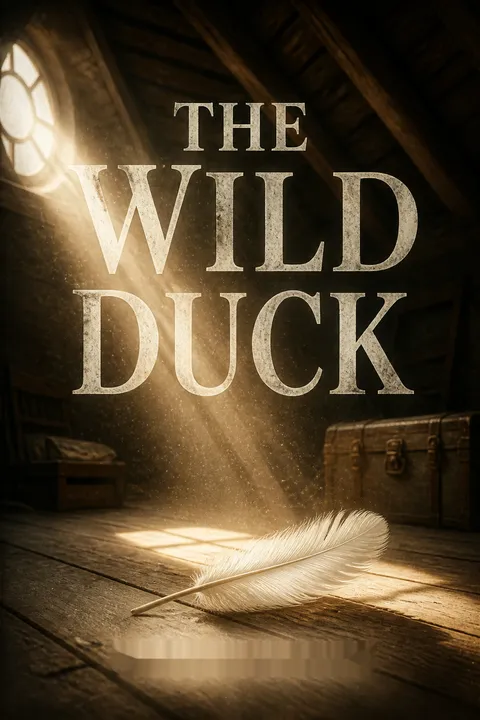
The wild duck, injured by Werle while shooting and saved from drowning by his dog, has become Hedvig’s treasured companion. Gregers sees the makeshift attic as a refuge for people who have been wounded and confined. Despite Gina’s unease, Hialmar welcomes him as a lodger, giving Gregers a place inside the household he intends to change.
The garret is both an animal enclosure and an imaginative landscape. Old Ekdal’s former forest life has contracted to rabbits, pigeons, and a wounded duck, yet the family’s care gives those small surroundings emotional scale. Hedvig’s blindness makes vision a practical danger as well as a metaphor, but the play does not make her merely symbolic: she reads, draws, helps with work, and claims a world of her own. Gregers interprets the household through the duck’s injury, a compelling analogy that also risks flattening its members into evidence for his moral theory. His lodgings turn concern into intervention.
Gregers Brings His Ideal
The next morning, Gregers finds Hialmar postponing paid retouching while Old Ekdal tends the garret and Hedvig offers to help. Hialmar instead describes an unfinished photographic invention that, he believes, will restore his father’s dignity and secure Hedvig’s future.
At lunch, Gregers calls the family’s contentment a kind of sickness; Dr. Relling, the lodger downstairs, argues that people often survive through sustaining illusions. The dispute sharpens when Werle arrives to reclaim his son.
Gregers refuses the firm, his inheritance, and a return to his father’s house. He then asks Hialmar to take a long walk, intending to reveal what he believes Hialmar must know. Gina and Relling both warn against the walk, but Hialmar goes, trusting his old friend.
This section stages two competing forms of care. Gregers treats painful knowledge as a route to freedom, while Relling treats protective fantasy as a practical support for people with little power. Neither position is neutral: Gregers needs a mission to make sense of his own guilt, and Relling’s skepticism can preserve comfort at the price of confronting injury. Hialmar’s invention sits between these approaches. It gives him dignity and a reason to imagine a future, but it also lets him avoid the labor and uncertainty of his actual business. Gregers mistakes emotional dependence for readiness to be remade.
The Past Enters the Studio
After the walk, Hialmar returns late and refuses dinner. He tells Gina he now knows that Werle pursued her while she worked in his household, and she admits that the relationship continued after Werle’s wife died. Gina says she hid it because she feared Hialmar would not marry her, and he recoils from the home she has helped build.
Gregers arrives expecting the truth to renew their marriage, but Hialmar cannot turn revelation into forgiveness. Relling warns that Gregers may harm the family by forcing his ideal of honesty upon them. Mrs. Sorby then announces that she and Werle will marry, openly aware of each other’s past. She adds that Werle is losing his sight and offers help to the Ekdals through his bookkeeper.
Gina’s confession changes the meaning of the household without changing the years of work that made it a home. Hialmar responds to the past as if it cancels the present, while Gina measures their marriage through the daily care and competence that have sustained him. The contrast with Werle and Mrs. Sorby complicates Gregers’s doctrine: their candor appears to permit a workable union, but it does not make their circumstances equivalent to the Ekdals’. Werle’s failing sight also echoes Hedvig’s condition, linking the families through vulnerability while preserving their unequal access to money and care.
A Gift Becomes an Accusation
Hialmar announces that he will repay Werle’s old financial support, though the family has little money. Then Hedvig brings out Werle’s birthday letter: it promises Old Ekdal a monthly allowance and transfers that support to Hedvig after his death. Gregers interprets the gift as Werle’s attempt to buy Hialmar’s silence.
Hialmar tears the document, then turns his suspicion on Gina and asks whether Hedvig is truly his child. Gina cannot give him certainty. Hialmar declares the home ruined and rushes out, rejecting Hedvig when she tries to stop him. Gregers urges the girl to prove her love through a voluntary sacrifice of her dearest possession, the wild duck. Hedvig accepts the idea and decides to ask Old Ekdal to shoot it.
The gift makes money carry several meanings at once: practical security for Old Ekdal, an inherited provision for Hedvig, and, in Gregers’s reading, leverage over Hialmar. Hialmar’s refusal may look principled, yet his suspicion transfers the burden of adult history onto a child who has done nothing to cause it. Hedvig responds by adopting Gregers’s language of sacrifice, converting affection into a test she can perform. The scene reveals the danger in Gregers’s idealism: he wants truth and selflessness, but he gives a vulnerable girl a dramatic task instead of helping her understand the adults’ conflict.
The House Holds Its Breath
The following morning, Hialmar returns after spending the night with Relling and Molvik. He is disheveled, says he will leave, and refuses Hedvig’s joyful attempt to welcome him, ordering her away. He gathers papers and scientific magazines for a departure he cannot organize, while Gina quietly offers food and time.
Hialmar admits he has no real confidence in the invention he once treated as his life’s work. He also begins to suspect that Hedvig’s affection was encouraged by the prospect of Werle’s money.
Gregers insists she can prove her love, but Hedvig has already abandoned the plan to kill the duck after reconsidering it. Alone, she takes the loaded pistol from its shelf and slips into the garret. The adults continue arguing in the next room, unaware she has gone.
The domestic details keep this crisis painfully ordinary: Hialmar cannot find his hat, eats breakfast while preparing to leave, and still depends on Gina to manage his belongings. His pride survives less as action than as a story he tells about himself, and its collapse leaves him unable to read Hedvig’s attachment except as possible manipulation. Gina’s practical patience buys time, but she cannot undo the words he has used to reject their daughter. Hedvig’s movement into the garret follows Gregers’s suggestion while also exceeding his control. The pistol, introduced as part of the household’s play and history, becomes a real danger.
The Garret's Final Shot
A gunshot breaks through the Ekdals’ argument. Gregers assumes Hedvig has made the sacrifice he proposed and tells Hialmar that she has killed the wild duck to win back his love. But Old Ekdal emerges unharmed, dressed in his lieutenant’s uniform, and says he did not fire. Hialmar searches the garret and finds Hedvig on the floor with the pistol in her hand.
Gina and Gregers help carry her out; Dr. Relling examines her and confirms that the bullet entered her chest and killed her immediately. Hialmar understands that he drove her away when she most needed him, and that the intended sacrifice has become irreversible. Gina insists they must bear the loss together, while Gregers sees the death as proof of Hedvig’s love.
The shot destroys the distance between metaphor and consequence. Gregers had treated sacrifice as a moral exercise, and Hialmar had treated the wild duck as a symbol of Werle’s influence; Hedvig’s death makes their interpretations answer to a body rather than an idea. The uncertain route from her decision to the fatal act does not soften the adults’ responsibility: she was left with a loaded weapon, a rejected attachment, and a task framed as proof. Hialmar’s remorse arrives only after there is no longer a living person to receive it. Gina’s insistence on shared grief offers the scene its most grounded response.
The Thirteenth Place
After Hialmar and Gina carry Hedvig into her room, Relling tells Gregers he believes the shot was deliberate, not accidental. Gregers refuses to settle the question and insists that Hedvig’s death has awakened something noble in Hialmar. Relling doubts that the change will last; he expects Hialmar to turn his grief into another performance of injured greatness.
He explains that he has long encouraged Hialmar’s belief in an important invention because the fantasy gives him energy, just as he has sustained Molvik’s belief that he is unusually troubled. Gregers cannot accept that comforting illusion may be more humane than painful truth. He leaves convinced his own fate is to remain the unwanted thirteenth guest.
The ending does not resolve the argument between truth and illusion; it makes both positions harder to defend. Gregers can point to Hedvig’s death as a moment that forces Hialmar into genuine grief, but Relling questions whether an intense feeling can remake a character permanently. His diagnosis is ethically compromised too: he has helped Hialmar avoid responsibility by feeding the fantasy of an invention. The play leaves the audience with no clean therapeutic answer. Exposure can injure, concealment can stunt, and the person who claims to heal may be protecting his own need to manage others.
Analysis
The Wild Duck turns a dispute about honesty into a question of who has the right to decide what another person can bear. Gregers sees disclosure as moral repair, but his certainty makes him treat Hialmar’s family as a project and Hedvig’s love as something that can be tested. Relling’s counterclaim, that people need illusions to survive, is more psychologically astute but ethically incomplete: he understands how Hialmar’s fantasies function, yet helps preserve the habits that keep him dependent and evasive. Neither man fully recognizes the consequences of directing another person’s inner life.
The play’s objects make these competing ideas tangible. The attic is simultaneously refuge and confinement; the wild duck is both a living animal and a story imposed on wounded people; the invention gives Hialmar purpose while concealing his lack of progress. The pistol is the harshest correction to metaphor. The characters have made the garret a place where danger can be domesticated as play, but the loaded weapon remains real.
Gina’s practical labor and Hedvig’s attentiveness complicate the men’s theories. They sustain a household that Gregers calls false and Relling calls tolerable, while receiving too little authority over the decisions that shape it. Hialmar’s central failure is not simply pride or dishonesty. It is his habit of measuring love by whether it confirms his importance. When that confirmation is withdrawn, he cannot recognize the devotion already present around him.
The ending offers no easy endorsement of silence or exposure. Concealment can shelter people from unbearable knowledge, but it can also preserve dependence and false selfhood. Truth can make relationships more honest, yet forced revelation can become another form of power. Ibsen leaves the audience with a sharper problem than whether illusion is good or bad: who is allowed to choose it, who pays for it, and what responsibility follows when one person’s ideal becomes another person’s burden?
Review Summary
The Wild Duck receives mostly positive reviews, with readers praising Ibsen's complex characters, layered storytelling, and thought-provoking themes. Many appreciate the play's exploration of truth, idealism, and the consequences of revealing hidden truths. Some find the ending predictable but impactful. Readers note the play's darker tone compared to Ibsen's other works and its ability to evoke strong emotions. The metaphor of the wild duck is seen as particularly powerful. Translations and audio versions are also mentioned positively.
People Also Read

Characters
Gregers Werle
Conscience in motionWerle’s adult son and Hialmar’s former school friend, Gregers has spent years away at his father’s timber works. He distrusts the respectable account of the past because he believes his father escaped responsibility for Old Ekdal’s ruin and mistreated Gregers’s mother. His conscience is sincere, but it is also restless: he needs a moral task large enough to justify his own earlier silence. Gregers treats truth as a form of rescue and is drawn to people he can imagine restoring. That impulse makes him courageous in challenging his father, yet poor at judging whether others have asked for his intervention. His conflict with Relling centers on whether people are strengthened by difficult truths or sustained by protective fictions.
Hialmar Ekdal
Dreaming family patriarchA photographer, husband to Gina, and father to Hedvig, Hialmar presents himself as the family’s provider and visionary. He speaks of an invention that will elevate his work and restore the Ekdal name, though he often leaves practical duties to Gina and retreats into the household’s attic world. His pride is especially tender around his ruined father and his own place as a man of consequence. Hialmar wants to be admired for sacrifice and devotion, but finds it difficult to face uncertainty without turning it into a story about his dignity. His dependence on others coexists with a strong need to believe he stands alone at the center of their welfare.
Gina Ekdal
Practical household anchorHialmar’s wife and Hedvig’s mother, Gina runs the Ekdals’ photography work while managing a tight household budget and caring for Old Ekdal. She is direct about food, money, customers, and the work that must be done, in contrast to Hialmar’s grand claims about his invention. Her practicality is not lack of feeling: she protects the family by concentrating on what can be repaired today. Gina also carries a private past she has not fully shared with Hialmar, partly from fear of losing the life she has built with him. She understands that affection and responsibility are often expressed through labor, even when the people receiving that care fail to recognize it.
Hedvig Ekdal
The attic's bright heartThe fourteen-year-old daughter of Hialmar and Gina, Hedvig is affectionate, observant, and eager to help the people she loves. Her eyesight is failing, but she remains curious: she reads, draws, takes an interest in engraving, and knows the details of the animals and oddments kept in the attic. She is especially attached to the wounded wild duck, whose isolation speaks to her without requiring explanation. Hedvig’s closeness to Hialmar makes his approval deeply important to her, while her parents’ efforts to protect her from painful knowledge leave her with little power to understand the tensions around her. Her kindness is active, not passive; she looks for ways to make herself useful and loved.
Old Ekdal
Disgraced forest hunterHialmar’s father, a former army officer and hunter, Old Ekdal was convicted after a timber-trading scandal and now survives through copying work arranged by Werle’s office. He is treated as a figure of shame in public, but within the family he preserves a sense of competence through his animals, tools, and memories of the forests. The attic allows him to keep practicing a diminished version of the life he lost. His scattered speech and private rituals can make him seem ridiculous to outsiders, yet they also show how carefully he protects what remains of his identity. His bond with Hedvig is rooted in shared attention to the small world they tend together.
Werle
Power behind the bargainA wealthy merchant and manufacturer, Werle is Gregers’s father and a former business partner of Old Ekdal. He uses money to support the Ekdals, but his help also keeps their livelihood tied to his influence. Accustomed to managing reputation and practical outcomes, he views family arrangements as matters that can be settled through money, marriage, and business. His concern for his son may be genuine, but it is difficult to separate from his wish to control how their relationship appears. Werle’s failing eyesight introduces vulnerability into a man who has long exercised power through wealth and status.
Mrs. Sorby
Clear-eyed new partnerWerle’s housekeeper and intended wife, Mrs. Sorby is socially capable, observant, and frank about the past she brings into a new relationship. She manages Werle’s household and understands the risks of living under public judgment. Unlike Gregers, she does not treat confession as an abstract moral test; she sees openness as a condition for a workable partnership. Her practical loyalty is paired with independence, and she is willing to choose a life that others may judge. Her position offers a contrast to the Ekdals’ hidden histories and precarious finances.
Dr. Relling
Doctor of useful fictionsA doctor living beneath the Ekdals, Relling is blunt, socially perceptive, and skeptical of Gregers’s moral crusade. He believes many people need an sustaining illusion to endure ordinary disappointments, and he has encouraged Hialmar’s faith in his invention. His care is unsentimental and sometimes manipulative: he sees the weakness in other people’s stories but also helps maintain them. Relling’s practical psychology gives him a sharp view of self-deception, though his confidence that he knows what others can bear may itself be a form of control.
Molvik
A clergyman in retreatA former theology student who lodges with Relling, Molvik is prone to drinking and depends on Relling’s companionship and explanations for his behavior. Relling preserves Molvik’s self-respect by encouraging him to think of his episodes as signs of an exceptional, troubled nature. His presence gives the play a small, comic example of how a person’s account of himself can be shaped by someone else’s care.
Pettersen
Werle's discreet servantWerle’s servant, Pettersen manages the household’s practical errands and knows how to move discreetly around its guests. He helps Old Ekdal pass through the office and is involved in the transfer of the wounded wild duck, linking Werle’s household to the Ekdals’ private refuge.
Graberg
The office's bookkeeperWerle’s bookkeeper, Graberg provides Old Ekdal with copying work and handles the financial arrangements that reach the Ekdal household. He is a small but important link between Werle’s wealth and the family’s fragile independence.
Plot Devices
The wounded wild duck
A mirror for the injuredWerle wounds the duck while shooting, and his dog retrieves it from the water after it has dived into weeds. Old Ekdal obtains the bird, and the family keeps it in the garret, where Hedvig treats it as her own. Its damaged wing, isolation, and dependence make it an image through which Gregers interprets the Ekdals. The duck also belongs to Hedvig’s private emotional world, so its meaning is not controlled by Gregers alone. As the play’s characters attach different hopes and fears to the bird, it exposes the gap between a symbol and the living creature it represents.
The attic refuge
A private forest in miniatureThe garret holds Old Ekdal’s pigeons, hens, rabbits, guns, books, and the wild duck. For him, it preserves a form of hunting and outdoor life after his public disgrace; for Hedvig, it is a realm of pictures and discovery. Hialmar adds small contrivances to keep the animals and family life going. Gregers interprets the enclosed space as evidence that the Ekdals have retreated from reality, while the family experiences it as comfort and shared activity. The setting makes both readings visible at once: the attic is a refuge, but also a small world that cannot replace what its occupants have lost.
Hialmar's invention
A promise without a productHialmar claims to be developing a major photographic invention that will elevate photography and restore the Ekdal name. He describes it as the purpose that gives his life meaning, and he imagines its success securing Hedvig’s future. In practice, the work remains undefined and repeatedly yields to household interruptions, retouching jobs, or activity in the garret. Relling admits that he encouraged Hialmar’s belief in the project as a sustaining illusion. The invention therefore operates both as Hialmar’s ambition and as a story that lets him feel indispensable without having to confront how little progress he has made.
Werle's birthday deed
Money turns into suspicionWerle’s letter promises Old Ekdal a monthly allowance and provides for the same support to pass to Hedvig. The document can be read as practical assistance for a poor family, but Gregers treats it as a means of buying Hialmar’s silence. Hialmar tears it up, then becomes suspicious that Werle’s attention to Hedvig may point to uncertainty about her parentage. The deed transforms an act of financial provision into a test of loyalty and belonging. Its arrival on Hedvig’s birthday makes the adult conflict impossible to keep separate from her need for security and affection.
The loaded pistol
Play becomes lethalThe pistol belongs to the family’s imagined hunting life in the garret. Hialmar and Old Ekdal use it to shoot at animals, and Hialmar warns Hedvig that it is loaded. Its presence quietly connects the old man’s history of shame, Hialmar’s account of despair, and the household’s playacting at the hunt. When Hedvig takes it after Hialmar rejects her, the familiar object changes from a prop in their private world into an instrument of real harm. The danger is established well before the final gunshot, making the catastrophe part of the household’s lived circumstances rather than an unexplained accident.
FAQ
Basic Details
What is The Wild Duck about?
- Family secrets unravel: The play centers on the Ekdal family, whose lives are disrupted by the return of Gregers Werle, who seeks to expose the lies and secrets that have shaped their existence.
- Clash of ideals: It explores the conflict between Gregers's rigid idealism and the more pragmatic, illusion-based reality of the Ekdals, particularly Hialmar, the son.
- Tragic consequences: The story follows the devastating impact of Gregers's pursuit of truth, which ultimately leads to a tragic outcome for the family, especially Hedvig.
Why should I read The Wild Duck?
- Complex characters: Ibsen crafts deeply flawed and relatable characters, each with their own motivations and vulnerabilities, making them compelling to analyze.
- Exploration of truth: The play delves into the nature of truth and illusion, questioning whether absolute honesty is always beneficial or if some lies are necessary for survival.
- Timeless themes: It tackles universal themes of family, betrayal, and the human condition, making it relevant to contemporary audiences and sparking ongoing debate.
What is the background of The Wild Duck?
- Social critique: The play reflects Ibsen's critique of the societal norms and moral hypocrisy of his time, particularly the rigid expectations placed on individuals.
- Psychological realism: Ibsen's focus on the inner lives and motivations of his characters anticipates the development of psychological realism in literature.
- Late 19th-century Norway: The setting provides a glimpse into the social and economic conditions of late 19th-century Norway, with its class divisions and changing values.
What are the most memorable quotes in The Wild Duck?
- "The woods avenge themselves.": Old Ekdal's recurring phrase highlights the theme of retribution and the consequences of past actions, foreshadowing the tragic events.
- "If you take away the life-lie from an average man, you take away his happiness.": Relling's cynical observation underscores the play's central conflict between truth and illusion, suggesting that some lies are necessary for survival.
- "To be the thirteenth at table.": Gregers's final line reveals his disillusionment and self-awareness of his role as a disruptive force, highlighting the tragic consequences of his idealism.
What writing style, narrative choices, and literary techniques does Henrik Ibsen use?
- Realistic dialogue: Ibsen employs naturalistic dialogue that reflects the characters' social backgrounds and psychological states, enhancing the play's realism.
- Symbolism: He uses recurring symbols like the wild duck and the garret to represent deeper themes and character states, adding layers of meaning to the narrative.
- Dramatic irony: Ibsen uses dramatic irony to create tension, as the audience is often aware of information that the characters are not, heightening the sense of impending tragedy.
Hidden Details & Subtle Connections
What are some minor details that add significant meaning?
- The locked office door: Old Ekdal's repeated struggle with the locked office door at Werle's symbolizes his exclusion and marginalization, highlighting his diminished status.
- The old uniform cap: Old Ekdal's wearing of his old uniform cap indoors reveals his longing for his past glory and his inability to accept his current circumstances.
- The mention of "sunshine": The repeated references to "sunshine" in relation to both wine and Chamberlains subtly satirizes the superficiality and dependence on external validation within Werle's social circle.
What are some subtle foreshadowing and callbacks?
- The thirteen at table: Werle's unease about having thirteen at the table foreshadows the disruption and tragedy that Gregers's presence will bring to the family.
- The dog's dive: The story of Werle's dog diving for the wild duck foreshadows Hedvig's own "dive" into the depths of despair and her tragic end.
- The "depths of the sea": Hedvig's discomfort with the phrase "depths of the sea" foreshadows her connection to the wild duck's fate and her own tragic end, linking her to the duck's symbolic journey.
What are some unexpected character connections?
- Relling and Mrs. Sorby: Their past relationship, hinted at by Relling's quivering voice and Mrs. Sorby's comment about "things might have gone further," adds a layer of complexity to their characters and their interactions.
- Gina and Mrs. Sorby: Their shared history as former housekeepers at Werle's house creates a subtle bond, despite their different approaches to life and relationships.
- Gregers and Relling: Despite their opposing views, they share a similar understanding of human nature, with Relling's cynicism acting as a dark mirror to Gregers's idealism.
Who are the most significant supporting characters?
- Relling: As the cynical doctor, he provides a counterpoint to Gregers's idealism, offering a more pragmatic view of human nature and the necessity of illusions.
- Mrs. Sorby: Her practical nature and her relationship with Werle challenge the traditional views of marriage and female roles, adding a layer of social commentary.
- Old Ekdal: His tragic past and his retreat into the garret highlight the themes of loss and the human need for escape, making him a poignant figure.
Psychological, Emotional, & Relational Analysis
What are some unspoken motivations of the characters?
- Werle's guilt: Despite his outward pragmatism, Werle's actions, such as providing for the Ekdals, suggest a hidden sense of guilt and a desire to atone for his past actions.
- Gina's self-preservation: Her reluctance to reveal her past and her focus on practical matters stem from a deep-seated need to protect herself and her family from further pain and instability.
- Hedvig's desire for connection: Her intense love for her father and her willingness to sacrifice her most prized possession reveal a deep-seated need for his affection and approval.
What psychological complexities do the characters exhibit?
- Hialmar's narcissism: His self-pity and his need for validation reveal a deep-seated narcissism that prevents him from truly connecting with others.
- Gregers's self-righteousness: His rigid adherence to his ideals and his inability to see the consequences of his actions highlight his self-righteousness and lack of empathy.
- Relling's cynicism: His cynical worldview and his belief in the necessity of illusions stem from a deep-seated disillusionment with human nature and the world.
What are the major emotional turning points?
- Hialmar's discovery of Gina's past: This revelation shatters his idealized view of his marriage and triggers a deep sense of betrayal and self-pity.
- Hedvig's decision to sacrifice the wild duck: This act, driven by her love for her father, marks a turning point in the play, leading to the tragic climax.
- Hialmar's rejection of Hedvig: His inability to accept Hedvig's love and his harsh words towards her lead to her despair and ultimately her death.
How do relationship dynamics evolve?
- Hialmar and Gina's marriage: Their relationship, initially based on a fragile illusion, crumbles under the weight of Gregers's revelations, exposing the underlying tensions and resentments.
- Hialmar and Hedvig's bond: Their close relationship, initially a source of comfort for Hialmar, is tragically destroyed by his inability to accept her love and his own self-absorption.
- Gregers and Werle's conflict: Their strained relationship, rooted in past grievances and differing ideals, escalates as Gregers seeks to expose his father's wrongdoings, leading to a final break.
Interpretation & Debate
Which parts of the story remain ambiguous or open-ended?
- Hedvig's true parentage: The play leaves the question of Hedvig's paternity unanswered, adding to the sense of uncertainty and the fragility of the family's foundation.
- The nature of truth: The play does not offer a clear answer as to whether absolute truth is always beneficial, leaving the audience to grapple with the complexities of human relationships and the value of illusions.
- The possibility of redemption: The ending leaves the characters' futures uncertain, raising questions about whether they can truly find redemption or if they are doomed to repeat their past mistakes.
What are some debatable, controversial scenes or moments in The Wild Duck?
- Gregers's interference: His relentless pursuit of truth and his imposition of his ideals on the Ekdal family raise questions about the ethics of his actions and the potential harm of well-intentioned interference.
- Hialmar's self-pity: His inability to take responsibility for his own life and his tendency to blame others for his misfortunes make him a controversial and unsympathetic character.
- The ending's ambiguity: The play's tragic ending, with Hedvig's death and the uncertain futures of the other characters, sparks debate about the play's message and the nature of tragedy.
The Wild Duck Ending Explained: How It Ends & What It Means
- Hedvig's tragic sacrifice: Her suicide, intended as a gesture of love, highlights the destructive power of misguided idealism and the tragic consequences of adult conflicts on innocent lives.
- Hialmar's self-deception: His inability to accept responsibility for his actions and his retreat into self-pity underscore the play's critique of self-deception and the dangers of clinging to illusions.
- Gregers's disillusionment: His final line, "To be the thirteenth at table," reveals his recognition of his role as a disruptive force and his disillusionment with his own ideals, suggesting that his mission has ultimately failed.
About the Author
Other books by Henrik Ibsen


Download PDF
Download EPUB
.epub digital book format is ideal for reading ebooks on phones, tablets, and e-readers.








