

Plot Summary
Prologue
A traveling canteen wagon moves with the Swedish army, carrying Anna Fierling, known as Mother Courage, and her three children: bold Eilif, honest Swiss Cheese, and mute Kattrin. The family sells food, drink, and whatever else soldiers need to keep marching.
Their opening song turns this trade into a plain bargain: the army consumes people, and the wagon feeds the army. They travel together, but the road already points in opposite directions, toward the war that earns Mother Courage her living and the dangers she cannot keep from her children.
The family’s wagon is both shelter and livelihood, but the song makes clear that its business depends on soldiers surviving long enough to buy provisions and dying soon enough to keep the army moving. Mother Courage’s practical wit is not separate from the war’s violence; it is adapted to that violence. The children join her song as if they share a family trade, yet they are also the human cost concealed inside its cheerful sales pitch. The prologue establishes the play’s central contradiction through action: the mother who wants to protect her children must keep serving the institution that endangers them.
The Wagon's Missing Son
In 1624, Swedish recruiters stop Mother Courage on a road and try to enlist Eilif, whose confidence makes him an easy target. She tears paper into lots marked for death, drawing one for each child and the sergeant; every slip bears a black cross. The warning briefly seems to hold the family together.
Then the recruiter distracts Eilif with promises of pay and military glory while Mother Courage haggles with the sergeant over a belt. By the time she returns, Eilif has gone with the recruiter. She can only send Swiss Cheese and Kattrin onward with the wagon, and her effort to outwit the army has helped create the opening it needed.
The lots turn a mother’s fear into a small ritual of control, but their identical marks cannot change the conditions that make her children vulnerable. Mother Courage’s attention is divided by the very trade that sustains her: a half-guilder matters because her family lives on transactions, yet the bargain costs her time with Eilif. The scene does not make her simply careless or simply powerless. She recognizes the danger and acts against it, then returns to commerce at the decisive moment. Her practical intelligence is real, but it cannot master a system that recruits the young through the same promises of profit and agency that govern her own life.
Heroism at Wallhof
Two years later, Mother Courage finds Eilif in the Swedish commander’s tent, celebrated for seizing oxen from peasants and killing those who resisted. The commander treats the raid as courage in a holy cause and gives Eilif a place at his table. Mother Courage has sold the commander an overpriced capon to secure a meal for her son, so the family’s business and the army’s violence meet over dinner.
She is proud of Eilif’s nerve, yet strikes him for refusing to surrender when outnumbered. The same act that earns him military honor alarms her because it was needlessly dangerous. Swiss Cheese, meanwhile, serves as a regiment’s paymaster, valued for his honesty and lack of ambition.
Eilif’s story exposes how war converts theft into virtue when the violence serves the army. The commander praises the same instinct Mother Courage fears, making the distinction between bravery and recklessness depend on who profits. Her slap is not a moral rejection of the killing; she is angry that Eilif risked his life. That response captures her deepest compromise: she knows the war’s rules are brutal, but tries to teach her children how to survive within them rather than how to refuse them. Swiss Cheese’s appointment as paymaster establishes a contrasting form of value, one based on reliability rather than spectacle.
Swiss Cheese's Last Errand
Three years later, a Catholic attack scatters the Swedish camp. Swiss Cheese takes the regimental cashbox because he believes an honest paymaster must protect it, despite Mother Courage’s warning that it could get them all arrested. When he tries to return it, soldiers capture him.
Mother Courage denies knowing her son while Yvette Pottier arranges a bribe, but the cashbox has been thrown into a river and the price of Swiss Cheese’s release keeps shifting. Mother Courage bargains over the amount, hoping to save both her son and the wagon that feeds the family. She finally agrees to pay, too late: Swiss Cheese is executed. When soldiers bring his body for identification, she denies him again so Kattrin and she can survive.
Swiss Cheese’s honesty, ordinarily treated as a virtue, becomes a trap when the army makes him responsible for its money and then suspects him of theft. Mother Courage’s bargaining is painful because it is not empty calculation: the wagon is their means of survival, and a bribe might preserve it as well as her son. Yet the scene makes every choice costly, then refuses the fantasy that perfect maternal sacrifice would necessarily have saved him. Her denial of his body protects the living, but it also forces her to perform the very indifference that keeps her in business. Survival here requires a public lie about private attachment.
The Complaint Unmade
After Swiss Cheese’s death, Mother Courage finds her wagon damaged and a fine imposed for reasons she knows are corrupt. A clerk warns that a formal complaint could expose her past connection to the paymaster and cost her place in the camp. While she waits, a young soldier storms in, furious that his captain has kept a reward he earned.
Mother Courage urges him to measure how long his anger will last; when he hesitates, she points out that his protest will change nothing if he cannot sustain it. The soldier sits down and lets the moment pass. Watching him, Mother Courage abandons her own complaint and leaves the injustice untouched, keeping the narrow space in which she can continue trading.
The soldier’s anger and Mother Courage’s grievance differ in scale, but both encounter an institution designed to outlast individual protest. She does not argue that the captain is right; she teaches the soldier that outrage without power can become another injury inflicted on the powerless. Her advice is psychologically astute and politically bleak. Because she has learned to survive by anticipating punishment, she can recognize the point where resistance becomes futile. The price is that her realism reproduces the order she resents. The scene makes capitulation neither a noble virtue nor a simple weakness, but a habit formed when the cost of dissent falls on people with little protection.
Kattrin Breaks the Bargain
In 1631, after a victory leaves a village damaged, the chaplain carries wounded peasants to Mother Courage’s wagon and asks for linen. Mother Courage refuses to tear up her officer shirts, which she could sell, and Kattrin answers by lifting a board against her. The chaplain takes the shirts and rips them into bandages.
When they hear a child still trapped in a house, Kattrin runs inside and brings the baby out, then rocks it while the adults treat its injured family. Mother Courage protests the lost goods and finally strips a stolen fur coat from a soldier who cannot pay for his drink. Kattrin’s actions save the child, but make visible the distance between her compassion and her mother’s calculations.
Kattrin’s muteness does not make her passive. She uses a board to challenge Mother Courage, then enters the damaged house when others hesitate. Her care for the child takes bodily form, unlike the army’s abstract claims about religious duty or victory. Mother Courage’s refusal is also concrete: the shirts represent inventory, taxes, and the family’s next meal. The conflict is not between a good daughter and a bad mother, but between two responses to scarcity. Kattrin risks what little they possess for strangers; Mother Courage protects the means of survival. The scene gives compassion a cost without dismissing the conditions that make generosity frightening.
A Scar Beneath Red Boots
In 1632, the army buries General Tilly, but Mother Courage doubts the funeral will end the fighting. The chaplain argues that war will continue, and she buys more supplies rather than risk being caught without stock. She also rejects his attempt to turn their shared life into a romance, insisting that practical help with the wagon and firewood is enough.
Kattrin later returns from fetching goods with a wound above her eye, having been attacked on the road. Mother Courage bandages her and gives her the red boots Kattrin once coveted, but Kattrin retreats into the wagon without putting them on. Mother Courage sees the scar as a barrier to marriage and children, while Kattrin’s silence leaves her pain unread.
The funeral offers an apparent pause, but Mother Courage reads it through the economics of supply and demand. Her decision to stock up shows how thoroughly the war has trained her to treat uncertainty as a business forecast. Kattrin’s wound makes the costs of that forecast personal: the daughter sent to collect goods returns marked by violence, and the mother’s gift cannot restore what was taken. The red boots carry a history of desire and imitation, yet Kattrin will not wear them now. Mother Courage interprets her daughter’s future through marriage and motherhood, revealing how even her tenderness is shaped by the social limits she has learned to accept.
Peace Takes Eilif
After the Swedish king dies, news arrives that the war has stopped. Mother Courage regrets buying extra supplies, while the Cook returns broke and Yvette appears prosperous, now a colonel’s widow. During the confusion, Eilif is brought to the wagon in chains. He has raided a peasant household as he once did during the war, but now the same violence is treated as a crime; soldiers take him away to be executed.
Mother Courage is out of the way, and the Cook conceals what happened, so she believes Eilif has merely gone on ahead. Before she can understand the loss, fighting resumes. She harnesses the Cook beside Kattrin and returns to the road, still expecting to meet her son.
Eilif’s arrest makes the war’s moral logic brutally visible: his action has not changed, only the political condition that once rewarded it. The shift from hero to criminal exposes how authority assigns virtue according to utility, not principle. Mother Courage misses the truth not through indifference but because the men around her hide it, leaving her hope intact and therefore unexamined. The renewed war restores her livelihood just as peace threatens it, but that practical relief is purchased with an absence she does not know how to name. Her forward motion is both resilience and entrapment: she can keep going because the road delays recognition.
The Inn Without Kattrin
By 1634, famine has reduced Mother Courage and Kattrin to begging beside their wagon. The Cook receives news that he has inherited an inn in Utrecht and offers Mother Courage a settled life with him, but only if she leaves Kattrin behind. He argues that the inn cannot support all three and points to Kattrin’s scar as an obstacle to customers.
Mother Courage refuses to abandon her daughter, though she insists the wagon, not Kattrin, is the reason she will not go. She sends the Cook away and pulls the wagon with Kattrin through the winter. Later, they pause outside a warm farmhouse, listen to a song about shelter, and continue toward the soldiers’ road.
The Cook’s offer gives Mother Courage a rare chance to leave the war economy, but its price is the exclusion of Kattrin. Mother Courage chooses her daughter, then protects herself from the emotional meaning of that choice by naming the wagon as the reason. That denial is consistent with her way of managing attachment: she can endure sacrifice more easily when she translates it into business. Kattrin, meanwhile, hears the proposal and prepares to leave, showing that she understands herself as a burden in the Cook’s calculation. Their continued journey preserves their bond, but offers no refuge from the hunger and violence that shaped it.
The Drum Over Halle
In January 1636, Catholic troops force a young peasant to guide them toward the Protestant town of Halle. Kattrin and a farming family learn that the sleeping town faces a surprise attack, but the farmers fear the soldiers will kill them if they raise an alarm. Kattrin climbs onto a roof with a drum and beats it toward the town.
The troops threaten her, damage the wagon, and finally shoot her, but her drumming continues long enough for the town’s bells and cannon to answer. At dawn, Mother Courage sits beside Kattrin’s body while the peasants promise a burial. Still believing Eilif lives, she harnesses herself alone and follows the departing regiment, calling for it to take her along.
Kattrin’s last action grows from the same impulse that led her to rescue the baby: she sees endangered people and moves toward them, even when the people nearby cannot act. The farmers’ fear is rational, which prevents the scene from making courage seem effortless or universally available. Kattrin’s drum turns a vulnerable body into a warning system, and the town’s answering guns confirm that her action has consequences beyond her death. Mother Courage’s departure preserves the play’s unresolved contradiction. She has lost her children to the war yet still follows the army that feeds her, carrying hope for Eilif because no one has told her otherwise.
Analysis
Mother Courage’s tragedy is not that she fails to understand war. She understands its prices with unusual clarity. She knows soldiers need food, commanders reward useful violence, officers can be bribed, and peace can ruin a business built around armies. The harder question is what such knowledge can accomplish when the choices are structured by scarcity. She repeatedly identifies danger, yet her means of avoiding it are entangled with the system that produces it. The wagon keeps her children fed and keeps her moving through the war’s reach.
The play tests moral categories by changing the circumstances around the same act. Eilif’s raid earns praise in wartime and punishment in peace, exposing how authority can make violence respectable when it serves a campaign. The Chaplain’s religious explanations and the commander’s celebrations offer different languages for that same convenience. Against them, Kattrin’s interventions are concrete: she gives linen, carries a baby from danger, and warns a town. Her choices do not depend on institutional permission, though they expose her to institutional force.
Mother Courage and Kattrin are not simple opposites. Both respond to vulnerability, but Mother Courage tries to secure survival through calculation while Kattrin answers immediate need through action. The difference is partly temperamental and partly produced by their positions: the mother must keep an entire livelihood moving, while the daughter acts on the suffering directly before her. By the final scene, Mother Courage continues to believe Eilif is alive because the Cook has concealed the truth. Her hope is not a comforting resolution; it is another condition that lets her pull the wagon forward. The ending refuses both easy condemnation and consolation. The war takes the family apart, while the business that depends on the war remains in motion.
Review Summary
Mother Courage and Her Children is a powerful anti-war play set during the Thirty Years' War. It follows a canteen woman who profits from the conflict while trying to protect her children. Reviewers praise Brecht's sharp critique of war and capitalism, though some find the protagonist unsympathetic. The play's epic theater style and alienation effect divide opinions. Many appreciate its timeless themes and political commentary, while others find it didactic or boring. Overall, it's considered an important work of 20th-century drama, provoking thought on war's impact on ordinary people.
People Also Read






Characters
Mother Courage
War's resourceful traderBorn Anna Fierling and known by her nickname, Mother Courage travels with a wagon selling food and goods to soldiers. She is sharp at bargaining, alert to danger, and fiercely protective of her children, but she measures nearly every choice against the need to keep her business alive. That practical instinct lets her read people and shifting military fortunes; it also narrows what she can imagine beyond survival. She distrusts grand claims about religion, honor, and peace because she has seen how easily they conceal profit. Her love is unmistakable, though she often expresses it through warnings, provisions, and attempts to manage risk rather than open tenderness.
Kattrin
The family's quiet rescuerMother Courage’s mute daughter, Kattrin communicates through gestures, sounds, and decisive action. A childhood injury inflicted by a soldier left her unable to speak, and the war has also shaped how others judge her appearance and prospects. She is gentle with children and vulnerable people, yet not meek: she resists her mother when conscience demands it and moves toward danger when others remain still. Kattrin’s closeness to Mother Courage is real but uneasy, since her mother’s protective plans often reduce her to someone to be guarded. Her compassion is not abstract; she acts with the people and needs immediately before her.
Eilif
The celebrated fighterMother Courage’s eldest son is bold, quick-witted, and drawn to the recognition that military life promises. He enjoys danger and knows how to turn a desperate situation to his advantage, traits that earn admiration from commanders. His confidence makes him impressive to others and difficult for his mother to restrain. Eilif has inherited the war’s public language of courage more readily than her warnings about survival. His story tests the distinction between bravery and violence, asking how much of a soldier’s reputation comes from character and how much from the circumstances in which his actions occur.
Swiss Cheese
The honest paymasterMother Courage’s middle child is steady, dutiful, and trusting. The army gives him responsibility for money because it considers him honest and unlikely to scheme, but his sense of duty can make him slow to recognize danger. He wants to do right by the people who have trusted him, including his regiment and family, even when their needs conflict. His goodness is quiet rather than heroic: he values proper accounting and dependable work. In a world where survival rewards suspicion and improvisation, his straightforwardness leaves him especially exposed.
The Cook
The practical old companionA Dutch army cook who first meets Mother Courage while bargaining over a capon, the Cook is hungry, shrewd, and more candid about appetite than military ideals. He knows that official talk about liberation and religion often hides ordinary self-interest. His past with Yvette and his attraction to Mother Courage make him a possible companion, but he remains attentive to the limits of his own comfort. The Cook can offer realistic advice and a route toward settled life, yet his practical calculations have sharp edges when Kattrin’s place in that future is considered.
The Chaplain
The war's pious interpreterAttached to the Swedish army, the Chaplain supplies religious explanations for a campaign whose conduct repeatedly contradicts its stated ideals. He is articulate, adaptable, and capable of helping with physical work when circumstances require it, though he prefers the authority of preaching. His shifting relationship with Mother Courage reflects his dependence on her wagon and his hope for personal closeness. He can recognize hypocrisy, but his ability to rationalize war also lets him live alongside it. He represents not simple faith, but the uneasy cooperation between religious language and military power.
Yvette Pottier
The camp followerYvette is a camp follower who has learned to survive through attachment, performance, and negotiation. Her history with an unreliable army cook has left her wary of romantic promises, and she tries to pass that knowledge to Kattrin. She can be generous when Mother Courage’s family is in danger, but she also knows how to make an exchange serve her own future. Her changing circumstances reveal how women near the army must treat desire and money as practical questions, not separate realms.
The Swedish Commander
The rewarded authorityThe commander welcomes Eilif as a celebrated soldier and interprets violence against peasants as service to the army’s cause. He embodies the power to decide which acts earn praise and which are punished, while his own authority depends on soldiers and provisions supplied by people like Mother Courage.
The Recruiting Officer
The army's persuaderThe recruiting officer searches for young men to fill the Swedish ranks. He recognizes Eilif’s appetite for recognition and exploits it with promises of pay and status, turning recruitment into a personal bargain that separates a family.
The Sergeant
The army's gatekeeperThe sergeant helps recruit soldiers and polices the road, treating military organization as a necessity even when it consumes local people. His dealings with Mother Courage show how bureaucracy and commerce overlap at the army’s edges.
One Eye
The camp informerA one-eyed informer who searches for the missing regimental cashbox, One Eye helps the soldiers identify Swiss Cheese. He represents the surveillance that makes even an ordinary family meal feel unsafe during military upheaval.
The Old Peasant Family
Civilians under threatAn elderly farmer, his wife, and their son are trapped between the approaching army and the danger of resisting it. Their fear is grounded in immediate threats to their home and cattle, not abstract loyalties, and their predicament frames Kattrin’s choice to warn Halle.
Plot Devices
The Canteen Wagon
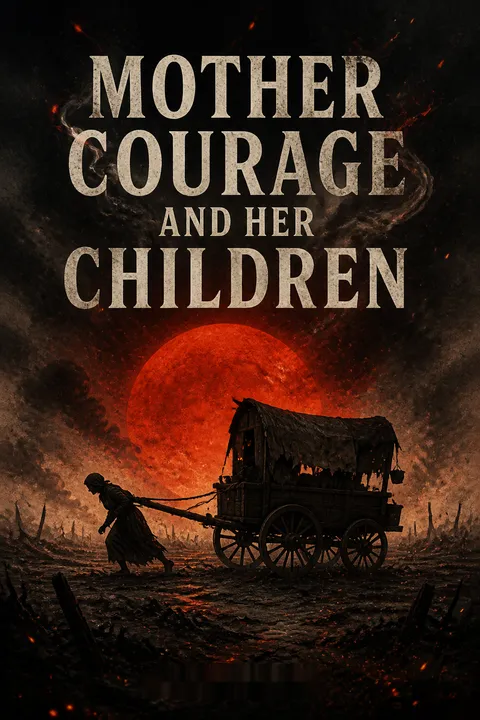
Livelihood and burdenMother Courage’s wagon carries the family’s stock, shelter, and means of earning money. Its movement links the play’s separate military encounters, while its contents make every act of generosity or loss financially consequential. Mother Courage protects it because without the wagon she has no trade, but the same trade keeps her attached to the armies that endanger her children. It is not merely a symbol of commerce: characters pull it, load it, strip it, and depend on it for food. Its continued motion gives the ending its stark shape, as Mother Courage takes it onward without the family that once traveled with her.
The Black-Cross Lots
A warning without controlMother Courage tears paper into slips and draws from a helmet to predict which family members face death. The ritual gives her fear a visible form and briefly appears to offer a way to prepare for danger. Yet every slip bears the same mark, suggesting that no child can be separated from the risks of the war around them. The lots do not cause the losses, nor do they prevent them. Their force comes from the gap between recognizing danger and having the power to change its conditions.
The War's Changing Rules
Violence changes its labelThe play moves through military advances, defeats, and a short peace, repeatedly changing what actions are rewarded. Eilif’s violence against peasants brings him honor during wartime and condemnation when the war pauses. Mother Courage’s trade likewise prospers while armies need supplies and falters when peace empties the roads. These reversals make political circumstance visible in ordinary decisions: the same deed, product, or skill can shift from profitable to punishable without changing in itself. The cycle connects family tragedy to the institutions that define what counts as courage, crime, or survival.
The Warning Drum
A body becomes an alarmKattrin takes a drum to the roof when she realizes Halle is about to be attacked. The instrument makes sound travel where she cannot use speech, turning her physical effort into a warning for people she has never met. Soldiers attempt to silence the drum through threats and violence, but the town’s bells and cannon answer it. Its role is prepared by Kattrin’s earlier acts of care, which also depend on action rather than explanation. The drum becomes a practical means of communication and a measure of what the army is willing to do to suppress it.
FAQ
Synopsis & Basic Details
What is Mother Courage and Her Children about?
- War profiteering and loss: The play follows Anna Fierling, known as Mother Courage, as she traverses war-torn Europe with her wagon, selling goods to soldiers and attempting to profit from the Thirty Years' War.
- Family's disintegration: Despite her efforts to protect them, Mother Courage loses all three of her children to the war, highlighting the conflict's destructive impact on families.
- Critique of war: The play serves as a critique of war, exposing its brutality, futility, and the moral compromises it forces upon individuals.
Why should I read Mother Courage and Her Children?
- Anti-war masterpiece: It's a seminal anti-war play that challenges romanticized notions of heroism and exposes the devastating consequences of conflict.
- Complex characters: The play features complex and morally ambiguous characters, forcing audiences to confront difficult questions about survival, ethics, and human nature.
- Brechtian techniques: It showcases Brecht's signature epic theatre techniques, such as alienation effect and episodic structure, offering a unique and thought-provoking theatrical experience.
What is the background of Mother Courage and Her Children?
- Thirty Years' War setting: The play is set during the Thirty Years' War (1618-1648), a devastating conflict that ravaged Europe, primarily fought over religious and political differences.
- Brecht's anti-fascist stance: Written on the eve of World War II, the play reflects Brecht's strong anti-fascist views and his concern about the rise of militarism and the exploitation of war.
- Historical inspiration: Brecht drew inspiration from historical accounts of canteen women who followed armies during the Thirty Years' War, adapting their stories to create a powerful indictment of war.
What are the most memorable quotes in Mother Courage and Her Children?
- "When a war gives you all you earn, One day it may claim something in return!": This quote foreshadows the tragic losses Mother Courage will suffer, highlighting the war's deceptive promise of profit and its ultimate cost.
- "The war, which is a scandal, will one day be exposed as nothing but business.": This quote encapsulates Brecht's critique of war as a commercial enterprise, driven by greed and exploitation rather than noble ideals.
- "Unhappy the land that has no heroes." "No, unhappy the land that needs heroes.": This exchange challenges conventional notions of heroism, suggesting that a society that requires heroes is inherently flawed and prone to conflict.
What writing style, narrative choices, and literary techniques does Bertolt Brecht use?
- Epic Theatre: Brecht employs techniques of Epic Theatre, including episodic structure, alienation effect (Verfremdungseffekt), and direct address to the audience, to encourage critical engagement rather than emotional identification.
- Didacticism: The play is overtly didactic, aiming to teach the audience about the destructive nature of war and the dangers of blind patriotism.
- Songs as commentary: Songs are used not to advance the plot or reveal character emotions, but to provide commentary on the action and to reinforce the play's themes.
Hidden Details & Subtle Connections
What are some minor details that add significant meaning?
- The changing condition of the wagon: The wagon's deterioration throughout the play mirrors Mother Courage's declining fortunes and the cumulative damage inflicted by the war.
- Yvette's red boots: The red boots initially symbolize Yvette's youthful allure and later represent Kattrin's longing for normalcy and love, highlighting the war's disruption of personal desires.
- The cook's pipe: The cook's pipe, initially a symbol of his past relationship with Yvette, becomes a reminder of lost connections and the fleeting nature of wartime alliances.
What are some subtle foreshadowing and callbacks?
- The fortune-telling scene: Mother Courage's fortune-telling at the beginning foreshadows the tragic fates of her children, creating a sense of impending doom.
- Eilif's wartime bravery: Eilif's initial act of bravery, praised by the Commander, foreshadows his later crime and execution, highlighting the war's distortion of moral values.
- The song of the Great Capitulation: Mother Courage's song about compromising principles is a callback to her own decisions throughout the play, emphasizing the gradual erosion of her moral compass.
What are some unexpected character connections?
- Yvette and the Cook's past: The revelation of Yvette and the Cook's past relationship adds a layer of complexity to their interactions and underscores the interconnectedness of lives in wartime.
- The Chaplain and the Cook's rivalry: The Chaplain and the Cook's rivalry for Mother Courage's attention reveals their shared desire for stability and companionship amidst the chaos of war.
- Kattrin and Yvette's shared longing: Kattrin's fascination with Yvette's red boots highlights a shared longing for beauty and normalcy, despite their different circumstances.
Who are the most significant supporting characters?
- The Cook: The Cook serves as a cynical counterpoint to Mother Courage, offering a pragmatic perspective on survival and exposing the moral compromises of war.
- The Chaplain: The Chaplain represents the idealistic but ultimately ineffective role of religion in the face of war's brutality, highlighting the conflict between faith and reality.
- Yvette Pottier: Yvette's transformation from a young camp follower to a wealthy widow illustrates the war's capacity to both destroy and elevate individuals, showcasing the complexities of survival and adaptation.
Psychological, Emotional, & Relational Analysis
What are some unspoken motivations of the characters?
- Mother Courage's fear of poverty: Beneath her entrepreneurial spirit lies a deep-seated fear of poverty, driving Mother Courage's relentless pursuit of profit even at the expense of her children's safety.
- Kattrin's desire for motherhood: Kattrin's muteness masks a profound longing for motherhood, evident in her nurturing behavior towards children and her distress over her disfigurement.
- The Cook's need for companionship: The Cook's return to Mother Courage reveals a need for companionship and stability, despite his cynical exterior and opportunistic tendencies.
What psychological complexities do the characters exhibit?
- Mother Courage's cognitive dissonance: Mother Courage exhibits cognitive dissonance, simultaneously condemning the war while profiting from it, revealing her internal conflict between maternal instincts and economic survival.
- Kattrin's suppressed emotions: Kattrin's muteness amplifies her emotional vulnerability, making her acts of compassion and sacrifice all the more poignant.
- The Chaplain's disillusionment: The Chaplain's gradual disillusionment with the war and religion reflects a psychological struggle to reconcile his ideals with the harsh realities of conflict.
What are the major emotional turning points?
- Swiss Cheese's death: Swiss Cheese's death marks a major emotional turning point, shattering Mother Courage's belief in her ability to protect her children and exposing the war's brutal consequences.
- Eilif's execution: Eilif's execution further devastates Mother Courage, forcing her to confront the arbitrary nature of justice and the war's distortion of moral values.
- Kattrin's sacrifice: Kattrin's sacrifice represents the ultimate act of selflessness, highlighting the power of individual courage and leaving Mother Courage utterly alone.
How do relationship dynamics evolve?
- Mother Courage and her children: The relationship between Mother Courage and her children deteriorates as the war progresses, with each loss straining their bonds and exposing the limitations of her maternal protection.
- Mother Courage and the Cook: The dynamic between Mother Courage and the Cook shifts from a pragmatic partnership to a strained alliance, reflecting their differing priorities and the corrosive effects of war on human relationships.
- Mother Courage and the Chaplain: The relationship between Mother Courage and the Chaplain evolves from a philosophical debate to a shared experience of hardship, revealing their contrasting approaches to survival and faith.
Interpretation & Debate
Which parts of the story remain ambiguous or open-ended?
- Mother Courage's self-awareness: The extent to which Mother Courage recognizes her own complicity in the war's destruction remains ambiguous, prompting debate about her moral responsibility.
- The possibility of redemption: The play's ending offers no clear resolution or redemption for Mother Courage, leaving open the question of whether she is capable of learning from her experiences.
- The effectiveness of Kattrin's sacrifice: The impact of Kattrin's sacrifice on the town's survival is left uncertain, raising questions about the efficacy of individual acts of resistance against overwhelming forces.
What are some debatable, controversial scenes or moments in Mother Courage and Her Children?
- Mother Courage's haggling over Swiss Cheese's ransom: Mother Courage's decision to haggle over the ransom for Swiss Cheese is a controversial moment, sparking debate about her priorities and the extent of her maternal love.
- The Chaplain's justification of war: The Chaplain's attempts to justify the war on religious grounds are controversial, challenging audiences to confront the ethical implications of faith and violence.
- Mother Courage's continued pursuit of profit: Mother Courage's continued pursuit of profit despite her losses raises questions about her capacity for empathy and the corrupting influence of greed.
Mother Courage and Her Children Ending Explained: How It Ends & What It Means
- Mother Courage's solitude: The play ends with Mother Courage alone, pulling her wagon, symbolizing her isolation and the devastating consequences of prioritizing profit over family.
- The cyclical nature of war: The repetition of the soldiers' song at the end reinforces the cyclical nature of war, suggesting that the conflict will continue regardless of individual suffering.
- A bleak outlook on humanity: The ending offers a bleak outlook on humanity, suggesting that individuals are often trapped by their circumstances and unable to break free from the destructive patterns of war and greed.
Download PDF
Download EPUB
.epub digital book format is ideal for reading ebooks on phones, tablets, and e-readers.








