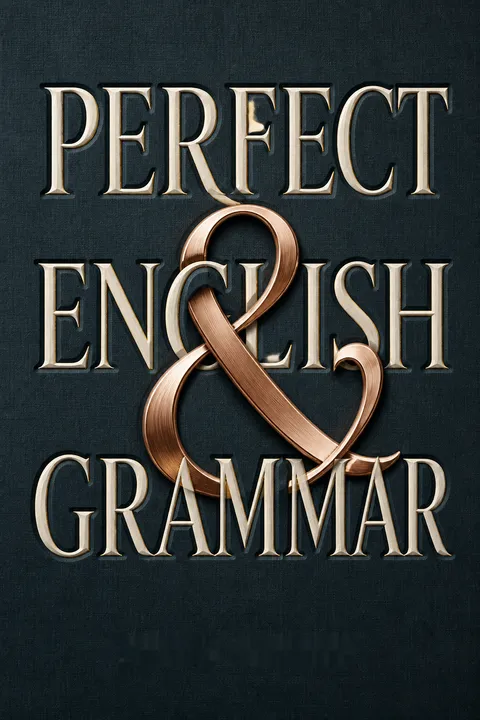


Key Takeaways
Treat perfect grammar as a direction, not a finish line.
Clarity outranks perfection. Grant Barrett recalls arriving at college confident in his writing, only to receive blunt feedback about excess commas and wordiness. That embarrassment launched a deeper study of English and, eventually, a career editing dictionaries. His lesson is not that every sentence must satisfy one final authority. English has few rules that hold in every setting, and some supposed rules are simply preferences repeated with great confidence. The practical goal is communication that suits the purpose, audience, and situation.
Practice, then stay curious. Barrett encourages readers to develop speaker’s intuition, their growing sense of what sounds natural and appropriate through reading, listening, and checking uncertain points. Grammar is a framework for finding a voice, not a substitute for one. Even the book’s word perfect is an aspiration, not a promise that language can be made flawless.
What's useful here is the separation of competence from infallibility. A writer can learn conventions without treating every correction as evidence of personal failure. That distinction also makes room for language change: a form can be understandable, widespread, and still judged unsuitable in a particular workplace or classroom. The guide’s flexibility is strongest when paired with its insistence on audience awareness. Its limit is that readers may still face gatekeepers who treat preferences as objective rules. Understanding that social pressure helps writers make deliberate choices rather than mistake every criticism for a grammatical fact.
Match your tone to the reader before choosing your words.
Audience sets the register. Register means the level of formality and the social setting signaled by language. A message to a client may need to be warm and concise, while a request to a professor may call for more formal wording and basic courtesies. Barrett describes seeing writers use an academic tone in casual client communication, and students send instructors messages too informal to fit the relationship. Neither style is universally best. The useful question is what this reader expects in this situation.
Purpose shapes the voice. Before drafting, identify who will read the message, what they need from it, and what response the writer hopes to get. A tone mismatch can distract from otherwise sound content. Formality is not a synonym for intelligence, and casual language is not inherently careless. Good choices make the message feel suited to its audience rather than copied from a different context.
This advice treats communication as a relationship, not a performance of abstract correctness. In pragmatics, the study of how meaning depends on context, the same sentence can function as a request, a rebuke, or a joke depending on who says it and where. Register gives writers a practical way to anticipate that effect. At the same time, audience matching should not mean surrendering every trace of personal voice. The goal is enough adaptation to remove friction, while preserving the warmth or directness that makes a message sound human.
Give each paragraph one job, then support it until it is earned.
Build a small argument. Barrett describes a formal paragraph as having a topic, supporting material, and a conclusion. The opening introduces the main point; the body explains or proves it with examples, facts, definitions, comparisons, or steps; the ending gives the reader a natural stopping point. Paragraphs can vary in length, because grammar does not require a fixed number of sentences. A paragraph needs enough evidence to do its job, not a quota of lines.
Scale the pattern up. The familiar five-paragraph essay expands this structure into an introduction, three supporting sections, and a conclusion. It is a useful scaffold, not a universal mold. Barrett advises putting the strongest argument near the beginning, since readers may not reach a delayed payoff. Transitions help ideas connect instead of reading like a stack of unrelated claims. Each paragraph should advance the argument, not merely increase the word count.
The paragraph model is valuable because it gives revision a concrete diagnostic: can a reader identify the point, see why it is plausible, and understand what follows from it? That question applies beyond school essays, including reports and persuasive emails. The five-paragraph template is best understood as training wheels, not a law of composition. Some arguments need one major section, others need many, and narrative writing may organize ideas through scenes. The deeper principle is purposeful progression, with each unit giving the reader a reason to continue.
Draft freely, but edit as if someone else must understand it.
Make a first move. When the blank page stalls a writer, Barrett suggests outlining, beginning with the ending, writing the most interesting section first, or simply putting down imperfect sentences. Talking through an idea with someone can also reveal what belongs in the outline. These are different ways to break the same barrier: trying to produce polished prose before the idea has taken shape. Formatting can wait until the content is stable.
Create distance for revision. Writers miss gaps because they already know what they meant, and familiar sentences become easy to skim. Barrett recommends setting a draft aside, changing its appearance if time is short, and inviting an outside reader for important work. Editing means checking whether the text actually says what the writer intends, then cutting, rearranging, or rewriting as needed. Even a sentence that feels especially clever deserves scrutiny. The draft is material to improve, not a verdict on the writer.
The distinction between generating and evaluating ideas explains why forcing both tasks into the same moment can feel so difficult. A rough draft lowers the cost of discovery; a later pass lets the writer judge what a reader can infer without access to the writer’s intentions. The outside reader is especially useful because comprehension is partly invisible to the person who created the text. Still, editing should not become endless polishing. A revision needs a purpose, such as improving logic or removing ambiguity, or it can trade a lively voice for sterile correctness.
Read sentence structure as relationships between actors, actions, and ideas.
Find the sentence’s frame. Barrett defines a clause as a group of words with a subject and predicate. An independent clause can stand alone; a dependent clause relies on another clause to complete its meaning. A phrase groups words but does not contain both a subject and predicate. For example, The mechanic checked the brakes is a complete clause, while after checking the brakes is a phrase. Recognizing these parts helps writers distinguish complete sentences from fragments and connect ideas cleanly.
Track what each word does. In a sentence, the subject performs or experiences the verb, while an object may receive its action. A phrase between subject and verb does not change their agreement: The basket of apples sits by the door, because basket is singular. These relationships matter more than memorizing labels. Once the structure is visible, choices about commas, conjunctions, and pronouns become easier to explain and check.
Sentence diagrams are not necessary for every writer, but the underlying habit of identifying relationships is powerful. It prevents a long sentence from becoming a blur of nouns and verbs, and it reveals why a dependent clause cannot always function as a standalone statement. This structural view also supports editing: when a sentence feels confusing, the problem may be an unclear actor, an incomplete thought, or a clause attached to the wrong idea. The terminology can feel intimidating at first, so examples should remain central. Labels serve understanding, not the other way around.
Keep verb choices consistent, and use passive voice with intent.
Control time and viewpoint. Verbs communicate when an action happens, whether it continues, and who performs it. A narrative can use past tense throughout, or present tense throughout, but unexplained shifts make readers work harder. Barrett recommends choosing a tense suited to the task: nonfiction often uses present tense for general facts and past tense for completed events. Fiction can use different tenses, though the past is familiar to many readers. Changes are useful when the time frame genuinely changes, not as accidental drift.
Choose the voice for the job. Active voice names the actor first: The crew repaired the roof. Passive voice puts the affected object first: The roof was repaired. Passive voice is not automatically weak. It can suit a sentence when the actor is unknown or unimportant. But it can also obscure responsibility. Barrett likewise clarifies the lay and lie distinction: lay means put something down, while lie means recline. Accurate verb choices make action and accountability easier to follow.
Verb decisions quietly shape the reader’s model of events. Tense locates actions in time, while voice directs attention toward an actor or an affected thing. That makes passive voice a rhetorical choice as well as a grammatical one: it can keep focus on the result, or make responsibility harder to see. The guide wisely resists a blanket ban, since some subjects are genuinely unknown or irrelevant. Consistency is similarly a reader service, not a demand for mechanical sameness. A deliberate shift can orient readers; an accidental one creates needless interpretive work.
Use one audience-appropriate style, even when English offers alternatives.
Conventions depend on place. English spelling and usage vary across regions. Center and centre are both established forms, and neither is the single correct choice everywhere. Barrett recommends following the spelling familiar to the intended audience and using an organization’s preferred style guide consistently. Dictionaries can help settle uncertain forms, especially when two reliable references offer different strengths. His advice for spelling is to read material just above one’s current level, keep a personal list of troublesome words, and use memorable stories to make spellings stick. A new spelling may take repeated lookups to become familiar.
Know the common traps. Homophones sound alike but have different meanings and spellings, such as principal for a school leader and principle for a guiding idea. Its marks possession; it’s contracts it is or it has. Some usage distinctions also shift over time. Barrett notes that singular they has a long history and that everyday can increasingly covers permission once assigned to may. Check context before correcting someone.
Consistency is a useful compromise between linguistic variation and reader expectations. A document that switches spelling systems may look accidental, even when every individual form is legitimate. The same distinction applies to usage: what sounds natural in one region, profession, or generation may sound marked in another. The guide’s emphasis on dictionaries and local style policies gives writers a method for resolving uncertainty without pretending English has one global standard. Its pragmatic caution also has a cost: avoiding a disputed form may protect a message from distraction, while leaving the stigma around that form intact.
Make punctuation clarify the sentence's architecture, not mimic your breathing.
Let marks show structure. A comma does more than signal a pause. It can separate an opening clause, set off nonessential information, distinguish items in a series, or divide independent clauses joined by a coordinating conjunction. It should not be dropped between two complete clauses without a connector. A colon can introduce a list after a complete clause, while a semicolon can join closely related independent clauses. These marks help readers see how ideas fit together rather than merely where a speaker might pause.
Follow conventions consistently. Quotation marks, dates, numbers, and spacing follow style choices that may differ by country or publication. Barrett notes, for example, that US and UK conventions differ in quotation-mark style and punctuation placement. A style guide can settle such choices for a particular project. Exclamation marks are best used sparingly, and commas should not surround information essential to identifying the noun. The aim is readable structure, not a display of punctuation expertise.
Punctuation acts like a compact visual map. It tells readers whether information is supplementary, whether one clause depends on another, and how quoted material relates to the surrounding sentence. This is why the breathing rule fails: spoken pauses vary by speaker, while a reader needs stable cues about syntax and meaning. The guide’s practical approach also recognizes that conventions are not perfectly universal. Writers benefit from learning the underlying relationships first, then applying the house style. Otherwise, punctuation can become a source of anxious rule-following rather than a tool for clarity.
Cut verbal padding and replace vague phrasing with exact language.
Make every phrase earn its place. Barrett identifies wordiness, clichés, repeated ideas, and unnecessary jargon as common ways writing loses force. A long phrase can often be replaced with a direct one, and a paragraph may not need to repeat a point already made. Clichés arrive easily because they are familiar, but that familiarity can leave an idea thin. Replacing them with a specific detail gives readers something concrete to picture or assess.
Choose useful emphasis. Adverbs are not errors, but they can be redundant or clumsy when they repeat what a verb already says. Instead of describing a person as speaking loudly, a more exact verb may carry the action. At the same time, Barrett warns against avoiding repeated words so aggressively that a writer cycles through distracting synonyms. A well-placed repeated word can reinforce a point. Editing means keeping what sharpens meaning and removing what merely occupies space.
Concision is not simply a lower word count. It is the removal of material that does not help a reader understand, remember, or judge the point. That distinction protects useful repetition, vivid adverbs, and necessary context from being cut by a simplistic brevity rule. The guide’s strongest test is functional: does this word add information, emphasis, or rhythm? If not, it may be padding. Precision also requires care. Replacing a general verb with a more vivid one is valuable only when the new verb accurately describes what happened.
Analysis
This is a reference guide with a personal origin story, not a conventional argument unfolding chapter by chapter. Barrett’s early experience of criticism leads into a practical handbook that ranges from composition and sentence structure to spelling, punctuation, and contested usage. Its intended readership is broad: students, English learners, and professionals who need either instruction or a reliable place to check a detail. That breadth is also the chief challenge in adapting it. A list of grammar tips would miss the book’s governing idea: correctness is partly structural, partly conventional, and always situated in communication.
The most productive tension is between flexibility and conformity. Barrett rejects the fiction that every disputed usage has one timeless answer, yet advises writers to follow house styles and avoid forms that may distract a particular audience. This is not a contradiction so much as a distinction between linguistic legitimacy and rhetorical consequence. A form can be valid English and still carry a social cost in a particular setting. That realism is useful, though it can also leave the reader responsible for navigating standards that are applied unevenly.
The book is strongest when it turns abstractions into decisions: identify the audience, choose a tense, distinguish an independent clause from a dependent one, or check whether a modifier clearly attaches to its intended subject. These procedures give writers something more dependable than vague commands to sound professional. The handbook is less powerful as a systematic account of English, by design. It covers many topics selectively, and some claims about usage or spelling are presented without extended evidence in the text. It should therefore be read as a practical companion rather than a complete linguistic authority.
Its deeper contribution is a model of confidence without arrogance. Learn the conventions that help readers, consult trusted references, and revise when a sentence misfires. But do not confuse a preference, an inherited classroom rule, or a regional norm with the whole language. The result is neither rule worship nor anything-goes writing. It is a disciplined effort to make meaning arrive intact.
Review Summary
Perfect English Grammar receives mostly positive reviews for its clear explanations and accessible style. Readers appreciate its comprehensive coverage of grammar rules, usage, and writing tips. Many find it useful as both a cover-to-cover read and a reference guide. Native and non-native English speakers alike praise its ability to clarify complex concepts. Some reviewers note its limitations in depth and examples but overall recommend it for those seeking to improve their English skills. A few criticisms mention editing errors and overly brief explanations.
People Also Read







Glossary
speaker’s intuition
Sense of natural usageA developing understanding of which English forms sound acceptable and appropriate in different contexts. Barrett presents it as something strengthened by reading and listening to skilled users, then checking uncertainties in a reference work. It is not a claim that every speaker shares one uniform instinct, since language varies by region, community, and situation.
register
Language shaped by contextThe degree of formality in speech or writing, and the way language signals membership in a profession, social group, or other community. A writer adjusts register to the audience and situation, such as choosing a more formal style for an institutional request than for a casual note to a friend.
clause
Subject and predicate unitA group of words containing a subject and a predicate. An independent clause can function as a sentence by itself. A dependent clause cannot stand alone because it leaves a relationship or thought unfinished, often beginning with a word such as when, because, or although.
phrase
Word group without a clauseA group of words that functions as a unit but does not contain both a subject and a predicate. Phrases can form parts of sentences and serve roles such as naming, describing, or indicating relationships. For example, under the old bridge is a prepositional phrase, not a clause.
phrasal verb
Verb with idiomatic meaningA combination of a verb and a preposition or adverb that functions as a unit with a meaning not always predictable from its parts. Break down can mean stop functioning, while break out can mean escape or begin suddenly. Some phrasal verbs allow an object between their parts, while others do not.
homophone
Same sound, different wordA word that is pronounced like another word but differs in spelling, meaning, or both. Homophones create common spelling errors because sound alone cannot identify the intended word. Principal and principle are an example: one can refer to a school leader, while the other refers to a rule or guiding belief.
hypercorrection
Mistake from overcorrectingA language error made while trying to sound more educated, formal, or correct, usually because a supposed rule has been misunderstood. The result may be less appropriate than the form the writer was trying to avoid. Barrett uses the idea to explain why knowing the actual grammatical distinction matters more than choosing the form that merely sounds fancier.
initialism
Letters spoken individuallyAn abbreviation formed from letters associated with a longer phrase and pronounced as the names of those letters. FBI is an initialism because speakers say the letters separately. It differs from an acronym in the book’s terminology, where the abbreviated form is pronounced as a word.
acronym
Abbreviation pronounced as wordA shortened form made from letters in a phrase and spoken as a word. NASA is an example. Barrett distinguishes acronyms from initialisms, which are spoken letter by letter, while noting that many people use acronym more loosely for both kinds of abbreviation.
elegant variation
Distracting synonym substitutionA style problem that occurs when writers avoid repeating a useful word by replacing it with a sequence of synonyms. The substitutions may sound varied, but can confuse readers about whether the words refer to the same thing. Barrett recommends clearer sentence structure and pronouns rather than constant synonym changes.
FAQ
What's "Perfect English Grammar" by Grant Barrett about?
- Comprehensive Guide: "Perfect English Grammar" is a detailed guide aimed at improving both writing and speaking skills in English. It covers a wide range of topics from basic grammar principles to advanced usage and style.
- Target Audience: The book is designed for a diverse audience, including students, professionals, and non-native English speakers who want to refine their language skills.
- Practical Approach: It provides practical advice, examples, and exercises to help readers understand and apply grammar rules effectively in real-life situations.
Why should I read "Perfect English Grammar"?
- Improve Communication: Reading this book can significantly enhance your ability to communicate clearly and effectively in English, both in writing and speaking.
- Wide Applicability: Whether you're a student, a professional, or someone learning English as a second language, the book offers valuable insights and strategies tailored to your needs.
- Author's Expertise: Grant Barrett, a lexicographer and language expert, brings a wealth of knowledge and experience, making the book a reliable resource for mastering English grammar.
What are the key takeaways of "Perfect English Grammar"?
- Grammar Guidelines: The book emphasizes understanding grammar as guidelines rather than strict rules, encouraging readers to make informed choices in their language use.
- Writing and Speaking Tips: It offers practical tips for writing well-structured essays, using correct punctuation, and avoiding common mistakes in both writing and speaking.
- Continuous Improvement: The book encourages readers to view grammar as a framework for finding their own voice and continuously improving their communication skills.
How does Grant Barrett define "Perfect Grammar"?
- Subjective Perfection: Barrett suggests that "perfect" grammar is subjective and more about striving for improvement rather than achieving an unattainable ideal.
- Grammar as a Framework: He views grammar as a framework that supports effective communication, helping individuals express themselves clearly and confidently.
- Guidelines Over Rules: The book promotes the idea of grammar guidelines, allowing for flexibility and personal style in language use.
What are the general principles of grammar according to Grant Barrett?
- Consistency Matters: Maintaining consistency in style, tense, and tone is crucial for clear communication.
- Multiple Options: English often offers more than one acceptable choice, and understanding these options can enhance language use.
- Audience Awareness: Writing should be tailored to the audience, ensuring that the language and style are appropriate for the context.
What advice does Grant Barrett give for getting started with writing?
- Overcome Blank Page Fear: Barrett suggests breaking the psychological barrier of a blank page by writing anything, even if it's unrelated to the main topic.
- Plan and Structure: He recommends building a structure using outlines or graphs to organize ideas before writing.
- Write Simply: Start with simple sentences and gradually build complexity, focusing on clarity and understanding.
How does "Perfect English Grammar" address common spelling errors?
- Spelling Challenges: The book acknowledges the complexities of English spelling, influenced by historical changes and inconsistencies.
- Practical Tips: It offers practical tips for improving spelling, such as reading challenging material and using mnemonic devices.
- Common Mistakes: The book highlights common spelling errors, including homophones and differences between British and American spelling.
What are the key components of sentence structure in "Perfect English Grammar"?
- Subjects and Predicates: Understanding the roles of subjects and predicates is fundamental to constructing complete sentences.
- Clauses and Phrases: The book explains the differences between clauses and phrases, emphasizing their roles in sentence construction.
- Objects and Complements: It covers the use of direct and indirect objects, as well as complements, to add depth and detail to sentences.
How does Grant Barrett explain verb usage and tense?
- Verb Conjugation: The book provides detailed explanations of verb conjugation, covering present, past, and future tenses.
- Aspect and Mood: It discusses verb aspects (simple, progressive, perfect) and moods (indicative, subjunctive, imperative) to convey different meanings.
- Irregular Verbs: Barrett includes a section on irregular verbs, offering guidance on their correct usage and forms.
What punctuation rules does "Perfect English Grammar" cover?
- Comprehensive Coverage: The book covers a wide range of punctuation marks, including commas, periods, colons, and semicolons.
- Common Mistakes: It addresses common punctuation mistakes and provides clear guidelines for correct usage.
- Practical Examples: Barrett uses practical examples to illustrate how punctuation can change the meaning and clarity of sentences.
What are the best quotes from "Perfect English Grammar" and what do they mean?
- "Perfect is what we shoot for but never achieve." This quote emphasizes the idea that perfection in grammar is subjective and the goal is continuous improvement.
- "Write to be understood." Barrett stresses the importance of clarity and comprehension in writing, prioritizing effective communication over rigid adherence to rules.
- "Grammar does not exist alone." This highlights the interconnectedness of grammar with other aspects of language, such as style and usage, in effective communication.
How does "Perfect English Grammar" help with style and usage?
- Avoiding Adverbs: The book advises on the judicious use of adverbs, suggesting alternatives for more impactful writing.
- Clichés and Wordiness: It warns against clichés and wordiness, encouraging concise and original expression.
- Pronoun Usage: Barrett provides guidance on pronoun usage, including handling indeterminate gender and avoiding common mistakes.
Download PDF
Download EPUB
.epub digital book format is ideal for reading ebooks on phones, tablets, and e-readers.








