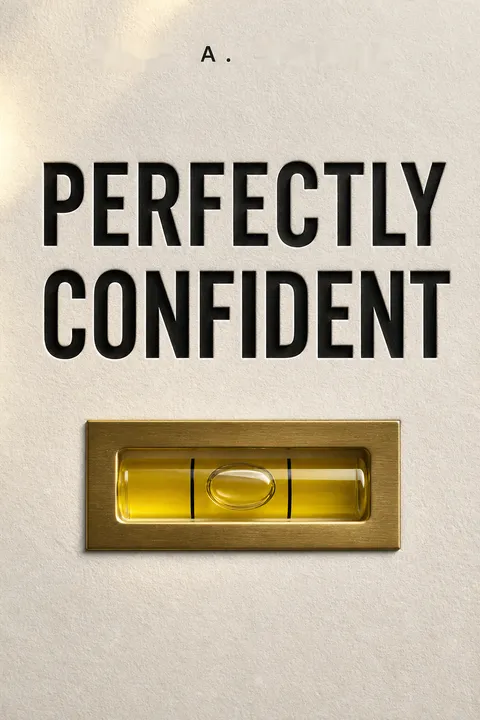


Key Takeaways
Confidence is not self-esteem; it is a forecast that must answer to facts.
Confidence is an assessment. Moore challenges advice to simply become more confident. Confidence is a judgment about ability, performance, or future success; it is not a personality trait or a measure of personal worth. It becomes overconfidence or underconfidence only when compared with what actually happens or what evidence supports the judgment.
His firewalk at a Tony Robbins event makes the stakes tangible. He crossed hot coals confidently, then discovered he had failed to follow an instruction to clear embers from his feet and suffered burns. Confidence had helped him act, but it had not made the risk disappear. Successful people such as Elon Musk can illustrate confidence alongside achievement, but their skill and resources may also explain their success.
The distinction between feeling capable and being well-calibrated shifts the question from “How confident do I feel?” to “What justifies this forecast?” That is a more useful standard for hiring, leadership, and personal risk because it separates self-respect from prediction accuracy. It also prevents a common category error: treating confidence as inherently virtuous or inherently dangerous. The firewalk shows why confidence can be motivational without being protective. Its benefits depend on whether it moves a person toward a worthwhile action or past safeguards that reality still requires.
Separate skill estimates, social rankings, and certainty about being right.
Three judgments differ. Moore distinguishes estimation, placement, and precision. Estimation concerns how capable you are or how likely you are to succeed. Placement concerns how you compare with other people. Precision concerns how sure you are that your belief is correct. A person might underestimate their skill, overrate their rank, and still be too certain about both judgments.
A 90 percent confidence interval should contain the true answer nine times out of ten. In studies of general knowledge, people’s actual hit rates are closer to 50 percent, a sign that their intervals are too narrow. In Moore’s classes, students also rate their honesty around the 75th percentile on average, although an accurately ranked class should average at the 50th percentile.
This three-part map is useful because different errors need different remedies. A person uncertain about competence may need practice and feedback. Someone misjudging their rank needs a clearer comparison group. Someone certain about a weak conclusion needs to examine contrary evidence. Treating all three as a single confidence problem encourages blunt advice, such as “believe in yourself,” that may help one dimension while worsening another. The framework also makes calibration observable: beliefs can be compared with later outcomes rather than inferred from a confident tone.
Before defending a belief, ask what evidence would make it false.
Beliefs guide the search. Harold Camping predicted the world would end on May 21, 2011, and his radio network spent over $100 million publicizing the prediction. Researchers offered followers $5 immediately or a larger payment after the date. Most refused any post-date payment, consistent with their conviction that there would be no future in which to collect it.
The problem is not limited to apocalyptic beliefs. When people were asked to determine whether someone was an extrovert, they chose more questions likely to produce extroverted answers than questions that might reveal introversion. Moore recommends testing the alternative: ask what could disprove the claim, and actively look for that evidence. This practice, often called “consider the opposite,” counters the mind’s natural preference for confirming information.
A deliberate search for disconfirmation turns humility into a procedure rather than a personality pose. It is especially valuable when a belief feels obvious, morally urgent, or flattering, because those are precisely the beliefs people have reason to defend. Still, skepticism alone does not guarantee accuracy. A weak counterargument can be dismissed too easily, while a strong test requires specifying in advance what evidence would count against the claim. The method works best when criticism is substantive, not merely contrarian, and when the person can revise the belief without treating revision as defeat.
Replace single-number predictions with ranges and probabilities.
The future has a spread. A point prediction gives one number for an uncertain outcome, such as a company’s expected sales. That number is almost never exact and hides the range of possibilities. Moore’s client BASF relied on product managers’ best guesses to plan production, risking excess stock or frustrated customers when demand differed from the forecast.
A probability distribution makes the range explicit by assigning likelihoods to possible outcomes. At Moore’s wedding, he and his fiancée estimated the chance that each of 223 invitees would attend. Their probabilities implied 127.7 guests; 126 came. For a project, the same approach might distinguish a likely finish date from meaningful chances of finishing earlier or much later. The point is not perfect prediction, but a more honest picture of uncertainty.
Ranges make forecasts more useful because decisions usually depend on consequences across several possible outcomes, not just the most likely one. A manufacturer needs to know whether excess inventory is cheap to store or costly to discard. A manager needs to know whether a delay would threaten a launch. A probability distribution makes those trade-offs visible. The method does require careful probability estimates, which people often find unfamiliar. Its value therefore grows when forecasts are recorded and later checked, turning uncertainty into a skill that can improve with feedback.
Price decisions by odds and consequences, not by how badly you want them.
Desire distorts likelihood. Moore’s adviser offered to pay him $90,000 if he failed to get an academic job, in exchange for a $5,000 premium. Under the stated assumptions, the insurance was worthwhile if Moore’s chance of getting a job was below 94.4 percent. The arithmetic forced him to examine his fear instead of treating it as proof that unemployment was likely.
Wishful thinking can distort the other way. Yahoo rejected Microsoft’s $44.6 billion purchase offer in 2008 while its CEO, Jerry Yang, spoke optimistically about the company’s prospects. Verizon acquired Yahoo’s core businesses in 2016 for $4.83 billion. Experiments described by Moore found that encouraging optimism did not reliably improve performance across several tasks, although optimism can feel good and sometimes motivate effort.
Expected value helps separate the chance of an outcome from its emotional importance. A small probability of a grave loss may justify precautions, while a large possible reward may justify a calculated risk. But arithmetic does not settle every choice: people differ in how they value money, security, time, and regret. Those preferences belong in the consequences, not disguised as altered probabilities. The useful discipline is to ask both what might happen and how much each outcome matters, then check whether fear or desire has quietly changed the odds.
Treat failure as evidence, and imagine it before committing.
Review the near miss. Aviation became safer partly through detailed investigations of accidents and a reporting system for incidents that almost became disasters. The purpose of a postmortem is to identify what happened, where luck mattered, and what should change. A premortem applies the same logic before a project: imagine it has failed, then list plausible reasons while there is still time to respond.
Forecasts also improve when large tasks are broken into smaller steps. In Moore’s Lego exercise, student teams expected a model-building assignment to take about eight minutes; many needed 15 to 20. They had imagined the task in broad strokes and missed practical obstacles. Enumerating components and likely delays helps counter the planning fallacy, the tendency to underestimate how long work will take.
Postmortems and premortems create a learning loop: one examines actual failure, the other makes possible failure discussable before it arrives. Both work better when people can report mistakes without being automatically punished for them. Otherwise, organizations receive polished stories instead of useful warnings. There is also a risk of overcorrecting into endless risk review. The goal is not to eliminate uncertainty or make every plan cautious, but to surface important failure modes early enough to reduce their cost or improve the decision.
Define the scorecard before declaring yourself above or below average.
Vague standards flatter. In one study, 93 percent of American drivers rated their skill above the midpoint. But “good driver” can mean alert, patient, fast-reacting, or cautious. When people judge specific driving behaviors instead of an undefined overall trait, claims of superiority shrink. Clear standards make comparisons more meaningful and can improve workplace evaluations as well as self-assessment.
Underconfidence also deserves attention. Many talented students from low-income families do not apply to elite universities, partly because they underestimate their chances and do not know about financial aid. The book reports that about one-third of top-performing students from the lowest-income quartile attend top universities, compared with 78 percent from the highest-income quartile. Defining the relevant performance standard can correct both inflated self-ratings and unjustified self-doubt.
A scorecard is not neutral simply because it uses numbers. The choice of measure determines what counts as skill, merit, or progress, so standards should be explicit and connected to the real task. Specific criteria reduce disagreement and help people see how to improve, but overly narrow metrics can invite gaming or ignore qualities that are harder to quantify. The strongest evaluation combines defined evidence with room to question whether the evidence captures the ability that actually matters.
Invite disagreement, then average independent judgments instead of chasing consensus.
Disagreement can add information. After a disastrous forecast about the US economy in 1982, investor Ray Dalio began seeking people who would challenge his assumptions. At Bridgewater Associates, he promoted open criticism and transparency so ideas could be tested rather than protected by rank.
A crowd can also improve estimates when its members contribute different information and their errors do not move together. At a 1907 fair, 787 people guessed the weight of an ox. Their average was only about a pound away from the true weight of 1,198 pounds. But a group sharing the same blind spot can become more biased through discussion. Moore describes politically like-minded groups leaving conversations more polarized, and research committees sometimes making worse choices after discussion than by simply using reviewers’ initial ratings.
The key ingredient is not a large group by itself, but diverse, partly independent judgments. If everyone adopts the first speaker’s opinion, averaging their views adds little. Collecting private estimates before a meeting protects quieter participants and preserves information that hierarchy might otherwise erase. Discussion still matters when it reveals evidence or changes a mistaken view; it is not automatically harmful. The practical question is whether conversation improves the information available or merely makes agreement feel more certain.
Compare real alternatives and opportunity costs before doubling down.
A choice needs a comparison. A “whether” decision asks whether to take one action in isolation. A “which” decision compares that action with realistic alternatives and what each would cost. In one study, 75 percent of people wanted a $14.99 movie when asked whether they would buy it. When asked to choose between the movie and keeping the money for something else, only 55 percent chose the movie.
This distinction matters when persistence turns into escalation. Mountaineer Jeffrey Rubin continued toward Mount Katahdin in poor visibility after his companion turned back. He died from exposure. His determination to complete a goal blinded him to the safer alternative. Before continuing a project, relationship, investment, or climb, assess the expected value of persisting and the value of what could be done instead.
Opportunity cost is often invisible because the alternative is not physically present. Naming it makes the choice more concrete and weakens the pull of sunk costs, which are past investments that cannot be recovered. The relevant question is not whether the original decision was defensible at the time, but which option is best from this point forward. Persistence remains valuable when effort can change the odds; it becomes a trap when commitment substitutes for fresh evidence.
Act boldly when evidence supports the risk, not when certainty feels good.
Courage needs calibration. Alex Honnold climbed Yosemite’s El Capitan without ropes, but he prepared extensively and chose a climb he judged physically and rationally within his abilities. The contrast is not between bravery and fear; it is between risk grounded in demonstrated skill and risk grounded in an inflated self-image.
Some ventures justify repeated failure when each attempt is affordable and the possible reward is large. Thomas Edison’s search for a workable lightbulb involved many discarded designs. By contrast, a single mistake on Honnold’s climb could have been fatal. Confidence is most useful when it follows evidence, accounts for consequences, and supports action appropriate to the stakes. A leader can communicate uncertainty without sounding helpless by giving a clear, evidence-based estimate rather than pretending the future is certain.
Calibration is not a command to hesitate. It is a way to match action to evidence and stakes. In a low-cost experiment, bold attempts can reveal information quickly; in a high-consequence setting, safeguards and rehearsal matter more than an inspiring self-image. The same confidence can therefore be rational in one context and reckless in another. A credible leader need not hide uncertainty, but should explain what is known, what remains uncertain, and why the proposed action is still worth taking.
Analysis
The book’s central contribution is a shift in what confidence means. Popular advice treats confidence as a feeling to increase; Moore treats it as a judgment whose quality depends on its relationship to evidence. That shift makes confidence less like a personal virtue and more like a forecasting practice. It also explains why confidence can be helpful in one setting and harmful in another: the same belief may motivate a worthwhile attempt, weaken necessary effort, or erase a safety margin.
The book’s most operational ideas are its methods for making judgment inspectable. Probability ranges expose uncertainty that a single forecast conceals. Expected-value calculations separate likelihood from consequence. Explicit standards make self-comparisons less vague. Premortems and postmortems turn failure into information, while disagreement and independent estimates supply evidence unavailable from one perspective. Together, these practices create a feedback system: state a belief, record its basis, observe the outcome, and update.
There are limits. Numerical forecasts can look rigorous while resting on poor assumptions, and a metric can simplify performance until it distorts what matters. Novel events may lack useful comparison cases, while people in unequal positions may not have equal access to feedback or opportunities to take risks. Calibration also has a social cost: an honest estimate can lose influence to a more theatrical claim. The book recognizes that tension, but its strongest implication is institutional. Individual humility is not enough if organizations punish bad news, reward confident overpromising, or suppress dissent.
The practical standard is therefore not “be less confident.” It is to make confidence answerable to evidence, to consequences, and to revision. Accuracy does not promise success; it improves the odds of choosing intelligently and learning from outcomes. The resulting confidence can be both ambitious and modest: ambitious about what evidence supports, modest about what remains unknown.
People Also Read





Glossary
Confidence calibration
Matching belief to evidenceThe practice of comparing a person’s confidence with relevant facts, performance, or eventual outcomes. Calibration is good when expressed certainty matches the accuracy the evidence warrants. It is not simply feeling confident or humble. The aim is to avoid both overconfidence, which can prompt costly action, and underconfidence, which can cause worthwhile opportunities to be missed.
Estimation
Judging ability or successOne of the book’s three forms of confidence. Estimation concerns how capable someone believes they are, how likely they think success is, or how long they expect a task to take. Comparing the estimate with actual performance or outcomes reveals whether the judgment is overestimated, underestimated, or well calibrated.
Placement
Ranking oneself against othersOne of the book’s three forms of confidence. Placement is a judgment about where a person stands relative to other people, such as whether their driving, honesty, or job performance is above average. Overplacement means believing oneself to rank higher than the evidence supports; underplacement is the reverse.
Precision
Certainty about being rightOne of the book’s three forms of confidence. Precision refers to how sure someone is that a belief or interpretation is correct. Overprecision occurs when certainty exceeds accuracy, as when a person gives an implausibly narrow confidence interval or treats an uncertain forecast as settled. Moore finds systematic underprecision much less evident.
Probability distribution
Likelihoods across possible outcomesA representation of uncertainty that assigns probabilities to a range of possible outcomes rather than naming one best guess. A sales forecast, for example, might specify the chances of low, typical, or unusually high demand. Distributions help decision makers compare consequences and costs across outcomes and make uncertainty explicit.
Expected value
Probability-weighted outcome valueA way to evaluate an uncertain choice by multiplying each possible outcome’s value by its probability and combining the results. It helps compare decisions such as buying insurance or pursuing a risky project. Expected value is not the same as personal utility: people may value outcomes differently, and those preferences should be included in the calculation.
Planning fallacy
Underestimating task durationThe tendency to underestimate how long a task or project will take. People often imagine a plan in broad outline and overlook coordination problems, small steps, and delays. Breaking work into components, considering likely obstacles, and comparing with the duration of similar past projects can produce more realistic forecasts.
Premortem analysis
Imagining failure in advanceA planning exercise in which a team imagines that a project has failed and lists plausible reasons for the failure before work begins. The exercise makes it easier to raise risks that might otherwise feel impolitic or pessimistic. Teams can then change the plan, add safeguards, or decide that the project is not worth pursuing.
BATNA
Best alternative to agreementAn acronym for Best Alternative To a Negotiated Agreement. It describes what a negotiator can do if no deal is reached. A strong BATNA increases leverage and provides a realistic basis for deciding when to accept or reject an offer. It helps distinguish what someone hopes to receive from what their actual alternatives permit.
Outside view
Use comparable casesA way of judging a situation by looking at how similar cases have turned out, rather than relying only on the details and hopes of the current case. For example, someone planning a complex project can examine how long comparable projects took. This perspective can counter unrealistic forecasts and also reassure people whose doubts ignore others’ common struggles.
Defensive pessimism
Use risks to prepareA strategy in which people anticipate potential failure and use that concern to prepare, rather than allowing it to become disabling rumination. A student may picture a poor exam result and respond by studying more. It is useful when attention to realistic risks improves preparation, but not when worry exaggerates danger or prevents worthwhile action.
Naive realism
Assuming one view is obviousThe tendency to treat one’s own perception of the world as the neutral, sensible view, and to regard disagreement as evidence that others are ignorant or malicious. This assumption makes it harder to learn from opposing perspectives. Considering why reasonable people might disagree can reveal missing information and weaknesses in one’s own reasoning.
Wisdom of the crowd
Aggregate diverse judgmentsThe tendency for an average of multiple judgments to be more accurate than most individual estimates when contributors possess some relevant information and their errors are not strongly correlated. Diversity and independence matter: a group sharing one bias can reinforce it instead of correcting it. Private estimates collected before discussion can help preserve independent views.
Download PDF
Download EPUB
.epub digital book format is ideal for reading ebooks on phones, tablets, and e-readers.








