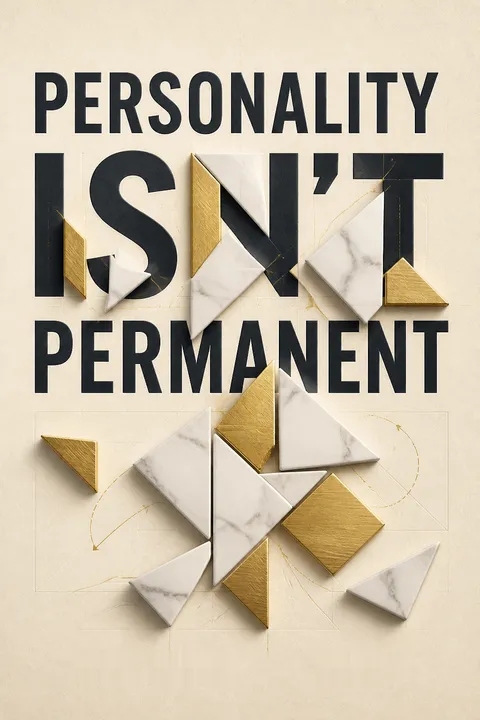


Key Takeaways
Treat personality tests as snapshots, not verdicts on your future
A label is not a life sentence. Hardy opens with a test nearly derailing his relationship: his future in-laws worried that his “White” personality would make him a poor match for Lauren, whom the Color Code classified as “Red.” Their assumptions missed the person he became and the marriage they built. The book argues that personality categories compress behavior into tidy boxes, while people act differently across situations and roles. The better-known Big Five model describes degrees of openness, conscientiousness, extraversion, agreeableness, and emotional reactivity, rather than fixed types. Hardy also reports research that over 90 percent of people want to change at least one aspect of their personality.
Use measures lightly. A test can prompt reflection, but it should not decide what work, relationships, or ambitions suit someone. The book’s case is not that measurement is useless, but that scores describe patterns, not an immutable self.
The distinction between a useful description and a binding identity is crucial. Personality research does find relatively stable average tendencies, and those tendencies can help predict behavior. But prediction is not destiny, and a score taken in one context cannot capture every role a person can learn to inhabit. The strongest version of Hardy’s argument is therefore not that traits are imaginary, but that trait language becomes harmful when institutions use it to sort people or individuals use it to excuse avoidable limits. A personality measure is most useful as a starting question: what conditions bring out a different response?
Choose a purpose that trains the personality your goals require
Purpose shapes the person. Andre Norman’s story shows how sharply identity can turn. A teacher helped him develop as a trumpet player, giving him a constructive focus. Under pressure from friends, he threw the trumpet away and adopted a different identity, one organized around gang status. In prison, he questioned where that ambition led and chose a new aim: attend Harvard. That goal gave his daily choices a direction, from studying to learning law, and helped shape a new life after prison.
Goals have sources. Hardy groups them into exposure, desire, and confidence. People cannot pursue options they have never encountered; their wants can be cultivated; and confidence affects which futures they can imagine. Even distraction serves an immediate purpose, such as numbing discomfort. Examining what a behavior is trying to achieve helps reveal whether it serves a chosen future.
This account links identity to motivation in a useful way: people often become interested in a pursuit through participation, not through a prior revelation of innate passion. That fits research on mastery and self-determination, where competence and meaningful choice can deepen motivation. Yet purpose alone does not guarantee wise action. Andre’s earlier goal of climbing a prison hierarchy was also motivating, but its endpoint was destructive. A compelling aim needs ethical scrutiny as well as energy. The practical test is not simply whether a goal changes someone, but what kind of person it rewards them for becoming.
Describe your future self, then commit to one measurable destination
Make the future concrete. Hardy asks readers to imagine a future self as someone distinct from the present self, with different skills, relationships, and daily routines. This counters the “end-of-history illusion,” the tendency to recognize past change while assuming little more change lies ahead. From that picture, choose one major, measurable goal that would make the desired future more possible. A clear outcome gives practice a direction and makes progress easier to judge.
Commitment directs effort. The book points to quarterback Joe Burrow, who transferred from Ohio State to LSU seeking an opportunity and expected his preparation to pay off. His breakout season followed sustained work toward a specific aim. Hardy also recommends writing goals, reviewing recent gains, and taking daily actions that stretch current ability. Plans may change, but they should be revised deliberately rather than left vague.
Thinking of a future self as a different person has a practical advantage: it makes delayed consequences more emotionally legible. Research on future-self continuity suggests that people often save or plan more when the future feels connected to the present. A vivid future can therefore make present effort feel less abstract. Still, a single target can become brittle if circumstances change or if the measure crowds out the underlying value. A useful goal combines a clear outcome with periodic review, so commitment creates focus without turning flexibility into failure.
Bring painful memories into safe conversation instead of building life around avoidance
Avoidance can shrink a life. Rosalie wanted to write and illustrate children’s books, but after an art teacher corrected her drawing in front of a class, she concluded she lacked ability and never tried again. Decades later, talking through that moment helped her draw once more. Hardy uses such cases to describe trauma broadly as a painful experience whose meaning continues to constrain choices, while recognizing that severe trauma may require professional support.
Flexibility makes room to act. Psychological flexibility means noticing emotions and thoughts without being ruled by them, then moving toward chosen values. Hardy calls a supportive listener who hears a painful account without judgment or rushing to advice an “empathetic witness.” Such a person can help someone express what happened, question a frozen conclusion, and choose a next step. Listening does not erase the event; it can loosen its grip on the future.
The emphasis on connection reflects a central insight of trauma-informed care: safety, trust, and agency matter, and isolation can intensify distress. A good listener helps another person regain authorship rather than supplying a tidy interpretation. The caution is that reframing should never be imposed as a demand to find a benefit in harm. Some experiences remain painful, and healing may require trained clinicians, practical protection, or time. The humane application is modest: create a safe space for a person to tell the story in their own terms, without making optimism the price of being heard.
Revise the meaning of past events without denying what happened
Memory carries interpretation. Hardy draws on narrative identity, the evolving story through which people connect past experiences, present identity, and an imagined future. A painful event can prompt conclusions about personal worth or the safety of the world, even when those conclusions exceed the evidence. New experiences and reflection can alter the meaning attached to the event, though not the historical facts.
Measure progress against yesterday. In the “gap and gain” approach, the gap is attention fixed on the distance between current reality and an ideal; the gain is attention to progress from an earlier point. Hardy recommends remembering a past difficulty through the perspective of a wiser future self and identifying what has been learned or built since. Buzz Aldrin became trapped by the belief that his moon landing left no meaningful next chapter, while Giannis Antetokounmpo treated an MVP season as an achievement, not a final identity.
Narrative reframing can support resilience because the same event can be integrated into a larger account of learning, care, or survival. Memory research also shows that recall is reconstructive, not a perfect replay. But that fact calls for care, not license to treat the past as fiction. Reframing should distinguish observable events from later interpretations, especially when accountability or another person’s safety is involved. The gain is not a claim that every injury was beneficial. It is a way to notice that the injury need not be the only fact that defines a life.
Repeat future-aligned actions until unfamiliar behavior feels like yours
The body learns routines. Hardy argues that repeated emotional and behavioral patterns can make old responses feel like a default. He recounts Jane Christiansen’s return of leg pain during a period of unexpressed anger and stress, followed by journaling, conversations with her husband, and a return to running. In the book’s account, these changes coincided with pain relief and greater flexibility. The larger point is that identity is reinforced by what someone repeatedly does, not only by what they claim to believe.
Action can update expectation. Hardy calls unusually challenging, meaningful moments “peak experiences,” because they can expand a person’s sense of what is possible. A small daily practice or a bold public commitment can provide evidence against an old self-image. The book also describes an “Upper Limit Problem,” a tendency to retreat toward familiar patterns when success or wellbeing feels unfamiliar.
The link between experience, emotion, and bodily response is real in broad terms: stress can affect sleep, attention, and pain, and repeated behavior can become easier through learning. Jane’s account, however, cannot establish that suppressed emotion caused her physical symptoms. Chronic pain has varied causes and deserves medical assessment; psychological support can complement, not replace, appropriate care. The most reliable lesson here is behavioral rather than diagnostic: try new actions while monitoring what helps, and avoid turning a powerful personal story into a universal explanation for illness.
Change your setting and social role to change which self shows up
Context calls up different selves. In Ellen Langer’s 1979 study, eight men in their seventies and eighties spent five days in a setting arranged to resemble 1959. They were encouraged to behave as they had when younger. The study reported improvements in some measures of physical and cognitive functioning. Hardy uses it to illustrate how expectations and surroundings can influence behavior and self-perception.
Roles shape habits. People often behave differently with old friends, at work, or in a new community. Hardy recalls slipping into teenage behavior when he reunited with high-school friends, despite having changed in other parts of life. Stable routines can make personality seem fixed because they repeatedly cue the same responses. Seeking new people, responsibilities, and settings can make new behaviors more available, although a changed environment does not guarantee transformation.
This is a strong person-situation insight: behavior is not produced by traits alone, but by the interaction between a person and the conditions around them. Social psychology and organizational research likewise show that norms and roles shape what actions feel expected. That perspective shifts change from an internal battle to a design problem. The Langer study is suggestive, but its small group and unusual setup do not prove that a brief environmental shift reverses aging. The broader lesson is still useful: examine which contexts repeatedly cue the behavior someone wants to outgrow.
Design your environment to cue growth and hide predictable distractions
Make the desired self visible. Hardy describes three environmental strategies. Strategic remembering places cues for important aims in everyday view, as painter James Whistler kept a successful work nearby to remind himself of his capacity. Strategic ignorance removes inputs already known to distract, such as unwanted apps or irrelevant invitations. A forcing function changes the situation so action is harder to postpone. Chef David Chang gave Christina Tosi a short deadline to create a dessert, helping her move from baking for staff to serving restaurant guests.
Build commitment into the setting. Hardy and a friend paid to enter an Ironman triathlon, turning a vague idea into a concrete obligation that prompted training and new learning. Such structures reduce reliance on momentary willpower. The purpose is not to eliminate every option, but to filter distractions and make the next useful action more likely.
These tactics resemble choice architecture: small changes to defaults, cues, and friction can make behavior more consistent without requiring constant self-control. They are especially helpful when a goal is already chosen but attention is scattered. There is a meaningful boundary, however. A forcing function can create useful accountability, or it can lock someone into a bad plan because money or reputation is already at stake. Strategic ignorance should filter noise, not shield a person from relevant evidence or dissent. Good environmental design preserves the ability to reconsider when new information matters.
Let a chosen purpose turn survival into service, without denying grief
A new story can redirect pain. Melissa Hull lost her young son Drew in an accident and blamed herself, becoming so despairing that she planned to die. A letter from Theresa, a stranger who had also lost a child, helped Melissa feel understood and choose to keep living. Years later, while revisiting her journals, Melissa began to understand her experiences through a different purpose: helping people who feel unheard.
Meaning becomes action. Melissa wrote and shared her story, offering others the kind of listening that had helped her. Her account closes Hardy’s argument: personality is not simply a record of past events, but can be shaped by commitments made in response to them. The lesson is not that tragedy is secretly good. It is that a person may build care and direction after tragedy, without pretending the loss did not happen.
This ending makes the book’s most compelling claim concrete: a future commitment can reorganize how a person understands earlier chapters. The letter matters not because it solved Melissa’s grief, but because a human connection interrupted isolation at a life-threatening moment. That distinction guards against turning purpose into a cure-all. Service can give suffering a direction, but it cannot be required of every survivor, nor does a meaningful story cancel the need for justice, treatment, or mourning. The humane measure of transformation is expanded choice, including the choice to help others when and how one is ready.
Analysis
The book’s central move is to replace a trait-centered account of personality with a developmental one. Instead of asking what fixed category explains a person, Hardy asks which goals, emotional interpretations, social roles, and environments are repeatedly producing the person’s current behavior. This is a useful shift because it makes change operational. A future identity is not merely imagined; it is supported by deliberate goals, new experiences, emotional processing, and contexts that reward different actions.
The book’s strongest evidence is often narrative rather than decisive proof. Andre Norman’s transformation, Rosalie’s stalled artistic ambition, and Melissa Hull’s recovery show how identities can be redirected, but individual stories cannot establish that everyone can change in the same way or at the same pace. Research on personality finds both continuity and change. Traits have predictive value, yet they are not destiny, and interventions can influence behavior and self-understanding. A more careful synthesis is that change is possible, but constrained by temperament, resources, health, culture, and opportunity.
The treatment of memory also needs a boundary. People can revise the meaning of past events because memory is reconstructed and because present goals alter attention. They cannot thereby make the historical event itself different. This distinction is ethically important wherever harm, responsibility, or trauma is involved. Reframing should create room for agency, not pressure survivors to describe every wound as a gift.
The practical model is most persuasive when its elements work together: choose a valued direction, take actions that test the old identity, find trustworthy support, and alter the settings that cue familiar responses. Its weaker claims appear where a personal anecdote is treated as a general mechanism, especially around physical pain or fasting. Readers can retain the book’s agency-centered framework while treating health claims cautiously and seeking qualified care. Personality may be revisable, but transformation is a process of supported practice, not a declaration of willpower.
Review Summary
Personality Isn't Permanent receives mixed reviews. Some readers find it insightful and transformative, praising its ideas on changing one's personality and future focus. Others criticize its repetitive style, oversimplification of complex issues, and perceived lack of empathy. Many appreciate the practical exercises and journaling prompts. Critics argue the book lacks scientific rigor and relies too heavily on anecdotes. Some readers find the author's tone preachy and his examples unrealistic. Overall, the book's core message resonates with many, but its delivery and approach are divisive.
People Also Read









Glossary
End-of-history illusion
Underestimating future changeA bias in which people recognize how much their interests, values, and personality have changed in the past, yet expect comparatively little change in the future. Hardy uses it to encourage readers to imagine a future self rather than treating their present preferences as permanent.
Massively Transformative Purpose
A purpose that reshapes lifeA large, personally chosen purpose that is compelling enough to organize decisions, effort, and learning across a person’s life. Hardy presents it as a source of transformation: pursuing the purpose can require new skills, relationships, behaviors, and a broader sense of identity.
Teleology
Behavior directed toward an endThe idea that actions can be understood by the outcomes or purposes toward which they are directed. In Hardy’s account, behavior has a goal even when the goal is implicit, such as seeking comfort, avoiding a difficult task, or building a desired future.
Psychological flexibility
Adapt while pursuing chosen valuesThe capacity to notice emotions and thoughts without being controlled by them, remain open to experience, and continue moving toward chosen values or goals. Hardy contrasts flexibility with rigidly identifying with old interpretations, avoiding difficult feelings, or treating past behavior as proof of permanent limits.
Empathetic witness
A nonjudgmental, attentive listenerA person who listens to another’s painful experience with care, asks sincere questions, and avoids rushing to judge or prescribe solutions. Hardy argues that such listening can help someone express emotions, examine conclusions formed during distress, and consider a next step. It does not replace professional treatment when that is needed.
Narrative identity
An evolving personal life storyThe internal story through which a person connects remembered experiences, present identity, and imagined possibilities into a sense of continuity and purpose. In Hardy’s presentation, this story can change as new experiences alter how past events are interpreted and what future the person pursues.
The gap and the gain
Measure progress from the pastA reframing approach associated in the book with Dan Sullivan. The gap is the shortfall between present circumstances and an ideal; the gain is the progress made compared with an earlier point. Hardy recommends keeping future ambitions while also recognizing past-to-present progress, which can support confidence and motivation.
Peak experiences
Intense moments of expanded possibilityEmotionally powerful experiences that can alter how someone perceives reality and their own capabilities. Hardy connects them to purposeful challenges and courageous action, arguing that such experiences can make unfamiliar behavior feel possible and broaden a person’s sense of identity.
Upper Limit Problem
Retreat from unfamiliar successA concept from Gay Hendricks that Hardy uses to describe a tendency to undermine progress when success, creativity, or wellbeing exceeds what feels familiar. The person may return to established patterns that feel safer, even when those patterns conflict with their goals.
Forcing function
A setup that compels actionA feature of a situation that makes a desired action difficult to avoid and produces a concrete result. Examples in the book include a firm deadline, a public commitment, or paying to enter a demanding event. It changes the conditions around action rather than relying only on intention.
Strategic ignorance
Filter known distractionsThe deliberate removal or avoidance of inputs already known to consume attention or undermine a chosen goal. Hardy distinguishes it from refusing to learn: the aim is to block predictable noise while remaining open to information, feedback, and experiences that genuinely support growth.
Counterclockwise study
A context-based aging experimentEllen Langer’s 1979 experiment, as described by Hardy, placed eight older men in a setting designed to evoke 1959 and encouraged them to behave as their younger selves. The study reported improvements in some physical and cognitive measures, illustrating the possible influence of expectations and social context.
FAQ
What's Personality Isn't Permanent about?
- Core Concept of Change: The book argues that personality is not fixed or innate but is dynamic and can be changed. Benjamin Hardy emphasizes that individuals can redefine themselves and their lives by making conscious choices.
- Myths of Personality: Hardy debunks several myths surrounding personality, such as the belief that it can be categorized into types or that it is solely determined by past experiences. He presents personality as a by-product of deeper choices and goals.
- Transformative Process: The book outlines a science-based process for personal transformation, focusing on how trauma, identity narratives, subconscious influences, and environment shape personality. It encourages readers to take control of their narratives and futures.
Why should I read Personality Isn't Permanent?
- Empowerment Through Knowledge: This book provides actionable insights and strategies to help readers break free from self-limiting beliefs. It empowers individuals to take charge of their personal development.
- Scientific Backing: Benjamin Hardy supports his arguments with cutting-edge research and real-life stories, making the content both credible and relatable. This combination of science and storytelling enhances the reader's understanding.
- Practical Application: The book offers practical advice on how to implement changes in your life, making it a useful guide for anyone looking to improve their self-awareness and success.
What are the key takeaways of Personality Isn't Permanent?
- Personality is Changeable: One of the main takeaways is that personality is not a fixed trait but can be reshaped through conscious effort and decision-making. Hardy emphasizes that individuals have the power to choose who they want to become.
- The Role of Trauma: The book discusses how unresolved trauma can limit personal growth and how reframing these experiences can lead to transformation. Hardy encourages readers to confront and process their past traumas.
- Future-Oriented Identity: Hardy advocates for a future-oriented identity, where individuals define themselves by their aspirations rather than their past. This shift in perspective is crucial for personal growth and fulfillment.
What are the best quotes from Personality Isn't Permanent and what do they mean?
- “Your personality isn’t permanent.”: This quote encapsulates the book's central theme that personality can evolve and change over time. It encourages readers to embrace the idea that they can redefine themselves.
- “You become who you choose to be.”: This quote highlights the importance of choice in shaping one's identity. It reinforces the idea that individuals have the power to create their own paths and destinies.
- “Your past is not prologue.”: This statement challenges the notion that past experiences dictate future outcomes. It emphasizes that individuals can break free from their past and create new narratives for their lives.
What are the myths of personality discussed in Personality Isn't Permanent?
- Categorization into Types: Hardy argues that personality cannot be accurately categorized into fixed types, as popularized by tests like Myers-Briggs. He states that this oversimplification limits personal growth and understanding.
- Innate and Fixed Nature: The belief that personality traits are innate and unchangeable is another myth Hardy debunks. He presents evidence that personality is dynamic and can be influenced by choices and experiences.
- Past-Driven Identity: The idea that personality is solely shaped by past experiences is challenged. Hardy emphasizes that individuals can redefine their identities based on future aspirations rather than past limitations.
How does trauma affect personality according to Personality Isn't Permanent?
- Stifles Growth and Flexibility: Trauma can create a fixed mindset, limiting an individual's ability to adapt and grow. Hardy explains that unresolved trauma often leads to a rigid identity that hinders personal development.
- Influences Identity Narratives: The book discusses how trauma shapes the stories individuals tell about themselves, often leading to a negative self-image. Hardy encourages reframing these narratives to foster a more empowering identity.
- Requires Empathetic Witnessing: Hardy highlights the importance of having empathetic witnesses to help process and reframe traumatic experiences. This support can facilitate healing and allow individuals to move forward.
What strategies does Personality Isn't Permanent suggest for personal transformation?
- Set Clear Goals: Hardy emphasizes the importance of defining specific, measurable goals that align with your desired future self. This clarity helps direct actions and decisions toward meaningful outcomes.
- Reframe Trauma: The book provides techniques for reframing past traumas to view them as opportunities for growth rather than limitations. This shift in perspective is crucial for personal development.
- Create a Supportive Environment: Hardy advises redesigning your environment to support your goals and aspirations. Surrounding yourself with positive influences can enhance motivation and facilitate change.
How can I enhance my subconscious according to Personality Isn't Permanent?
- Engage in Peak Experiences: Hardy suggests that peak experiences—moments of intense joy or achievement—can help reshape your subconscious beliefs. Actively seeking out these experiences can lead to significant personal growth.
- Practice Gratitude: The book highlights the power of gratitude in transforming your mindset and emotional state. Regularly reflecting on what you are grateful for can enhance your overall well-being and outlook on life.
- Visualize Your Future Self: Hardy encourages readers to visualize their future selves and the life they want to create. This practice can help align subconscious beliefs with conscious goals, fostering a sense of purpose.
What role does environment play in shaping personality in Personality Isn't Permanent?
- Influences Behavior and Choices: Hardy explains that the environment significantly impacts behavior and decision-making. A supportive environment can encourage growth, while a negative one can reinforce limiting beliefs.
- Redesign for Success: The book advocates for actively redesigning your environment to align with your goals. This may involve changing social circles, physical spaces, or daily routines to better support your desired identity.
- Creates Accountability: A well-structured environment can foster accountability and motivation. Surrounding yourself with like-minded individuals can help reinforce positive behaviors and aspirations.
How can I shift my identity narrative as suggested in Personality Isn't Permanent?
- Focus on Future Aspirations: Hardy encourages individuals to define their identities based on future goals rather than past experiences. This shift allows for a more empowering and flexible self-concept.
- Challenge Fixed Mindsets: The book suggests actively questioning and reframing limiting beliefs about oneself. By recognizing that these beliefs are often based on past trauma, individuals can begin to reshape their narratives.
- Engage in Reflective Practices: Journaling and self-reflection are recommended as tools for exploring and redefining identity narratives. These practices can help clarify goals and reinforce a future-oriented mindset.
What is the concept of an "empathetic witness" in Personality Isn't Permanent?
- Supportive Role: An empathetic witness is someone who listens and provides support without judgment. This person helps you process your experiences and encourages you to move forward.
- Importance of Connection: The book emphasizes that having empathetic witnesses in your life is crucial for personal growth. They can help you reframe your narrative and provide the encouragement needed to face challenges.
- Building a Support Network: The author encourages readers to identify and cultivate relationships with those who can serve as empathetic witnesses. This network can significantly impact your ability to transform your life.
How does Personality Isn't Permanent address trauma?
- Transforming Trauma: The book discusses how trauma can be a source of strength if reframed correctly. It encourages readers to confront their traumas rather than avoid them, allowing for healing and growth.
- Empathy and Understanding: The author highlights the importance of empathetic listening in processing trauma. By sharing experiences with empathetic witnesses, individuals can gain clarity and move toward healing.
- Psychological Flexibility: The book teaches that developing psychological flexibility is essential for overcoming trauma. This flexibility allows individuals to adapt and grow, rather than remain stuck in their past experiences.
About the Author




Download PDF
Download EPUB
.epub digital book format is ideal for reading ebooks on phones, tablets, and e-readers.








