

Key Takeaways
Persuasion raises the odds, but cannot rescue an unreasonable or harmful ask
Start with legitimacy. The book treats persuasion as a way to improve the chance of agreement, not a guarantee. It cannot reach someone who refuses to listen, make an outrageous request seem reasonable, or turn a harmful proposal into a good one. The basic test is whether the other person can see a genuine benefit in what is being proposed.
Respect the boundary. That limit matters because the same techniques can support cooperation or manipulation. The book argues for using them only when both parties stand to benefit, and for beginning with a request the other person might reasonably consider. Persuasion is most useful when it clarifies a worthwhile choice, not when it tries to override someone’s values or judgment.
This ethical boundary is more than a disclaimer. It gives the techniques a standard for use: persuasion should help another person recognize a real option, not disguise a bad bargain. That framing also makes success more durable, since agreement based on accurate expectations is less likely to collapse into resentment. The difficult question is who decides what counts as a benefit. A persuader may sincerely believe an offer is helpful while missing the other person’s priorities. Asking before pitching is therefore not merely polite; it is a practical check against self-serving assumptions.
Earn goodwill before asking; similarity and sincere attention make strangers more receptive
Connection changes the exchange. The book’s opening claim is that people are more open to requests from someone they like. In research on Tupperware parties, guests’ liking for their host was reported to matter twice as much to purchasing decisions as their opinion of the products. In another campus study, a fundraiser who identified as a fellow student more than doubled contributions. Small signals of shared identity can make a stranger feel less like a stranger.
Show real interest. A genuine compliment can also foster positive feelings, according to a study cited in the book. Appearance plays a role too: research on Canadian elections found attractive candidates received about two and a half times as many votes, while attractive fundraisers received twice as many donations. The practical lesson is to build rapport and present yourself thoughtfully, without pretending to share what you do not.
The strongest version of this advice is not to manufacture sameness, but to notice authentic overlap and treat the other person as more than a target. Similarity can lower social distance; attentive listening can reveal whether that connection is real. The appearance findings also expose a bias, not a measure of competence. Grooming may shape a first impression, but it cannot establish reliability. These tactics are most defensible when they open a conversation rather than substitute for the quality of the offer.
Translate your proposal into the listener’s gains, then make those gains vivid
Answer their question. Before considering a proposal, people often want to know what they stand to gain. The book groups benefits into four broad kinds: greater respect or confidence, improved ability to get things done, concrete gains such as time or money, and greater enjoyment. A persuasive case should focus on the benefit that matters most to this particular person, rather than reciting what the seller wants.
Make the payoff imaginable. Specific details help people picture an outcome and can make a claim feel more credible. In a University of Michigan experiment, mock jurors rated a mother more favorably when a positive account included a child’s distinctive toothbrush detail: an average of 5.8 rather than 4.3 out of 10. The detail did not change the underlying evidence, but it changed how tangible the story felt.
This advice joins audience analysis with the psychology of mental imagery. A benefit becomes more persuasive when the listener can connect it to a concrete future, rather than decode a vague promise. The mock-jury example also supplies a warning: vividness can influence judgment without improving the evidence. Specificity is therefore a communication tool, not proof. A responsible pitch makes outcomes clear while distinguishing what is known from what is merely easy to picture.
Build real expertise, then let relevant proof make it visible
Signals need substance. Credentials, awards, professional associations, media appearances, books, and client stories can all help establish credibility, especially when they are relevant to the proposal. The author describes growing a communication blog from no audience to 1,600 email subscribers in a year, which helped generate referrals and client inquiries. He also used public speaking and media appearances to make his work visible to potential clients.
Competence is the foundation. The book’s clearest example is a sales meeting in which a representative could not answer technical questions about the IT product she was offering. The client began to doubt the company’s ability, and the sale was lost. Public signals may earn attention, but actual knowledge is what allows a persuader to answer questions and sustain trust. If expertise is missing, the solution is learning, not decoration.
Credibility has two layers: evidence that others can inspect, and competence that appears under questioning. The distinction explains why a long list of associations may open a door but cannot carry a conversation. The book’s own account of blogging and speaking also shows that expertise becomes legible through useful work shared over time. A caution follows: borrowed status can create expectations that exceed a person’s skill. The closer the claim is to a consequential decision, the more important it is that credentials and endorsements accurately represent ability.
Begin with genuine agreement to make the conversation feel less adversarial
Set a receptive tone. The book’s “Yes Ladder” means starting with statements or questions the other person is likely to agree with, before making the main request. The aim is to create an atmosphere of agreement and connection, not to force a sequence of automatic yeses. Mood matters too: a person in a positive state may be more receptive than one approached in a tense moment.
A mindset can carry over. In research described by the book, Democrats and Republicans watched speeches by politicians from their own or opposing parties, then evaluated a Toyota advertisement. Participants found the ad more persuasive after watching a speech aligned with their political views. The study suggests that an earlier experience of agreement can affect how people receive a later, unrelated message.
The useful insight is about conversational climate, not a mechanical trick. Starting from shared ground can signal that the parties are trying to understand one another rather than win a contest. But agreement on easy points does not imply consent to a difficult request. If the opening questions feel staged, the technique may damage trust by making rapport seem like a sales device. The best starting point is a real shared concern or goal, with room for the other person to disagree.
Name the weakness, answer it fairly, and prepare people for counterarguments
Candor can strengthen a case. A one-sided pitch lists advantages and hides drawbacks. The book reports that Daniel O’Keefe’s review of more than a hundred studies found two-sided arguments more persuasive when they also answered the objections they raised. Acknowledging a limitation can make a case seem more considered, while a clear response helps the listener judge whether the drawback is manageable.
Prepare before pressure arrives. The book calls “inoculation” the practice of exposing someone to a weaker version of an opposing argument, then helping them form a response. In a study involving adolescents, participants who practiced answers to pro-smoking peer pressure were reported to be 50 percent less likely to smoke than those who did not. In a sales conversation, the same principle means addressing likely concerns calmly, rather than pretending they do not exist.
A balanced case earns credibility because it lets the audience see that the speaker has considered trade-offs. Inoculation adds a useful preparation step: people are less easily blindsided when they have already rehearsed how to evaluate a challenge. The distinction between preparation and spin matters. A counterargument should answer a genuine weakness, not trivialize it with a canned rebuttal. If the response is thin, raising the objection may make it more memorable without making the case stronger.
Give useful help first, without making generosity feel like a trap
Help invites openness. The book describes reciprocity, the social tendency to feel an urge to return a favor. In a 1974 experiment, Phillip Kunz mailed holiday cards to 600 strangers and received about 200 replies. Another study found that waiters who gave customers a mint received larger tips; when a second mint was presented as a personal extra, tips rose by 20 percent.
Make the favor genuine. A negotiation story shows the principle in a more substantial setting. A negotiator struggling with a client’s demand for lower prices learned that the client’s daughter hoped to attend his former university. He connected her with people who could help with the application process. The later discussion became more cooperative, and the parties agreed on payment terms without a price cut. The book cautions against making help feel like a concealed invoice.
Reciprocity can create a bridge between people who have little reason to trust one another. The most durable form is assistance that would still be worthwhile if no favor came back. Otherwise, a gift can feel like an attempt to create debt, especially when the request follows too quickly. The negotiation story also shows that useful help need not be grand: its value depends on the recipient’s actual priorities. The ethical test is whether the giver respects the other person’s freedom to decline later.
Show what peers actually do, not the bad behavior you hope to stop
People look sideways. Social proof is the tendency to use other people’s behavior as a clue about what is normal or worthwhile. The book illustrates it with a Hong Kong noodle shop whose wall of customer photos helped reassure a first-time visitor, and with research suggesting that longer lists of previous donors can encourage further donations. Showing that relevant peers chose an option can reduce uncertainty.
Warnings can backfire. At the Petrified Forest National Park, a sign warned visitors that many people had been removing pieces of wood and damaging the site. The message meant to discourage theft, but the book reports that theft tripled. The warning also advertised how common the behavior was. A message meant to promote good conduct should make that conduct visible, rather than spotlighting how many people violate the rule.
Social proof is especially useful when a person lacks direct information about quality, but its influence depends on which group appears relevant. A large number of anonymous users may matter less than a few credible peers with similar needs. The forest example shows that information has a descriptive effect as well as a moral one: people hear not only what they should do, but what others supposedly do. Effective public messages must therefore check what behavior their examples accidentally normalize.
Use one concrete human story to make a large problem emotionally legible
A person focuses attention. In an experiment described by the book, participants could donate part of a five-dollar reward to address hunger. One group received statistics about food shortages across several countries; 23 percent of their earnings were donated. Another group read about Rokia, a seven-year-old girl facing hunger in Mali; that group donated 48 percent. The story made the problem personal in a way that a list of statistics did not.
Give the story a shape. The book recommends stories with a character, a difficulty, a way through it, and a resulting change. It points to Subway’s advertising featuring Jared Fogle, who lost 245 pounds while following a Subway diet; the company’s sales reportedly rose nearly 20 percent when his story appeared. Stories can connect an outcome to a proposal, but the connection still needs to be truthful.
Stories help audiences imagine a person’s experience, while statistics show the scale and distribution of a problem. These forms of evidence answer different questions, so the strongest explanation may use both: a case that creates attention, followed by data that restores proportion. The Rokia finding is powerful, but it also exposes a limitation of compassion focused on one identifiable person. An emotionally vivid example can attract help while leaving less visible people out of view. Narrative should open attention, not narrow the moral field.
End with one unmistakable action, not a vague invitation to decide
Make the next move concrete. A listener may understand and even like a proposal yet remain unsure what to do. The book advises ending with a clear request, such as setting a meeting time, confirming a reservation, or naming the specific change being sought. A definite next step turns general interest into a decision the listener can actually make.
The hotel evidence is striking. Researchers reviewed 4,400 recorded calls from 30 hotels to identify what was associated with a completed booking. When reservation agents offered to secure the reservation, callers were reported to be 4.4 times more likely to book. The book presents this as a dramatic reminder that people may need a direct invitation to act. The request should remain proportionate to the discussion and easy to understand.
Clarity reduces the small but consequential gap between wanting something and knowing how to proceed. A concrete next step also makes refusal or acceptance easier to interpret, which is more useful than leaving both parties in polite ambiguity. The hotel finding is based on recorded calls, so it should not be read as proof that the closing question alone caused the difference; confident agents or more interested callers may also have contributed. Still, a clear invitation is a low-cost way to test genuine interest.
Protect the other person’s choice, then treat a no as useful evidence
Freedom can lower resistance. The book’s BYAF technique, short for “but you are free,” explicitly reminds someone that they may decline. The cited research suggests that this can double the chances of agreement. The proposed explanation is psychological reactance: when people feel their freedom is being restricted, they may resist to restore it. Making choice explicit can remove some of that pressure.
Use refusal to learn. If the answer is no, the book recommends asking why, listening to the objection, and responding to the actual concern. In a study by Bolster, participants using this “why not?” approach achieved a 60 percent compliance rate. A refusal can reveal a mismatch in timing, value, or information, and help improve a future proposal. It is not permission to keep pressing after a clear boundary.
The combination of choice and curiosity is stronger than pressure because it treats the other person as an agent, not an obstacle. Asking about a refusal can uncover a solvable concern, but the question should invite explanation rather than demand justification. The reported compliance rate does not mean every no is negotiable. Some refusals express firm values or disinterest, and respecting them preserves trust. The most useful result may be a clearer understanding, not a changed answer.
Analysis
This book is best understood as a compact field guide to influence, organized around recognizable social mechanisms rather than one grand theory. Its strongest through-line is that persuasion depends on reducing the listener’s uncertainty: liking eases social uncertainty, expertise eases uncertainty about competence, vivid examples ease uncertainty about outcomes, and a clear next step eases uncertainty about action. Social proof and reciprocity address a different problem, namely how to act when the value or intention of an offer is not yet clear.
The book is also strongest when it identifies how a tactic can reverse on itself. A warning that advertises widespread misconduct may normalize it. A gift that feels calculated can trigger suspicion. A one-sided pitch can make the speaker seem less credible than an honest account of limitations. These reversals keep the advice from being merely a list of tricks and point toward a useful principle: influence depends not only on what a message says, but on what the listener infers about the speaker and the surrounding social situation.
The research examples are memorable, but the book often presents them as direct practical lessons despite differences in setting, population, and outcome. A laboratory judgment about a parent, a political vote, a charitable donation, and a hotel booking are not interchangeable measures of persuasion. The numerical effects are useful as illustrations, not universal forecasts. Nor do reported associations establish that a single technique caused the outcome in every case.
The most durable reading is therefore neither cynical nor credulous. The techniques can help people communicate value, establish trust, and make a decision easier to navigate. They can also exploit biases if detached from a worthwhile offer. The book’s own ethical proviso supplies the necessary discipline: persuasion should increase understanding and choice around a proposal that can genuinely benefit the other person. Without that condition, effectiveness is a poor measure of success.
Review Summary
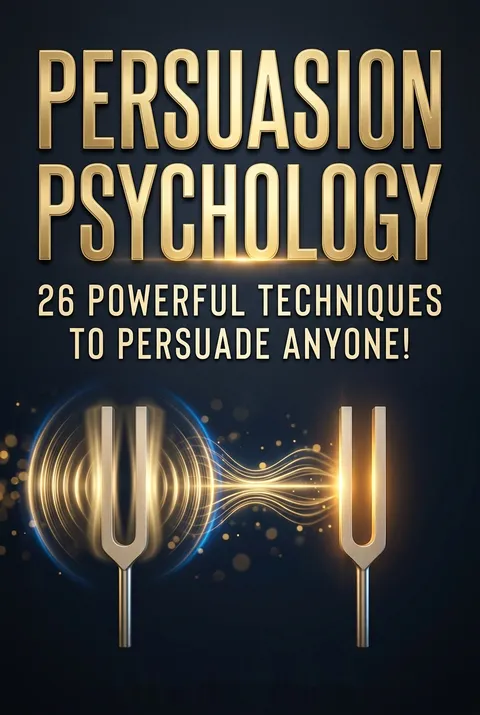
Persuasion Psychology presents 26 influence techniques including the Yes Ladder and reciprocity, supported by psychological research. Reviewers find it accessible with a conversational tone and practical examples, making it useful for teachers, salespeople, and small business owners. However, criticisms focus on its lightweight content compared to Cialdini's Influence, with some noting it feels thin with unnecessary recaps. Many readers discovered they already practice several techniques mentioned. Overall, it's considered a good starter guide for quick persuasion tools rather than in-depth analysis.
Glossary
WIIFM
Listener’s personal benefitAn abbreviation for “What’s in it for me?” It names the listener’s implicit question when someone makes a proposal: what benefit will agreement bring? The book uses WIIFM as a reminder to frame a pitch around the other person’s goals, rather than the persuader’s needs.
EDGE
Four kinds of benefitA benefit framework attributed in the book to speaker Craig Valentine. Its letters refer to esteem, doing more, gaining more, and enjoying more. It helps a persuader consider whether a proposal offers greater confidence or respect, increased productivity, concrete gains such as money or time, or greater pleasure.
Two Birds of a Feather
Similarity builds likingThe book’s label for using genuine common ground to create rapport. Shared identity, interests, or other similarities can make an interaction feel more familiar and increase openness to a request. It is presented as a way to establish connection before making a persuasive appeal.
Expert Spillover Effect
Others’ status transfersThe book’s term for the credibility that can arise through association with respected experts in the same field. Professional networks, conferences, and industry groups can make a person’s work more visible and signal that peers take it seriously. The book treats this as a long-term reputation process, not an instant credential.
Yes Ladder
Begin with shared agreementA conversational technique in which a persuader begins with questions or statements the listener is likely to agree with, before making the central request. The intended effect is to create a more cooperative mindset and build rapport. It works best when the early agreement is genuine rather than staged.
Fair Persuader
Balanced case with responsesThe book’s name for making a two-sided argument: present the case for a proposal, acknowledge a relevant weakness, and respond to that weakness. The approach is meant to signal considered judgment and address objections before they dominate the discussion. The book reports that two-sided messages work best when they include counterarguments.
Inoculation
Practice answering oppositionA persuasion technique that prepares someone to resist a stronger opposing message by first presenting a weaker version of it and developing a response. The book compares this to medical inoculation and describes its use in preparing adolescents to handle pro-smoking peer pressure. It also applies the idea to anticipating objections in a pitch.
Rokia Technique
Use a personal storyThe book’s label for using an individual’s story to make an abstract problem emotionally immediate. It refers to an experiment in which participants who heard about a hungry seven-year-old girl in Mali donated more of their reward than participants who read statistics about hunger across several countries.
BYAF Technique
Explicitly preserve choiceAn abbreviation for “but you are free.” The technique makes clear that the other person may decline a request. The book presents it as a way to reduce pressure and psychological reactance, the resistance that can arise when people feel their freedom of action is threatened.
The Power of “Why Not?”
Explore the reason for refusalThe book’s method for responding to a no by asking what concern or objection lies behind it. The persuader listens, then addresses the specific concern if possible. The question can reveal information for improving the current offer or future pitches, but it does not make every refusal negotiable.
About the Author

Download PDF
Download EPUB
.epub digital book format is ideal for reading ebooks on phones, tablets, and e-readers.








