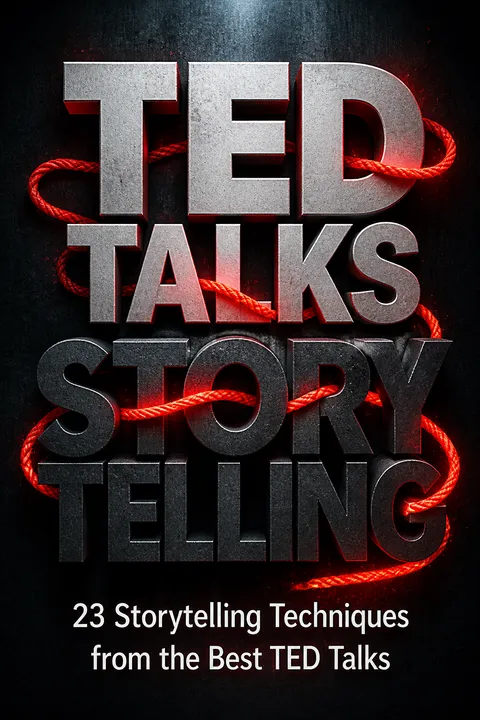


Key Takeaways
Build the talk around one idea, then let a story carry it.
Choose the point first. The book begins with a practical constraint: a TED talk has about 18 minutes, so a speaker must decide what one idea the audience should retain. Akash Karia says he studied more than 200 TED talks and found storytelling to be the common thread among the most compelling ones. Stories let speakers communicate an idea through an experience rather than deliver it as a lecture.
The story is not a decorative detour. It gives the audience a human situation through which to understand the talk’s central point. Before drafting, ask what lesson should remain if the rest is forgotten, then choose a story that makes that lesson tangible.
A story can lower the social friction of persuasion: listeners encounter a situation and draw meaning from it instead of feeling directly instructed. But emotional force and sound reasoning are not interchangeable. A vivid anecdote can make a claim feel true without establishing that it is representative. The strongest talk uses narrative to make an idea memorable, then gives the audience enough reasoning or evidence to assess it. The one-idea constraint is especially useful for short talks, though a complex subject may need several linked claims rather than one slogan.
Open inside a story before the audience starts sorting credentials.
Give listeners a scene. Karia recommends beginning with a story rather than a name, a thank-you, or a summary of the topic. He uses Susan Cain’s TED talk as an example: Cain starts by describing her first summer camp at age nine and the books her mother packed. The opening gives listeners a person, a place, and a small question about what happened next.
The book treats the first 30 seconds as a crucial window for attention. A story can make those seconds feel like the beginning of an experience, not a preamble. The audience can picture the speaker as a child and connect the scene to its own memories of school, camp, or family.
A scene creates forward motion because the audience can ask what happens next. It also gives the speaker a chance to earn attention before asking for trust. The 30-second rule is best treated as a useful coaching heuristic, not a universal deadline: a formal introduction may be necessary in some settings, and a startling opening can feel manipulative if it has little to do with the talk. The test is whether the opening scene naturally leads toward the talk’s main idea.
Give the story a real obstacle and an uncertain outcome.
Create a reason to wonder. In Karia’s usage, conflict means opposing forces that make the result uncertain. A story without an obstacle offers little reason to keep listening because the audience can already predict the outcome. In Titanic, for instance, viewers wonder both whether characters will survive the sinking and whether a romance across social divisions can endure.
Karia also points to Leslie Morgan Steiner’s talk about surviving domestic violence. Its emotional power comes from the painful tension between being harmed and still loving the person causing harm. Conflict makes listeners care what happens, rather than merely receive a sequence of facts. For a speaker, the useful question is: what does the character want, what stands in the way, and what could be lost?
Conflict is a structure for attention, not a requirement to make every story sensational. A missed opportunity, an internal doubt, or a clash between values can hold attention as effectively as physical danger. This distinction matters in professional talks, where exaggerated stakes can undermine credibility. The audience needs a genuine uncertainty, not theatrical misery. A well-chosen obstacle also clarifies the idea being taught: it reveals what the character must understand, decide, or change.
Choose personal stories over familiar parables audiences have heard before.
Bring fresh material. Karia warns against relying on widely repeated stories, such as the tale of a boy throwing stranded starfish back into the sea one at a time. Its lesson may be sound, but listeners who recognize it can disengage before the speaker reaches the point.
A personal story is more likely to feel new to that particular audience. It can also help the speaker sound more natural: recalling an event may bring back some of the emotion that accompanied it, giving the delivery greater authenticity. Personal does not have to mean dramatic. A small moment can work if it contains a clear obstacle and connects to the talk’s central idea.
Originality is not the only virtue of a story, but familiarity has a cost: listeners may spend their attention anticipating the ending instead of considering the point. A speaker’s own experience can also supply texture that a borrowed parable lacks. Still, disclosure is not automatically persuasive. The story should serve the audience’s understanding, not become a demand for sympathy, and speakers need not expose private or painful experiences to prove authenticity.
Show characters through observable details, not labels.
Make people visible. Karia highlights a passage from Malcolm Gladwell’s talk about spaghetti sauce. Gladwell gives details about a man named Howard, including his build, large glasses, thinning hair, parrot, and interests in opera and medieval history. Instead of simply calling Howard unusual, those details let listeners picture him and infer some of his personality.
The principle is to show rather than tell. A few well-chosen details can make a person seem more real and help the audience follow the story. They should be selective, not a full inventory. Ask which details help listeners imagine the character or understand why that person matters to the scene.
Concrete description lets an audience make its own inferences, which can feel more engaging than being handed a character label. The details also function as a kind of shorthand: a hobby or habit can suggest personality more efficiently than a paragraph of explanation. Yet description has to earn its place. Irrelevant traits can distract, and a character should not be reduced to appearance or a quirky prop. The most useful detail reveals something connected to the story’s action or meaning.
Use sensory cues to make the audience mentally enter the scene.
Build a brief mental movie. Karia uses VAKOG as a checklist for sensory description: visual, auditory, kinesthetic, olfactory, and gustatory cues. Mike Rowe’s account of work castrating sheep is his example. Rowe describes what the worker does and includes a memorable sound, prompting listeners to imagine the scene rather than hear only a summary of it.
The book argues for using as many senses as suit the story, while keeping descriptions short. Rowe’s passage does not explicitly supply a smell or taste, which illustrates an important practical point: the checklist is a prompt, not a quota. One or two apt sensory details can do more than a crowded description that slows the talk.
Sensory language gives listeners material to simulate, which can make a scene feel immediate and easier to recall. It also gives speakers options beyond visual description: sound, physical sensation, and emotion can carry a moment. But vividness is not always a benefit. Graphic detail can repel or embarrass an audience, as Rowe’s example deliberately does. The speaker should consider the room, the purpose, and the audience’s tolerance, then use enough detail to serve the point without turning the talk into spectacle.
Trade vague descriptions for details listeners can picture and trust.
Make the scene precise. Karia contrasts general descriptions with measurable details: saying a man is tall gives less of a picture than estimating his height, and saying a crowd is large gives less context than naming its size. He argues that specifics also add internal credibility by giving the audience a concrete timeline or setting.
He points to Leslie Morgan Steiner’s account, which specifies that five days passed before bruises faded, and to neuroscientist Jill Bolte Taylor naming the exact date she experienced a brain disorder. Such details help listeners follow events and judge their texture. Use precise dates, numbers, and descriptions when they are known and relevant, rather than padding a story with invented exactness.
Precision can make testimony easier to imagine and scrutinize. It also signals that a speaker has attended to the particulars of an event instead of relying on stock language. But specificity is not proof: a fabricated or mistaken number can sound convincing precisely because it is precise. Strong storytelling therefore depends on a discipline of verification. Where memory is uncertain, an honest approximation is more credible than a confident detail that the speaker cannot support.
Make the turning point explain how the character changes.
Show what unlocks change. Karia calls the event, idea, or insight that helps a character move through conflict the spark. A story then needs to show a difference in the character’s circumstances or understanding, not merely announce that the problem ended.
Sir Ken Robinson’s account of Gillian Lynne illustrates this movement. As a child, Lynne struggled to sit still at school. A specialist noticed that she responded to music by moving and directed her toward dance training. She went on to become a dancer and choreographer. The point is not just that she succeeded, but that someone recognized a capacity that had been mistaken for a problem. The story’s lesson should emerge from that change.
A turning point gives the audience a usable mechanism, not just a before-and-after picture. It answers the question of how change became possible, which makes the story more transferable. Still, a clean spark can oversimplify a complicated life. Lynne’s anecdote illustrates the value of noticing a child’s strengths, but it should not be taken as a general substitute for careful assessment. A persuasive story can offer an insight without pretending that one intervention explains every outcome.
Use dialogue to let the audience hear the scene unfold.
Put words in the room. Karia recommends using dialogue instead of summarizing every exchange in narration. In Robinson’s story about Lynne, the specialist speaks directly to her mother and identifies dance as a possible fit. Hearing the conversation gives the audience a clearer sense of the moment than a report that the specialist simply offered advice.
Dialogue can also create vocal variety. A speaker may shift pace, pitch, or volume to distinguish people and reflect emotion, making a story more dynamic. It is especially useful for a brief exchange that changes the direction of the story. Long conversations, or dialogue added only for drama, can make a talk feel staged rather than vivid.
Dialogue invites listeners to interpret tone and character for themselves, while narration tends to compress those judgments into the speaker’s explanation. That makes it a powerful tool for scene and pacing. It also creates an ethical obligation: remembered conversations are rarely exact transcripts. Speakers should avoid presenting reconstructed wording as certain fact, especially when the precise words carry the moral weight of the story. Honest paraphrase can preserve the scene without pretending memory is a recording.
End with a compact lesson and, when truthful, a hopeful resolution.
Leave a clear aftertaste. Karia distinguishes between stories in which a character overcomes conflict and those in which the character ends in a worse position. He calls the first kind positive-message stories and argues that they can educate while leaving an audience energized. His example is The Pursuit of Happyness, in which Chris Gardner faces homelessness with his young son, persists through an unpaid internship, and eventually succeeds as a stockbroker.
A story should finish with a short takeaway that listeners can remember and repeat. A hopeful ending is useful when the events support it; a story need not manufacture a triumph. The final lesson should fit what the audience has just seen, rather than sound like a slogan pasted onto it.
A concise takeaway gives the audience a handle for recalling the story and discussing it afterward. Hope can make difficult material feel actionable, especially when the character’s choices are visible. Yet uplifting endings can distort reality if they imply that effort alone defeats every obstacle. Some stories are valuable because they reveal loss, injustice, or limits. The goal is not compulsory cheerfulness, but an ending whose emotional tone and lesson are earned by the events.
Analysis
This is a concise practical guide to turning a presentation into an audience experience. Its core argument is that stories do more than entertain: they create a route from attention to emotion to a memorable idea. The author compresses 23 techniques into a small set of durable choices: begin with a scene, give that scene an obstacle, make people and places imaginable, show what changes, and state the lesson clearly. Examples from TED talks make the advice concrete, while familiar films help explain why uncertainty and resolution matter.
The book’s most useful contribution is its movement from abstraction toward craft. A speaker can revise a draft by asking specific questions: Is the opening a scene or a preamble? Can the listener picture the character? What is at stake? What changes, and what caused it? This turns storytelling from a vague talent into a set of editorial decisions. The sensory checklist and attention to precise details are particularly practical because they identify material that can be added or cut during rehearsal.
The approach also has limits. The book sometimes treats storytelling as a near-universal cure for dull talks, but a story can obscure a technical explanation, overwhelm evidence, or make a weak claim feel persuasive. Its preference for positive resolutions is a useful motivational strategy, not a rule for every subject. Some honest accounts end without triumph, and forcing a happy conclusion can imply that structural problems are merely personal failures. Similarly, personal stories may increase authenticity, but they are not required for every speaker or topic.
The strongest use of the method is therefore selective. A story should earn its place by clarifying the central idea, and every vivid detail should be accurate and relevant. Narrative supplies attention and human consequence; analysis supplies boundaries and reasons to believe. A speaker who combines both can be compelling without asking the audience to confuse emotional impact with proof.
Review Summary
TED Talks Storytelling receives mixed reviews, with an average rating of 3.72 out of 5. Positive reviews praise its concise, practical tips for public speaking and storytelling, while critics find it shallow and repetitive. Many appreciate its quick-read format and real-world examples from TED talks. However, some feel it lacks depth and could have been condensed into a shorter article. Readers generally agree it's useful for beginners but may not offer much new information for experienced speakers. The book's focus on storytelling techniques is seen as its main strength.
People Also Read



Glossary
Story Start
Story-based openingA presentation opening that begins with a story rather than introductory remarks, credentials, or a topic announcement. It gives the audience a character and situation to imagine, inviting attention through curiosity and personal connection. Karia recommends using this approach early, while ensuring the opening story leads naturally into the talk’s main idea.
VAKOG
Five sensory channelsAn acronym for visual, auditory, kinesthetic, olfactory, and gustatory experience: sight, sound, physical or emotional feeling, smell, and taste. Karia uses it as a prompt for choosing sensory details that help listeners imagine a scene. The acronym is a checklist rather than a requirement to include all five senses in every story.
The Spark
Trigger for changeThe insight, event, process, or piece of guidance that helps a story’s character begin to overcome a conflict. It explains what makes change possible, rather than simply showing that the character’s situation improves. In Karia’s approach, the spark connects the obstacle to the character’s resulting change and the story’s lesson.
positive-message stories
Stories of overcoming conflictStories in which a character overcomes an obstacle and changes for the better. Karia argues that these stories can convey advice indirectly while leaving an audience inspired. The character’s progress should arise from the story’s events, and the ending should support the lesson rather than impose an unrelated moral.
negative-message stories
Stories of worsening outcomesStories in which a character fails to overcome the conflict or ends in a worse position. Karia describes these as potentially instructive because they show what not to do, but says they can leave an audience emotionally low. The distinction concerns the story’s outcome and effect, not whether the story has any value.
FAQ
What's "TED Talks Storytelling" about?
- Focus on Storytelling: "TED Talks Storytelling" by Akash Karia is a guide that explores the storytelling techniques used by the best TED speakers to captivate their audiences.
- 23 Techniques: The book outlines 23 specific storytelling techniques that can be applied to make any presentation more engaging and memorable.
- Practical Application: It provides practical advice on how to incorporate these techniques into your own presentations, whether for a TED talk or a corporate setting.
- Master Storytelling: The ultimate goal is to help readers become master storytellers, enhancing their public speaking skills and audience engagement.
Why should I read "TED Talks Storytelling"?
- Enhance Presentation Skills: The book offers valuable insights into improving your presentation skills by mastering storytelling.
- Engage Audiences: It teaches how to keep audiences engaged and interested, which is crucial for effective communication.
- Learn from the Best: By analyzing over 200 TED talks, the book distills the techniques of some of the best speakers in the world.
- Practical and Actionable: The techniques are presented in a way that is easy to understand and apply, making it a practical resource for anyone looking to improve their public speaking.
What are the key takeaways of "TED Talks Storytelling"?
- Storytelling is Key: The magic ingredient in all great TED talks is storytelling, which makes presentations captivating and memorable.
- Start with a Story: Opening a presentation with a story is a powerful way to grab the audience's attention.
- Conflict Drives Engagement: A strong conflict in a story makes it irresistible and keeps the audience engaged.
- Use Sensory Details: Providing sensory details helps create vivid mental images, making stories more impactful.
How does Akash Karia suggest starting a presentation?
- Open with a Story: Karia emphasizes the importance of starting with a story to immediately engage the audience.
- Avoid Boring Intros: He advises against starting with dull, predictable introductions, which can lose the audience's interest.
- Create Curiosity: A well-told story at the beginning can arouse curiosity and set the tone for the rest of the presentation.
- Example from TED Talks: He uses Susan Cain's TED talk as an example of an effective story start that hooks the audience.
What is the 'magic ingredient' in delivering a great TED talk according to Akash Karia?
- Storytelling Mastery: The magic ingredient is the mastery of storytelling, which is common among all great TED speakers.
- Engagement through Stories: Stories allow speakers to share their message without appearing to lecture, making it easier for audiences to accept the message.
- Memorable Presentations: Storytelling makes presentations more memorable and engaging, keeping the audience hooked.
- Practical Guide: The book provides a guide to crafting and presenting stories effectively in any presentation setting.
What is the 'Story Start' technique in "TED Talks Storytelling"?
- Immediate Engagement: The 'Story Start' technique involves beginning a presentation with a story to capture the audience's attention right away.
- Avoid Predictability: It helps avoid predictable and boring openings that can disengage the audience.
- Mental Journey: Stories take the audience on a mental journey, making them more likely to stay engaged.
- Example of Effectiveness: Susan Cain's TED talk is highlighted as a successful example of using a 'Story Start' to engage the audience.
What role does conflict play in storytelling according to Akash Karia?
- Essential Element: Conflict is the number one element that makes a story irresistible and keeps the audience engaged.
- Creates Curiosity: A strong conflict creates suspense and curiosity, making the audience wonder what will happen next.
- Emotional Engagement: Conflict arouses emotions, helping the audience connect with the story and the speaker.
- Example from Movies: Karia uses the movie "Titanic" as an example of how conflict drives engagement and interest.
How can sensory details enhance storytelling in presentations?
- Visual Imagery: Sensory details help create vivid mental images, making the story more engaging and memorable.
- Engage All Senses: Using sight, sound, touch, smell, and taste can turn a story into a mental motion picture for the audience.
- Show, Don't Tell: Providing specific sensory information allows the audience to experience the story rather than just hear it.
- Example from TED Talks: Malcolm Gladwell's TED talk is used as an example of effectively using sensory details to bring characters to life.
What is the importance of specific details in storytelling?
- Enhances Credibility: Specific details add internal credibility to the story, making it more believable and engaging.
- Creates Clear Images: Specificity helps the audience visualize the characters and scenes, enhancing their understanding and interest.
- Avoids Vagueness: Non-specific language can make a story less impactful and harder for the audience to connect with.
- Example from TED Talks: Leslie Morgan Steiner's TED talk is highlighted for its use of specific details to enhance the story's impact.
What are positive-message stories and why are they important?
- Inspiring and Uplifting: Positive-message stories are those where the main character overcomes conflict, leaving the audience on an emotional high.
- Educational and Motivational: They educate the audience while also inspiring them, making the message more impactful.
- Avoid Negative Endings: Negative-message stories can leave audiences on an emotional low, which is less desirable in a presentation.
- Example from TED Talks: Sir Ken Robinson's TED talk is used as an example of a positive-message story that inspires and engages the audience.
How does Akash Karia define the 'spark' in storytelling?
- Catalyst for Change: The 'spark' is the process, idea, or wisdom that allows the character to overcome the conflict in the story.
- Valuable Lesson: It provides a valuable lesson or takeaway that the audience can apply to their own lives.
- Essential Story Element: The spark is a crucial part of the story structure, leading to the character's change and the story's resolution.
- Example from Personal Stories: Karia shares personal stories to illustrate how a spark can lead to overcoming challenges and achieving goals.
What are the best quotes from "TED Talks Storytelling" and what do they mean?
- "The one thing that all great TED speakers have in common is that they are master storytellers." This emphasizes the central role of storytelling in successful presentations.
- "If you don’t grab your audience’s attention within the first thirty seconds, your audience will mentally tune out of your presentation." Highlights the importance of a strong opening to maintain audience engagement.
- "No conflict = no curiosity = no interest." Underlines the necessity of conflict in storytelling to keep the audience curious and engaged.
- "Positive-message stories are inspiring. Leave your audience on an emotional high." Encourages the use of uplifting stories to inspire and motivate the audience.
About the Author


Download PDF
Download EPUB
.epub digital book format is ideal for reading ebooks on phones, tablets, and e-readers.








