

Key Takeaways
Use mathematics to strip away detail and make complex reality manageable
Abstraction is the tool. Mathematics is useful not because it copies the world in every detail, but because it isolates a structure that matters. A road network becomes intersections joined by routes. A changing temperature becomes numbers that a thermostat can track. Once the problem is represented this way, a computer can calculate without needing human intuition or a complete picture of reality.
The simplification has a purpose. Ancient administrators used numbers to track food, taxes, and labor; modern services use them to rank search results, suggest films, and plan journeys. Mathematics makes these tasks faster and more consistent, but it does not eliminate the real-world problem. It gives people a compact model with which to handle it.
What's striking is that mathematics gains practical force by leaving things out. This resembles a map: it is useful precisely because it omits most of the terrain. The important question is not whether a model captures everything, but whether its omissions are harmless for the task. A route planner can ignore scenery; a medical model cannot casually ignore a factor that changes treatment outcomes. The book's central idea therefore carries a practical test: identify what the model preserves, what it discards, and whether that tradeoff fits the decision.
Treat mathematics as useful even while its ultimate nature remains unsettled
Two competing pictures. Platonists hold that mathematical objects, such as numbers, exist independently and are discovered. Nominalists treat mathematics more like a consistent invented story: statements are judged by whether they follow the rules, not by whether numbers inhabit a separate world. The book presents neither position as a solved account of what mathematics is or how people learn it.
Yet mathematics surprises. Newton's model of gravity unified falling objects and planetary motion, and later measurements found it extraordinarily accurate within its range. Dirac's equations pointed toward the positron before it was observed. These cases suggest that mathematical structures can reveal patterns people had not yet detected, not merely tidy up familiar ones.
The philosophical puzzle matters because usefulness alone does not settle what mathematics describes. A model can be internally consistent and still fail to match the world; empirical testing supplies the missing check. The positron story shows a productive relationship between formal reasoning and observation: mathematics generates a candidate, while experiments decide whether nature cooperates. This avoids two extremes, treating equations as mystical truth or as arbitrary symbols. Their significance depends on both the structure of the model and the evidence linking it to reality.
Build exact number systems on top of the brain's rough estimates
Estimation comes first. People and other animals can notice shapes, compare lengths, and distinguish small quantities without formal mathematics. Babies can track a few objects individually, while larger groups are perceived approximately: the difference between four and eight is easier to notice than the difference between four and six. A basket that looks fuller is not the same thing as a precise count.
Exactness is learned. The Pirahã, described in the book through researcher Daniel Everett's work, live without number words and manage everyday exchange through familiarity and rough judgment. The Yupno and Loboda also use body-based counting or comparisons rather than numbers in many situations. These examples show that mathematical symbols are not required for ordinary survival, but they let people record quantities precisely and communicate them beyond immediate perception.
This distinction helps explain why mathematical learning can feel unnatural: it extends intuitive capacities while also correcting their limits. Perception is fast and approximate, whereas counting creates stable, shareable quantities. The cultural examples also caution against equating a lack of conventional numerals with a lack of intelligence. Different communities solve practical tasks with the tools their lives demand. At the same time, the book's account is strongest when read as a contrast between estimation and exact notation, not as proof that an entire culture has no mathematical reasoning.
Math became indispensable when societies outgrew face-to-face memory
Cities needed records. In Mesopotamia, growing settlements had to manage food stores, taxes, trade, and labor at a scale where personal memory and rough estimates no longer sufficed. Merchants first used clay tokens to represent goods. Marks representing those tokens were pressed onto clay envelopes and tablets, helping give rise to written numbers. By around 4000 BC, such records were already being used for administration.
Precision organized power. Egyptian scribes used arithmetic to divide rations, calculate taxes, and record exchanges of bread and beer. In Mesopotamia, bookkeeping could track enormous labor obligations, including debts imposed on overseers. Mathematics made large-scale coordination possible, but it also made administration more exacting. The same tools that help organize shared resources can help authorities monitor and control people.
The history connects mathematics to institutions, not just clever individuals. Record-keeping allows decisions to persist across time and distance, but it also makes populations legible to rulers. That is a double-edged achievement: a food ledger can prevent shortages, while a labor ledger can enforce an unjust burden. The book's account invites readers to ask who benefits when a system becomes measurable. Numbers can improve coordination without making the goals being coordinated fair or humane.
Use calculus to turn continuous change into manageable small steps
Rates and totals differ. Calculus is the mathematics of change. Differentiation measures how quickly something is changing at a particular moment; integration adds up many small changes to find a total. Newton and Leibniz developed these methods independently in the seventeenth century, amid a bitter dispute over credit.
The applications are physical. A car's cruise control adjusts acceleration by tracking changes in speed. Weather models calculate how air and temperature shift across large regions. Engineers use calculus to estimate how much a bridge girder bends under load, and car designers use it to model motion during a crash. The intuitive principle is to divide a changing process into smaller steps: smaller intervals improve the estimate, while integration accumulates those intervals into a whole.
Calculus turns motion into something that can be reasoned about without freezing the world into a single snapshot. Its power comes from linking local change to larger consequences, a pattern useful in engineering, physics, and economic modeling. But precision in calculation should not be confused with certainty about the system being modeled. A forecast can be mathematically exact relative to its inputs and still miss because those inputs are incomplete or the real process is too complex. The method improves estimates; it does not abolish uncertainty.
Let probability quantify uncertainty, but inspect the assumptions underneath
Chance became calculable. In 1654, Blaise Pascal and Pierre de Fermat worked on how to divide a gambling pot when a game ended early. Their solution helped launch probability theory. Later mathematicians developed methods for learning from incomplete evidence, rather than requiring every possible outcome to be known in advance.
Base rates change the answer. Bayes's formula combines prior prevalence with test performance to estimate the chance that a positive result is true. In the book's example, cancer affects 2 percent of a population, a test detects 90 percent of cases, and 8 percent of people without cancer also test positive. Among all positive results, only 18.75 percent would be true cases. A test's accuracy is not the same as the meaning of a positive result.
The example illustrates a general reasoning trap: people often focus on how accurate a test is while neglecting how common the condition is before testing. Probability forces both pieces of information into view. The same discipline applies to risk claims, screening tools, and forecasts. Still, a calculated probability is only as trustworthy as its inputs and definitions. If prevalence is poorly estimated, or the test performs differently in the group being assessed, a neat answer can conceal a weak foundation.
Before trusting a statistic, ask who was counted and what comparison means
A number needs a denominator. A 10 percent rise in murders can sound dramatic while concealing that the overall rate remains low, or that an increase is concentrated in one city. The book describes a 1936 election poll that surveyed millions yet predicted the wrong winner because its sample favored wealthier people, who were more likely to support the losing candidate. A large sample is not automatically representative.
Association is not cause. A correlation coefficient measures how closely two variables move together, on a scale from -1 to +1. The book gives a deliberately absurd example: Nicolas Cage film counts correlated with swimming-pool drownings. The relationship is measurable, but that does not show that one causes the other. Averages can likewise hide important differences within groups.
Statistical literacy is less about distrusting every number than about asking what process produced it. Sampling, denominators, categories, and comparison groups determine what a figure can support. This is especially important when a statistic is used to recommend policy: a true percentage can still create a misleading impression if its baseline or distribution is hidden. Correlation is a useful clue for further investigation, not a causal verdict. The habit of asking how the data were gathered is a form of civic scrutiny.
Recognize networks, because one graph can solve routes, search, and diagnosis
A graph is a network model. In graph theory, points represent places or things, and connecting lines represent relationships between them. Leonhard Euler used this abstraction to solve the Königsberg bridge puzzle: by representing land areas as points and bridges as lines, he showed that crossing every bridge once was impossible.
The same structure travels. Route planners model intersections and roads; search engines use links between web pages to rank results; recommendation systems connect films through patterns in viewers' choices. Researchers have also used network-based ranking to identify genes relevant to cancer treatment. In one study discussed in the book, predictions of treatment response improved from 60 percent accuracy to 72 percent. A general method can become useful in very different settings when their relationships share a structure.
Graph theory is a particularly clear example of mathematical reuse: the content changes, but the pattern of connections remains. That is a powerful way to transfer methods across fields, especially when systems contain many interacting parts. Yet a network's output depends on what counts as a node, a link, and a meaningful connection. A gene interaction, a web hyperlink, and a friendship are not identical kinds of evidence. The common structure enables calculation, but domain knowledge must determine what the calculation should mean.
Demand accountability when algorithms decide what information reaches you
Algorithms have boundaries. Search and recommendation systems often rank items by how they connect to what a person already views or chooses. That can make useful results easier to find, but it can also make unfamiliar perspectives harder to encounter. The book argues that such systems cannot simply identify truth or meaning from connections alone; a link to a page does not prove that the page is reliable.
Data gives prediction power. Social networks and neural networks process information to estimate relationships, preferences, or likely behavior. The same tools can recommend friends, target advertisements, or make predictions from large collections of personal data. Their effects depend not only on mathematical techniques but also on who supplies the data, what objective the system is trained to pursue, and who can inspect or challenge its decisions.
The key civic issue is that technical performance and social value are different standards. An algorithm can efficiently maximize engagement or predict a preference while narrowing what a person sees. This makes transparency about objectives as important as accuracy claims. The book is right that changing an algorithm is not always a simple fix: a system built to rank similarity cannot automatically produce trustworthy disagreement. But design choices remain choices, and public oversight can ask whose interests they serve.
Analysis
The book's most useful move is to treat mathematics not as a school subject made of symbols, but as a set of abstractions that make difficult tasks tractable. It builds that case through a clear progression: humans estimate quantities intuitively; growing societies need exact records; calculus handles change; statistics handles uncertainty; and graph theory handles relationships at scale. The modern applications then feel less like magic. Google Maps, polls, weather forecasts, and cancer predictions all become different instances of translating a problem into a structure that can be calculated.
That progression also reveals the central tension. Abstraction is mathematics' advantage and its risk. A model can process a huge network because it ignores much of what makes each connection meaningful. A statistic can summarize a population, but its average may obscure unequal circumstances. A prediction can be accurate on a selected dataset while still serving a questionable objective. The book's strongest civic lesson is therefore not simply that people should learn more mathematics. It is that people should ask what was modeled, what was left out, and how the result is used.
The philosophical discussion of whether mathematics is discovered or invented remains deliberately unresolved. The examples of Dirac and Fresnel give the question real force: mathematical reasoning sometimes leads to physical discoveries that were not the original aim. Yet the book does not need a final metaphysical answer to establish practical value. Successful application depends on a fit between mathematical structure and real-world structure, tested through observation and revised when it fails.
As a popular introduction, the book favors memorable cases over technical completeness. Its accounts make difficult ideas approachable, though simplified explanations can understate disputes about evidence, algorithms, or how mathematical models are validated. The right response is not to distrust the mathematics, but to pair mathematical literacy with subject knowledge and ethical scrutiny. The result is a more precise kind of skepticism: respect what calculation can reveal, while refusing to treat a number as self-explanatory.
Review Summary
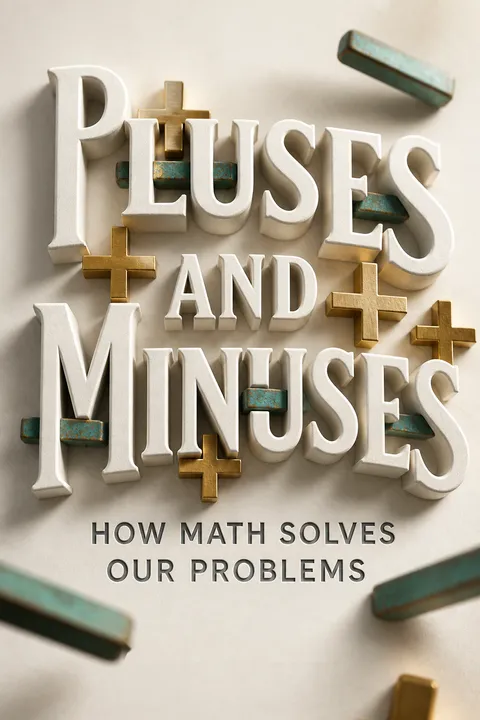
Pluses and Minuses receives mixed reviews, with ratings ranging from 1 to 5 stars. Readers appreciate the book's accessible explanation of math's real-world applications and historical context. Some find it engaging and eye-opening, while others criticize its vagueness and simplistic approach. The book covers various mathematical concepts, including calculus, statistics, and graph theory. Reviewers note that it may be more suitable for younger audiences or those with limited mathematical background. Some readers wish for more in-depth explanations and concrete examples, while others praise the author's passion for making math relatable.
People Also Read





Glossary
Platonism
Mathematics as discoveryIn the philosophy of mathematics, Platonism is the view that mathematical objects, such as numbers, exist independently of human thought. Mathematicians discover truths about this abstract realm rather than inventing them. The view faces a difficult question: if mathematical objects are nonphysical and separate from everyday experience, how can people gain knowledge of them?
nominalism
Mathematics as constructed languageNominalism rejects the idea that mathematical objects exist in a separate abstract realm. On the account described in the book, mathematics is more like a coherent story: its statements are assessed according to whether they follow the rules of the system. This explains how mathematical claims can be correct within mathematics, but leaves open why mathematical structures describe the physical world so effectively.
calculus
Mathematics of changeCalculus is the branch of mathematics used to analyze changing quantities. Its two central operations are differentiation, which measures a rate of change at a particular point, and integration, which accumulates small changes into a total. Developed independently by Isaac Newton and Gottfried Wilhelm Leibniz in the seventeenth century, calculus underlies many models in physics, engineering, weather prediction, and control systems.
differentiation
Measures instantaneous changeDifferentiation determines how quickly a quantity changes at a particular moment. The book explains the idea by estimating a moving car's speed over shorter and shorter intervals: as the interval shrinks, the estimate approaches the car's speed at a specific instant. Differentiation is used in applications such as cruise control, weather modeling, and predicting how structures respond to forces.
integration
Accumulates small changesIntegration combines many small contributions to calculate a total. It can estimate the area beneath a changing curve by adding the areas of increasingly narrow rectangles, or determine a total amount from a rate measured over time. The book applies this principle to examples such as calculating movement during a car crash and modeling accumulated changes in physical systems.
Bayes's formula
Updates probability from evidenceBayes's formula calculates the probability of a claim given new evidence by combining the claim's prior likelihood with how often the evidence occurs when the claim is true or false. It helps answer questions such as the chance that someone has a disease after receiving a positive test. The answer depends on the underlying prevalence as well as the test's performance.
correlation coefficient
Measures paired movementA correlation coefficient is a number from -1 to +1 that describes how closely two variables vary together. A value near +1 indicates that they tend to rise together, a value near -1 that one tends to rise as the other falls, and a value near zero that no consistent linear relationship is apparent. Correlation alone does not establish that one variable causes the other.
graph theory
Mathematics of networksGraph theory studies networks represented as points connected by lines. Points can stand for places, websites, films, or genes, while lines represent roads, links, similarities, or interactions. The same mathematical structure can support very different applications, including route planning, search ranking, recommendations, and analysis of biological networks.
A* algorithm
Guides efficient route searchThe A* algorithm searches for a route by considering both the distance already traveled and an estimate of the distance remaining to the destination. Compared with Dijkstra's algorithm, which expands routes in order of their accumulated length, A* can examine far fewer possibilities. It finds a shortest route when its estimate does not overstate the true remaining distance.
neural networks
Networks trained to predictNeural networks are computational systems made of connected units that transform numerical inputs into outputs. During training, the system compares its predictions with known answers and adjusts the strength of its connections. Repeating this process can improve performance on tasks such as image recognition or preference prediction, although the internal basis for a particular result may be difficult to interpret.
Download PDF
Download EPUB
.epub digital book format is ideal for reading ebooks on phones, tablets, and e-readers.








