

Key Takeaways
Locate sovereignty where someone decides that ordinary rules have failed.
Find the decisive authority. Schmitt defines sovereignty through the exception: a crisis that threatens the political order and cannot be handled by applying ordinary rules alone. The sovereign is not simply whoever holds the highest office. It is whoever decides that normal conditions have broken down, chooses the response, and determines when ordinary order has returned.
Look beyond titles. In Weimar Germany, the president had emergency powers under Article 48, but parliament could demand their suspension. Schmitt’s question was whether such legal arrangements could fully settle who had final authority in a crisis. His answer was that the decisive power becomes visible precisely when rules cannot settle what must be done.
The definition turns an abstract constitutional question into a practical test: who can name the crisis, act on that judgment, and declare it over? That sequence is useful because emergency authority often hides inside procedures that look routine until a conflict arrives. The harder question is whether identifying this power also legitimizes it. Schmitt’s account is strongest as a diagnosis of where authority operates, not as proof that the person exercising it deserves obedience.
Study the exception to see what a legal order quietly assumes.
Rules need normal conditions. Schmitt argues that a legal rule can guide conduct only when there is a stable situation in which it can be applied. A general statute cannot anticipate every detail of a genuine crisis, nor can it decide by itself whether a crisis has occurred. The exception is therefore not merely an unusual case within the rules. It exposes what the rules rely on but cannot fully specify.
Order is not chaos. For Schmitt, suspending ordinary law does not necessarily mean that all order disappears. The state may remain in place while the usual legal framework recedes. This distinction matters: a crisis decision can create the conditions under which ordinary law becomes usable again, even as it temporarily sets aside some of its constraints.
This argument draws attention to a real weakness in rule-based systems: rules need conditions of application, and those conditions can themselves become contested. The exception makes that dependency visible. Yet the idea can also be used to inflate ordinary problems into existential crises. A useful reading therefore asks two questions at once: what assumptions does the law require, and who benefits when someone claims those assumptions have failed?
Law needs an authorized decider, not merely a flawless chain of rules.
Norms cannot appoint themselves. Schmitt challenges legal theories, especially Hans Kelsen’s, that treat the state as a unified system of valid rules. A legal norm can prescribe how a decision should be made, but it cannot, by its own force, identify the person or institution entitled to make that decision. Applying a general rule to a concrete case involves judgment, and the authority to judge cannot be derived from the rule’s wording alone.
Competence changes outcomes. Schmitt’s point is not simply that officials sometimes break rules. Even a legally correct decision requires an authorized decision-maker, and a mistaken decision may still have legal effects if it is recognized as authoritative. For him, law’s practical force depends on both general standards and a concrete power that can apply them.
The distinction between a rule and the authority that applies it remains valuable: legal texts do not interpret themselves, and institutions must settle disagreements about interpretation. Schmitt shows why claims of purely mechanical law can conceal human judgment. But his emphasis on authority risks making the decision-maker appear more fundamental than the standards meant to constrain that person. The challenge is not to choose rules or judgment, but to make each answerable to the other.
Emergency powers may rescue a constitution by loosening its safeguards.
Weimar made the dilemma concrete. Article 48 allowed the German president to take measures when public security and order were seriously threatened, including suspending certain listed rights. Schmitt argued that the list limited which rights could be suspended, not every other action the president might take to restore order. Most legal interpreters rejected this expansive reading, fearing that it would give the executive excessive freedom.
Preservation can become transformation. Schmitt presented emergency powers as a way to restore the conditions under which the constitution could function. Yet a power broad enough to respond to unforeseen events can also weaken the limits that distinguish constitutional government from rule by decree. The same provision intended to defend the state could become a route around its ordinary restraints.
Emergency law presents a structural problem: the executive may need speed and discretion, while the public needs assurance that temporary powers will not become permanent. Schmitt clearly identifies the first need, but his broad reading gives less weight to the second. His case is a reminder that safeguards cannot eliminate every uncertainty, but they can determine who reviews emergency action, what must be justified, and how normal procedures resume.
Modern state authority still carries theology in secular clothing.
Political concepts inherit old structures. Schmitt’s political theology is the study of how important modern state concepts retain the shape of theological ideas. The sovereign lawgiver, for example, resembles the all-powerful God in older accounts of the world. Schmitt argues that the resemblance is not only historical. It also appears in the way political systems imagine a final authority capable of intervening when ordinary rules fail.
The exception resembles a miracle. A miracle interrupts the expected order of nature; an exception interrupts the expected order of law. Schmitt uses this analogy to explain why a crisis decision reveals what a legal system normally leaves in the background. He is not simply proposing a return to religious government. His claim is that secular political authority still depends on concepts of ultimate power and intervention.
The analogy is illuminating when treated as a map of political imagination rather than a claim that modern law is secretly theology. Societies often assign extraordinary authority to whoever can restore order, and the language of necessity can lend that authority a sense of inevitability. The analogy also has limits: political decisions are made by fallible people, not supernatural agents. Recognizing the theological structure should sharpen scrutiny of authority, not sanctify it.
Politics draws a boundary between the community and its possible enemies.
A collective identity has an outside. The foreword and introduction connect Schmitt’s sovereignty theory to his friend-enemy distinction. This is not a label for personal dislike. It describes a political community that understands itself as a distinct group and recognizes the possibility of serious conflict with another group. Schmitt argues that the state must be able to identify threats to its unity, including threats within its own borders.
The boundary carries danger. In Weimar Germany, Schmitt feared that anti-constitutional parties could use elections and parliamentary rules to gain power, then dismantle the system that let them compete. He therefore argued against granting equal political opportunity to parties he considered hostile to the constitutional order. The problem is that whoever defines the enemy may also decide which dissenters remain entitled to participate.
The friend-enemy distinction explains why political conflict cannot always be reduced to policy disagreement or private hostility. It also reveals the danger of treating unity as something that requires a clearly marked outsider. Once political leaders claim authority to identify internal enemies, opposition can be reframed as disloyalty rather than disagreement. The concept is most useful as a warning about how political boundaries are made, not as a neutral test for who belongs.
Recognize when procedural debate is deferring a decision rather than resolving it.
The counterrevolutionaries wanted finality. Schmitt examines Joseph de Maistre, Louis de Bonald, and Juan Donoso Cortes, thinkers who believed the conflicts of their era demanded decisive choices. Donoso Cortes called the liberal bourgeoisie a class inclined to turn political conflict into discussion and negotiation. To him, debate could become a way to avoid responsibility when the political order faced a fundamental challenge.
But finality has a cost. Schmitt finds this argument powerful, yet his account also shows how its logic escalates. Donoso Cortes concluded that monarchy had lost its legitimacy and called for dictatorship. Schmitt ultimately distinguishes this kind of decisionism from legitimate authority: intensifying the demand for a decision can destroy the very claim to legitimacy that was meant to justify it.
Schmitt’s criticism catches a genuine failure mode: procedure can become theater when participants use it to postpone choices with real consequences. Still, discussion is not inherently evasive. It can expose weak assumptions, include affected groups, and make a decision more accountable. The key distinction is whether deliberation changes what decision-makers understand and do, or merely supplies respectable language for avoiding responsibility.
Use institutions to stabilize power, but do not mistake them for sovereignty.
Schmitt added a third legal style. In the 1934 preface, he distinguishes normativist thinking, which emphasizes impersonal rules, and decisionist thinking, which emphasizes personal decisions, from institutional thinking, which focuses on organizations and durable social arrangements. He associated institutions with structures that can persist beyond a single decision or leader.
Stability needs structure. Schmitt saw institutions as a way to anchor political life in practices such as professional service and organized social groups. But he warned that institutions, if treated as independent sources of authority, could fragment political unity. His proposal was for the state to protect these social orders while retaining the capacity to settle conflicts among them. The balance is difficult: institutions can restrain arbitrary power, but they can also compete with one another for final authority.
The three styles identify different ingredients of a working legal order: rules provide continuity, decisions address unsettled cases, and institutions preserve practices across time. None can safely replace the others. Schmitt’s concern about institutional fragmentation highlights the need for common procedures to manage conflicts among organizations. Yet a strong center is not the only source of cohesion. Shared constraints can also hold institutions together without giving one actor unlimited discretion.
Schmitt's Nazi allegiance exposes the danger of treating order as legitimacy.
Theory entered political life. Schmitt published Political Theology in 1922, before the Nazi seizure of power. In 1933 he joined the Nazi Party, and in 1934 he publicly defended Hitler’s purge of the SA leadership as an act that protected the legal order. The foreword describes his attraction to a regime he believed could restore decisive political authority, as well as his later claim that he had turned against it.
A diagnosis is not a safeguard. Schmitt’s work identifies a real problem: rules alone may not settle a crisis. But his own political choices show the danger of treating the power to impose order as evidence that a decision is legitimate. The theory helps explain how emergency authority can be understood and defended; it does not provide a reliable test for whether that authority serves justice or merely the ruler.
Schmitt’s political record belongs beside his theoretical contribution, not as a substitute for understanding it and not as a footnote to excuse it. His case shows that a theory can accurately expose gaps in legal systems while offering weak protection against the abuse of those gaps. The crucial distinction is between describing who can decide and deciding what that person ought to be permitted to do. Political analysis needs both questions.
Analysis
Political Theology is a compact argument about the point where law meets its own limits. Schmitt’s central move is to shift attention away from sovereignty as a title or abstract quantity and toward the power to determine when ordinary legal conditions no longer hold. This makes the book more than a defense of executive strength. It is also a challenge to theories that imagine rules can fully specify their own application, authority, and suspension.
The argument is persuasive as diagnosis. Legal systems require institutions and people who interpret rules, resolve disputes, and respond to situations that lawmakers did not predict. Schmitt insists that this human element cannot be made to disappear by describing law as a closed system. His theological analogy extends the point: secular political language can preserve older patterns of ultimate authority even after religious explanations lose public force.
The difficulty is that diagnosis and prescription become dangerously entangled. If no rule can determine whether an emergency exists, the decision-maker gains power over both the description of the crisis and the response to it. Schmitt recognizes that this decision can create legal order, but the theory supplies no dependable standard for separating necessary intervention from self-serving domination. His discussion of Weimar Article 48 makes that problem tangible, while his later support for Nazi rule makes its political stakes impossible to ignore.
A careful reader should therefore hold two conclusions together. Legal rules cannot eliminate judgment, and judgment cannot be trusted simply because it claims to restore order. The central constitutional task is not to pretend that exceptions can be perfectly prewritten, but to distribute emergency authority, demand reasons for its use, preserve avenues of challenge, and make the return to ordinary law an accountable decision. Schmitt clarifies why sovereignty cannot be reduced to paperwork; he also demonstrates why decisive power needs limits beyond its own confidence.
Review Summary
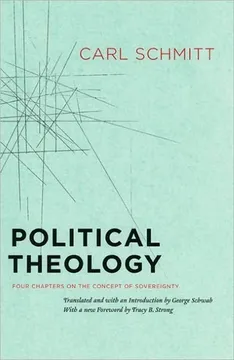
Reviews of Political Theology are deeply divided. Many readers find Schmitt's central thesis — that sovereignty resides in whoever decides on the "state of exception" — both intellectually sharp and politically dangerous. Critics connect his ideas directly to fascism, Nazism, and modern authoritarianism, including Trump-era politics. Supporters acknowledge the analytical power of his critique of liberalism and legal positivism, even while rejecting his conclusions. Most agree the book is concise and provocatively written, with the opening line — "Sovereign is he who decides on the exception" — considered among the twentieth century's most consequential political statements.
People Also Read





Glossary
Sovereignty
Final authority in crisisFor Schmitt, sovereignty is not merely the highest office or the greatest quantity of power. It is the authority to decide whether ordinary legal conditions have failed, what measures the crisis requires, and when normal order has returned. This definition makes the decision in an exceptional situation the clearest evidence of where political authority resides.
Exception
Crisis beyond ordinary rulesThe exception is a severe situation that threatens the existing political or legal order and cannot be fully anticipated or governed by ordinary rules. It is not simply any unusual event or emergency measure. In Schmitt’s account, the authority that identifies the exception and responds to it reveals the structure of sovereignty.
Political theology
Theology within state conceptsPolitical theology examines how major political and legal concepts preserve the structure of theological ideas. Schmitt argues that modern concepts such as the sovereign lawgiver resemble older ideas of divine authority, both historically and in their systematic role. The term does not simply mean rule by religion; it describes an analogy between theological and political forms of authority.
Normativism
Law centered on impersonal rulesNormativism treats law primarily as a system of general, impersonal norms whose validity can be explained through other norms. Schmitt associates this approach with efforts to understand the state as a legal order rather than as an authority that makes decisions. He argues that rules cannot by themselves identify who is competent to apply them or settle an exception.
Decisionism
Law centered on decisionsDecisionism emphasizes the role of an authoritative personal decision in establishing or applying legal order. In Schmitt’s account, a general norm cannot fully determine its own application in concrete circumstances, so a competent authority must decide. The approach highlights a real feature of law but risks elevating the decision-maker above the standards meant to limit power.
Institutional thinking
Law centered on durable organizationsInstitutional thinking understands legal life through organizations and social arrangements that persist beyond individual rules or decisions. Schmitt added it to his account of legal thought in 1934, alongside normativism and decisionism. Institutions can stabilize social practices, but he warns that isolated institutional authority may fragment the political unity of the state.
Friend-enemy distinction
Political boundary of collective identityThe friend-enemy distinction identifies political conflict as opposition between organized groups capable of serious struggle. It does not refer simply to personal dislike or ordinary competition. In the account presented in the book’s introductory material, a political community defines itself through a collective identity and its distinction from those it regards as potential enemies.
Commissarial dictatorship
Emergency rule to restore a constitutionA commissarial dictatorship uses extraordinary authority to restore order so that an existing constitutional system can function again. Schmitt distinguishes it from a sovereign dictatorship, which uses a crisis to replace the existing constitution and establish the conditions for a new one. He treated the emergency powers in Weimar Article 48 as commissarial in purpose.
Sovereign dictatorship
Emergency rule to create a constitutionA sovereign dictatorship uses an exceptional situation to set aside the existing constitutional order and create the conditions for a constitution the ruler regards as valid. Unlike commissarial dictatorship, which aims to revive the existing constitution, this form seeks a new political and legal foundation. Schmitt developed the distinction in his work on dictatorship.
Download PDF
Download EPUB
.epub digital book format is ideal for reading ebooks on phones, tablets, and e-readers.








