

Key Takeaways
Treat modernity as possible civilizational decline, not history's inevitable ascent
Evola's central claim. The book rejects the idea that history naturally improves as societies become more scientific, wealthy, and technologically capable. Evola contrasts a traditional world, ordered around a reality beyond ordinary life, with a modern world that treats material existence as the whole of reality. In his account, losing contact with the sacred does not simply change people's beliefs. It alters institutions, social rank, ethics, and the sense of what human beings are for.
A demanding standard. This argument asks readers to distinguish material achievement from spiritual or ethical development. A society may build machines and expand its power while, in Evola's view, becoming less capable of self-mastery, hierarchy, and meaningful action. His verdict is sweeping, and the book presents it as a metaphysical interpretation rather than a conclusion established by historical evidence.
What's valuable here is the refusal to use technological sophistication as a synonym for human flourishing. Political theory and social history often distinguish a society's capacity to produce from its capacity to create trust, purpose, and legitimate authority. Those measures need not move together. The limitation is that Evola treats spiritual loss as the master explanation for almost every modern change. That makes the thesis difficult to test. A useful reading keeps his question, what counts as progress, while demanding independent evidence for his answer.
Read the four ages as a mythic model, not a proven timeline
A recurring pattern. Evola organizes history through the Doctrine of the Four Ages: a Golden Age of spiritual order, followed by Silver, Bronze, and Iron stages of increasing materiality and disorder. He connects the final stage with the Hindu term Kali Yuga, meaning the Dark Age, and finds related sequences in Greek, Persian, and other traditions. The sequence is not simply a calendar. It is a model for interpreting what happens when a society loses its sense of the sacred.
Origins and evidence. Evola also links the earliest age to a primordial northern homeland, then traces migrations and altered traditions through an Atlantic cycle and later civilizations. He reads myths, symbols, and legends as evidence of this hidden history. That method gives his account a sweeping narrative, but the proposed Arctic origins and civilizational migrations are claims, not demonstrated historical findings.
Myth can preserve a society's picture of loss, danger, and renewal even when it cannot serve as a literal record of events. In that sense, Evola's ages offer a typology readers can use to compare competing ideas of progress. The distinction between a meaningful myth and a verified chronology matters, however. Archaeological evidence and textual history require methods that can revise or disconfirm a claim. Evola's framework often interprets every counterexample as further evidence of decline, which makes it more compelling as cultural diagnosis than as historical science.
Make authority answer to a sacred order, not mere force
Rule as a bridge. Evola portrays the traditional ruler as more than a political manager. The ruler's legitimacy comes from a connection to a higher order, expressed through rites and the duty to uphold law. He uses the term pontifex in its older sense of a bridge-builder between human and divine realms. In this picture, ritual is not decoration: it is an action believed to maintain a real relationship with powers beyond the visible world.
Examples across cultures. Evola points to the Egyptian pharaoh's ritual role, the Roman association between emperor and solar authority, and the Chinese idea that a ruler's virtue affects the order of the realm. These examples support his ideal of sacred kingship. They do not establish that every historical ruler actually possessed spiritual authority, and Evola's model offers few safeguards against rulers who merely claim it.
The distinction between authority and coercion remains useful. Political sociology, including Weber's account of traditional and charismatic authority, asks why people regard rule as legitimate rather than merely unavoidable. Evola adds a demanding spiritual criterion: a ruler must serve an order beyond personal appetite. The danger lies in leaving that criterion to the ruler's own self-description. Without public accountability or independent checks, sacred legitimacy can become a shield for arbitrary power rather than a limit on it.
Treat inherited rank as Evola's solution, not a neutral law of nature
A social hierarchy. Evola presents the caste system as an arrangement of different human functions: spiritual authority, warrior rule, commerce, and labor. He uses dharma to mean both the order that sustains the world and the particular duty or nature assigned to a person. The related term svadharma means one's own specific duty. In his view, a person finds dignity by fulfilling that role rather than competing for another's position.
The cost of the model. Evola argues that inherited roles once matched people's deeper natures and created a coherent society. He also describes racial and spiritual rankings as part of this order. These are central claims, not incidental details. The book does not provide a reliable way to distinguish genuine vocation from the interests of those who benefit from hereditary privilege, and it treats equality and individual choice as symptoms of decline.
The strongest version of Evola's argument is that societies need forms of contribution beyond competition for status, and that work can carry ethical meaning. That insight does not require inherited castes. Modern sociology shows how institutions can make birth appear to prove merit, even when access to education, wealth, and power is uneven. Evola's hierarchy risks converting social advantage into supposed spiritual truth. His account of racial rank is especially unsupported, and readers should not confuse a critique of consumerism with evidence for hereditary inequality.
Use action to master the self, not to glorify violence
Two kinds of struggle. Evola distinguishes the greater holy war, an inner struggle against fear, appetite, and self-absorption, from the lesser holy war, an external armed conflict. He draws on the Bhagavadgita, where the warrior Arjuna is urged to act without being ruled by attachment to outcomes. He also discusses Islamic teaching that uses the same distinction between inward discipline and outward battle. In Evola's ideal, external action can become a ritual expression of inner mastery.
A dangerous overlap. This framework gives action a spiritual purpose rather than treating it as mere force. Yet the book repeatedly lets the inward metaphor and literal warfare reinforce each other. It praises heroic death and presents victory as evidence of a higher power. Readers should distinguish disciplined courage from the claim that violence itself proves moral or spiritual superiority.
The distinction between acting with discipline and acting from impulse has real force. It resembles ethical traditions that ask whether a person can do what is required without being governed by fear or vanity. But a metaphor of inner struggle does not validate an actual war. When political violence is described as sacred, opponents can be cast as spiritual enemies and ordinary restraints can look like weakness. The practical lesson is to retain the demand for self-command while refusing to treat victory, sacrifice, or military success as proof of righteousness.
Measure empire by the loyalties it unites, not territory alone
A universal ideal. Evola contrasts empire with a large nation-state or a territorial power. In his account, an empire is a spiritual and political center that unites distinct peoples without erasing their local laws and identities. Medieval feudal loyalty, or fides, means more than obedience: it is a bond of faithfulness and service between persons and ranks. Evola sees the Holy Roman Empire as the last major Western attempt to give this universal principle an institutional form.
A divided inheritance. The medieval Church and Empire each claimed universal authority. Evola interprets their conflict as a struggle between priestly and royal power, not merely a political dispute. He argues that as both sides weakened, kingdoms became centralized nation-states and local loyalties fractured. His account captures a conflict over legitimacy, but it idealizes imperial unity and understates the coercion and exclusion that empires can also entail.
The idea of a political order that coordinates distinct communities without making them identical offers a useful contrast to both nationalism and centralized administration. It resembles modern debates about federalism and subsidiarity, where authority is distributed across levels. The challenge is that a universal center can preserve diversity only if its members have meaningful consent and protection. Evola's imperial ideal assumes a spiritual legitimacy that history rarely supplies on demand. The concept is most useful as a test of political integration, not as automatic praise for empire.
Track how sacred duties become markets, nations, and mass politics
A downward sequence. Evola describes social change as a regression through the four castes: spiritual leaders give way to warriors, warriors to merchants, and merchants to laborers. He maps this sequence onto the decline of sacred authority, the rise of capitalist wealth, the formation of national states, and finally mass politics and collectivism. The French Revolution is a turning point in his account because it replaces inherited rank with the sovereignty of the people and a new political order.
Modernity's machinery. Evola sees technology and production as intensifying this shift. Work becomes a public ideal, economic growth a measure of value, and individuals increasingly components in a large system. He treats both capitalist America and communist Russia as different versions of a society organized around quantity and production. This is a powerful schematic comparison, though it compresses major political and economic differences.
Evola's comparison of rival systems around production, mass organization, and technology is more revealing than a simple opposition between capitalism and communism. Both can reduce human worth to productivity, though they do so through different institutions and incentives. Political economy helps clarify that distinction: state ownership is not the same as private capital, and neither automatically explains a society's whole moral life. The useful question is what a system rewards and what it makes difficult to value, rather than whether its label is capitalist or collectivist.
Separate his critique of sexual flattening from his defense of hierarchy
Distinct paths. Evola argues that men and women should not be treated as interchangeable. He presents the male path through warrior action or contemplation, and the female path through loving devotion or motherhood. In his view, modern feminism reflects a broader loss of sexual difference and a desire to imitate male roles. He connects this change to the modern ideal of the self-sufficient individual.
An essentialist conclusion. Evola's argument treats gender as a fixed spiritual destiny and links women's dignity to service to men or children. His critique of standardization can be considered separately from that prescription. The book offers no evidence that all women share one vocation, or that autonomy necessarily erases femininity. Its claims about women reproduce the same hierarchy it presents as natural elsewhere.
Evola notices a genuine tension: modern institutions often reward people for fitting standardized roles while calling the result freedom. That question applies to men as well as women. But the answer need not be a fixed division between male action and female devotion. Contemporary scholarship on gender distinguishes social expectations from individual capacities and shows how institutions shape which choices seem available. A serious critique of homogenization should expand meaningful options, not assign a destiny at birth or make women's independence evidence of civilizational decay.
Keep his critique of mass society, reject its racial and authoritarian premises
Separate diagnosis from doctrine. Evola's account identifies real features of modern life that deserve scrutiny: materialism, consumerism, bureaucratic power, and the treatment of people as interchangeable units. But he ties these criticisms to a vision of hereditary hierarchy, racialized civilizational origins, and rule by an elite claiming access to transcendent truth. His proposed alternative is not democratic equality. It is a restored traditional order governed from above.
Read with discrimination. The book's sweeping stories of Arctic origins, civilizational cycles, and racial decline should be understood as Evola's interpretive framework, not accepted as established history. Its challenge to modernity can still prompt useful questions about technology and meaning. That value does not require accepting its political program, its gender hierarchy, or its claims of superior and inferior peoples.
The book is most useful when it forces a reader to ask what modern systems do to attention, loyalty, and human agency. It is least reliable when it presents a preferred hierarchy as the recovery of timeless truth. Historical claims require evidence that can be checked, while political authority requires limits that do not depend on an elite's own account of its spiritual standing. Keeping these questions separate prevents a valid criticism of mass society from laundering authoritarianism or racial ideology.
Analysis
Evola's book is a grand theory of decline built from a sharp contrast: traditional life is oriented toward a reality beyond the individual and the material world, while modern life treats those limits as the whole of reality. Its narrative moves from sacred kingship and ritual through warrior and commercial orders to national states, mass politics, and technological society. The four ages give this history a memorable pattern, while myths of northern origins and lost civilizations supply a dramatic prehistory.
The framework's force comes from its insistence that institutions depend on a view of human nature. If authority, work, sex, and knowledge are understood differently, social order changes with them. Evola also sees a continuity between otherwise opposed modern systems: both capitalist and communist societies can elevate production, technology, and mass organization above personal formation. That comparison invites productive scrutiny of what economic systems reward.
Its central weakness is that the historical model is difficult to falsify. Myths are treated as evidence of a lost primordial civilization, and contrary developments are often interpreted as further signs of decline. The same method allows Evola to rank societies according to a preferred spiritual hierarchy without establishing an independent measure of spiritual worth. His racialized origins, hereditary caste system, and restrictive gender roles are not neutral historical observations. They support an authoritarian political vision that cannot be separated from the book's diagnosis.
A careful reader can retain the questions about materialism, technological power, and the loss of meaning without accepting the answers Evola supplies. The distinction matters: skepticism toward progress is not proof that the past was just, nor does dissatisfaction with mass society establish the legitimacy of rule by an elite. The book is best approached as a provocative and ideologically charged philosophy of history, not as a dependable account of archaeology, race, or political legitimacy.
Review Summary
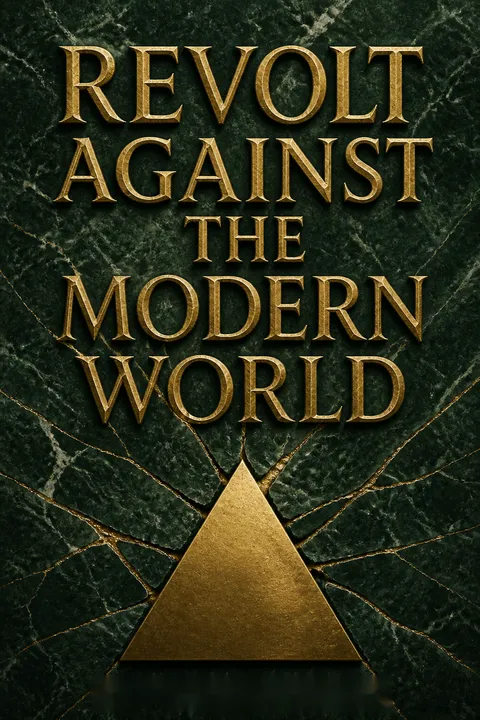
Reviews of Revolt Against the Modern World are sharply divided. Admirers praise it as a profound, magisterial metaphysical critique of modernity, celebrating its spiritual depth, critique of materialism, and longing for transcendent hierarchical order. Critics dismiss it as pseudoscientific, incoherent, and dangerously reactionary, noting its poor scholarship, repetitive structure, and ideological extremism. Many acknowledge Evola is compelling when critiquing capitalism and modern alienation, but deeply wrong on race, history, and mythology. The book is widely recognized as foundational to traditionalist and far-right thought, with polarizing relevance today.
People Also Read



Glossary
Tradition
Perennial sacred orderEvola uses Tradition to mean a supposedly timeless, supra-human order expressed through religion, law, ritual, social hierarchy, and political authority. It is not simply inherited custom or conservatism. He treats traditional societies as those that orient earthly life toward a spiritual reality beyond ordinary human existence.
Doctrine of the Four Ages
Four stages of declineA cyclical model in which history passes from a spiritually ordered Golden Age through Silver and Bronze stages into an Iron Age. Evola draws parallels with accounts in Hindu, Greek, Persian, and other traditions. He uses the sequence as a map of spiritual and social decline, rather than merely as a dated chronology.
Kali Yuga
The Dark AgeIn Hindu cyclical teaching, Kali Yuga is the final age in a four-part cycle, associated with disorder and the weakening of sacred law. Evola uses it as a name for the modern period and compares it with the Iron Age of Greek tradition. His application is a metaphysical interpretation of history.
dharma
Order and proper dutyEvola uses dharma for both the sustaining order of the world and the law or duty appropriate to a particular being. In his account of caste society, fulfilling one's dharma means acting according to one's nature and social function. He presents this as a path to order, a claim that also underwrites inherited hierarchy.
fides
Faithful personal bondIn Evola's discussion of Roman and medieval society, fides refers to a bond of faithfulness, trust, and service between persons or ranks. It has political and ethical force, and in its highest forms is linked to spiritual allegiance. Evola contrasts this personal bond with obedience based only on law or material advantage.
cakravartin
Universal wheel rulerA term from Indian tradition meaning a universal ruler, literally associated with the turning or ruling of the wheel. Evola treats the cakravartin as an ideal model of sovereignty, combining political centrality with spiritual authority. The figure symbolizes rule that orders a realm without being merely one territorial power among others.
hvareno
Iranian royal gloryIn ancient Iranian tradition, hvareno is a divine glory or sacred force associated with kingship and victory. Evola interprets it as a real spiritual power that legitimizes a ruler and can be lost by an unworthy one. It is more than a personal quality or political title in his account.
Greater holy war
Inner spiritual struggleEvola uses this term for the inward struggle against fear, appetite, and attachment to the ordinary self. He contrasts it with the lesser holy war, an outward armed conflict. The distinction appears in Islamic teaching and is compared by Evola with the warrior's spiritual discipline in other traditions.
About the Author

Download PDF
Download EPUB
.epub digital book format is ideal for reading ebooks on phones, tablets, and e-readers.








