

Key Takeaways
Treat tradition as a living standard, not a museum of old institutions
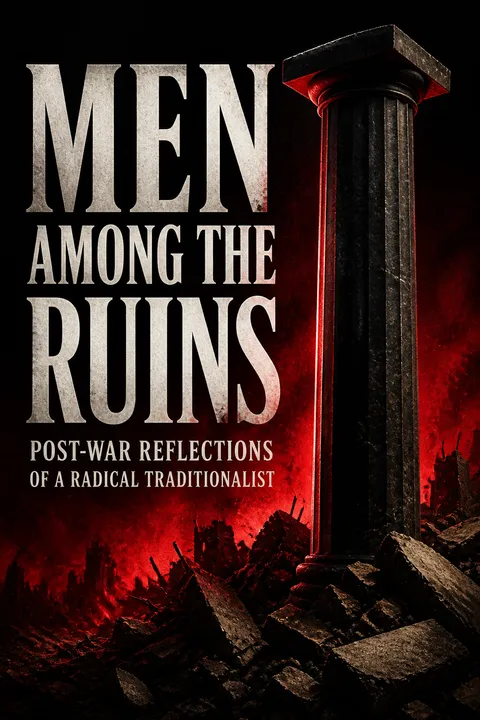
Not nostalgia, but a filter. Evola uses Tradition to mean an enduring spiritual order, not simply inherited customs or old laws. He argues that institutions change with circumstances, while the principles they express, such as hierarchy and political authority, remain valid beyond any one era. His starting point is postwar Europe, which he sees as a civilization in ruins after centuries of political upheaval.
Rebuild from principles. He calls for a reaction against the ideas he traces to the French Revolutions of 1789 and 1848, but not for the mechanical restoration of the past. A genuine renewal, he says, would create new institutions shaped by older principles. For him, tradition is a force for reconstruction, not a demand to copy history.
The distinction between enduring principles and obsolete institutions is useful: societies can preserve a commitment to justice, for example, while revising the laws meant to serve it. The difficulty is deciding who identifies the supposedly timeless principles. Evola treats his own preferred order as universal, but does not offer a neutral test for separating perennial wisdom from political preference. Tradition can guide renewal, yet claims of timeless authority deserve scrutiny, especially when they authorize unequal power.
Ground political authority in a durable principle, not popular mood
Authority from above. Evola argues that a true State must draw legitimacy from a principle beyond society's immediate wishes, interests, or economic needs. He calls this sovereign command imperium, using the Roman term for authority that joins political rule with sacred significance. In his view, a leader should embody an idea and a higher order, rather than merely claim to represent popular opinion.
Politics above welfare. The State's purpose, for Evola, is not simply to provide security or prosperity. It should orient people toward duties and ideals beyond private comfort. He allows emergency powers when normal law cannot preserve the State, but regards such powers as legitimate only when they restore an existing order, not when they establish a ruler's personal supremacy.
Evola identifies a real question in political theory: why should citizens obey laws beyond fear of punishment or hope of personal gain? Shared ideals can sustain civic commitment. But transcendent legitimacy is difficult to verify, and a ruler who claims to embody it may evade accountability. Modern constitutional systems answer the same problem by combining civic purpose with limits on office, public consent, and legal review. Those safeguards do not guarantee wisdom, but they make authority more contestable.
Do not let spiritual hierarchy erase equal protection under law
Person versus individual. Evola distinguishes the person, shaped by distinctive character and social function, from the individual, whom he describes as an interchangeable unit in a mass. He rejects the idea that people should have equal rights simply because they are human. Instead, he argues that rights and freedoms should vary according to a person's rank, capacities, and duties.
Hierarchy as a moral order. In his ideal, people develop by fulfilling different roles within an ordered society. Self-command is meant to qualify someone to lead; obedience is supposed to help others develop discipline. This is not a minor adjustment to liberal democracy. It replaces equal civic standing with a system in which political authority and rights depend on judgments about personal worth.
The distinction between identical outcomes and equal legal standing matters. Equal protection does not require pretending that people have identical abilities or lives. It does offer a safeguard against rulers deciding that some groups deserve fewer rights. Evola's framework makes personal merit politically decisive, but gives no reliable, impartial way to measure it. In practice, status can reproduce itself across generations while being presented as evidence of superior character.
An organic state needs distributed autonomy, not just centralized discipline
A whole with many parts. Evola calls a State organic when a shared idea gives unity to its institutions and communities while allowing each a degree of independence. He contrasts this with totalitarianism, which imposes uniformity through bureaucracy, surveillance, and centralized control. In his account, a healthy State coordinates distinct parts rather than turning them into obedient pieces of a machine.
Authority should be internal. He argues that people should follow a legitimate authority because they recognize its standing, not simply because they fear punishment. This ideal permits local and professional bodies to manage their own affairs, provided they accept the State's higher authority. But the source of that authority remains a spiritual principle, not a transparent procedure citizens can use to challenge it.
The contrast between coordination and uniform control is valuable. Complex societies often work better when local institutions retain knowledge and discretion rather than wait for every decision from the center. Yet decentralization alone does not make a system free: local hierarchies can be coercive, too. Evola's organic model depends on genuine recognition of authority, but offers few protections for people who reject the ruling group's account of the common good.
Put production under political ends, instead of making it life's purpose
The economy as master. Evola sees both capitalism and communism as expressions of an economic age: each treats production, consumption, and material welfare as dominant measures of progress. He calls this the demonic nature of the economy, meaning that economic activity becomes an end that commands people rather than a tool serving human needs. He challenges the glorification of work when it leaves no room for other purposes.
A corporative alternative. He looks to guilds and craft associations as models for organizing work around skill, responsibility, and shared purpose. His proposed company would unite managers and workers in a hierarchy, with the State limiting the power of financiers and unions. He cites a report of workers cutting their hours after a pay increase to suggest that income alone does not determine what people consider enough.
The warning against measuring all progress through output remains pertinent: a larger economy does not automatically mean more time, security, or dignity. The proposed remedy, however, places managers above workers and assumes that shared membership will produce loyalty. That arrangement may soften class conflict, but it does not ensure workers can contest unfair decisions. Economic security also matters in its own right, since poverty can sharply restrict the freedom to pursue work beyond mere survival.
Recover military discipline without mistaking violence for virtue
More than an army. Evola presents the warrior ideal as a style of life built on courage, discipline, loyalty, self-command, and readiness to serve a purpose beyond personal comfort. He distinguishes it from the soldier hired for pay and from the modern mass army, which depends on conscription and national propaganda. In his preferred order, military virtues would shape public life without turning society into a barracks.
War as a test. He treats combat as a possible setting for inner discipline and personal transformation, even when the cause is uncertain or defeat seems likely. But he also recognizes that modern war is dominated by technology and can destroy civilians as well as combatants. He therefore recasts heroism as a matter of spiritual endurance, not merely battlefield aggression.
Discipline and solidarity can give people a sense of shared responsibility, and training for danger can develop composure. Those virtues do not make war morally cleansing. A focus on the combatant's inner experience can obscure civilians' suffering, political manipulation, and the long aftermath of violence. The distinction between military preparation and militarism is important, but it requires institutions that restrain war-making as well as cultures that honor courage.
Interrogate national myths before choosing political ancestors
History has competing inheritances. Evola argues that a nation does not have one continuous tradition. Its past contains rival political possibilities, so a society must choose which ones to revive. He presents this as an alternative to historicism, the belief that history follows an inevitable direction and that whatever prevails must be accepted as progress.
Italy as his case. He challenges familiar accounts of the Italian Communes as an early national liberation movement, the Renaissance as unqualified renewal, and the Risorgimento as simply a patriotic struggle. He instead reads these episodes as breaks with imperial or hierarchical authority, and argues that later national histories have been selectively written to legitimize modern politics. His alternative is also a political reading, not a view from nowhere.
Questioning national origin stories can reveal which groups and events have been excluded from public memory. It also prevents political leaders from presenting current arrangements as the inevitable culmination of the past. But a revisionist narrative can be just as selective as the myth it opposes. The useful question is not only which tradition a movement chooses, but what evidence supports its account and whose experiences that account leaves out.
Calling race spiritual does not make racial hierarchy harmless
Race beyond biology. Evola rejects a purely physical definition of race and describes three dimensions: bodily traits, psychological character, and spiritual orientation. He argues that inner qualities should outrank ancestry, and presents Roman and Nordic ideals as higher types of culture and character. In this way, he distinguishes his doctrine from the biological racism promoted by National Socialism.
The hierarchy remains. Moving race into the realm of character does not remove the ranking of peoples or the political consequences of that ranking. The book's editor documents Evola's anti-Jewish writing and notes that his claims about Jewish texts relied on unreliable sources. The broader context also shows that Evola criticized Nazi racial doctrine while still advancing racial theories of his own.
Changing the vocabulary of race does not establish that the proposed categories are real or measurable. A spiritualized typology can still turn cultural judgments into inherited group traits, then use those traits to justify exclusion. Evola's opposition to biological racism is a meaningful historical distinction, but it does not make his hierarchy egalitarian or empirically grounded. His case illustrates why a theory should be judged by the power it assigns to categories, not only by how it defines them.
Test conspiracy claims instead of treating doubt as proof of concealment
A hidden dimension. Evola argues that visible political and economic events may be shaped by secret forces working behind history. He calls this a three-dimensional view: beyond public events and their apparent causes, there is a concealed level of coordinated influence. He describes tactics such as disguising a movement's goals, redirecting resistance, and using substitutes for older ideas.
A dangerous example. He discusses the Protocols of the Elders of Zion, a text presented as a record of a Jewish conspiracy. Although he acknowledges doubts about its authenticity, he treats its themes as a useful hypothesis. The introduction to this edition notes that Evola's supporting quotations from Jewish religious sources were badly sourced, falsified, or invented. His framework can convert missing evidence into a reason to suspect still deeper concealment.
Powerful actors do sometimes coordinate in secret, so scrutiny of lobbying, propaganda, and covert action is legitimate. The problem begins when a theory cannot be disproved because contrary evidence is classified as part of the plot. That structure encourages scapegoating instead of tracing specific decisions to verifiable people and institutions. Here, speculation about hidden power attaches old anti-Jewish accusations to modern social change, turning an inquiry into a source of prejudice.
Build Europe through accountable institutions, not an anti-democratic empire
Union beyond markets. Writing after the Second World War, Evola argues that European cooperation cannot rest on economic coordination alone. He sees the continent as politically weakened between the United States and the Soviet Union, and calls for a common authority capable of acting across national borders.
An empire of states. His preferred Europe would preserve distinct nations within a larger, hierarchical structure. It would be guided by an elite and a shared spiritual idea, not by a democratic European parliament or a unified popular identity. He rejects both nationalism and the idea of blending Europe's peoples into one nation. The plan reflects his broader insistence that political unity must be built from above, through authority rather than mass consent.
Evola is right that markets alone cannot create political solidarity. A durable union needs shared institutions, public trust, and a way to resolve conflicts across borders. His solution, however, gives legitimacy to unelected elites while denying citizens a meaningful role in authorizing them. A common political project can respect national differences without making hierarchy the price of cooperation. The unresolved issue is how to build unity that remains answerable to the people who live under it.
Analysis
Men Among the Ruins is best read as a political manifesto built on a metaphysical diagnosis. Evola sees modernity as a long decline from sacred, hierarchical order into mass democracy, economic rule, and materialism. His chapters move from that diagnosis to a proposed alternative: a State led by an elite, organized through hierarchy, and connected to a spiritual principle that stands above popular preference. The book's recurring test is whether politics serves a higher order or merely manages material interests.
That structure helps explain why Evola could criticize actual Fascist and National Socialist regimes while remaining committed to authoritarian, anti-democratic politics. He objected to their populism, bureaucratic centralization, and biological racism, and imagined a more aristocratic and spiritually grounded alternative. Yet rejecting those regimes' versions of power does not make his own project liberal or noncoercive. His elite still claims authority beyond democratic accountability, and his racial theories retain a hierarchy even when framed as spiritual rather than biological.
The most durable analytical value lies in the questions he forces into view: Can economic growth become an end in itself? Can political unity survive without shared purpose? What kind of history does a society choose to remember? His answers are inseparable from their authoritarian premises, so these questions should not be mistaken for endorsement of his remedies. The book also illustrates how conspiratorial explanations can masquerade as historical depth. The Protocols of the Elders of Zion, which Evola treats as a useful hypothesis, is a fabricated antisemitic text, not reliable evidence of a Jewish plot. His reliance on it shows how a theory of hidden causes can turn a demand for proof into suspicion of the people it targets.
Read critically, the book exposes tensions between autonomy and hierarchy, spiritual authority and political accountability, and resistance to materialism and contempt for mass participation. Those tensions, more than its proposed system, make it a revealing document of radical right-wing thought.
Review Summary
Glossary
Tradition
Timeless ordering principlesEvola uses Tradition for an alleged enduring spiritual order that exists beyond any specific historical society. It is not simply inherited custom or the unchanged survival of old institutions. Particular laws and political forms may vary, he argues, while expressing principles such as hierarchy and legitimate authority that remain valid across eras.
imperium
Sacred sovereign authorityEvola uses the Roman term imperium for sovereign political command grounded in a higher, spiritual principle. It denotes more than territorial power or administrative control. In his ideal, the ruler embodies an authority that stands above society's immediate interests and gives political unity its legitimacy.
organic State
Hierarchical unity with autonomyAn organic State is Evola's proposed alternative to both liberal fragmentation and totalitarian uniformity. A shared idea gives the whole political system coherence, while its communities and institutions retain distinct functions and some autonomy. The model depends on a central authority that people recognize as legitimate, rather than one that relies only on coercion.
Männerbund
Initiatory warrior associationA German term meaning a men's association, used by Evola for groups in which membership is marked by discipline, initiation, and shared responsibility. He treats these associations as a historical model for political authority distinct from family or ordinary social life. His account draws on theories that connect warrior groups and rites of passage to the origins of political organization.
race of the spirit
Spiritual racial categoryEvola's specialized racial concept, intended to describe a group's inner orientation, values, and form of religious or cultural life rather than only bodily ancestry. He places it above what he calls race of the body. Although this separates his theory from strictly biological racism, it still assigns qualities and ranks to human groups without establishing a reliable empirical basis.
occult war
Hidden political influenceEvola's term for secret influence he believes shapes political and social events beyond their visible causes. He describes concealed actors as guiding existing movements, redirecting opposition, and using ideas as instruments. The concept is meant to explain why historical outcomes may exceed the intentions of the people visibly involved, but it risks treating a lack of evidence as evidence of concealment.
demonic nature of the economy
Economy made supremeEvola's phrase for a society in which work, production, and material prosperity become ends that dominate political and personal life. He applies the criticism to both capitalism and communism, which he sees as sharing an economic measure of progress. His proposed remedy is to subordinate economic activity to political and spiritual purposes.
About the Author


Download PDF
Download EPUB
.epub digital book format is ideal for reading ebooks on phones, tablets, and e-readers.








