

Key Takeaways
Train a mind that connects disciplines, not one that worships a single tool.
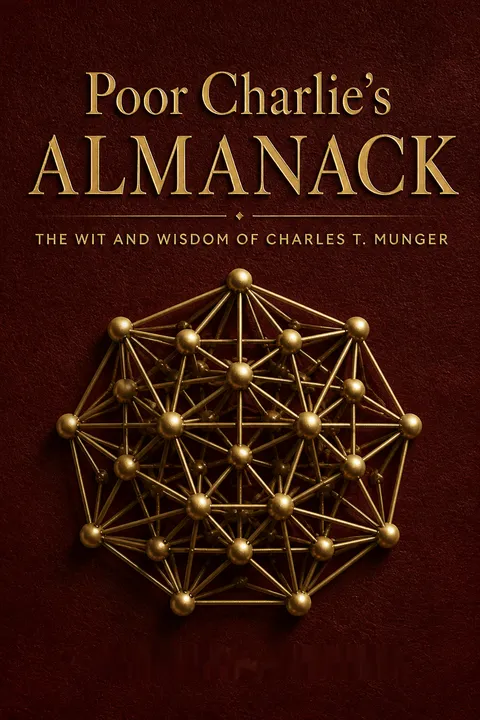
Build a mental latticework. Munger argues that facts become useful when connected through models: patterns that explain how events work. His latticework draws from mathematics, physics, biology, engineering, psychology, history, and economics. It need not make someone an expert in every field. The goal is to know each discipline's most useful ideas well enough to recognize when they apply.
Avoid the one-tool trap. A person trained only in economics may reduce every problem to prices, just as an engineer might see every problem as mechanical. Munger's broad learning was largely self-directed. He believed that reading widely, asking why, and connecting ideas made both business judgments and ordinary decisions more reliable.
What's powerful here is the shift from collecting information to building retrieval paths between ideas. Cognitive science distinguishes memorized facts from organized knowledge, which can be applied to unfamiliar problems. Munger's approach resembles systems thinking: a firm, for instance, is shaped by incentives, technology, human behavior, and market structure at once. The challenge is discipline. A broad toolkit can become name-dropping unless each model clarifies a decision, predicts a consequence, or changes an action.
Look for forces that multiply each other, not isolated causes.
Watch for reinforcing forces. Munger calls unusually large outcomes produced by several forces acting together the Lollapalooza Effect. The result may be far greater than adding the forces separately, much like reaching a threshold in a physical system can change what happens next.
Coca-Cola as a thought experiment. In a hypothetical plan for building a beverage business, Munger combines a memorable brand, a pleasurable product, advertising, broad availability, and the tendency to follow what others enjoy. Each element strengthens the others: availability encourages trial, a satisfying experience encourages repeat use, and visibility helps make the product familiar. The lesson is to study how parts interact, including the bad combinations that can amplify failure.
This is a useful antidote to explanations built around one celebrated factor, such as a charismatic founder or clever advertisement. In complex systems, feedback loops can turn modest advantages into durable dominance, or small defects into cascading breakdowns. The Coca-Cola exercise makes the interaction concrete. Still, identifying mutually reinforcing factors after a company succeeds can invite hindsight bias. A good analysis should also ask what evidence would distinguish a real reinforcing loop from a persuasive story.
Ask how a plan fails before asking how it succeeds.
Turn the question around. Munger's technique of inversion means examining a problem from the opposite direction. Instead of asking only how to achieve success, ask what would reliably produce failure, then avoid those causes. This is especially useful when the route to a good outcome is unclear but the hazards are visible.
Make the check routine. Munger recommends checklists because memory and attention omit important factors. He also admires Charles Darwin's habit of actively seeking evidence against his own theories rather than protecting favored conclusions. Together, inversion and disconfirmation turn humility into a procedure: imagine the failure, inspect contrary evidence, and check for overlooked risks before committing.
Inversion is more than a clever rhetorical trick. Safety engineering often begins with failure analysis, asking how a system could break before it is deployed. That approach exposes risks that optimistic planning tends to overlook. Checklists similarly protect attention when familiar tasks feel too simple to review. They are not substitutes for expertise, however. A checklist can only catch hazards someone has anticipated, so it works best alongside curiosity and a willingness to revise the list.
Stay within your competence, then wait for rare odds to favor you.
Know where knowledge ends. Munger sorts potential investments into three categories: understandable opportunities, clear rejections, and cases too difficult to assess. The last category matters. Repeating an expert's language is not the same as being able to answer the next hard question.
Save action for the right pitch. Munger likens investing to baseball, where a hitter can decline many pitches and wait for one suited to his strengths. He and Warren Buffett believed a small number of unusually good decisions could drive much of a lifetime's results. They therefore avoided constant trading and acted decisively when their analysis gave them an advantage. That concentration requires unusual knowledge and temperament, not just confidence.
The distinction between genuine expertise and fluent imitation is valuable well beyond investing. In medicine, aviation, and law, practitioners need to know when a problem exceeds their training and when to seek help. Munger's patience also challenges institutions that reward visible activity. Yet waiting for exceptional opportunities is not equally practical for everyone, and concentrated bets magnify error as well as insight. The method depends on accurate self-assessment, a capacity to bear losses, and an honest account of uncertainty.
Judge a company by durable economics, not by a stock's exciting story.
Think like an owner. Munger evaluates a stock as a share of a real business. He asks whether it has a lasting competitive advantage, capable and trustworthy management, durable cash generation, and a price below or near a reasonable estimate of its future value. He treats reported accounting figures as a starting point, not a complete picture.
Quality can beat apparent cheapness. Buffett credited Munger with helping him move beyond buying merely cheap companies toward owning stronger businesses. See's Candies became a lesson: the partners nearly walked away over a small increase in price, then reconsidered the value of quality after hearing criticism from an investor. Munger also warns that a good company bought at an absurd price can still be a bad investment.
This framework connects valuation to business strategy. A strong competitive position can preserve pricing power and returns, while weak businesses may pass efficiency gains to customers rather than owners. The focus on cash and management also guards against treating accounting ratios as reality itself. But “durable” is hard to forecast, and past advantages can erode through technology or competition. The framework is strongest when valuation assumptions are tested against plausible unfavorable outcomes, not just the preferred long-term story.
Rewire incentives before lecturing people to behave better.
People follow the payoff. Munger treats incentives as powerful drivers of both action and belief. At Federal Express, package sorting improved when night workers were paid for completing the shift's task rather than for the hours spent working. The problem had not been solved by exhortation; the reward structure had changed.
Design against predictable abuse. A cash register made theft harder in a small store, while accounting rules that disguise compensation costs can encourage misleading reports. Munger argues that systems should make dishonesty difficult and should not reward outcomes that are easy to fake. Good intentions matter, but they cannot reliably overcome a structure that pays people to act against the stated goal.
This is a practical application of principal-agent theory: the people doing the work often respond to rewards that differ from the organization's declared interests. Process design can align those interests more reliably than moral appeals alone. The same logic supports transparent accounting and safeguards against conflicts of interest. Incentives are not the whole explanation, however. Professional norms, identity, and peer behavior also shape conduct. A sound system aligns rewards while preserving accountability and room for judgment.
Treat your own mind as a biased instrument that needs checks.
Expect predictable distortions. Munger's Psychology of Human Misjudgment gathers recurring errors, including overconfidence, social conformity, loyalty to earlier conclusions, authority effects, and disproportionate reactions to loss. The tendencies can be useful in some settings, but harmful when they steer judgment without being noticed.
Look for combinations. Munger interprets the Milgram obedience experiments, in which many participants followed an authority figure's instructions to administer what they believed were painful shocks, as the product of several psychological pressures, not authority alone. His practical response is to use a checklist of likely influences and consider how they interact. The aim is not to eliminate human tendencies, but to recognize when they may be distorting a decision.
The strength of this approach is its refusal to blame every error on a single bias. Real decisions often combine authority, conformity, incentives, and stress. Modern behavioral research likewise finds that context shapes judgment, although the size and reliability of specific effects can vary. Munger's list is best treated as a prompt for inquiry rather than a fully validated diagnostic instrument. Its value lies in making hidden influences discussable, then checking them against the actual situation.
Make trust and reliability assets you compound daily.
Character shows up in small acts. Munger's son remembered him stopping to refill a borrowed jeep, even though the tank was still half full and the owner was unlikely to notice. The point was not efficiency. It was returning what had been borrowed in better condition than expected. At the family table, Munger also taught that admitting an honest mistake could preserve trust, while hiding it could destroy it.
Stay beyond the legal minimum. Munger argues that people and firms need ethical boundaries wider than the limits of criminal law. Reliability attracts dependable partners, reduces suspicion, and makes cooperation easier. In business, he saw honesty as both a moral obligation and a sound policy. Trust is not a decorative virtue added after success; it is part of how durable relationships and institutions function.
Trust functions like social infrastructure: it lowers the need for monitoring, makes commitments credible, and supports cooperation among people who cannot verify every action. The borrowed-car story gives that abstract value a memorable scale. Ethical conduct can also protect reputation when a mistake occurs, as candor makes repair possible. The claim that honesty pays should not be mistaken for a guarantee of immediate reward. Its deeper force is that trustworthiness remains valuable even when a particular act brings no visible return.
Keep learning into old age, and don't confuse wealth with a life.
Treat wisdom as unfinished work. Munger admired Benjamin Franklin and Cicero for remaining intellectually active and useful in later life. He describes learning a major body of evolutionary thought in his seventies, evidence of his belief that curiosity need not end with formal education. Reading biographies, science, history, and business helped him learn through other people's successes and failures.
Let money serve independence. Munger sought wealth partly to gain freedom, not as the final measure of a life. His advice joins steady improvement with reliability, humor, and close relationships. His reflections on aging favor continued learning and contribution, while recognizing that people must adjust their roles as health and circumstances change. The aim is not endless work, but a life whose later years still contain purpose and growth.
Lifelong learning is most persuasive here as a practice of intellectual renewal, not as a promise that every person should remain professionally ambitious forever. Research on cognitive aging distinguishes maintaining familiar expertise from mastering entirely new skills, so curiosity can enrich later life without denying physical limits. Munger's emphasis on relationships and humor also prevents the learning ideal from becoming a workaholic creed. Wealth may buy independence, but it cannot by itself supply the purposes that independence makes possible.
Analysis
Poor Charlie's Almanack is less a manual for picking stocks than an argument about how to think. Its speeches, anecdotes, and meeting remarks circle one practical ambition: build enough connected knowledge to notice what matters, then have the discipline to act only when judgment is strong. Investing supplies vivid cases, but the method also addresses professional ethics, education, relationships, and aging.
The book's unusual strength is its insistence that rationality is not a personality trait one simply possesses. It is a craft supported by habits: read widely, distinguish evidence from confidence, consider incentives, test the opposite case, and use checklists. Stories make these habits memorable. The borrowed jeep makes fairness tangible; the Federal Express shift pay shows incentives changing behavior; the Coca-Cola exercise demonstrates how brand, product, and distribution reinforce one another.
The same confidence that makes Munger an engaging teacher also marks the limits of his account. His psychological catalogue is a practical synthesis, not a controlled or universally accepted taxonomy. Some arguments rely on memorable examples where systematic evidence would be stronger. And Berkshire's success cannot establish that concentrated investing is generally replicable. Exceptional skill, temperament, timing, and survivorship all complicate that inference. Readers should separate portable disciplines, such as patience and intellectual honesty, from strategies that require unusual expertise and risk tolerance.
The most durable lesson is therefore procedural rather than financial. Munger asks readers to make their reasoning less brittle: widen the set of models, inspect the incentives, and search for what could prove the favored view wrong. That does not guarantee correctness. It improves the odds of noticing a mistake before it becomes expensive, and it connects worldly competence to character rather than separating the two.
Review Summary
Poor Charlie's Almanack is highly praised for its wisdom on business, investing, and life. Readers appreciate Munger's multidisciplinary approach, emphasis on continuous learning, and insights into human psychology. The book is valued for its practical advice, thought-provoking ideas, and Munger's unique perspective. Some criticize the repetitive nature of content and excessive praise for the author. Many consider it a must-read, offering valuable lessons applicable beyond finance. The book's large, coffee-table format is both praised and criticized for its uniqueness and inconvenience.
People Also Read






Glossary
Multiple Mental Models
cross-disciplinary thinking toolsA set of explanatory ideas drawn from fields such as mathematics, psychology, biology, engineering, history, and economics. Munger uses these models together to understand a problem from several angles, rather than forcing it into one discipline. Their purpose is practical: reveal relevant causes, interactions, trade-offs, and possible consequences.
Lollapalooza Effect
amplifying forces combineMunger's term for an unusually large outcome produced when several causes reinforce one another. The combined effect may be nonlinear, far exceeding what any single cause would suggest. It can explain powerful business success, but also severe failures when incentives, social pressure, and other forces push behavior in the same direction.
Circle of Competence
boundary of reliable knowledgeThe area in which a person understands a subject well enough to judge its important features and recognize the limits of that understanding. Munger treats knowing the boundary as part of competence itself. A person should not mistake familiarity with specialized language for the ability to assess a difficult question.
Focus Investing
concentrated, patient ownershipAn investing approach that holds a relatively small number of securities selected through extensive analysis, rather than spreading capital widely or trading constantly. Munger and Buffett used it when they believed they understood a business and its value. It depends on sound judgment and tolerance for uneven results, so it is not a universal prescription.
Two-Track Analysis
rational and psychological reviewMunger's method of examining a decision on two levels. First, identify the rational factors governing the parties' interests and the relevant probabilities. Second, consider subconscious influences that may shape judgment, such as incentives, emotion, authority, or social pressure. The method is intended to reveal both the case's logic and likely human distortions.
Deprival-Super Reaction Tendency
loss-triggered overreactionMunger's label for the tendency to react intensely when something valued is lost or nearly gained and then taken away. The reaction can overwhelm proportionate judgment, encouraging people to chase losses, resist necessary changes, or overbid in auctions. Munger treats it as a recurring psychological force that deserves deliberate attention.
febezzlement
hidden waste mistaken for wealthMunger's term for a functional equivalent of undisclosed embezzlement. It describes situations where money is wasted or transferred through excessive fees, costs, or other arrangements, while the apparent rise in asset values hides the loss from those paying it. The costs can continue for a long time without being experienced as theft.
Moat
durable competitive protectionMunger and Buffett's term for a business advantage that protects a company from competitors and helps sustain its economic returns. Possible sources include a strong brand, customer loyalty, distribution, or other durable strengths. They look for businesses able to preserve and widen this protection, while recognizing that competitive forces can erode it.
FAQ
What's Poor Charlie's Almanack about?
- Wit and Wisdom: The book compiles the thoughts, speeches, and insights of Charlie Munger, focusing on his unique approach to life, learning, and decision-making.
- Investment Philosophy: Munger shares his strategies, emphasizing the importance of understanding multiple disciplines and using a "latticework" of mental models.
- Life Lessons: Beyond investing, it covers themes of personal development, ethics, and happiness, encouraging lifelong learning and integrity.
Why should I read Poor Charlie's Almanack?
- Learn from a Master: Charlie Munger is a respected figure in investing, offering valuable lessons for personal growth and decision-making.
- Practical Wisdom: The book is filled with practical advice and anecdotes that illustrate Munger's principles, encouraging critical thinking.
- Inspiration for Lifelong Learning: Munger emphasizes curiosity and continuous learning, inspiring readers to adopt a similar mindset.
What are the key takeaways of Poor Charlie's Almanack?
- Multiple Mental Models: Munger advocates using a variety of mental models from different disciplines to analyze problems effectively.
- Importance of Integrity: He stresses that honesty and ethical behavior are crucial for long-term success.
- Patience and Discipline: Successful investing requires patience and discipline, focusing on long-term opportunities.
What are the best quotes from Poor Charlie's Almanack and what do they mean?
- "Acquire worldly wisdom...": This quote emphasizes learning from life experiences and adapting behavior accordingly.
- "To the man with a hammer...": Munger warns against relying on a single perspective, advocating for diverse tools in decision-making.
- "If you can't decide...": Reflects Munger's approach to decisions, suggesting indecision indicates a lack of clarity.
What is Munger's approach to life and decision-making in Poor Charlie's Almanack?
- Lifelong Learning: Munger believes in continuous education and intellectual curiosity, encouraging reading and learning from various disciplines.
- Rational Thinking: He advocates for a systematic approach to analyzing problems, using logic and emotional intelligence.
- Avoiding Mistakes: Munger advises learning from experiences to avoid common pitfalls, highlighting humility and self-awareness.
How does Munger define "worldly wisdom" in Poor Charlie's Almanack?
- Practical Knowledge: Worldly wisdom involves applying knowledge effectively in real-life situations, understanding human behavior and economics.
- Learning from Experience: Munger emphasizes learning from successes and failures, advocating for a reflective approach.
- Ethical Considerations: True worldly wisdom includes a strong ethical foundation, guiding beneficial decisions for society.
What are Munger's "Mungerisms" and their significance in Poor Charlie's Almanack?
- Pithy Insights: Mungerisms are concise sayings encapsulating Munger's philosophy on investing and life.
- Practical Application: They reflect Munger's emphasis on rational thinking and ethical behavior, providing actionable advice.
- Cultural Impact: Mungerisms have influenced the investment lexicon, highlighting Munger's unique perspective.
How does Munger's investment philosophy differ from traditional methods in Poor Charlie's Almanack?
- Focus on Quality: Munger prioritizes investing in high-quality businesses with sustainable competitive advantages.
- Concentration vs. Diversification: He supports a concentrated investment approach, focusing on a few well-understood opportunities.
- Long-Term Perspective: Munger emphasizes patience and holding investments for the long term, contrasting with frequent trading.
What role does psychology play in Munger's investment strategy as discussed in Poor Charlie's Almanack?
- Understanding Human Behavior: Munger highlights the importance of psychology in decision-making, recognizing cognitive biases.
- Psychological Models: He uses psychological principles to assess management quality and potential misjudgments.
- Emotional Discipline: Munger stresses emotional control, advocating for a rational, disciplined approach to investing.
How does Munger view the concept of "moats" in Poor Charlie's Almanack?
- Competitive Advantage: A "moat" describes a company's ability to maintain a competitive edge over rivals.
- Importance of Sustainability: Munger emphasizes that a moat must be sustainable over time as industries evolve.
- Investment Criteria: He advises seeking businesses with strong moats, aligning with his focus on quality and long-term value.
What is the Doubt-Avoidance Tendency in Poor Charlie's Almanack?
- Quick Decision-Making: This tendency refers to the inclination to quickly eliminate doubt by reaching a decision.
- Evolutionary Basis: Munger explains it as rooted in evolution, where quick decisions were essential for survival.
- Implications for Judgment: It can lead to poor decision-making, especially in high-stress situations.
How does Poor Charlie's Almanack suggest improving decision-making?
- Multidisciplinary Approach: Munger advocates drawing knowledge from various fields for innovative solutions.
- Continuous Learning: He emphasizes lifelong learning and staying curious to improve decision-making skills.
- Critical Thinking and Reflection: Munger encourages evaluating options and considering potential outcomes for better choices.
Download PDF
Download EPUB
.epub digital book format is ideal for reading ebooks on phones, tablets, and e-readers.








