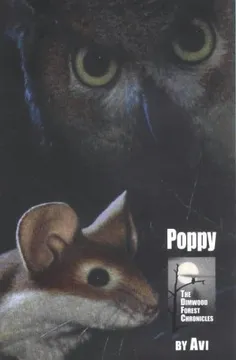


Plot Summary
Ragweed’s Last Hazelnut
Poppy, a cautious young deer mouse, joins Ragweed, her bold golden-mouse companion, on Bannock Hill for a romantic night beyond their family’s permitted territory. Ragweed finds a hazelnut and dismisses Poppy’s warnings that Mr. Ocax, the great horned owl who claims to rule Dimwood, may be watching. When Poppy finally steps into the open, Ocax dives.
She escapes beneath the bark, but Ragweed is seized and swallowed. At dawn, Ocax attacks Poppy again as she tries to reach Gray House. A desperate leap sends the owl crashing onto a plank and flings Poppy into a hiding place. She survives, but Ragweed’s death leaves her alone with the fear that her family’s rules may be built around a predator’s appetite.
Ragweed’s death makes the cost of dissent immediate, but the scene does not reduce the conflict to caution versus recklessness. Ragweed’s curiosity exposes how little the mice know about the rules governing them, while Poppy’s caution cannot protect her from a system whose ruler can strike at will. Her survival comes through quick perception and improvisation, not obedience. The contrast plants the story’s central psychological question: whether safety is real when it depends on accepting another creature’s account of danger. Grief is therefore entangled with doubt from the beginning.
Gray House Runs Short
At Gray House, Poppy finds the enormous deer-mouse family assembled for an emergency meeting. Her father, Lungwort, explains that their crowded home cannot supply enough food and proposes moving half the family to New House, near richer fields. He insists that the move must be approved by Ocax, whom he presents as the mice’s protector.
Poppy has little time to explain Ragweed’s absence before Lungwort chooses her to accompany him on the petition, mistaking her steady gaze for loyalty to his plan. When she reveals that Ocax killed Ragweed, Lungwort focuses on the broken rule rather than the loss. He then assigns Poppy to explain Ragweed’s death to the family as a warning against disobedience.
The family meeting turns a private bereavement into a public political problem. Lungwort’s authority rests on procedure and inherited fear, so he interprets Poppy’s composure as agreement and Ragweed’s death as evidence for the rules. His response is not simple cruelty: he believes order is the only available defense against hunger and predators. Yet his need to preserve that belief makes him unable to hear what Poppy has actually experienced. The family’s food shortage gives Ocax’s power practical force. A move is necessary, but the mice have been trained to request permission even when staying put may endanger them.
The Petition Collapses
After two days of rehearsing a formal speech, Lungwort leads Poppy toward Ocax’s watching tree beneath a white flag. Rain soaks the document and turns the banner muddy before they reach the owl. Ocax recognizes Poppy by the scratch on her nose, then listens impatiently as Lungwort asks permission to move the family to New House.
His composure falters when he learns Lungwort has never seen the place. He refuses the move without a reason, except to connect his decision to Poppy and Ragweed’s unauthorized trip. He also announces that a vicious porcupine threatens Dimwood, presenting himself as the mice’s necessary shield. On the walk home, Poppy retrieves Ragweed’s earring from one of Ocax’s discarded pellets.
Ocax’s brief uncertainty is more revealing than his threats. He does not ask whether New House can sustain the mice; he wants to know whether Lungwort has seen it. The distinction exposes a ruler protecting information rather than subjects. The white flag and soaked speech show how ritual can make submission look like orderly negotiation, while Ocax’s arbitrary refusal strips away that appearance. Poppy’s discovery of Ragweed’s earring gives her grief a physical remnant, but it also ties the family’s political crisis to the owl’s feeding. The authority that claims to preserve mouse life has literally consumed one of them.
Poppy Chooses the Forest
Back at Gray House, the family blames Poppy for Ocax’s refusal, and Lungwort retreats into his boot study, convinced that his household is doomed. Alone, Poppy replays the petition and notices that Ocax specifically barred the mice from New House. She reasons that Ragweed’s rule-breaking may be a pretext and that something at the destination is what Ocax wants concealed.
Poppy tells her father she intends to investigate, but he dismisses her idea and can offer only a warning about porcupines. She studies a map and chooses Dimwood Forest over the exposed Tar Road or the painful route across Bannock Hill. Before leaving, she tells Basil, her supportive cousin, that the responsibility is hers, and he gives her Ragweed’s earring for courage.
Poppy’s first act of leadership begins not with certainty but with a better question. Rather than accept Ocax’s explanation or her family’s accusation, she studies the exact wording and behavior around the refusal. This is a shift from self-blame toward evidence. Her decision to go alone has a double edge: it expresses moral agency, but it also shows how thoroughly she has absorbed responsibility for a crisis created by Ocax’s control. Basil’s quiet support matters because he offers companionship without taking the decision away from her. Ragweed’s earring becomes a portable reminder of the curiosity that the family’s rules discouraged.
The Forest Tests Her
Poppy crosses the Old Orchard and reaches Glitter Creek, where high water blocks the bridge near Ocax’s watching post. She attempts to jump across on rocks, slips on moss, and is swept downstream. The current carries her to the far bank, close to the forest and dangerously near Ocax’s tree.
She plunges into Dimwood, chooses a direction by the light and moss, and continues despite being lost and frightened. A fox follows her scent and corners her at a hollow log. Inside, Poppy discovers that the den belongs to Ereth, a large porcupine she has been taught to fear. Ereth drives the fox away with his tail, leaving Poppy trapped in the log with the creature her father described as a monster.
The journey dismantles Poppy’s inherited map of safety. The creek makes the familiar crossing unusable, and the forest she was taught to fear becomes the only route forward. Each danger forces her to act without the adult guidance that supposedly keeps her safe. The encounter with Ereth sharpens that contradiction: the creature presented as a threat protects her from an actual predator. Yet Poppy is not instantly free of fear, because years of instruction have made the false story feel bodily true. The scene treats prejudice as learned expectation, not a switch she can simply turn off when new evidence appears.
Ereth Breaks the Story
When Poppy begs Ereth not to hurt her, he explains that he eats bark, not mice, and cannot shoot his quills. He identifies Ocax as the mouse-eater who invented the danger of porcupines to keep the deer mice obedient. Ereth also admits that the owl fears him, though he has no interest in ruling anyone.
Poppy tells Ereth about Ragweed, the denied move, and the family’s food shortage. He initially refuses to help, preferring his solitude, until she promises to bring him the salt block at New House. Ereth agrees to escort her. Ocax, listening from nearby, learns that Poppy is heading for the place he fears and launches after them.
Ereth’s blunt account separates actual danger from the story Ocax has imposed on it. His strength is real, but his appetite and motives contradict the frightening portrait; the mice have been taught to fear the wrong creature. Ereth himself resists becoming a conventional rescuer. His independence is genuine, and Poppy must negotiate with him through the one desire he openly admits, salt. Their bargain complicates the idea of heroism: cooperation grows from different needs rather than shared ideals. Ocax’s overhearing also changes the journey’s stakes. Poppy’s search is no longer secret, and the powerful predator now has reason to pursue her directly.
The False Owl at New House
Ereth guides Poppy through Dimwood, where other animals give the porcupine a wide berth. Ocax dives at Poppy, but Ereth turns his quilled tail toward the owl and drives him off. At the forest’s northern edge, they cross a road and a cornfield overflowing with food, then find New House beside a salt block mounted on a tall pole.
A huge owl sits on the barn, frightening Poppy; Ereth, focused on the salt, leaves her to manage the rest. Poppy hides in the corn and watches the house awaken. A boy handles the barn owl, turns it toward another direction, and leaves it unmoving. She has evidence that it may be artificial, but not yet enough to understand why Ocax fears it.
New House makes the material stakes visible: the corn could feed the mice, while the salt block gives Ereth a reason to keep his bargain. But abundance alone does not resolve Poppy’s dilemma, because the enormous owl seems to replace one threat with another. The scene lets her revise her judgment slowly, through observation rather than reassurance. Ereth’s departure also prevents her from relying indefinitely on a stronger companion. When the boy physically turns the barn owl, Poppy sees a contradiction in its apparent power. The fake sentinel mirrors Ocax’s own rule: both depend on what frightened observers believe they can do.
George Confirms the Ruse
Poppy watches a boy, a cat, and chickens move around the barn without disturbing the huge owl. The boy even turns it by hand. To confirm what she suspects, Poppy approaches the old cat, George, who explains that the people installed the decoy after a real horned owl stole a chicken. The real owl saw it, panicked, and never returned.
Poppy realizes Ocax is frightened of a fake rival and has blocked the mice from New House to preserve his control over their food and movements. She begins to leave, but spots Ocax watching from the forest. Poppy teases him with the truth and draws him into a seemingly calmer exchange. Believing she may persuade him, she steps out of the corn, and he attacks from behind.
George supplies the missing evidence, but Poppy’s conclusion exceeds the narrow fact that the decoy frightened an owl. She connects that fear to Ocax’s refusal, his false protection, and his dependence on a captive supply of mice. This is the intellectual turning point: scattered observations become a coherent account of power. Yet insight brings a new danger. Poppy takes Ocax’s willingness to flatter her as possible negotiation, revealing how urgently she wants a peaceful solution. The trap works because it uses her hope as well as her pride. Knowing the truth does not make her invulnerable; she still has to judge whom to trust.
The Quill Turns the Hunt
Ragweed’s earring flutters in the air pushed ahead of Ocax’s dive, warning Poppy in time to leap aside. She lands on the open road, where the owl blocks her escape into both the corn and the forest. Poppy draws the quill she collected from Ereth and uses its sharp point to keep Ocax’s beak and talons at bay.
She tells him the barn owl is fake, but the revelation enrages him rather than weakening his attack. In the struggle, Poppy drives the quill into his claw. Its barbs catch, and he takes off with her dangling from it. Ocax’s frantic flight becomes uncontrolled; as he aims to scrape the quill against the salt block, Poppy lets go. He crashes into the block, which shatters beneath him.
The climax brings together objects that have carried emotional and practical meaning across the journey. Ragweed’s earring first signals danger, while Ereth’s quill turns the false lesson about porcupines into a real means of defense. Poppy survives by combining memory, observation, and physical courage; neither knowledge nor bravery alone would be enough. Her taunt briefly shifts the contest, but it also provokes Ocax, demonstrating that truth can threaten a bully without automatically disarming him. The decisive escape comes when Poppy releases the quill and accepts a fall she cannot fully control. Survival requires relinquishing the weapon at the moment it has become dangerous.
A New Dance Begins
Poppy finds Ocax motionless, then follows Ereth’s scent back through Dimwood. Ereth ignores her news at first and rushes to claim the salt scattered by the crash; after eating, he listens as she recounts the owl’s end. Poppy rests in his log and returns to Gray House the next day. Lungwort is preparing the family to disperse because he believes no move is possible.
Poppy shows them Ocax’s feather and reports the cornfield’s abundance, giving them both proof of the danger’s end and a destination. Thirteen full moons later, she stands on Bannock Hill with her husband, Rye, and their eleven young. She honors Ragweed by placing his earring on a hazelnut tree, then dances with her family beneath the moon.
The resolution answers the opening’s two losses: the family’s lack of food and Poppy’s stolen chance to dance with Ragweed. She cannot restore her first love, but she preserves his memory without allowing grief to define the future. Lungwort’s change is left understated; Poppy returns with evidence strong enough to make action possible, rather than asking her father to validate her judgment. Ereth’s salt is likewise a comic but meaningful measure of a bond formed through negotiation. The final dance takes place on the hill that once signified forbidden movement. Freedom becomes ordinary and teachable when Poppy brings the next generation into the open.
Analysis
Poppy’s adventure is built around a contest between experience and inherited explanation. Ocax does not control the mice through strength alone. He supplies the stories by which they interpret danger: porcupines supposedly eat them, his permission supposedly protects them, and resistance supposedly invites punishment. Lungwort and Sweet Cicely repeat these claims because they want their family safe, which makes the system more durable than a simple rule imposed from above. Its authority has been internalized as parental care.
Poppy breaks that structure through close observation. Ocax’s hesitation about New House, the boy’s handling of the barn owl, and George’s account of the real owl’s retreat become evidence she can compare with what she has been taught. Curiosity is therefore an ethical practice in the story. It asks who benefits from a frightening claim and whether the claim survives contact with the world. Ragweed models the question, while Poppy learns to pursue it with greater care than he did.
The animal encounters complicate easy divisions between safe and dangerous. Ereth looks like the monster in the family’s lesson but behaves with more fairness than Ocax, whose supposed protection conceals predation. The contrast does not suggest that appearances are always false; it shows that reputation cannot substitute for watching what someone actually does. Poppy’s growing judgment is the capacity to hold fear without letting fear decide what is true.
The ending makes freedom concrete. The mice gain access to food, but they also return to Bannock Hill, where movement once required permission and cost Ragweed his life. Poppy’s dance and the earring on the hazelnut tree convert a site of grief into a shared family place. The future does not erase loss. It changes what the community is allowed to do with it.
Review Summary
Poppy is a beloved children's book about a brave mouse on an adventure to save her family. Readers praise the engaging story, well-developed characters, and themes of courage and questioning authority. Many use it as a classroom read-aloud. The book deals with death and challenging subjects thoughtfully. Some criticize the dialogue and pacing. Overall, it's highly recommended for middle-grade readers, though some suggest it may be better suited for slightly older children due to its content and storytelling style.
Characters
Poppy
The watchful young mousePoppy is a deer mouse raised to believe that obedience is the price of safety. Cautious and observant, she notices details others overlook, but she also absorbs blame quickly and worries that her choices have harmed those she loves. Ragweed’s questions awaken her curiosity; his loss forces her to test those questions against evidence. Poppy’s courage is not fearlessness. She trembles, hesitates, and longs for help, yet keeps moving when a family’s survival depends on what she discovers. Her gentleness makes her attentive to others, while her growing independence lets her challenge authority without becoming a copy of the force she opposes.
Mr. Ocax
Dimwood’s feared owlMr. Ocax is a great horned owl who claims authority over the creatures near Dimwood and expects them to seek permission before traveling. He is patient as a hunter and theatrical in his threats, using his night vision, reputation, and knowledge of the mice’s fears to keep them compliant. His supposed role as protector gives his rule a respectable surface, while his appetite and need for control shape his decisions. Ocax is not merely powerful; he is preoccupied with how others perceive him. That dependence on fear makes him alert to challenges and prone to treating independent thought as a threat.
Ereth
The gruff forest allyEreth is an old porcupine who values privacy, bark, and salt, and has little patience for anyone who interrupts his routine. His foul temper conceals a clear moral boundary: he does not prey on smaller animals, despite the stories told about his kind. Ereth dislikes sentimental appeals and resists being cast as a hero, preferring to act on his own terms. His friendship with Poppy develops through blunt honesty and practical exchange rather than easy warmth. He becomes a counterexample to the authority of reputation: formidable in appearance, independent in spirit, and more dependable than the creatures who claim to protect others.
Ragweed
The daring questionerRagweed is a golden mouse from outside Poppy’s tightly organized family. Restless, irreverent, and hungry for experience, he asks questions that expose gaps in the explanations adults treat as settled fact. His confidence can make him careless, and his boldness unsettles Poppy’s parents, but Poppy is drawn to the freedom in his refusal to accept fear as proof. He gives her a glimpse of a life shaped by curiosity rather than permission. Ragweed’s importance lies not only in his closeness to Poppy, but in the questions he leaves her to carry forward.
Lungwort
The rule-bound fatherLungwort is Poppy’s father and the formal head of a large deer-mouse family. He believes that rules, careful speeches, and deference to Ocax are necessary protections against a dangerous world. His pompous manner can make him seem ridiculous, but beneath it is genuine anxiety about feeding and sheltering his descendants. Lungwort turns to tradition when uncertainty overwhelms him, which leaves him vulnerable to Ocax’s claims. His relationship with Poppy is strained by his instinct to interpret disagreement as disobedience, even as he wants the family to survive.
Sweet Cicely
Poppy’s anxious motherSweet Cicely is Poppy’s mother and Lungwort’s wife. Small, affectionate, and habitually nervous, she tries to protect her children by teaching caution and reinforcing the family’s customs. Her care is real, but fear shapes what she believes is possible; she urges Poppy to be quiet and compliant because she sees those habits as safeguards. Sweet Cicely can offer tenderness when Poppy is grieving, even while repeating the explanations that make Poppy feel responsible. She embodies the loving side of a family culture that can still pass harmful beliefs from parent to child.
Basil
Poppy’s steady cousinBasil is Poppy’s younger cousin and one of the few members of her family who offers support without demanding that she defend herself. He notices her distress, brings her food, listens to her account, and gives her Ragweed’s earring before she leaves. Basil is neither a bold challenger nor a leader, but his quiet loyalty gives Poppy a point of human warmth inside a family turning against her. He respects her decision to travel alone even when he would rather accompany her.
George
The barn’s sleepy witnessGeorge is an elderly farm cat who spends much of his time sleeping near the barn. His unhurried presence helps Poppy approach him without provoking a chase, and his firsthand observation clarifies the purpose of the oversized owl on the barn. George has no grand ambitions; he notices what happens around him and shares it casually. His small role matters because he supplies the reliable witness Poppy needs to distinguish her inference from fact.
Rye
Poppy’s fellow deer mouseRye is a deer mouse associated with Poppy’s family life. He appears briefly in the closing scene, where the two share a dance on Bannock Hill. The text offers little beyond this glimpse of him, so he serves chiefly as part of the future Poppy builds.
Plot Devices
The permission ritual
Makes control look protectiveOcax requires the mice to ask before traveling beyond the area around Gray House. Lungwort treats the custom as a reasonable exchange for protection from predators, and the family’s repeated losses seem to confirm the danger of disobedience. The rule gives Ocax control over where the mice forage and what they can learn. Its most important use is the denied move to New House: a ritual presented as safety becomes a means of keeping the family hungry and uninformed. Poppy’s investigation tests not only Ocax’s authority, but the family’s assumptions about why the rule exists.
Ragweed’s earring
Carries memory into dangerThe small earring identifies Ragweed as himself and becomes the keepsake Poppy finds among the remains of Ocax’s meals. Basil returns it to her before her journey, giving her a tangible link to the friend whose questions first unsettled her view of the world. Its movement in the air alerts Poppy to Ocax’s final attack, turning remembrance into practical warning. At the story’s close, Poppy places the earring in a hazelnut tree on Bannock Hill, connecting Ragweed’s memory to the family’s newly claimed freedom.
Ereth’s fallen quill
Turns fear into defenseEreth explains that his quills are barbed hairs rather than weapons he can shoot. One falls from his tail after he leaves Poppy at New House. Poppy studies its point and carries it in a grass sash, at first as a precaution against danger. During the fight with Ocax, she uses it to keep the owl’s beak away, then lodges it in his claw. The quill’s physical design makes the climax possible, while its earlier explanation overturns the false account that porcupines attack mice with deliberate cruelty.
The barn owl decoy
Exposes fear as performanceThe large owl mounted on the barn at New House is a scarecrow designed to deter real owls from the chickens. Poppy watches a boy turn it by hand, then hears George explain that a real horned owl fled after mistaking it for a rival. The decoy explains why Ocax is anxious about New House and gives Poppy evidence that his rule is sustained by fear. It is also an image of authority without actual agency: its power depends on what another creature believes it can do.
The salt block
Binds an unlikely allianceA large salt lick at New House is Ereth’s greatest appetite and the only inducement that convinces him to escort Poppy through the forest. Its placement high on a pole initially seems to make it inaccessible to him. The salt motivates Ereth’s practical bargain, offers Poppy a way to secure his help, and later becomes part of the physical setting of her struggle with Ocax. After the confrontation, Ereth can finally reach the broken pieces, giving the alliance a humorous payoff grounded in his very particular desire.


Download PDF
Download EPUB
.epub digital book format is ideal for reading ebooks on phones, tablets, and e-readers.








