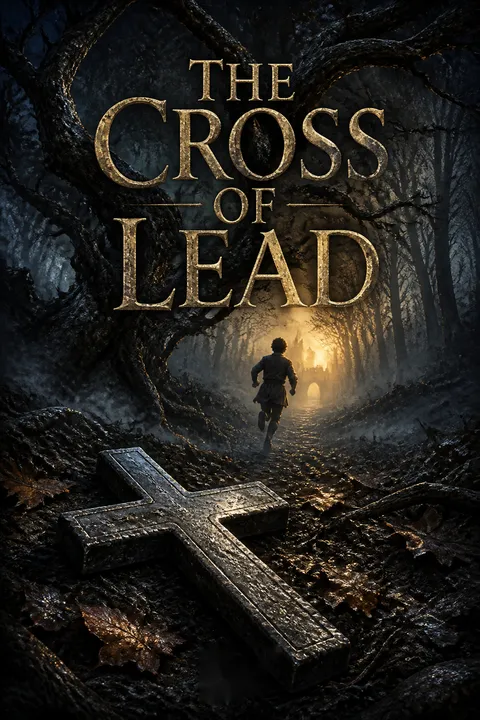


Plot Summary
A Funeral, Then a Hunt
At thirteen, Crispin has never been called anything but Asta's son. When his mother dies, the village watches her burial without offering comfort, and John Aycliffe, the manor steward, demands their ox as a death tax. Losing the animal would leave Crispin unable to work or eat. He runs into the forest, where he later wakes after striking his head and sees Aycliffe meeting a richly dressed stranger.
The man gives Aycliffe a sealed document and warns of danger connected to a woman and her kin. Aycliffe spots Crispin and swings at him with a sword. Crispin escapes over a cliff, but the steward has seen him, and the meeting makes his mother's death the beginning of a larger danger.
Crispin's first crisis is both intimate and political. His mother dies, and the manor immediately converts her death into a claim on the family's last means of survival. The villagers' silence shows how completely poverty has isolated them, while Aycliffe's authority makes even mourning feel punishable. Crispin does not yet understand the meeting he witnesses, but the sealed document links his private loss to the machinery of inheritance and power. His flight begins as an attempt to escape grief; it becomes a struggle to stay alive in a world where a serf's body and property belong to someone else.
The Name Beneath the Cross
Returning toward Stromford, Crispin watches Aycliffe's men pull down and burn his cottage. The steward accuses him of stealing manor money, declares him a wolf's head, and offers a reward for his capture. Father Quinel gives him sanctuary and explains that his secret baptismal name is Crispin. He urges the boy to reach a free town, where a year and a day could release him from serfdom, and hints that Asta could read and write.
Before Quinel can explain the writing on her lead cross or Crispin's father, he sends the boy to Goodwife Peregrine. Cerdic redirects Crispin into an ambush; he escapes through the millrace, but finds Quinel murdered at the village boundary. With his home gone and the priest dead, Crispin flees alone.
The destruction of the cottage turns Aycliffe's threat into a public fact: Crispin has been stripped of home, legal protection, and even the presumption of innocence. Quinel's revelations offer a name and a possible route out, but they arrive incomplete, so knowledge becomes another source of danger. The priest's murder also teaches Crispin that the institutions he trusts can be penetrated by violence. His religious worldview makes him blame himself, as though suffering were proof of sin. The section begins loosening that belief by showing that powerful people, not divine judgment, are arranging his persecution.
A Gallows at the Crossroads
Hungry and lost, Crispin reaches a crossroads where a corpse hangs from the gallows. The sight makes him understand that he wants to live, despite having prayed for death. He follows the road to a village emptied by plague and hears singing inside its ruined church. There he meets Orson Hrothgar, a huge red-bearded juggler known as Bear.
Bear offers bread, then grips Crispin and forces him to swear lifelong service, threatening to return him to Aycliffe. Crispin obeys because the alternative is likely death. Bear explains that a runaway serf belongs to the first free man who claims him, making his protection another form of captivity. Crispin leaves the church carrying Bear's pack, bound to a stranger but no longer alone.
The gallows changes Crispin's relationship to survival. Until this point, he has treated death as a possible escape from grief and damnation; the hanging body makes him fear the physical reality of being erased. Bear's rescue is deliberately compromised: he provides food and shelter by coercing Crispin into another bond. That contradiction matters. The novel does not pretend that kindness automatically cancels power. Crispin's new companion is both shelter and master, and the boy's first step toward agency occurs inside a relationship he did not choose.
Lessons from the Jester
On the road, Bear tells Crispin about being abandoned by his father, sent to a monastery, and drawn away by the music and humor of traveling performers. He teaches Crispin to juggle, play a recorder, and sing, insisting that the boy can learn skills beyond farm labor.
Bear's blustering threats gradually reveal a rough, practical affection, though he still expects obedience. He also challenges Crispin's certainty that God assigned every person an unchangeable place, while warning him not to speak openly against church authority.
Crispin begins to question whether he is truly worthless and discovers that his breath can make music. Bear eventually offers him a choice to remain as an apprentice rather than merely a servant. Crispin accepts, choosing trust while staying alert.
Bear's teaching gives Crispin more than an income-producing skill. It lets him experience his body as capable of creation rather than only labor and punishment. The recorder makes agency audible: Crispin can produce something that other people will gather to hear. Bear's beliefs are complicated, too. He distrusts religious institutions but performs reverence to survive, teaching Crispin that conviction and public behavior do not always align. Their relationship changes when Bear offers apprenticeship, but the important shift is internal: Crispin begins making a choice without attributing it entirely to God's will.
The Bridge Is Watched
Bear spots agitated pigeons and leads Crispin off the road before they reach a bridge watched by Aycliffe and armed men. The pursuit confirms that Crispin is not merely being hunted for an ordinary theft.
They cross country to Lodgecot, where Bear teaches Crispin how to enter a village safely: perform for the people and first seek permission from its priest. Their music and juggling win food and coins, though a one-eyed young man resents Bear's teasing.
Inside the church, Crispin hears the public accusation that the runaway boy stole from a manor and murdered a priest. He realizes the lie has followed him beyond Stromford. Bear gives him a penny for his work, and Crispin begins to understand that earning and keeping something can be a small form of freedom.
The bridge ambush proves that Crispin's fear has been accurate, forcing Bear to revise his assumptions and treat the boy's danger seriously. Their performance in Lodgecot offers a contrasting way to move through the world: rather than hide, they make themselves useful and receive payment. Yet the public story about Crispin shows how quickly authority can manufacture a criminal identity. The one-eyed spectator's hostility plants a quieter danger inside the apparent success. Crispin's penny matters because it represents labor exchanged on terms closer to fairness, not because it frees him outright.
Inside Great Wexly
After weeks of performances and lessons in snares, weapons, and reading people, Crispin and Bear reach Great Wexly. Bear guides them through the guarded gate by dancing while Crispin plays, turning their act into a harmless-looking entrance. At the Green Man inn, Widow Daventry welcomes Bear and reveals that Lord Furnival has died, leaving his widow in control of the estate.
Crispin slips out to explore the city, sees Lady Furnival pass in her costly finery, and enters the cathedral. There he encounters Aycliffe, who recognizes him and sets guards after him. Crispin escapes through the crowded streets, but the gates close for curfew before he can leave. Trapped inside the walls, he has to find Bear while Aycliffe's men search the city.
Great Wexly magnifies everything Crispin has known in Stromford: wealth, hierarchy, and danger now occupy streets too crowded for him to read. His first response is wonder, especially at the cathedral and the sheer abundance of food. Then Aycliffe turns that openness into surveillance. The city is not automatically a refuge; its walls protect residents while also imprisoning anyone caught inside after curfew. Crispin's decision to explore alone marks a fragile confidence, but the pursuit shows that independence without knowledge can become exposure. The contrast between Lady Furnival's display and Crispin's precariousness makes class visible as architecture and spectacle.
The Meeting in the Shoemaker's
Crispin finds Bear again at the inn and learns that John Ball, a radical priest, is meeting him about abolishing serfdom and manorial power. The one-eyed youth from Lodgecot appears to be tracking them, and Crispin sees him leave with a man in Furnival livery. When Bear goes to a meeting in a shoemaker's house, Crispin follows despite being told to stay away.
He overhears Ball's plan for a more equal society, then spots Aycliffe approaching with soldiers and the one-eyed informer. Crispin warns the group in time for Ball and several conspirators to escape over a garden wall. The soldiers seize Bear before he can get away. Crispin avoids capture and returns to the inn, where he learns the searchers are now looking specifically for him.
The political plot converges with Crispin's personal danger when he recognizes that the ideals John Ball describes would undo the system that has kept him powerless. Yet his choice to follow Bear is not simply political conviction: loyalty and fear for his friend override his own safety. The one-eyed informer gives the pursuit a human mechanism, turning casual resentment into collaboration with armed authority. Crispin's warning saves the conspirators but not Bear, a costly partial success. For the first time, the boy acts to protect others rather than merely evade capture.
The Cross Names a Father
Aycliffe's soldiers ransack the Green Man, beat Widow Daventry, and leave Crispin hiding in a compartment behind the wall. Once they leave, the widow tells him that Bear had read the inscription on his lead cross: Crispin is Lord Furnival's son.
She believes Asta may have been the daughter of Lord Douglas, brought to Stromford and kept there after bearing the child. The steward's theft charge was a pretext; Crispin's possible claim to the Furnival inheritance made him dangerous after the lord's death.
Bear had concealed the truth to protect him. The widow urges Crispin to escape, but he understands that Bear has been tortured for his sake. He decides not to flee and instead plans to reach the palace and free the man who has acted as his father.
The cross turns from devotional keepsake into evidence, changing the meaning of Crispin's entire childhood. His mother's secrecy, the villagers' contempt, and Aycliffe's disproportionate violence become legible as consequences of a concealed lineage. The revelation does not offer security or status; noble blood increases the danger because others might use Crispin as a claimant. This is a sharp inversion of the usual inheritance fantasy. Crispin's emotional father is Bear, not the lord whose name creates his peril. His decision to return for Bear makes chosen loyalty more important than inherited rank.
A Son Faces Aycliffe
The widow arranges a guide to take Crispin out of Great Wexly, but he pays the man to lead him instead to the White Stag, where John Ball and the surviving conspirators are hiding. Ball distrusts Crispin's connection to Furnival and refuses to risk the group for Bear.
A man guides Crispin as far as the square, leaving him to act alone. Crispin climbs between the palace wall and a neighboring building, reaches a balcony, and slips inside. In the great hall's private chapel, he sees a painted image of Lord Furnival whose face resembles his own.
He recognizes that resemblance without accepting the lord's character as his own. Aycliffe catches him there. Crispin reveals the cross's inscription and forces the steward to promise that he and Bear may leave the city.
Crispin's route through the city marks a decisive change from the frightened boy who once could not imagine choosing a direction. He refuses the safer escape, seeks help, and continues when the conspirators reject him. The chapel brings inherited identity into literal view: Furnival's image resembles Crispin, but resemblance is not allegiance. By confronting Aycliffe, Crispin uses the evidence that once made him vulnerable as leverage. His demand is modest, not a claim to title or property. He wants Bear released, defining himself through responsibility rather than blood.
The Oath Breaks at Dawn
Aycliffe takes Crispin down into the palace dungeons, where Bear hangs bound and badly beaten. Crispin cuts him free and helps him stand, then insists that the steward honor his oath. At the city gate, however, Aycliffe declares Crispin an outlaw and offers a reward for his death. Bear takes up a dagger and fights the steward while soldiers close around them.
When Aycliffe knocks the weapon away, Crispin retrieves it. Bear seizes Aycliffe and hurls him into the soldiers' raised swords, killing him. The crowd recoils, and the guards leave the way open. Crispin places his mother's cross on Aycliffe's body, ending the bargain by surrendering the proof that had made him a target. He and Bear walk beyond the walls together.
The climax tests whether an oath can restrain a system built on coercion. Aycliffe treats sacred language as a tool, honoring his promise only until he reaches a point where force seems safer. Crispin and Bear survive because they combine different capacities: the boy's quick intervention and the injured man's strength. Their victory is violent, not a clean legal correction, and it leaves the public order intact. Crispin's act of placing the cross on Aycliffe closes the immediate struggle over evidence, but the deeper victory is his refusal to let inherited status dictate whom he will save.
A Guild of Free Men
Outside Great Wexly, Crispin and Bear pause on the road, alive after the palace and its soldiers tried to keep them. Bear recalls the cathedral chant about death within life and reframes their escape as proof that life can begin again even after loss. He places his two-pointed jester's hat on Crispin's head, then names him a member of the guild of free men, bound only to God.
Crispin accepts the name he had once been unsure was truly his. He takes up the recorder, and Bear answers with music as they continue down the road. Crispin has no secure inheritance or home to return to, but he now travels by choice, with a companion he trusts and a future not assigned by the manor.
The ending resolves the opening's central deprivation: Crispin began without a name he knew, a home he could keep, or authority over his own movement. He does not recover his mother or gain power through Furnival's estate. Instead, he claims a chosen identity through the life he has built with Bear. The guild's declaration is symbolic rather than a demonstrated legal settlement, but it gives Crispin a language for belonging that does not depend on blood or land. Music, once an imposed lesson, becomes his voluntary expression of a future he can help shape.
Analysis
The Cross of Lead makes freedom difficult to separate from the question of who gets to name a person. Crispin begins as Asta's son, an identity that records his social exclusion but gives him no secure place in the world. Aycliffe then imposes the label of outlaw, while the cross carries a hidden lineage Crispin cannot read. Each name comes from someone else, and each has consequences for his safety. His development lies in learning that inherited status and official accusations do not fully determine who he is.
The novel is sharply attentive to how power becomes ordinary. The death tax, compulsory labor, fines, village boundaries, and the threat of execution are not distant abstractions; they organize where Crispin may go, what he can eat, and whether he can survive. Great Wexly initially appears to offer abundance and possibility, but its walls, armed gates, and curfew reveal that a city can confine as well as shelter. The social order is maintained not only by violence but by stories that make violence seem lawful.
Bear offers a counter-model, though not a flawless one. He first claims Crispin through coercion, reproducing the very hierarchy he mocks. Their bond becomes more ethical as Bear teaches skills, shares earnings, and eventually invites Crispin to choose apprenticeship. The change is gradual, which gives the novel's idea of freedom its practical weight: it requires both material abilities and relationships that allow choice.
The lead cross and the music form contrasting kinds of inheritance. The cross bears a truth about blood that attracts danger; music is learned, shared, and earned through practice. Crispin's final identity rests less on the father whose face and rank he inherits than on the work and loyalty he chooses. The ending does not abolish the feudal world, but it gives one boy a credible beginning beyond the role assigned to him.
Review Summary
Crispin: The Cross of Lead received mixed reviews. Some praised its historical accuracy, character development, and engaging plot, while others found it slow-paced and boring. Many appreciated the vivid depiction of medieval England and religious themes. Critics noted the book's challenging vocabulary and potential to spark discussions. Some felt it was better suited for older readers. The Newbery Medal win was both celebrated and questioned. Overall, readers were divided on its appeal, with some finding it a compelling adventure and others struggling to connect with the characters and story.
People Also Read


Characters
Crispin
A boy claiming his nameCrispin is a thirteen-year-old peasant, observant but deeply inexperienced, who has learned to interpret misfortune as evidence that he is sinful or worthless. His life in Stromford has trained him to lower his eyes, obey authority, and expect contempt. Grief and danger force him to move beyond those habits, while Bear's teaching gives him practical skills and the chance to make choices. Crispin's curiosity is as important as his courage: he watches birds, faces, and rooms, gradually learning that attention can protect him. He is also shaped by faith, though his understanding of it is unsettled by the difference between divine mercy and the cruelty of people who claim to govern in God's name.
Bear
A jester with a conscienceOrson Hrothgar, known as Bear, is a huge traveling performer whose comic boldness hides a history of abandonment, monastic training, and hard experience. He distrusts institutions that preach obedience while exploiting the poor, yet knows how to perform public reverence when survival requires it. Bear teaches through contradiction: he can be domineering and frightening, but also generous, perceptive, and fiercely protective. Music and laughter are not decorations in his life; they are skills that feed him and ways of refusing despair. His relationship with Crispin shifts from a coercive claim over a runaway boy toward a bond grounded in instruction, loyalty, and earned trust.
John Aycliffe
The manor's ruthless stewardAycliffe governs Stromford in Lord Furnival's absence, enforcing labor, taxes, and punishments with personal contempt for the villagers beneath him. He treats the law less as a shared rule than as an instrument he can direct against anyone who threatens his authority. His composure depends on people accepting their assigned rank, which makes defiance intolerable to him. Aycliffe's position connects local cruelty to wider aristocratic power: he is not merely a bully in one village but an administrator serving a ruling household. His harsh certainty contrasts with Crispin's developing capacity to question the social order.
Asta
Crispin's guarded motherAsta is a frail, impoverished woman whom Stromford's villagers shun and whose past remains largely hidden from her son. She works under the manor's demands while trying to protect Crispin from knowledge that could endanger him. Her affection is difficult for him to read: at times she holds him close, at others she seems distant, leaving him to wonder whether he is the cause of her pain. Her silence is not simple emotional coldness. It reflects the narrow choices available to a woman living under powerful people who control her movement and livelihood.
Father Quinel
The village priest and protectorFather Quinel is an elderly priest who has spent his life serving Stromford. His frailty contrasts with the risks he takes to protect Crispin, whom he treats with unusual gentleness in a village that largely shuns the boy and his mother. Quinel offers spiritual comfort, but he also recognizes that prayer alone cannot shield Crispin from Aycliffe's power. His partial revelations about Crispin's name and family show both his care and the burden of keeping dangerous knowledge. He embodies a compassionate faith distinct from the religious language used to justify social obedience.
Widow Daventry
An innkeeper with resolveWidow Daventry runs the Green Man in Great Wexly and has a warm, teasing friendship with Bear. Her blunt manner and bustling authority conceal deep grief for the family she has lost. She offers Crispin food, shelter, and practical advice, then becomes an important source of information when the danger closes in. Daventry understands that powerful people can turn private secrets into weapons, yet she does not allow fear to erase her compassion. Her kindness is practical rather than sentimental: she feeds, hides, warns, and helps people move when remaining still would be fatal.
John Ball
A priest preaching equalityJohn Ball is a radical priest who gathers allies around a vision of ending serfdom and the privileges attached to land and office. His arguments give political language to the hardships Crispin has known without understanding as a system. Ball is committed to change, but his caution around Crispin reveals how suspicion and strategy complicate solidarity. He and Bear share opposition to exploitation while disagreeing over whether the moment is right to act. Ball's presence links Crispin's personal flight to a broader challenge to the structures that govern medieval England.
Lady Furnival
A widow holding powerLady Furnival is the wealthy widow who controls the Furnival household after her husband's death. Crispin sees her in Great Wexly surrounded by guards and dressed in conspicuous luxury, a brief encounter that makes the distance between noble privilege and peasant life visible. She rarely appears directly, but her authority shapes Aycliffe's actions and the political uncertainty surrounding the estate. Her position is defined by power she has inherited and intends to retain, not by any personal relationship with Crispin.
Richard du Brey
A courier bearing newsRichard du Brey is a well-dressed courier who brings news of Lord Furnival's return and failing health. His sealed document and private meeting with Aycliffe connect Stromford's local events to decisions being made by the ruling household. Crispin does not know the message's meaning when he sees it, making du Brey a small but important link in the mystery surrounding the steward's sudden urgency.
Cerdic
A village boy turned guideCerdic is a slightly older boy from Stromford who approaches Crispin with news supposedly passed on by Father Quinel. His uncertain manner makes Crispin question whether the message can be trusted. In a story where information can determine who lives and who is caught, Cerdic's brief appearance illustrates how little security Crispin can find even among people his own age.
The one-eyed youth
A watchful informerThe one-eyed young man encounters Bear and Crispin during a village performance and resents being made part of the juggler's act. His attention lingers after the show, and he later appears in Great Wexly alongside men in Furnival livery. He has little direct contact with Crispin, but his watchfulness turns a passing public encounter into part of the pursuit.
Plot Devices
The lead cross
A keepsake that proves lineageAsta's small cross of lead is the object Crispin carries as his only tangible connection to his mother. At first it functions as a devotional aid and a comfort in the wilderness. Its inscription, which Crispin cannot read, gives Bear and later Widow Daventry crucial information about Crispin's parentage. The object therefore changes meaning over the story: private keepsake, hidden document, and bargaining tool. Its value is not the metal itself, but the knowledge written on it and the danger that knowledge creates.
The wolf's head
An outlaw label without protectionAycliffe's declaration that Crispin is a wolf's head strips him of the ordinary protections of law and makes his capture or killing seem permissible. The accusation of theft supplies a public justification, even though Crispin denies the crime. This legal status forces him to hide, makes every town entrance dangerous, and gives Aycliffe's men authority to pursue him. The device shows how a powerful official can use procedure and rumor together: the false charge does not merely damage Crispin's reputation, it changes what other people are allowed to do to him.
The free-town rule
A narrow route out of serfdomFather Quinel tells Crispin that a serf who remains in a town with its own liberties for a year and a day can gain freedom. The rule gives the boy a concrete destination and turns the journey toward Great Wexly into more than an escape from Aycliffe. The story complicates the promise because Crispin reaches the city but does not establish that he completes the required term. His eventual freedom comes through Bear's recognition and his own choices, so the legal custom functions as an aspiration and a measure of how difficult true independence is to secure.
Music and juggling
Work that creates belongingBear's performances provide food and money while giving Crispin skills beyond the farm labor assigned to him. Playing the recorder lets Crispin contribute to their shared livelihood, and the crowds' attention offers a first experience of being welcomed rather than shunned. Performance also serves as cover: the pair enter Great Wexly by attracting the gate guards with a public act. The device joins survival to identity. Crispin does not simply escape his old world; he acquires a way to participate in a new one through practiced work and collaboration.
Crispin Series

Download PDF
Download EPUB
.epub digital book format is ideal for reading ebooks on phones, tablets, and e-readers.








