


Plot Summary
The Fourth Body at Dawn
At 2:33 AM on a rain-soaked Saturday in Richmond, Virginia, chief medical examiner Kay Scarpetta1 receives a call from Sergeant Pete Marino.2 A fourth woman has been strangled. Kay1 calls her babysitter to stay with her visiting ten-year-old niece Lucy,6 then drives to a modest house on Berkley Avenue.
Lori Petersen12 — thirty years old, Harvard-trained surgical resident — lies naked and bound with electrical cords in a horrifyingly familiar pattern: one loop around the neck, another binding wrists behind the back, a third cinching the ankles so that straightening the legs tightens the noose.
The killer entered through an unlocked bathroom window. This victim shows escalation — deliberately broken fingers, fractured ribs, prolonged torture before death. Three women preceded her in two months. The strangler is accelerating.
Fingerprints on the Dead
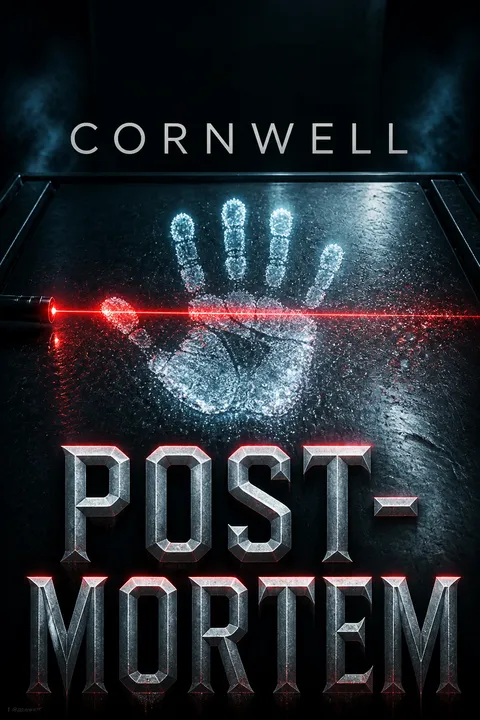
In the darkened X-ray room, Kay1 and fingerprint expert Neils Vander9 sweep a laser across Lori's12 body. Three luminous fingerprints materialize above her right collarbone, alongside a mysterious glittering residue found on all four victims. Vander9 runs the prints — they match Matt Petersen,7 Lori's12 husband.
Matt,7 a handsome actor and literature student, discovered his wife's body after returning from a dress rehearsal. During his interrogation, he mentioned a strange sweet smell lingering in the bedroom, like maple syrup.
Marino2 seizes on other leads: Matt's7 prints were already in the system from a prior rape arrest in New Orleans, and he shares the killer's rare non-secretor blood characteristic. Kay1 pushes back, certain the killer is a stranger. But the circumstantial web tightens around the grieving husband.
The Uninvited User
Margaret, Kay's1 computer analyst, discovers that someone outside the office accessed the forensic database over the weekend, attempting to retrieve Lori Petersen's12 case. The intrusion invalidated the administrator password.
Before Kay1 can investigate, Commissioner Amburgey8 — her bureaucratic nemesis — summons her alongside public safety director Tanner and prosecutor Bill Boltz,3 the man she has been secretly dating. Amburgey8 accuses Kay's1 department of leaking sensational details to the press. When Kay1 confesses the computer breach, Amburgey's8 eyes sharpen with vindication.
He orders all press communications routed through him, effectively silencing her. The meeting leaves Kay1 professionally hobbled — muzzled, suspected, and isolated. Bill3 refuses to meet her eyes throughout the entire confrontation.
Two Theories, One Killer
FBI profiler Benton Wesley5 meets with Kay1 and Marino2 to analyze the strangler's pattern. Wesley5 describes a white male of above-average intelligence, likely holding a humble job — organized, methodical, escalating in sadism with each murder.
Marino2 erupts, dismissing the profile as academic fantasy. He points to Matt Petersen's7 theatre studies, his non-secretor blood, his proximity to two unsolved Boston stranglings with identical methods from his Harvard years.
Wesley5 privately admits to Kay1 that he hasn't ruled Matt7 out either, but urges her to understand Marino's2 class resentment — a working-class cop who reflexively distrusts handsome, educated men. The investigation fractures along personal fault lines, each detective following a different thread toward a killer who may resemble neither theory.
The Soap That Glows
Kay1 and Vander9 have spent weeks testing substances to identify the mysterious glittering residue found on all four victims. The breakthrough comes accidentally — after Kay1 washes her hands with grainy powder from the morgue's wall dispenser and touches a surface, the laser reveals brilliant white sparkle.
The soap is Borawash, a borax-based industrial cleanser supplied to public buildings across Richmond. Experiments reveal a striking property: the more a person washes, the more residue accumulates and transfers to everything touched.
The killer washes his hands compulsively, perhaps twenty times a day. Kay1 contacts the distributor and obtains a list of seventy-three institutional customers — including the police department, the vehicle registry, and the Department of Health and Human Services. Thousands of employees work in those buildings.
Planted Evidence in the Fridge
Wingo,10 Kay's1 autopsy technician, finds a cardboard evidence folder in the specimen refrigerator labeled with Lori Petersen's12 case number — one Kay1 does not remember preparing. The slides inside test negative for seminal fluid, contradicting the properly submitted samples.
If defense attorneys discover a second, inconsistent set of slides, they could argue the entire evidence chain is compromised. Kay's1 certainty fractures: did she make an error during an exhausting Saturday of six autopsies?
When Vander9 examines the folder under laser light, the glittering residue blazes across its surface. Marino2 suggests someone planted it. Kay's1 mind races through the short list of people who handled Lori's12 case file — and who visited the building after hours the evening Amburgey8 reviewed her records.
The Wrong Sister Dies
Kay1 arrives at a three-story brownstone to find a fifth victim. Henna Yarborough,13 a thirty-one-year-old journalism professor, lies bound and decomposing in an upstairs bedroom. She is the younger sister of Abby Turnbull,4 Richmond's most aggressive crime reporter, who had been in New York all weekend.
The killer climbed a rusted fire escape to an open window. Abby4 returns to find police swarming her home and screams for them to leave. She tells Marino2 that a black car followed her home nights earlier and she reported it, but police did nothing.
She is convinced the killer targeted her, not Henna.13 The autopsy reveals the worst violence yet — the strangler used a knife. Kay1 can barely speak when she sees what lies beneath the dark blue coverlet.
The Man Kay Trusted
While Marino2 interviews Abby4 at her home, she reveals that prosecutor Bill Boltz3 took advantage of her after their newspaper profile interview weeks earlier. Abby4 describes dining together, feeling suddenly ill after a single glass of wine, and waking the next morning to find him still there. She believes he drugged her drink. Afterward, he threatened to destroy her career if she spoke.
Marino2 later corners Kay1 in his car and confirms he saw Bill's3 white Audi parked at Abby's4 house overnight. He probes whether Bill3 was ever aggressive with Kay1 — and her memories of his forceful physical advances surge back unbidden. The relationship she trusted has been hollowed out. Bill's3 charm was a performance, and Kay1 was merely the latest audience.
The DNA Bluff
Kay1 recruits Abby4 for an audacious gambit. Together with Wesley,5 they draft a newspaper article claiming DNA analysis has revealed the strangler suffers from a metabolic defect possibly causing mental impairment.
Kay's1 real theory centers on maple syrup urine disease — a genetic condition producing the distinctive sweet body odor Matt Petersen7 smelled in Lori's12 bedroom. The published article will not name the specific disease but will suggest the killer may be mentally deficient, striking at his arrogance.
If he reads it, he may panic into seeking medical evaluation, obsessively research the condition, or attempt to access Kay's1 database again. Wesley5 installs a phone-tracing device on the office computer line. The trap is baited with the killer's own vanity.
Maple Syrup in the Dumpster
Marino2 arrives at Kay's1 office carrying a gray evidence bag, barely containing his grin. A homeless informant found a dark blue coverall in a dumpster less than a block from Henna's13 murder scene. The fabric is stiff with dried blood.
When Marino2 opens the bag, Kay1 recoils — not from the blood but from the unmistakable smell of maple syrup, cloying and sweet. Marino2 has already taken the coverall to Matt Petersen,7 who confirmed it matches the strange odor from his wife's bedroom.
Under the laser, the garment erupts with glittering borax residue. Betty's11 serological analysis matches the blood to Henna Yarborough's13 type. The manufacturer's label has been removed, but the killer's signature — chemical, olfactory, forensic — saturates every fiber.
The Ten-Year-Old Detective
Kay1 turns to the person she trusts most — her niece.6 Lucy,6 who has spent weeks devouring computer manuals in Kay's1 home office, demonstrates with startling clarity how the intruder broke in.
Using the default System/Manager login — a god-level command documented in publicly available manuals — anyone could create a new administrator password and access every table in the database. Lucy6 shows Kay1 a file called Public.SQL on the office server that lists all database usernames in plain text.
The method is devastatingly simple: enter via System/Manager, assign yourself a new password under an existing username, and the old password silently dies. This explains why Margaret found her administrator password invalidated. Kay1 realizes the intruder needed only basic knowledge and nerve.
The Voice on the Other End
Kay1 spends a day and a half wearing headphones, listening to weeks of 911 recordings while cross-referencing printed call logs. The revelation arrives buried in electronic static.
Cecile Tyler — the black victim whose selection never fit the racial pattern — once dialed 911 by accident, hitting nine instead of four when trying to reach directory assistance. Her name and address flashed on the operator's screen. Her refined voice was indistinguishable from a white woman's.
Kay1 checks the others: Brenda Steppe called after a car accident, Lori Petersen12 reported a suspected prowler, Abby Turnbull4 reported being followed. Four of five women spoke to 911 before they died. The killer chose them not by appearance but by voice. Kay1 phones Marino2 — he recognizes the operator on the tape.
Marino's Four Bullets
Past midnight, Kay1 wakes to a foul, sweet stench and a hand clamped over her mouth. A man in a dark coverall presses a knife against her neck, his face flattened behind a white nylon stocking. He tells her he saved the best for last.
Kay's1 revolver lies beneath her pillow, twenty centimeters from her right hand. She inches sideways as he studies the room, calculating how to cut the lamp cord for ligatures. When he steps off the bed to reach the curtains, she lunges — and the bedroom explodes.
Marino,2 who has been staking out her house from the bushes, bursts through the door and fires four rounds. The killer — a twenty-seven-year-old 911 operator named Roy McCorkle — crumples dead. Kay1 discovers, with cold terror, that her revolver was never loaded.
The Commissioner's Cigarette
Days later, Wingo10 enters Kay's1 office with a plastic bag containing a cigarette butt. Knowing Amburgey8 publicly crusades against smoking, Wingo10 watched the commissioner sneak cigarettes in his parked car and collected a discarded butt.
Betty's11 saliva analysis reveals blood type AB — matching the mislabeled slides planted in the morgue refrigerator, a type found in only four percent of the population. A phone trace confirms the computer intrusion originated from Amburgey's8 home.
The commissioner fabricated the evidence kit and altered database entries to frame Kay's1 department as the source of press leaks. Kay,1 Marino,2 and Wingo10 share an exhausted, cathartic laugh — the first in weeks. Bill Boltz3 quietly ends his relationship with Kay.1 She accepts without protest, takes Lucy's6 hand, and flies to Miami.
Analysis
Kay Scarpetta1 exists at the intersection of multiple power imbalances. As a woman leading a male-dominated profession, she faces not one antagonist but a constellation of men who diminish, manipulate, or exploit her: Amburgey8 undermines her from above, Marino2 challenges her from within the investigation, and Boltz3 betrays her intimacy. The novel's most unsettling structural insight is that the institutional predator and the serial predator employ remarkably similar tactics — both exploit positional access and trust, both operate within systems that shield them from accountability.
The killer's method — selecting victims by their voices during 911 calls — transforms the act of seeking help into the trigger for victimization. This inversion carries profound thematic weight: vulnerability is not an inherent flaw the victims carry but a weapon the system wields against them. Lori Petersen's12 deprioritized emergency call crystallizes this failure with devastating precision. She followed every protocol and died anyway.
Cornwell also interrogates how forensic science, for all its empirical rigor, remains embedded in human institutions vulnerable to corruption and ego. The computer database, designed as an objective repository of truth, becomes simultaneously a tool for justice, a weapon for political sabotage, and a hunting ground for the killer. Scientific truth requires not just methodology but moral courage — the willingness to defend evidence against those who would distort it for personal advantage.
Perhaps most resonantly, Postmortem argues that the greatest danger women face is not the lone predator but the institutional indifference that enables him — the deprioritized emergency call, the ignored complaint, the colleagues who joke about violence against women while ostensibly investigating it. Kay's1 survival depends not on one heroic act but on building, case by case, a network of unlikely trust.
Review Summary
Postmortem received mixed reviews, with an overall positive reception. Readers praised Cornwell's groundbreaking forensic details, compelling characters, and suspenseful plot. Many appreciated the historical context of 1990s technology and forensic science. Some found the technical explanations dated or tedious. The novel was lauded for its strong female protagonist and realistic portrayal of workplace challenges. Critics noted the book's influence on the crime thriller genre and forensic TV shows. While some felt it was slow-paced or unmemorable, most readers found it an engaging start to the series.
People Also Read










Characters
Kay Scarpetta
Chief medical examinerItalian-American, early forties, divorced, appointed as Virginia's first female chief medical examiner. She approaches each victim with rigorous clinical precision and profound emotional investment—every wound she catalogues becomes testimony she will defend in court. Her professional excellence masks deep isolation: a failed marriage to a man who never remembered how she took her coffee, a mother who laments her unmarried status, and a sister more devoted to fictional characters than her real daughter. Kay's defining tension is between emotional vulnerability and institutional authority. She craves connection but retreats behind forensic methodology when relationships threaten to breach her defenses. Her bond with niece Lucy6 reveals the maternal warmth she fears she lacks—and the courage she does not yet realize she possesses.
Pete Marino
Homicide detective, antagonist-allyA gruff, overweight, chain-smoking homicide sergeant transplanted from New York. Marino's working-class resentment runs deep—he distrusts educated professionals, harbors reflexive hostility toward women in authority, and compensates for social insecurity with crude humor and intimidating physicality. His investigative instincts are genuinely sharp, honed by decades of street work, but his class-based prejudices frequently blind him to evidence contradicting his theories. Beneath the abrasive exterior lies a complicated loyalty: he protects those he respects, even when he cannot articulate the respect. His evolving relationship with Kay1 charts a grudging transformation from antagonism to alliance, driven not by ideology but by the slow recognition that competence transcends gender and pedigree.
Bill Boltz
Prosecutor, Kay's secret loverRichmond's commonwealth's attorney—handsome, politically astute, and Kay's1 secret romantic interest. Their relationship exists in shadowed restaurants and careful silences. His public persona radiates confidence and integrity, but beneath the golden surface, Bill's moral architecture proves less sound than Kay1 believed. His wife's suicide the previous year hints at deeper complexities, and his loyalties shift ominously under political pressure.
Abby Turnbull
Aggressive crime reporterAn award-winning reporter whose relentless pursuit of the strangler story makes her simultaneously Kay's1 adversary and reluctant ally. Abby's professional fearlessness masks personal wounds—she is a woman who built walls of ambition around a core of vulnerability. When tragedy devastates her own family, those walls collapse, revealing someone far more complex and sympathetic than the aggressive journalist Kay1 initially resented.
Benton Wesley
FBI criminal profilerFBI profiler from Quantico's Behavioral Science Unit. Prematurely silver-haired and impeccably dressed, Wesley brings clinical detachment to cases others approach emotionally. A former school principal turned agent, he mediates between Kay's1 forensic perspective and Marino's2 street instincts. His psychological analyses prove eerily precise, though he remains honest about their limitations.
Lucy
Kay's genius ten-year-old nieceKay's1 visiting niece from Miami, a computer prodigy whose IQ staggers examiners. Lucy compensates for maternal neglect with intellectual ferocity and desperate attachment to her aunt1. Her emotional volatility—oscillating between adoration and rage—reflects a child who processes adult horrors with unsettling sophistication while fearing the specific loss of the one person who makes her feel wanted.
Matt Petersen
Victim's husband, prime suspectLori Petersen's12 strikingly handsome husband—an actor and literature graduate student whose theatrical eloquence during interrogation reads as either genuine devastation or masterful performance. A prior rape charge and his non-secretor blood status make him Marino's2 prime suspect, though the evidence cuts ambiguously between coincidence and guilt. His testimony about a strange smell in the bedroom provides a crucial forensic clue.
Amburgey
Commissioner, political antagonistCommissioner of Health and Human Services, Kay's1 bureaucratic superior. A small, bald man with elaborate notes and darting eyes, he resents Kay's1 professional autonomy and seizes on the strangler case as political leverage. His anti-smoking crusades and bureaucratic fastidiousness conceal a willingness to weaponize institutional power for personal vendettas.
Neils Vander
Fingerprint and laser expertKay's1 eccentric fingerprint specialist who operates the forensic laser. Perpetually disheveled with a bombilla-shaped head, he manages the cutting-edge technology revealing invisible evidence on victims' bodies.
Wingo
Loyal autopsy technicianKay's1 sensitive, stylish autopsy technician. Targeted by Marino's2 crude jokes, Wingo possesses quiet observational skills and fierce loyalty to Kay1 that prove unexpectedly decisive.
Betty
Head of serology labChief serologist nearing retirement, bringing thirty years of meticulous expertise to analyzing blood evidence, seminal fluid, and mysterious residues across all five cases.
Lori Petersen
Fourth victim, surgical residentA thirty-year-old Harvard-trained surgical resident whose murder provides the inciting incident. Her broken fingers and fractured ribs signal the strangler's escalating sadism.
Henna Yarborough
Fifth victim, Abby's sisterAbby Turnbull's4 younger sister, a journalism professor living in Abby's4 house during a marital separation. Her death raises the question of whether the killer targeted the wrong woman.
Spiro Fortosis
Forensic psychiatrist, Kay's advisorUniversity of Virginia psychiatrist who serves as Kay's1 paternal confidant, providing psychological insight into the killer's likely behavior and warning her about political dangers.
Plot Devices
The Forensic Laser
Reveals invisible evidenceA specialized light source that causes certain substances to fluoresce brilliantly against skin and fabric. Kay1 and Vander9 use it to discover fingerprints, trace fibers, and the mysterious glittering residue present on every victim's body. The laser transforms crime scenes from visible-spectrum investigations into luminous landscapes of hidden contact, making the killer's touch literally glow in the dark. It represents forensic science's power to reveal what the naked eye cannot—but also its limitations, since each discovery still requires a suspect for comparison. The laser's findings drive every major forensic breakthrough in the case, from identifying Matt Petersen's7 fingerprints to confirming the presence of borax on the killer's coverall.
The Office Database
Target, weapon, and trapKay's1 computerized case management system contains autopsy results, serological data, and victim information for every death her department investigates. Designed for efficiency, it becomes the novel's most contested territory when someone accesses it remotely. The database serves three simultaneous narrative functions: a potential source of leaked information that threatens Kay's1 career, a site of political sabotage where data can be subtly altered, and ultimately a trap when Wesley5 installs phone-tracing equipment. Its vulnerability—accessible via a default system login and a publicly visible username file—mirrors the institutional vulnerability of the women the system is meant to protect. Whoever controls the data controls the narrative of the investigation itself.
The Glittering Residue (Borawash)
Links crimes through chemistryA mysterious substance that fluoresces under laser light, found on all victims' bodies and binding materials. Weeks of testing household products yield nothing until Kay1 accidentally identifies it as Borawash, an industrial borax-based hand soap used in public restrooms throughout Richmond's government buildings. The residue possesses a counterintuitive property: it accumulates with repeated washing rather than diminishing, meaning the more obsessively the killer scrubs his hands, the more damning evidence he transfers to everything he touches. This narrows the investigation to institutional employees while creating an ironic forensic signature—the killer's compulsive cleanliness leaves the most persistent trail. The Borawash also connects thematically to the killer's possible metabolic condition.
The 911 Recordings
Reveal killer's selection methodAudio tapes of emergency calls stored on reels in the police communications room. Kay's1 exhaustive review of weeks of recordings uncovers the devastating pattern connecting the victims: each woman called 911 from her home at some point before her death, and her name and address appeared instantly on the operator's screen. One victim reported a car accident; another called about a prowler; a third dialed 911 by mistake. The tapes transform the investigation from a geographic puzzle into a vocal one—the killer selected women not by how they looked but by how they sounded on the phone, making the act of calling for help the mechanism that marked them for death.
The Mislabeled Evidence Kit
Weaponizes forensic protocolsAn Evidence Recovery Kit bearing Lori Petersen's12 case label, found in the morgue refrigerator weeks after the autopsy. It contains slides with no seminal fluid, contradicting the properly submitted samples. Its existence suggests either Kay1 committed a catastrophic procedural error—potentially devastating at trial—or someone deliberately fabricated it to undermine her credibility. The kit forces Kay1 to question her own competence during the case's most pressured period, which is precisely its intended effect. The rare blood type found on the slides eventually becomes the key to identifying who planted it, turning a weapon designed to destroy Kay's1 career into evidence of the saboteur's own hand.
Kay Scarpetta Series Series


Download PDF
Download EPUB
.epub digital book format is ideal for reading ebooks on phones, tablets, and e-readers.








